Desert Online General Trading LLC
Dubai, United Arab Emirates
Desert Online General Trading LLC
Dubai, United Arab Emirates

Full description not available
C**I
Very Interesting
This is a very interesting and informative book for anyone who's interested in the history of the English language. English is a Germanic language that contains influences from many other languages. English has a very rich history, and there are some surprising things about it that this book details. I think English teachers and English students would love this book, and it would be fun to pass along the interesting and little known tidbits to others. I found this book as engrossing as a novel, and I'm sure I'll read it again some day. If you have any interest in the history of the English language, this is the book for you.
E**.
Thorough
This is a great overview of the English language. It's quite thorough in its examination, and after reading it I felt like I understood much more about the history of England itself, as well as the language.
S**N
How English has changed since ancient use to modern post-colonial use worldwide
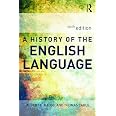
Have you ever wondered how grammar and vocabulary have evolved over time? This book is for those (like me) who wish to understand the history of the English language. This textbook is perhaps the greatest work of its kind. It covers the evolution from Old English to Middle English, from the Renaissance to modern usage worldwide.Baugh and Cable’s tale is not simple, but then again, neither is English’s. The language, rooted in the British isles, borrowed heavily from French after the Norman Invasion in 1066. Under the influence of academic scholarship in conversation with the European continent, it also borrowed heavily from Latin. More recently, worldwide, post-colonial use in far-flung places like America, India, and Egypt have decentralized use so that each region borrows from the other. (In other words, there is currently no one group, even in England, that can claim to hold “true English” usage.)There are several nuggets that I found interesting in this book. Many of the regional differences in American pronunciation stem from where in England colonists immigrated from. English dialects vary more dramatically from region to region than do American dialects – presumably because Americans interact with each other more and migrate more often. Spelling reforms continued until into the twentieth century and were seen as a form of efficiency. English is known for having a liberal policy towards vocabulary but conservative towards grammar. No matter how much they are hated, language purists seem to haunt every age in every region.Because it is written as a critical historical examination, this work is most used pedagogically as a textbook in classrooms. Only the occasional lifelong student would read this book cover-to-cover for mere self-education. Nonetheless, it reads well and breaks down the subject matter into short numbered sections in each chapter. This work has helped me make sense of the diverse world that the English language provides to us in literature and over the Internet.
A**R
History of English
This book is right in the space where I live. If you need to know how English came to be English, this book is really good.
S**L
Five Stars
Good book.
H**R
Five Stars
This is so good!
G**S
Fifth for free
Excellent book; has stood the test of time. But if having the absolutely latest edition is not important to you, you can find a PDF of the fifth edition (2002) freely available on the Internet; just use your favorite search engine.
E**C
Scholarly, in-depth survey of the history of the English language
This book reviews the history and evolution of the English language from ancient times to the present. The authors do so in a methodical, scholarly manner that provides a thorough, in-depth look at how the English language (a member of the Indo-European family of languages) developed and changed over time in the context of social, religious, political and military, and economic events in English history.At the end of each chapter is an extensive bibliography that will provide interested readers with numerous leads to additional and supplemental reading materials. The book is scholarly and academic, and not suitable for readers with only a casual interest in the history of the English language. Anyone studying the history of the English language for the first time should consider looking at more basic, introductory publications before trying this book.Apart from readers with a scholarly interest in historical linguistics, this book could be of interest as a reference book for teachers and instructors of English as a Second Language (ESL). Although this book does not provide material that could be readily used in an ESL class, its discussion of how the English language developed and changed over time could help ESL teachers and instructors better understand some of historical reasons behind various aspects of the English language that often are difficult to explain to English language learners. A less technical book on history of the English language that is specifically addressed to ESL teachers and instructors is Norbert Schmitt and Richard Marsden, Why Is English Like That?: Historical Answers to Hard ELT Questions (Michigan Teacher Training).
Trustpilot
1 month ago
2 weeks ago
1 week ago
3 weeks ago