
DOWNLOAD THE APP


Customer Services
Copyright © 2025 Desertcart Holdings Limited
DOWNLOAD THE APP
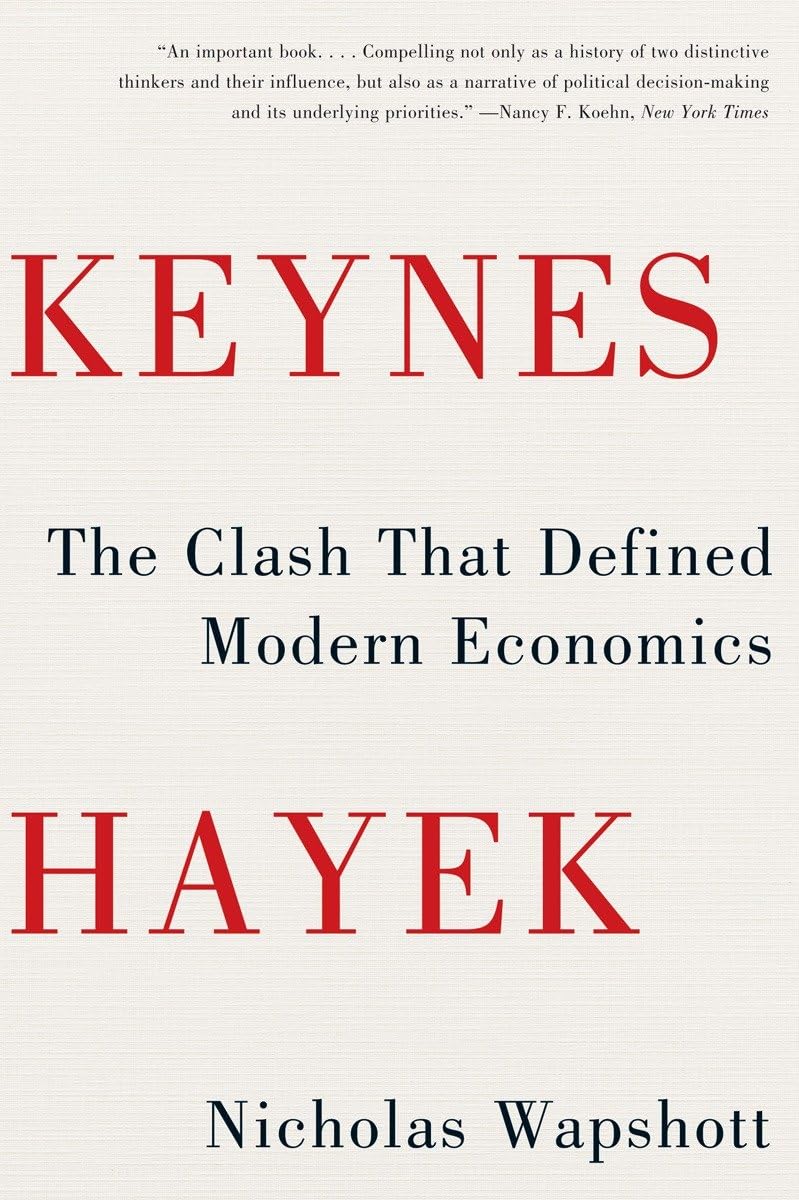
Keynes Hayek: The Clash that Defined Modern Economics [Wapshott, Nicholas] on desertcart.com. *FREE* shipping on qualifying offers. Keynes Hayek: The Clash that Defined Modern Economics Review: Engaging account of the intellectual battle of Keynes and Hayek reminding us that history rhymes - Keynes Hayek is the account of the relationship and evolving debate between Keynes and Hayek. It is an engaging account of the personalities involved and the rivalries that grew. It gives a perspective on the historical relationships of the economists of various schools of thought as well as an account of how each of the economists ideas evolved over time to come to their final form. It is engaging and informative from a variety of viewpoints and the substance of their disagreements continues to be a source of tension today as we face similar dilemmas in today's world. This is well timed to remind us that history often rhymes and the issues we face have similarities with the past. The author discusses events chronologically starting with Keynes's role and disgust at the Treaty of Versailles and his work The Economic Consequences of the Peace. Given Hayek lived in Austria that was literally starving after the War, the overlap between the two is shown to have started very early. An account of the devolopements of each character is detailed as are the intellectual currents that drove their work. The major debate really starts with the publication of Treatise on Money in which Keynes begins to formulate his ideas about disequilibrium and the stickiness of prices on self adjustment of economic systems. He starts to consider market aggregates as variables to study. Hayek, being an economist focused on capital formation starts a vigorous debate about the assumptions made by Keynes and a very technical argument ensues. The two were looking at economics very differently, Keynes from a top down approach and Hayek from a bottom up. Keynes believed market failures of demand could be plugged by government expenditure whereas Hayek believed that economics could only be understood from knowledge at the microeconomic level and top down allocation would be wasteful and crowd out private investment. There differences became formalized in their respective epic works, The General Theory of Employment, Interest and Money and Hayek in Road to Serfdom. After introducing the ideas of each author and their contentions with one another the book continues on the journey of real events and how the respective economists influenced policy. Keynes is shown to have been the most influential until the world was hit by the stagflation that contradicted the understanding of the relationship of unemployment and inflation previously understood via the Phillips curve. Hayek is shown to have resurfaced in influence via UK Margaret Thatcher and Reagan (though Hayek did not believe either really followed through nearly enough, with Reagan not at all). The historical account laid out by the author lays the groundwork for an unfamiliar reader to get a grasp of the ideas, arguments and philosophies of the two economists. The reader already familiar with the ideas of Keynes and Hayek will get a lot out of the history as it is written very colorfully. As for the economics side, the author does a good job describing the basic differences between the two approaches and the reader gets a sense of both the benefits and limitations of both economist approaches. The discussion is not comprehensive nor should it be as such a discussion can fill volumes. All in all one gets a lot of interesting material from a historical account as well as a good overview of the intellectual differences from an economic account. Very worthwhile read. Review: Good introduction to a deep debate. - This is a good book. Wapshott clearly prefers Keynes over Hayek, but he gives both men plenty of space to explain their ideas, and often in their own words. They had a very public intellectual rivalry, but Keynes and Hayek were personal friends. Wapshott might have given a bit more time explaining how such rare civility was possible. Many of us could learn as much from that as from the discussions on economics and ideology. The book also gives a good look at the birth of modern macroeconomics, how quickly and suddenly Keynesian ideas caught fire--and how quickly Keynesians became more Keynesian than Keynes himself. One also gets a sense of how lonely Hayek must have been for much of his life. During the early 1930s, he and Keynes were two of the world's best-known economists. Once Keynes' ideas became popular, Hayek became nearly anonymous overnight. Hayek's own students turned on him en masse, often with a surprising lack of tact (Nicholas Kaldor, despite his merits as a thinker, comes off as a thoroughly unpleasant person). Despite the success of 1944's Road to Serfdom and his founding of the Mont Pelerin Society, Hayek was a lonely and depressed man until, at age 75, he won the economics Nobel and experienced something of a late-career renaissance. The book's final chapters are about how both men's ideas continue to clash today, though by this point Wapshott treats them more as symbols of progressivism vs. classical liberalism than referring to the Kaynes and Hayek themselves. I have one genuine complaint about the book. Wapshott often confuses Hayek's ideas with reactionary conservatism, even when acknowledging Hayek's famous essay, "Why I Am Not a Conservative." Conservatives want stasis; they want to conserve the old ways. Hayek wants ever-changing dynamism. It's the intelligent design vs. evolution debate in a different discipline. Many conservatives, with their emphasis on top-down law-and-order and deference to tradition, have little in common with Hayek's bottom-up, emergent order philosophy. Conservatives are objective; Hayek is subjective. They have little in common. Interested readers should further pursue Robert Skidelsky's extensive biographies of Keynes, and Bruce Caldwell's Hayek's Challenge. And while not a dual biography like Wapshott's book, Lawrence White's Clash of Economic Ideas is an excellent comparative history of 20th century economic thought, written from a Hayekian/classical liberal perspective.
| Best Sellers Rank | #228,187 in Books ( See Top 100 in Books ) #134 in Theory of Economics #333 in Economic History (Books) |
| Customer Reviews | 4.5 4.5 out of 5 stars (482) |
| Dimensions | 5.5 x 0.9 x 8.3 inches |
| Edition | Reprint |
| ISBN-10 | 0393343634 |
| ISBN-13 | 978-0393343632 |
| Item Weight | 2.31 pounds |
| Language | English |
| Print length | 400 pages |
| Publication date | September 10, 2012 |
| Publisher | W. W. Norton & Company |
A**N
Engaging account of the intellectual battle of Keynes and Hayek reminding us that history rhymes
Keynes Hayek is the account of the relationship and evolving debate between Keynes and Hayek. It is an engaging account of the personalities involved and the rivalries that grew. It gives a perspective on the historical relationships of the economists of various schools of thought as well as an account of how each of the economists ideas evolved over time to come to their final form. It is engaging and informative from a variety of viewpoints and the substance of their disagreements continues to be a source of tension today as we face similar dilemmas in today's world. This is well timed to remind us that history often rhymes and the issues we face have similarities with the past. The author discusses events chronologically starting with Keynes's role and disgust at the Treaty of Versailles and his work The Economic Consequences of the Peace. Given Hayek lived in Austria that was literally starving after the War, the overlap between the two is shown to have started very early. An account of the devolopements of each character is detailed as are the intellectual currents that drove their work. The major debate really starts with the publication of Treatise on Money in which Keynes begins to formulate his ideas about disequilibrium and the stickiness of prices on self adjustment of economic systems. He starts to consider market aggregates as variables to study. Hayek, being an economist focused on capital formation starts a vigorous debate about the assumptions made by Keynes and a very technical argument ensues. The two were looking at economics very differently, Keynes from a top down approach and Hayek from a bottom up. Keynes believed market failures of demand could be plugged by government expenditure whereas Hayek believed that economics could only be understood from knowledge at the microeconomic level and top down allocation would be wasteful and crowd out private investment. There differences became formalized in their respective epic works, The General Theory of Employment, Interest and Money and Hayek in Road to Serfdom. After introducing the ideas of each author and their contentions with one another the book continues on the journey of real events and how the respective economists influenced policy. Keynes is shown to have been the most influential until the world was hit by the stagflation that contradicted the understanding of the relationship of unemployment and inflation previously understood via the Phillips curve. Hayek is shown to have resurfaced in influence via UK Margaret Thatcher and Reagan (though Hayek did not believe either really followed through nearly enough, with Reagan not at all). The historical account laid out by the author lays the groundwork for an unfamiliar reader to get a grasp of the ideas, arguments and philosophies of the two economists. The reader already familiar with the ideas of Keynes and Hayek will get a lot out of the history as it is written very colorfully. As for the economics side, the author does a good job describing the basic differences between the two approaches and the reader gets a sense of both the benefits and limitations of both economist approaches. The discussion is not comprehensive nor should it be as such a discussion can fill volumes. All in all one gets a lot of interesting material from a historical account as well as a good overview of the intellectual differences from an economic account. Very worthwhile read.
R**G
Good introduction to a deep debate.
This is a good book. Wapshott clearly prefers Keynes over Hayek, but he gives both men plenty of space to explain their ideas, and often in their own words. They had a very public intellectual rivalry, but Keynes and Hayek were personal friends. Wapshott might have given a bit more time explaining how such rare civility was possible. Many of us could learn as much from that as from the discussions on economics and ideology. The book also gives a good look at the birth of modern macroeconomics, how quickly and suddenly Keynesian ideas caught fire--and how quickly Keynesians became more Keynesian than Keynes himself. One also gets a sense of how lonely Hayek must have been for much of his life. During the early 1930s, he and Keynes were two of the world's best-known economists. Once Keynes' ideas became popular, Hayek became nearly anonymous overnight. Hayek's own students turned on him en masse, often with a surprising lack of tact (Nicholas Kaldor, despite his merits as a thinker, comes off as a thoroughly unpleasant person). Despite the success of 1944's Road to Serfdom and his founding of the Mont Pelerin Society, Hayek was a lonely and depressed man until, at age 75, he won the economics Nobel and experienced something of a late-career renaissance. The book's final chapters are about how both men's ideas continue to clash today, though by this point Wapshott treats them more as symbols of progressivism vs. classical liberalism than referring to the Kaynes and Hayek themselves. I have one genuine complaint about the book. Wapshott often confuses Hayek's ideas with reactionary conservatism, even when acknowledging Hayek's famous essay, "Why I Am Not a Conservative." Conservatives want stasis; they want to conserve the old ways. Hayek wants ever-changing dynamism. It's the intelligent design vs. evolution debate in a different discipline. Many conservatives, with their emphasis on top-down law-and-order and deference to tradition, have little in common with Hayek's bottom-up, emergent order philosophy. Conservatives are objective; Hayek is subjective. They have little in common. Interested readers should further pursue Robert Skidelsky's extensive biographies of Keynes, and Bruce Caldwell's Hayek's Challenge. And while not a dual biography like Wapshott's book, Lawrence White's Clash of Economic Ideas is an excellent comparative history of 20th century economic thought, written from a Hayekian/classical liberal perspective.
W**.
An outstanding treatment of Keynes and Hayek
This is a very readable book about the conflict and the reasons for it between Keynes and Hayek in their economic theories. No other economic theory had as much influence on the World in the years 1940 to 1980 as did the Keynesian Theory. For many students who learned Economics in college, including myself, they only learned Keynesian Economics. Most us never heard of Hayek! But Keynesian theories failed in the 1970's: actually it was only then that we learned of the flaws in Keynesian economics, that is "stagflation." It was then that we learned of the free market theories of Hayek and Friedman (who wasn't initially influenced by Hayek.) The application of free market theories in the 1980's by Britain's Margaret Thatcher and US's Ronald Reagan stopped the runaway inflation of the 1970's as the bills accrued in the Keynes's years came due. There are many lessons to be learned in this book about economic policy. Both Keynes and Hayek had valid points in their theories. Keynes, the more successful of the two, approached economics (Macroeconomics) from a top down, full employment approach. Hayek on the other hand approached economics from a bottoms up (Microeconomics) based on minimizing inflation and free markets. Ultimately, one would expect the theories to converge; so there is still work to do. What one learns in this book is that politicians, who establish short term economic policy, will do anything to further their reelection, even though the economic theory projects future problems! That is really the sad overall lesson from this book. Rarely are these the best long term solution!
J**S
Keynes and Hayek an approach to MacroEconomics... Very interresting and captivating book , particularly because of the human (personalities) approach to two giant Economic theories.... But I still do not fully understand Hayek...
S**R
I feel language is difficult for someone who is from another stream or subject
E**H
Excellent read on different economic models
M**Z
This book gives a hint about the professionals lifes of two great Economists: Keynes and Von Hayek and the dynamics around economics issues and it's expected consequences for everybody's day to day life in two different points of view. It too gives us a neutral narrative among contemporary economics facts and government economics decisions since 1929 till 2010. Five stars for sure.
A**X
Ottimo
Trustpilot
3 weeks ago
2 weeks ago