Some deliveries may take a little longer than usual due to regional shipping conditions.

DOWNLOAD THE APP


Customer Services
Copyright © 2025 Desertcart Holdings Limited
DOWNLOAD THE APP
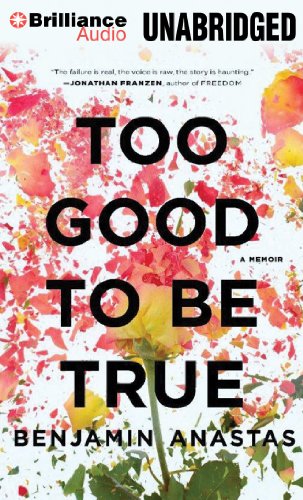
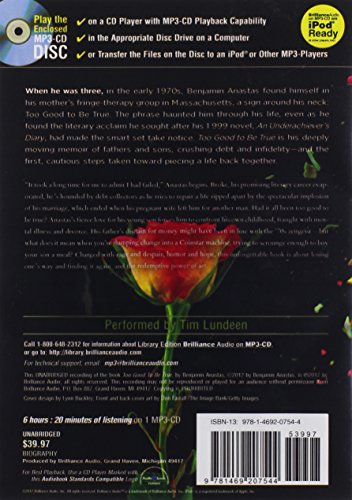
Full description not available
T**H
The Life of a Writer
I read an excerpt from this book and found it compelling: a writer of some success finds that his life has fallen apart and he is failing. Then, when I sought the book out, I realized that I knew this guy--as an author, anyway. I had read his first novel, An Underachiever's Diary, when it came out. The fact that I remembered it so well after better than a dozen years reminded me that I had liked it. So I was interested to find out more about his story. As Anastas himself describes it, it turns out to be a tale of failures, both his own and of those around him.In short: Anastas writes a novel which has some modest success and then gets his second novel published by a prestigious house, FSG, where his upward rise continues. This is followed by difficulties in producing a third novel. Along the way, he has a brief affair which he confesses to his fiancé. She decides to marry him anyway, but they are divorced within a year and she is pregnant with his son. In the years after his son's birth, his financial position becomes more and more precarious, to the point where he is heavily in debt and earning nothing.There is a lot of tragedy here, but the main focus seems to be his near bankruptcy. Some of the most moving passages have to do with how he scrounges change to pay for the rare nights he gets to spend with his son. It also appears to be the hinge of his new relationship. Eliza seems to want to marry and have children with Anastas but is concerned he doesn't have the wherewithal to dig himself out of his hole.Ultimately, the money situation is more than just a practical problem. It is symbolic of his inability to recover from the damage of his marriage and career, and get back on his feet. As the memoir nears its end, we are given some smatterings of hope that Anastas has turned himself around, but it certainly isn't clear that he's made it through. Perhaps because this is a story still in progress.In the end, I was glad I read this book. I had trouble with parts of it. I have difficulty with people who seem to be creators of their own problems and then let their problems manipulate them, generally through pseudo-psychoanalysis. On the other hand, I felt very close to Anastas as I read. Not only because I'm familiar with his other work and can see how the mighty have fallen but also because I have writerly pretentions that are similar to Anastas's. Had things been a bit different for me, I might have seen a road similar to his. I like to think I would have treaded more carefully but who can tell? It was interesting for me to see what life can be really like for a writer.
K**R
Improves as it goes.
I have to honestly say that I hated this book for the first fourth of it. I thought that Anastas was whiny and frankly the kind of guy I would warn my daughter against. His career as a novelist was in free fatal, and he was broke. In a nice piece of writing, he discusses his humiliating world of taking coins to Coinstar to buy groceries. He was with one woman who would like him to stabilize his life, and to whom he is lying about his debts. His firstnwife had left him while pregant with his son. He had cheated on her just before the wedding, but they had thought they had gotten past this betrayal. At this point, the book is filled with rage, self hate, and envy of those who are succeeding. I tend to finish my books, and it grew on me. I can see the pain he endured as a child, the casualty of the great 60's experiment, and a dreadful psychiatric hospital. We hear more about his efforts to salvage his marriage.In the second part of the book, he widens his focus to include his understanding of the pain he really has caused. We see a more balanced man. I began to like him better. One can only love a man who is in love with his son. The focus began to shift from the wrongs done to him, to the ways he could pull his life to a place where he could be productive agai, maximize his life with his son, and attempt to save his relationship with honesty. The writing is indeed clear and evocative.Read it and see what you think.
P**A
A painful struggle for redemption
This book has a number of touching, powerful sections. Unfortunately it also has a lot tedious sections. It jumps all over the place and yet the basic story is interesting enough to keep you reading. The author, a writer, is down on his luck: broke, a single father, can't write, dealing with failed relationships and trying desperately to hold on to his current relationship but his financial status is causing massive tension in the relationship (and in his whole life). Anyone who has been broke can sympathize with some of the situations he faces but it still breaks your heart. You want to shout: "Go get a job - any job!" Actually, by the end of the book he does but by that time he has dug himself into quite a financial (and emotional) hole. It seems he uses this book as a sort of diary or journal to work his way out of the mess - and that probably explains why the book is somewhat messy. He tries to give up his electronics and just scribble in notebooks. Perhaps that helps him - particularly as he figures out more about his incredibly dysfunctional family.One little technical note: I read this book on my Kindle and throughout the book the word "off" was truncated to "of". It happens repeatedly but the context makes the meaning clear. I thought this was interesting.Despite my complaints above, I can still recommend this book as an interesting memoir of collapse and attempt to rejuvenate. The title of the book has a particularly poignant meaning... And the last chapter is particularly touching.
E**N
Eloquent but very self absorbed
That's the good part. I liked this piece of writing at first. I was eager to learn how he felt growing up with hippy parents, the effects that had on him.What you get is quite a lot of writing about his misery about his debts. At first I am sympathetic but then not so much.He has a son he clearly loves and when Benjamin looks back at his own father's behaviour he has clearly made a lot of improvement !The tales of his father's mooning are really revolting and Benjamin's writing is very articulate on those experiences. Glad I never knew anyone like that!His mother suffered terrible depressions, she went to join a very weird commune for her healing. Really weird. it could only have been in America where these kinds of communes could hide out in all that space. The children are made to wear placards around their necks on which is written a cruel comment on their character. Benjamin's was "Too Good To Be True" How can an adult be such an insensitive ass as this to a three year old?Given everything he had to grow beyond, I am glad that Benjamin's ability to love is strong, it is his work life that he has to "get together" . His new lover Eliza (not the mother of his son) wants a better quality of life than they currently share. He has to have a job, and that isn't happening.As a writer with previously published books Benjamin wants to make his living writing, but just can't finish anything.This book is completed, the author has made a lot of growth in himself, come to peace over some of his childhood and best of all can now make an honest relationship with the woman he wants to live with and marry.I am not sure how much I really enjoyed the book as a whole but I liked a lot of it, some parts made me smile and sometimes it was just too detailed and introverted for my taste. It is often painfully honest and that was one of the reasons I am giving the book four stars. I liked the honesty. Also I ended up liking the author so I guess he won me over too.
D**R
Poignant and Deeply Funny
Heartbreaking, poetic and very very funny - Anastas has bared his soul in this.At first you just get the effects which are difficult to have a lot patience with (being painfully broke and having writers block) and then, almost half way through you get the causes which are startling.Benjamin had the misfortune to have two parents with mental health problems and he is the witness and sufferer of many of their worst ideas. His father's public mooning for one, his mothers decision to take him to a Reichian therapy place called 'Freedom to Be' where the therapists in their sadistic wisdom put labels around the children's neck which sum them up like 'Crybaby, Know it All, and Too Good to Be True' for another. Benjamin knows about Alice's thick bush of pubic hair at the age of 8 and he likes tamari dressing. Alice tells him he is deep in industry versus inferiority.Anastas is understandably put off therapy and the conflict between needing therapy and not having it is probably what provides the spark for his writing. The language is self-bludgeoning and the opposite of self-congratulatory. It is likewise poignant and very funny. I really enjoyed this and hope Anastas gets onto the next level and capitalises on his imagination and his idiosyncratic humour in his next novel.
J**S
Only in America
The term 'only in America' is the catch all term applied to social conditions from which 'Too good to be true' is drawn. An at times jaw dropping account of a child being brought up by,what we in the UK would call 'nutters!' New age airy fairy fantasists who apply their theories to devastating effect on the author as a child. The more charitable would point to mental health problems but that would not come as any comfort at the time to the young Benjamin Anastas who had to experience their flaky behaviour and appalling parenting. Despite it all, Anastas survived and has flourished as an author. Too good to be true for myself, all too quickly lost itself in the stultifying morass of 'Californicating' weirdness which I failed to relate to or emphasize with the main character. I just wanted to kick all the characters up the backside! File under 'interesting but irritating' !
C**R
Open and Honest
I didn't know what to expect from this book, but having grown up on the fringe of the 'Hippy Era', I was keen to find out. As it's an autobiographical piece it's bound to be self-absorbed and introverted and this certainly is! Then if you take into account the writer's childhood in hippy communes and the parental influences on him, you can understand his lack of direction and commitment in his later life, especially where romantic relationships and working are concerned. Anastas has constant money worries and again this stems from his background, which he hopes to amend with his writing, if he manages to get anything else finished and published.I enjoyed the book for its honesty and integrity. It won't appeal to everyone, but it did to me.
A**D
High-brow misery memoir par excellence
Benjamin Anastas is an American writer, previously unknown to me but, it would seem, much acclaimed for his second novel, The Faithful Narrative of a Pastor's Disappearance. Anyway, as well being a novelist, with Too Good To Be True, he's now also a memoirist: this is effectively his autobiography. Or at least, it tells the story of a certain phase in his life: his stalled career as a writer, the end of his marriage, and his attempts to rebuild his life. Some interesting passages about growing up in a therapy cult, too. A refreshing subversion of the traditional memoir - comic and feelgood (despite being about a succession of personal failures!).
Trustpilot
1 month ago
4 days ago