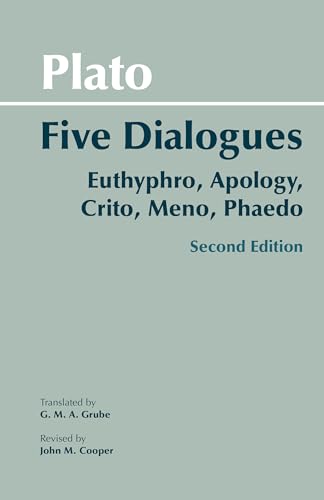


Plato: Five Dialogues: Euthyphro, Apology, Crito, Meno, Phaedo (Hackett Classics) [Plato, Cooper, John M., Grube, G. M. A.] on desertcart.com. *FREE* shipping on qualifying offers. Plato: Five Dialogues: Euthyphro, Apology, Crito, Meno, Phaedo (Hackett Classics) Review: Hackett Edition is indispensable: Short and Effective - Plato’s Five Dialogues in the Hackett edition is more than philosophy; it’s a training ground for the mind and soul. I first read it years ago, and recently I bought a copy for my son so we could work through it together the summer before he started high school. We went line by line, exploring Euthyphro, Apology, Crito, Meno, and Phaedo, and it was hands-down the best investment we ever made: by the time school began, he could argue, question, and reason with a confidence rooted in centuries of thought. The dialogues are alive with the pursuit of virtue and the examination of life itself. Socrates’ insistence on defining justice, understanding piety, and confronting death resonates deeply with the Catholic worldview, echoing Augustine, the Gospels, and the timeless call to moral courage. Reading Plato alongside Augustine and the classics has shaped the way I approach parenting, education, and even daily decision-making: the cultivation of reason, virtue, and moral clarity is not optional—it is the foundation of life well lived. This edition’s balance of precision and readability makes the text accessible without flattening its power, and sharing it with my son reminded me that the formation of the mind and soul is a multigenerational responsibility. Plato, like Homer, reminds us that civilization rests on ideas, argument, and the courage to pursue truth even when the world resists. Review: Plato is Amazing - An excellent introduction to Plato's philosophy. If you're interested in the historical figure of Socrates, these dialogues are most are most concerned with his life. Philosophically, these "Five Dialogues"--Euthyphro, Apology, Crito, Meno, Phaedo--along with Phaedrus, Symposium and the Republic form the bulk of Plato's thought on Forms and the soul. This is a great place to start. The Euthyphro is a typical early dialogue and sets the stage for the charges that face later Socrates in the Apology. Both are very readable. Crito and Phaedo show Socrates in prison accepting his fate with poise and refusing to escape. They are also the most vivid explanation of the immortality of the soul. Meno is a middle dialogue that poses important problems of knowledge and learning resolved by the theory of Forms and Recollection. It's also the most difficult and rewarding of the bunch. This Hackett edition is nice but not great. The dialogues are the Grube translation, edited by Cooper. The introduction by Grube is rather short and just explains the logic behind the grouping of the five dialogues, which is disappointing compared to other Hackett's. However, the translation is good, if a bit literal. There are explanatory footnotes for all of Socrates' idioms and historical references. The margins and book design are nice and readable for such a compact book. The main advantage this little 8x5 paperback has is that it's cheap, easy to carry, and perfect for writing in. I feel the same way about the other excellent Hackett editions of "Symposium", "Phaedrus", and "Laches and Charmides". Now that my interest in Plato has solidified, I will likely invest in the Hardcover collection "Plato: Complete Works". However, you will miss out on the introductions found in the individual Hackett's, in particular Symposium's and Phaedrus which are fantastic.
| Best Sellers Rank | #1,375 in Books ( See Top 100 in Books ) #1 in History of Philosophy #2 in Political Philosophy (Books) #6 in Ancient Greek & Roman Philosophy |
| Customer Reviews | 4.6 4.6 out of 5 stars (2,464) |
| Dimensions | 5.75 x 0.25 x 8.5 inches |
| Edition | Second Edition,2 |
| ISBN-10 | 0872206335 |
| ISBN-13 | 978-0872206335 |
| Item Weight | 2.31 pounds |
| Language | English |
| Print length | 168 pages |
| Publication date | October 1, 2002 |
| Publisher | Hackett Publishing Company, Inc. |
J**E
Hackett Edition is indispensable: Short and Effective
Plato’s Five Dialogues in the Hackett edition is more than philosophy; it’s a training ground for the mind and soul. I first read it years ago, and recently I bought a copy for my son so we could work through it together the summer before he started high school. We went line by line, exploring Euthyphro, Apology, Crito, Meno, and Phaedo, and it was hands-down the best investment we ever made: by the time school began, he could argue, question, and reason with a confidence rooted in centuries of thought. The dialogues are alive with the pursuit of virtue and the examination of life itself. Socrates’ insistence on defining justice, understanding piety, and confronting death resonates deeply with the Catholic worldview, echoing Augustine, the Gospels, and the timeless call to moral courage. Reading Plato alongside Augustine and the classics has shaped the way I approach parenting, education, and even daily decision-making: the cultivation of reason, virtue, and moral clarity is not optional—it is the foundation of life well lived. This edition’s balance of precision and readability makes the text accessible without flattening its power, and sharing it with my son reminded me that the formation of the mind and soul is a multigenerational responsibility. Plato, like Homer, reminds us that civilization rests on ideas, argument, and the courage to pursue truth even when the world resists.
H**G
Plato is Amazing
An excellent introduction to Plato's philosophy. If you're interested in the historical figure of Socrates, these dialogues are most are most concerned with his life. Philosophically, these "Five Dialogues"--Euthyphro, Apology, Crito, Meno, Phaedo--along with Phaedrus, Symposium and the Republic form the bulk of Plato's thought on Forms and the soul. This is a great place to start. The Euthyphro is a typical early dialogue and sets the stage for the charges that face later Socrates in the Apology. Both are very readable. Crito and Phaedo show Socrates in prison accepting his fate with poise and refusing to escape. They are also the most vivid explanation of the immortality of the soul. Meno is a middle dialogue that poses important problems of knowledge and learning resolved by the theory of Forms and Recollection. It's also the most difficult and rewarding of the bunch. This Hackett edition is nice but not great. The dialogues are the Grube translation, edited by Cooper. The introduction by Grube is rather short and just explains the logic behind the grouping of the five dialogues, which is disappointing compared to other Hackett's. However, the translation is good, if a bit literal. There are explanatory footnotes for all of Socrates' idioms and historical references. The margins and book design are nice and readable for such a compact book. The main advantage this little 8x5 paperback has is that it's cheap, easy to carry, and perfect for writing in. I feel the same way about the other excellent Hackett editions of "Symposium", "Phaedrus", and "Laches and Charmides". Now that my interest in Plato has solidified, I will likely invest in the Hardcover collection "Plato: Complete Works". However, you will miss out on the introductions found in the individual Hackett's, in particular Symposium's and Phaedrus which are fantastic.
R**Y
very epic
my goat
Z**E
Great set
An excellent introduction to Plato's philosophy. If you're interested in the historical figure of Socrates, these dialogues are most are most concerned with his life. Philosophically, these "Five Dialogues"--Euthyphro, Apology, Crito, Meno, Phaedo--along with Phaedrus, Symposium and the Republic form the bulk of Plato's thought on Forms and the soul. This is a great place to start. The Euthyphro is a typical early dialogue and sets the stage for the charges that face later Socrates in the Apology. Both are very readable. Crito and Phaedo show Socrates in prison accepting his fate with poise and refusing to escape. They are also the most vivid explanation of the immortality of the soul. Meno is a middle dialogue that poses important problems of knowledge and learning resolved by the theory of Forms and Recollection. It's also the most difficult and rewarding of the bunch. This Hackett edition is nice but not great. The dialogues are the Grube translation, edited by Cooper. The introduction by Grube is rather short and just explains the logic behind the grouping of the five dialogues, which is disappointing compared to other Hackett's. However, the translation is good, if a bit literal. There are explanatory footnotes for all of Socrates' idioms and historical references. The margins and book design are nice and readable for such a compact book. The main advantage this little 8x5 paperback has is that it's cheap, easy to carry, and perfect for writing in. I feel the same way about the other excellent Hackett editions of "Symposium", "Phaedrus", and "Laches and Charmides". Now that my interest in Plato has solidified, I will likely invest in the Hardcover collection "Plato: Complete Works". However, you will miss out on the introductions found in the individual Hackett's, in particular Symposium's and Phaedrus which are fantastic.
K**Y
Very nice
Understandable translation. Slim, with reasonable font size.
C**C
Encourage and Support Reading
I thought this book might be too advanced for my grandson, but I was wrong. He had asked me to get it for him. His intelligence and ability to absorb information really amazes me
J**S
Everyone should read this book at some point in their life. The Socratic method is an approach to life where one must challenge social norms and ideals, including morality, that we often readily accept without knowledge of origin and history, and sometimes even the meaning of such norms and ideals. We are at such a critical time where we all must challenge everything we see, hear, think, feel, and share with one another. The facade is broad, and it is powerful. And, it grows by the day. The future is not ours to see. It is ours to question. This book helped put me on track to challenging my thoughts and morals, and everytime I pick it up again, it reminds me to be ever so careful of guarding my mind, because we are prone to fallacies and simplified truths, as well as what we are surrounded by. The world is not what it once was, but was it ever any such way that challenging ouraelves to introspection and trusting in gut intuition wasn't absolutely necessary?
D**N
This is the ideal introduction to Plato and to Socrates. Four of the works lead up to the death of Socrates. We first find Socrates, who has just been informed that he's to be prosecuted for impiety, meeting the priest Euthyphro and discussing the nature of piety. In the Apology, Socrates presents his defence in court. After his conviction, his friend Crito visits him in prison and they reflect on justice. Finally, Phaedo describes how Socrates spoke on the nature of the soul with his friends just before his execution. In the extra dialogue, Socrates and Meno discuss the virtue and knowledge. This is a good, readable translation and well-printed.
B**S
helemaal prima, broerneef. Fijne vertaling, lekker aanvoelende, dunne bladzijdes, en goede voetnoten.
Z**R
Content is great, but it is hardly 150 pages, and the cost is 1300 INR. Extremely costly.
P**H
Higly recommended for all the readers interested in philosophy
Trustpilot
1 week ago
5 days ago