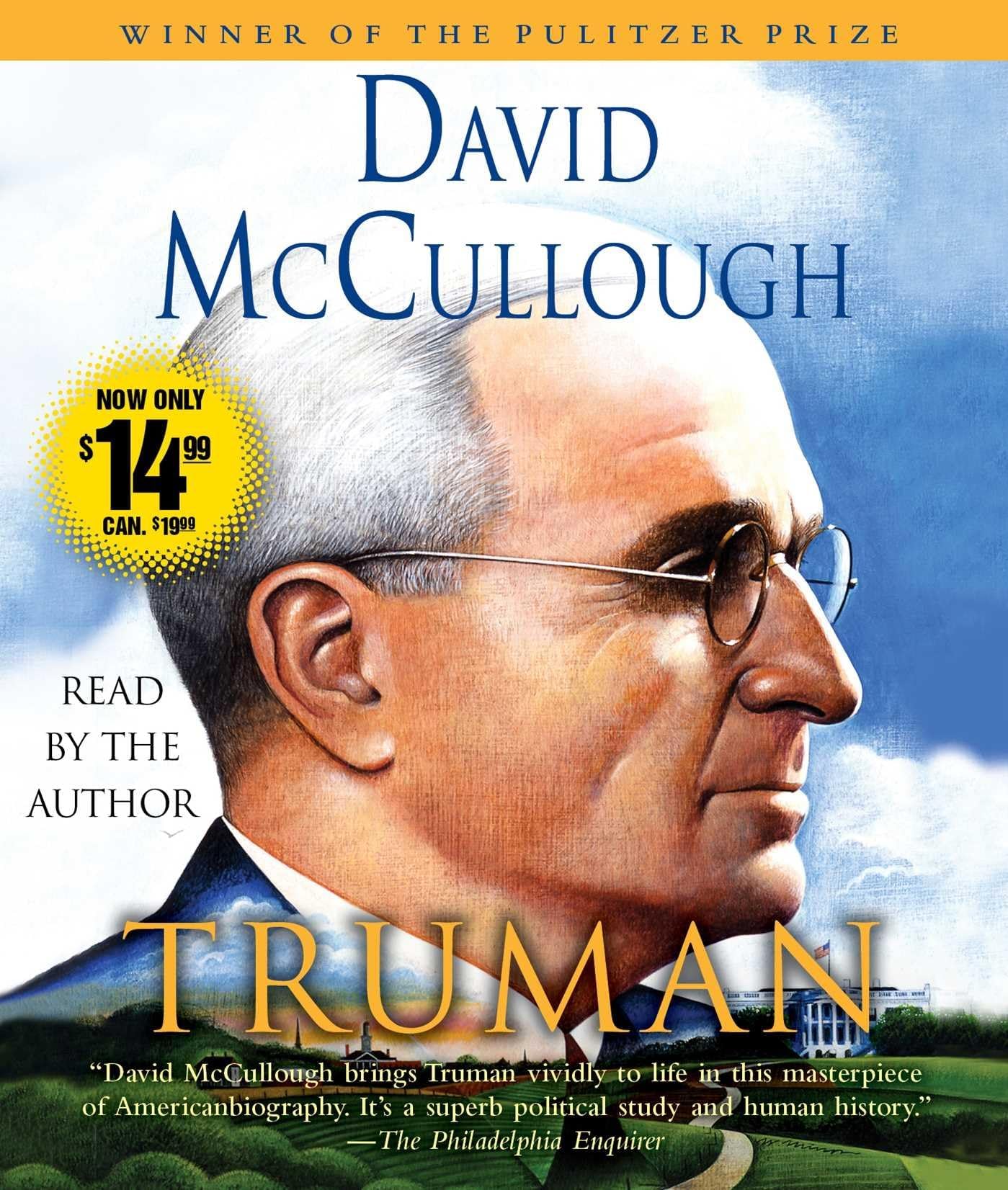

desertcart.com: Truman: 9781442387805: McCullough, David, McCullough, David: Books Review: Truman gave em hell! McCollough gave us a masterpiece. - After finishing David McCollough’s legacy redefining tome of the 33rd U.S. President Harry Truman, it is easy to see why “Truman” is largely considered a masterpiece and the gold standard of Presidential biographies. Although an intimidating 992 pages long, McCollough’s work is so well written and meticulously researched, it makes for a great read. Harry S. Truman has been placed in the upper echelon of great American Presidents, and it’s easy to see why. Never has a President been unexpectedly thrown into the breach of the office with so many ominous decisions to make, yet seemingly so unprepared for the highest and most powerful office in the land. After been reluctantly selected to be Franklin Roosevelt’s Vice President, Truman took the oath of office upon the death of FDR, the world was still at war, just 82 days into Roosevelt’s unprecedented fourth term. Upon learning of the President’s death, it is said Truman asked Eleanor Roosevelt if there was anything he could do for her; she replied, "Is there anything we can do for you? For you are the one in trouble now!" Truman’s rise to the Presidency is a great American story, which McCollough details vividly. The son of a Missouri farmer, which Harry himself became, Truman was truly a man of the people. Earnest, plain spoken, and hardworking, these were the characteristics that justly defined him. After serving as a Field Captain in World War 1, Harry returned to Independence, Missouri where he would marry his sweetheart Bess and become a haberdasher before he would find his calling in public service. After some aid from Kansas City Democratic Machine Boss Tom Pendergast, Truman would go on to become Jackson County Judge, an administrative position similar to that of a County Commissioner. Harry oversaw the County’s “Ten Year Plan”, which included the transformation of the county’s public works including updating the network of roads and a new county courthouse. He was elected the president of the Greater Kansas City Plan Association and made director of the National Conference of City Planning. As an urban planner myself, I found this to be great trivia! After serving 12 years as County Judge, Truman would go on to be elected to the U.S. Senate in 1934, again leveraging the aid of Boss Pendergast. Upon entering the Senate, he would be disregarded as “The Senator from Pendergast”. It was after being reelected to the Senate in 1940, where Truman would begin to make a name for himself, establishing the Truman Committee, charged with rooting out waste and war profiteering from the expansive war mobilization efforts of the Roosevelt Administration. It was during his time on this committee where Truman’s no nonsense and hard work allowed him to establish himself as worthy of a Vice Presidential candidate. Truman’s tenure as President is as consequential as any during the 20th Century. Soon after taking office he set off to Potsdam, Germany to meet with Winston Churchill and Joseph Stalin to discuss the postwar order of Europe. Within months, he authorized the use of the atomic bomb, quickly ending what would have continued to be an enduring and ghastly war with Japan. Upon taking the oath of office, Truman, even as FDR’s Vice President, had no idea the bomb was even in development, which is much more a reflection of FDR given his failing health. His presidency helped achieve historic institutions of monumental consequence including the creation of the United Nations and NATO. Ushered in the Marshall Plan which helped rebuild post-war Europe. Initiated the Berlin Airlift, a campaign to deliver food, coal and other supplies using military aircraft on a massive scale allowing the circumvention of a Soviet blockade to Western Europe. Instituted the “Truman Doctrine” of communist containment. Recognized the creation of Israel. All within his first term! The gripping account of the 1948 reelection bid is certainly a highlight of the book. Truman’s reelection campaign is on of political folklore, and McCollough details it masterfully. Down mightily in the polls to New York Governor Thomas Dewey, and with ever political pundit in the country counting him out, Truman zig-zags across the country by train speaking at every stop along the way. Truman’s plain-speaking approach and “give em hell, Harry!” style contrasting with Dewey’s lofty and empty rhetoric coupled with a lack of urgency ultimately wins the day. Even after garnering massive crowds, he was expected to go down in defeat as of election night. After emerging victorious the day after, Truman holds up the front page of the Chicago Tribune announcing “Dewey Defeats Truman”! Harry S. Truman was never a man to be counted out, and he earned everything he got. Truman’s second term was no less ominous than his first. Even as the economy was as strong as ever, the Korean War and labor strikes dictated much of his time. A lasting triumph of his second term was the desegregating of the military, an action that began to erode the Democratic party’s stronghold on the south. Truman left office after his second term a very unpopular President, succeeded by World War II hero General Dwight D. Eisenhower. It’s said that McCollough’s “Truman” helped to reshape his standing among U.S. Presidents, and it should. Harry S. Truman is proof that if you are given a job, it is your duty to give it all you got, and that hard work does pay off, and that only in America can a man of humble beginnings can soar to great heights. Review: One of My Favorite Books - Once in a while a book makes an indelible impact. For me, David McCullough's biography, Truman, is one of those magnificent books that I will forever cherish. I savored each page, and as I read, I didn't want Harry Truman's extraordinary story of courage and perseverance to end. Beyond his stature as President, Truman was a remarkable human being, striving always to do what was right. From the time he was a boy growing up in Missouri, young Harry S. Truman possessed a determination to work hard and succeed. He may have looked frail and awkward with his thick-lens spectacles, and he may have remembered himself as a "sissy" due to the fact he was shy and lacked athleticism during his adolescence, but he was well-liked and respected by his peers. He was a voracious, studious reader, and he loved to play the piano. He dreamed of wanting to become a renowned pianist or a famous general. After high school, he wanted to attend West Point, but his poor eyesight barred his acceptance. He went on to work various jobs, always earning high praise from his employers for his strong work ethic and intelligence. Then the Great War compelled him to fulfill what he believed was his duty to serve. At age thirty-five, he did not have to go, but going to war became the formative experience of Truman's life. Elevating himself to the rank of Captain of Battery D in the U.S. Army, the experience of battle on the frontlines changed him forever: gave him the confidence that, indeed, he possessed an innate quality to lead men. He gained the courage not to run from fights; he discovered the courage to inspire. These were traits demanded of him, after the death of Roosevelt, when he was catapulted into the unthinkable scenario of assuming the presidency. Confronted with the challenge of leading the nation through the end of the Second Great War, his choice to use the bomb against Japan was a deeply conscientious decision based on his considerations of the moral ramifications of using or not using an atomic weapon. He chose to use it as the soundest method to ending the war immediately, rather than deciding to expend the lives of potentially millions more, both on the American and Japanese sides, had the continuance of the war required the Allies to take the island of Japan in a military undertaking larger than that of the D-Day operation. During the postwar crisis, when the nuclear age and the rise of communism could have spun history towards apocalyptic disaster, he remained steadfast and optimistic with resolve to rebuff the Soviet advance in Europe by implementing the Truman Doctrine, the Marshall Plan, and the Berlin Airlift, all resounding achievements considering the tension the world teetered on. Aside from Churchill, Truman ranks in the 20th Century as one of the most the altruistic leaders of peace in his efforts to prevent the onslaught of a nuclear war. How Truman pulled out the 1948 election when every political pundit and media source declared him defeated is one of the most inspiring moments to read about in the history of American politics. As an elected president emerging from the shadow of FDR, Truman's agenda and what he stood for are representative of an exemplary leader. He was incorruptible, a man of the highest integrity and honesty. He had a remarkable ability to remain calm, composed, and poised with strength under pressure. And no matter how tough the decisions he had to make, he always fell back on choosing to do what was right, even in regard to the nightmare that transpired in Korea. His leadership was a testament of courage and perseverance to stand firm against communism. He believed with confidence in the triumph of democracy as the guiding force to achieve peace. In a world of trouble and fear, he was unblinking in his determination to steer American and Russia on a path to avoid destruction. Aside from his abilities as a leader, Truman was a model human being. He treated everyone with the same dignity and respect, never acting short or petty with anyone. He was friendly, likeable, cheerful, warmhearted, always smiling, and didn't take himself too seriously. He put his heart in the right place and never gave up on anything he undertook. He was considerate and soft-spoken. He was strong-willed, good-natured, and patient under duress. He had ambition to succeed, but he was always decent and never allowed himself to by misguided by power. He could always be relied upon for the truth, and counted upon to make conscientious decisions in the face of adversity. He was brave, hopeful, undaunted, and indomitable in all his duties. He believed in the cause of the common man and was loyal in wanting to do everything in his power to help those who struggled to make ends meet. McCullough's magisterial work on Truman's life is a tremendous inspiration to read. I love this book and Truman is one of my heroes.
| Best Sellers Rank | #1,275,507 in Books ( See Top 100 in Books ) #17 in US Presidents #31 in U.S. State & Local History #2,263 in Books on CD |
| Customer Reviews | 4.7 out of 5 stars 6,811 Reviews |
J**E
Truman gave em hell! McCollough gave us a masterpiece.
After finishing David McCollough’s legacy redefining tome of the 33rd U.S. President Harry Truman, it is easy to see why “Truman” is largely considered a masterpiece and the gold standard of Presidential biographies. Although an intimidating 992 pages long, McCollough’s work is so well written and meticulously researched, it makes for a great read. Harry S. Truman has been placed in the upper echelon of great American Presidents, and it’s easy to see why. Never has a President been unexpectedly thrown into the breach of the office with so many ominous decisions to make, yet seemingly so unprepared for the highest and most powerful office in the land. After been reluctantly selected to be Franklin Roosevelt’s Vice President, Truman took the oath of office upon the death of FDR, the world was still at war, just 82 days into Roosevelt’s unprecedented fourth term. Upon learning of the President’s death, it is said Truman asked Eleanor Roosevelt if there was anything he could do for her; she replied, "Is there anything we can do for you? For you are the one in trouble now!" Truman’s rise to the Presidency is a great American story, which McCollough details vividly. The son of a Missouri farmer, which Harry himself became, Truman was truly a man of the people. Earnest, plain spoken, and hardworking, these were the characteristics that justly defined him. After serving as a Field Captain in World War 1, Harry returned to Independence, Missouri where he would marry his sweetheart Bess and become a haberdasher before he would find his calling in public service. After some aid from Kansas City Democratic Machine Boss Tom Pendergast, Truman would go on to become Jackson County Judge, an administrative position similar to that of a County Commissioner. Harry oversaw the County’s “Ten Year Plan”, which included the transformation of the county’s public works including updating the network of roads and a new county courthouse. He was elected the president of the Greater Kansas City Plan Association and made director of the National Conference of City Planning. As an urban planner myself, I found this to be great trivia! After serving 12 years as County Judge, Truman would go on to be elected to the U.S. Senate in 1934, again leveraging the aid of Boss Pendergast. Upon entering the Senate, he would be disregarded as “The Senator from Pendergast”. It was after being reelected to the Senate in 1940, where Truman would begin to make a name for himself, establishing the Truman Committee, charged with rooting out waste and war profiteering from the expansive war mobilization efforts of the Roosevelt Administration. It was during his time on this committee where Truman’s no nonsense and hard work allowed him to establish himself as worthy of a Vice Presidential candidate. Truman’s tenure as President is as consequential as any during the 20th Century. Soon after taking office he set off to Potsdam, Germany to meet with Winston Churchill and Joseph Stalin to discuss the postwar order of Europe. Within months, he authorized the use of the atomic bomb, quickly ending what would have continued to be an enduring and ghastly war with Japan. Upon taking the oath of office, Truman, even as FDR’s Vice President, had no idea the bomb was even in development, which is much more a reflection of FDR given his failing health. His presidency helped achieve historic institutions of monumental consequence including the creation of the United Nations and NATO. Ushered in the Marshall Plan which helped rebuild post-war Europe. Initiated the Berlin Airlift, a campaign to deliver food, coal and other supplies using military aircraft on a massive scale allowing the circumvention of a Soviet blockade to Western Europe. Instituted the “Truman Doctrine” of communist containment. Recognized the creation of Israel. All within his first term! The gripping account of the 1948 reelection bid is certainly a highlight of the book. Truman’s reelection campaign is on of political folklore, and McCollough details it masterfully. Down mightily in the polls to New York Governor Thomas Dewey, and with ever political pundit in the country counting him out, Truman zig-zags across the country by train speaking at every stop along the way. Truman’s plain-speaking approach and “give em hell, Harry!” style contrasting with Dewey’s lofty and empty rhetoric coupled with a lack of urgency ultimately wins the day. Even after garnering massive crowds, he was expected to go down in defeat as of election night. After emerging victorious the day after, Truman holds up the front page of the Chicago Tribune announcing “Dewey Defeats Truman”! Harry S. Truman was never a man to be counted out, and he earned everything he got. Truman’s second term was no less ominous than his first. Even as the economy was as strong as ever, the Korean War and labor strikes dictated much of his time. A lasting triumph of his second term was the desegregating of the military, an action that began to erode the Democratic party’s stronghold on the south. Truman left office after his second term a very unpopular President, succeeded by World War II hero General Dwight D. Eisenhower. It’s said that McCollough’s “Truman” helped to reshape his standing among U.S. Presidents, and it should. Harry S. Truman is proof that if you are given a job, it is your duty to give it all you got, and that hard work does pay off, and that only in America can a man of humble beginnings can soar to great heights.
R**K
One of My Favorite Books
Once in a while a book makes an indelible impact. For me, David McCullough's biography, Truman, is one of those magnificent books that I will forever cherish. I savored each page, and as I read, I didn't want Harry Truman's extraordinary story of courage and perseverance to end. Beyond his stature as President, Truman was a remarkable human being, striving always to do what was right. From the time he was a boy growing up in Missouri, young Harry S. Truman possessed a determination to work hard and succeed. He may have looked frail and awkward with his thick-lens spectacles, and he may have remembered himself as a "sissy" due to the fact he was shy and lacked athleticism during his adolescence, but he was well-liked and respected by his peers. He was a voracious, studious reader, and he loved to play the piano. He dreamed of wanting to become a renowned pianist or a famous general. After high school, he wanted to attend West Point, but his poor eyesight barred his acceptance. He went on to work various jobs, always earning high praise from his employers for his strong work ethic and intelligence. Then the Great War compelled him to fulfill what he believed was his duty to serve. At age thirty-five, he did not have to go, but going to war became the formative experience of Truman's life. Elevating himself to the rank of Captain of Battery D in the U.S. Army, the experience of battle on the frontlines changed him forever: gave him the confidence that, indeed, he possessed an innate quality to lead men. He gained the courage not to run from fights; he discovered the courage to inspire. These were traits demanded of him, after the death of Roosevelt, when he was catapulted into the unthinkable scenario of assuming the presidency. Confronted with the challenge of leading the nation through the end of the Second Great War, his choice to use the bomb against Japan was a deeply conscientious decision based on his considerations of the moral ramifications of using or not using an atomic weapon. He chose to use it as the soundest method to ending the war immediately, rather than deciding to expend the lives of potentially millions more, both on the American and Japanese sides, had the continuance of the war required the Allies to take the island of Japan in a military undertaking larger than that of the D-Day operation. During the postwar crisis, when the nuclear age and the rise of communism could have spun history towards apocalyptic disaster, he remained steadfast and optimistic with resolve to rebuff the Soviet advance in Europe by implementing the Truman Doctrine, the Marshall Plan, and the Berlin Airlift, all resounding achievements considering the tension the world teetered on. Aside from Churchill, Truman ranks in the 20th Century as one of the most the altruistic leaders of peace in his efforts to prevent the onslaught of a nuclear war. How Truman pulled out the 1948 election when every political pundit and media source declared him defeated is one of the most inspiring moments to read about in the history of American politics. As an elected president emerging from the shadow of FDR, Truman's agenda and what he stood for are representative of an exemplary leader. He was incorruptible, a man of the highest integrity and honesty. He had a remarkable ability to remain calm, composed, and poised with strength under pressure. And no matter how tough the decisions he had to make, he always fell back on choosing to do what was right, even in regard to the nightmare that transpired in Korea. His leadership was a testament of courage and perseverance to stand firm against communism. He believed with confidence in the triumph of democracy as the guiding force to achieve peace. In a world of trouble and fear, he was unblinking in his determination to steer American and Russia on a path to avoid destruction. Aside from his abilities as a leader, Truman was a model human being. He treated everyone with the same dignity and respect, never acting short or petty with anyone. He was friendly, likeable, cheerful, warmhearted, always smiling, and didn't take himself too seriously. He put his heart in the right place and never gave up on anything he undertook. He was considerate and soft-spoken. He was strong-willed, good-natured, and patient under duress. He had ambition to succeed, but he was always decent and never allowed himself to by misguided by power. He could always be relied upon for the truth, and counted upon to make conscientious decisions in the face of adversity. He was brave, hopeful, undaunted, and indomitable in all his duties. He believed in the cause of the common man and was loyal in wanting to do everything in his power to help those who struggled to make ends meet. McCullough's magisterial work on Truman's life is a tremendous inspiration to read. I love this book and Truman is one of my heroes.
A**.
A Rare Study in Courage
Harry Truman was never supposed to be President. He grew up in rural Missouri, the son of an unsuccessful businessman and farmer. He was backed by the powerful Pendergast machine for all of his state elections and was a consensus pick for Vice President in 1944, to an increasingly ailing FDR. When he assumed the office, he was unprepared and it showed. How he came to greatness all his own, as well as being generally considered among the best Presidents of all time despite leaving office with a disapproval rating of 66% (still the all-time record) is the subject of this extraordinary book. Truman was just a common man, some would say, but they'd be wrong. Our 33rd president was a man of great vigor and vitality, and most of all, courage. Despite being from the South he was the leading voice in the Democratic Party for legal equality for all Americans and an end to desegregation. The time had not yet come, but that didn't stop him from doing all he could to get the ball rolling, such as desegregating the Armed Forces in 1948, during a close election campaign in which the normally "Solid" South was being courted by recently deceased uber-racist Strom Thurmond on a Dixiecrat ticket. That campaign, against Thomas Dewey, was the biggest upset of the 20th century, and it just proved further never to count Harry out. As would be expected for a book with a subject so complex and fascinating as Harry S. Truman, this is a mammoth tome. However, it rarely drags. His childhood and adolescence are preceded with a little family history, then followed by his service in World War I, his failed garment business, his time in office as a county administrator in Independence, then the U.S. Senate, where he rose to fame by being a fierce investigator of wartime appropriations. He was one of the most popular and visible Senators because of his service on the Truman Committee, and thus was drafted by party bosses around the country to replace the excessively liberal and unliked Henry Wallace on the Democratic Ticket in '44. Public opinion toward Truman after FDR died was quite hostile, but as with all the other challenges in his life, he rose to meet this one. The major events of his presidency are all here: Civil Rights, the Truman Doctrine and Marshall Plan (which marked an end to the same old song of American Isolationism for good), the Berlin Airlifts, The Bomb, re-election, and Korea and the showdown with General MacArthur. The campaign stuff is especially great--Dewey/Warren was a 13 point favorite over Truman/Barkley, with Thurmond trying to break off the Southern vote and Wallace trying to snatch the liberal vote. Losing two components of his core constituency, plus facing an attractive, moderate opposition ticket while extremely vulnerable himself, indicated certain doom. However, Truman, through sheer force of personality, refused to give up and never seemed to doubt winning as he zigzagged across the country, throwing partisan fire and convincing average Americans he was one of them and would keep the New Deal alive, as opposed to his to-the-manner-born opponent, who was long on rhetoric but short on ideas and issues. The result, of course, was Truman's re-election and the end of Dewey's political career. Truman won without softening his record--for example, he was the first candidate to stump in Harlem, as the book notes. It's a recurring theme: Truman took stances that didn't quite resonate with his base, i.e. desegregating the Armed Forces, drafting the Coal Miners into the Army, etc., but he did them anyway. Although he was willing to admit a mistake, he was never willing to back down on his principles, and history has judged him well for it. Truman is rightly considered one of the giants of American History, although it did take us all a little time to figure it out. Ultimately, Harry Truman was no ordinary man. Following FDR, he was initially compared to the consensus pick for worst president, Andrew Johnson, who followed Lincoln and managed to bumble his way into politically-motivated impeachment. Now, he is mentioned in the same breath with his idol, Andrew Jackson. His nearly incredible reserve of energy and earnest desire to help all people make him a President for the ages.
J**T
An engaging portrait of our 33rd president
Harry Truman is an interesting character, and David McCullough presents an engaging portrait of our 33rd president. McCullough is thorough and readable as he presents a chronological narrative of Truman's life. Although a credentialed historian, McCullough avoids academic gobbledygook and knows when to end a sentence. He writes in a clean, straightforward fashion that invites the reader to turn the page. When McCullough writes a biography, he investigates every nook and cranny of the subject's life until he knows everything knowable about the individual. Attention to detail reveals the real person behind the public facade, but this fixation on the subject produces two flaws in McCullough books: they're too long and the supporting cast are often cardboard cutouts. At 1,120 pages, Truman is a long book. A very long book. After gathering all this information, McCullough doesn't know what to leave out. The 1948 presidential race was historic, but after dozens of pages, I came to believe we would witness every whistle-stop. This is just one example of overwhelming detail. Truman would have remained a tome if cut by 200 pages, but the book would have been a more powerful biography. McCullough's focus on the subject of his biographies gives slight notice to other prominent people. The collection of great or notorious leaders during the World War II period probably rivaled the Revolution. At these rare times in history, collective greatness molds and/or reinforces the accomplishments of each individual player. (Doris Kearns Goodwin is a master at capturing the dynamics and undercurrents of formidable characters at formidable moments.) We learn everything about the character and actions of Truman, but Franklin D. Roosevelt, George C. Marshall, Winston Churchill, Dwight Eisenhower, and the members of his cabinet and staff rotate around Truman with all the animation of carousel ponies. We have faint idea what Roosevelt thought about Truman or why he picked him to be vice president and then chose to ignore him after the election. FDR knew his health was failing, and handpicked a relatively obscure junior senator as his successor. Why? McCullough does not give us much insight because we see events only from Truman's perspective. Truman was an enjoyable read and a highly professional biography of one of our best presidents. Despite my grumblings, I read every word of this fine book and returned to reading it at every opportunity. I would highly recommend it ... supplemented with other history books about this pivotal period in our history.
J**B
👍 Great bio!
Wonderful book. He brings history and Pres. Truman to life.
D**N
"There was greatness in the man"
I picked up Truman, primarily because I wanted to understand a little more about the post WW-II events and decisions that so marked the latter half of the 20th century. What I got was something much more. An opportunity to live alongside one of the most remarkable and unlikely lives in American History. Harry Truman was the second to last US President to have been born in the 1800s. His grandparents lived during the era of the Missouri frontier and the Civil War. “The arc of his life spanned more change in the world than in any prior period in history…he had to assume command of the most powerful industrial nation on earth at the very moment when that power, in combination with the stunning advances in science and technology, had become an unparalleled force in the world.” There is a romance to the life, a seemingly fictional element in the biography. Truman did not go to college, nor did he get involved in politics until midlife. He worked a decade as a farmer until his early 30s, went to war in Europe and returned only to get married and start a men’s clothing warehouse. In many ways he was a normal middle American man, who had his share of ups and downs and financial debts. Truman was not bred for the Presidency, nor trained for the global decisions he would have to make like an FDR or a Churchill. His rise to power could not have been more unforeseen; but with the Pendergast (a powerful Missouri political boss) backing he proved to be very successful in state government. From there, there was no looking back. From state government to US Senator, from Senator to Roosevelt’s Vice President, from Vice President to President, from President to the creation of United Nations and Victory in Europe and Potsdam and the dropping of the atomic bomb. These first 4 months were riveting to read. And from that point the story does not cease to amaze: from a very low approval rating as President to an exhausting campaign and a most improbable victory over Dewey. Truman’s story is an unfolding of one unlikely event followed by another unlikely, momentous event. Truman’s second term included the founding of the state of Israel, the unpopular start of the Korean War, and the eventual firing of Douglas MacArthur. It was not just the decisions and the policies implemented that really struck me as a reader. To be sure I did learn a lot more about the post-WWII world; but I found myself becoming very much attached to the key figure in the story. Truman is an admirable protagonist with a noble heart. He is just, moral, upright, wary of the temptations that come with power. He makes mistakes. His persona exudes vitality and industrial energy that is contagious to everyone who works with him. Throughout his life he possessed a deep desire to “do the right thing” no matter what. If modern generations look back on the atomic bomb or the “dangerous foreign intervention precedent” of Korea with disdain—they should read this book. Time and time again Truman is faced with two deeply flawed options in real time: drop a bomb or allow a world war to continue; intervene in Korea or watch on from a distance; use extreme governmental measures or let the crippling strike go on during wartime. An imperfect decision had to be made and rarely was there a third option. At his farewell address in 1953 Truman said: “When Franklin Roosevelt died, I felt there must be a million men better qualified than I, to take up the Presidential task. But the work was mine to do, and I had to do it. And I have tried to give it everything that was in me... Good night and God bless you all.” To sum it up, this was a very enjoyable ride. I found myself at times staying up until the early morning binging, because I was so engrossed in the narrative. I was sad to finish, just like I am sad when I finish any good biography. You walk so far with the characters it is almost an emotional experience when they pass on and a new era arises. As for the writing, David McCullough in one of the best historians alive and his prose is perfect as always. A remarkable story teller to match a remarkable life.
D**N
The Truman You Never Knew
While this is not a myth-creating book, you will find it impossible to read this biography and come away as anything less than a fan of a decent man who did his best under difficult circumstances. I have always respected McCullough's research and attention to detail, but this book is also just a cracking good read. Many have been brought up - perhaps by the educationocracy that still worships at the altar of Marxism and FDR - with the caricature of Harry Truman as a bumbler selected for his insignificance who fell into office and then screwed it up. He has also been portrayed in pro-military circles as the personification of foolish political interference in military matters; yet with his experience in World War I he had as much military experience in the most brutal conflict on record as any prior or subsequent President except those few who were career military men. FDR, by contrast, winner of the greatest war this nation ever fought, had no military service except as Secretary of a peacetime Navy, and as one of the richest men in America was hardly in a position to sincerely understand the problems of regular people. We all know of the Truman-Dewey polling fiasco, his decision to use the atom bomb, and probably of his conflict with MacArthur. But unless you are a history buff of that era, you do not know of his reluctant climb through the party machine, his financial dependence on his parents-in-law, his valiant service in the short but ugly experience of World War I, his creation of and service on the committee for overseeing waste and abuse during World War II, and Bess Truman's total unsupportiveness in his White House years. McCullough does not gloss over any of this, and indeed it is these experiences perhaps that shape Truman's character (something that many of our recent politicians lack utterly). Those of us who are accustomed to the imperial Presidencies, and the strange but never-investigated accrual of wealth by politicians of all classes who come into office as middle-class and leave office as multi-millionaires, will be astounded to learn that when he completed his term as President, he just went home to Independence and lived more or less on the financial edge, with a minimal pension after a lifetime in public service, and he was politically persecuted for the rest of his life by the Republicans because he was all that was left of the FDR administration that had persecuted THEM, and by the Democrats because he was all that was left of the FDR administration yet he was not FDR. Truman was a plain-spoken person who never lost track of his farming roots. For this reason the Eastern aristocracy looked down on him, even as they were embracing the principles of Marxism, and in the scholastic presses (which until recently were based almost exclusively in Boston and New York) he was denigrated because he was not the demigod Roosevelt (who as we now know was mostly a caricature himself by 1940). And since 1970 or so he has been overlooked by Republicans because they were not in search of a Democratic role model, and by today's anti-American Democrats because he inconveniently seemed to be quite sincere in actually believing in truth, justice and the American way. Perhaps the status of limitations for political correctness is about 50 years. In that case, now is the time to read McCullough's balanced portrait of a great American.
J**N
Made me aware of the true Truman. Very different from the tough little guy persona.
I gave this a 5 star rating for several reasons. One being that the depth and the breadth of McCullough’s research is astonishing. But what impressed me even more about this book is that it made me aware that Truman was very different from the “Give’em Hell Harry” little tough guy, who was not very bright, and who rose to power by slugging his way to the top with the help of corrupt political bosses. He may have been tough mentally but physically he was not a bruiser. As a child and young man, he never got into a fight, he would much rather play classical piano or read books. In his senior year of high school, his objective was not sports but to read all the books in the school library. In his 30’s he did volunteer for World War I and the men he commanded praised his valor, but he did not enjoy the violence. It was to him the inescapable evil of war. Perhaps the image of him as a tough guy was enhanced by his having threatened physical assault against a music critic who disparaged Margaret Truman’s singing ability. The assault never happened and when the two men did meet many years later, Truman bore no animosity to the critic and treated him with the greatest courtesy. It is true that he did owe a lot of his political success to the intervention of the powerful Pendergast machine, but he was still meticulously honest in every job they threw his way. They tolerated it because his work ethic was almost beyond human ability but perhaps more importantly it was difficult not to like Harry. He was a man who genuinely liked almost all people and people perceived that affection and tolerance. He always treated even the lowliest with respect and always felt morally obligated to help them in their time of need. Although he did not have a college degree, it was not for lack of intelligence. He left because his father needed his help to support the family when his father went bankrupt. He was not brilliant, but he was very intelligent and a voracious reader. He loved architecture and was involved in almost every step of the massive renovation of the White House. But what he loved even more than architecture was history. To him, it gave him a remarkable grasp of the significance of the flow of human events. In the 1948 presidential race, every political poll, every pundit gave him no chance of winning. He predicted that he would win the presidency with 340 electoral college votes, Dewey 108, Thurmond 42. The actual tally: Truman 303, Dewey 189, Thurmond 39. A man of limited intelligence could not have made such a prediction. A man of limited intelligence could not have orchestrated the rebuilding of Europe (Marshall Plan) and the painless transformation of America from a war to a peacetime economy. Truman is to me a conundrum. He seemed to be virtually devoid of the lust for power that is almost invariably a trait of those who achieve it. He was more like a draft horse putting one foot in front of the other pulling the load given to him, not conscious of any other purpose. But this farmer from Missouri, who did not have the overwhelming presence of a Washington or Roosevelt, who did not have the brilliance of an Adams or a Jefferson, was in Churchill’s estimation the man who save Western civilization. Churchill told him so when he visited Truman in 1952, “The last time you and I sat across the conference table was at Potsdam, Mr. President. I must confess, sir, I held you in very low regard then. I loathed your taking the place of Franklin Roosevelt. I misjudged you badly. Since that time, you more than any other man, have saved Western civilization.”
Trustpilot
2 weeks ago
1 month ago