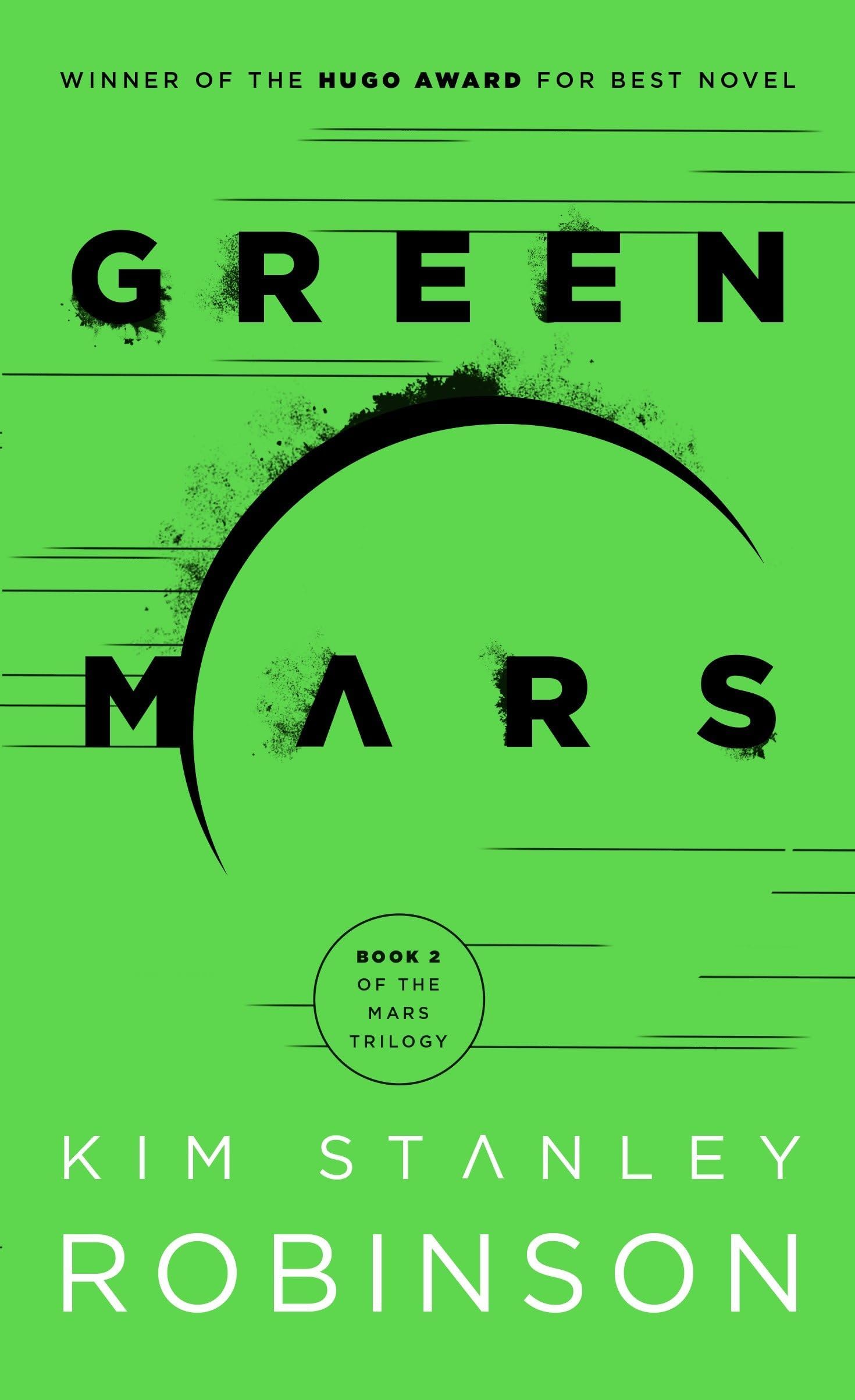
Green Mars
Product ID: 10313268
🌍Hard science meets future terraforming
📚624 pages of immersive sci-fi
🚀Epic Mars colonization saga
Buy anything from 5,000+ international stores. One checkout price. No surprise fees. Join 2M+ shoppers on Desertcart.
Desertcart purchases this item on your behalf and handles shipping, customs, and support to Israel.
🚀 Transform your bookshelf with the ultimate Mars odyssey!
Green Mars by Kim Stanley Robinson is the second installment in a critically acclaimed sci-fi trilogy exploring the colonization and terraforming of Mars. Published in 1995, this 624-page mass market paperback combines hard science with rich political drama and detailed world-building, earning a 4.4-star rating from over 3,000 readers. It’s a must-have for professionals craving visionary, scientifically grounded speculative fiction that captures the future of humanity beyond Earth.
| Best Sellers Rank | #202,080 in Books ( See Top 100 in Books ) #136 in Hard Science Fiction (Books) #222 in Exploration Science Fiction #437 in Science Fiction Adventures |
| Customer Reviews | 4.4 out of 5 stars 3,094 Reviews |
T**N
2nd of Sci Fi trilogy. Best Mars colonizing and Mars terraforming
Read Red Mars 5 stars fantastic.Read my review. Read Green Mars also 5 stars fantastic. This is the best Sci Fi trilogy on Mars colonization and Terra Forming. Its a big book...over 600 pages but reads well and quick. So detailed and exciting. No boring parts. Kim Stanley Robinson is great with character development and so detailed in his Mars landscape descriptions. Here a little of this exciting epic classic. Now there are hundreds of thousands on Mars in various cities and small dome/tent facilities. Earth is having major problems with famine, wars and the West Antarctic ice sheet dropping off and melting and raising the sea level 6 meters. The big mega internationals are still trying to control Mars and only about 10% of earth's population has been given the treatment for extending life( may live a thousand years). The rest are starving and dieing. Kim Stanley Robinson still has the second elevator from Mars to asteroid Clarke 2 . The Mega Internationale's Earth police goon squads keep trying to put Mars in "order". Reinforcements are transported down the ""elevator" ( The elevator is too improbable to me). The elevator allows spaceships from earth to land on asteroid Clarke2 and save fuel by bypassing mars gravity well. There is the second revolution and Burroughs Mar's largest city is flooded by the extremist "Reds" ( don't want terraforming and leave Mars like it was). The police goon squads are forced to leave and concentrate at Sheffield another Mars city where the "Elevator" is. Hundreds of thousands of Burroughs citizens escape and walk out of Burroughs wearing filters and heavy clothing. They then board trains to other cities. A very narrow escape!The underground shoots down military space and communications platforms around Mars and keep their own communications intact. Major 2nd revolution that this time succeeds. Lots of Terra Forming going on and now in low parts people are able to breath temporarily with the help of filters outside of domes but it still very cold like Siberia but now there is liquid water part time in the Summer on parts of low level Mars. A big Megainternational named Praxis is now helping Mars and trying to help Earth with its own disaster. I give Green Mars a 4 1/2 star rating because of the "elevator" which in the near future of a hundred years I don't think the technology will be there but will list it as 5 stars as its an epic and the best Mars colonization/ terraforming trilogy ever. See the many big wheels like Arthur C Clarke and scientist Robert Zubrin's high praise for this classic Mars trilogy epic. Reading Blue Mars and so far its great. Will post review.
D**G
The Martian saga gets bogged down in descriptive overkill
The first book in this trilogy, *Red Mars*, is a brilliant tale of interplanetary exploration and colonization, rife with human drama and supported by a plot that rings true as a very likely "future history." The sequel, however, is less satisfying. After an enticing first hundred pages in which new characters, developments, and plot possibilities are introduced, the story bogs down and much of the middle portion of the book is devoted to ENDLESS "description" of what Mr. Robinson believes Mars might look like at particular stages of its future "terraformed" mutilation by human beings. I applaud Robinson's desire to make the Martian landscapes real to the reader, but he should know that past a certain point, people become saturated with endless descriptions of physical terrain. After reading page after page of these descriptions, my eyes finally began to glaze over. The final portion of the book is much more satisfying, as the second part of the story, involving political intrigue and various clashes of personalities, comes to an exciting climax. Robinson once again impresses in terms of his knowledge of the sciences and his ability to bring this knowledge to bear in his writing. In fact, one of the key developments in the plot (those who have not read the book, avert your eyes here!)involves the catastropic melting of part of the Antarctic ice sheet, an eventuality that leads to rising sea levels of political upheaval worldwide. This very possibility has recently received significant press coverage. Kudos to Robinson for weaving future disaster scenarios that seem maximally plausible. Overall, however, I think that the book could easily have been a hundred pages shorter without any loss of impact.
E**K
Green Mars, a textbook scifi
Speculative science fiction, when done well, can feel like a yet to be fulfilled prophecy. Kim Stanley Robinson achieves this feeling in his novel Green Mars. Green Mars is the second installment of Robinson's epic opus, The Mars Trilogy. Evidence of the book's popularity among scientific crowds is the fact that Green Mars was included in the payload of the 2008 Phoenix expedition to the planet Mars. It is among the first books in the Interplanetary Library. An initial warning: Red Mars, the first book of Kim Stanley Robinson's trilogy, should be read prior to reading Green Mars. The trilogy is not a series of stand alone story arcs that can be coherently read out of order. Red Mars and Green Mars were published a scant 13 months apart in 1993 and 1994. This quick publishing turn around time and the fact that the books are over half a thousand pages each leads one to believe that both books were finished at the same time. While this is just speculation (although I'm sure Kim Stanley Robinson has addressed this matter in interviews in the past 20 years), one can continue to speculate as to why the story was published slightly over a year apart in two different books. Perhaps the author wanted to double his entries in the Hugo and Nebula sweepstakes (Red Mars won the Nebula in 1993, Green Mars won the Hugo 1994). Perhaps the editor thought the tome would be too ponderous for a single book. Perhaps the publisher (Spectra/Bantam Dell/Random House) wanted the profits from two books instead of just one. Whatever the reason, just make sure, even though you are presently reading a review of Green Mars, that you read Red Mars first. Green Mars is set in the near future and is centered around the populating and terraforming of Mars by immigrants from Earth and native born Martians. Green Mars weaves into its plot many other speculative science fiction devices in addition to terraforming. Medical advancements that double or triple the human lifespan play heavily into the story's plot. Other major plot conflicts include environmental disasters and protection (both on Earth and Mars), political dominance by multinational corporations, population growth, and battles over and with advanced technologies such as space elevators, orbiting solar mirrors, and the medicinal treatments for prolonging life. The story is extremely multifaceted and epic in scope. The trilogy spans about 150 years. Green Mars is not particularly light reading, but the story and the science in the story will not soon leave a reader's hippocampus. Kim Stanley Robinson employs a narrative style common to fictional mega-epics with a large cast of characters. The story is told from a third person perspective that is limited to a single character's point of view per chapter. The point of view character alternates every chapter so that the reader can get an idea of everything going on all around Mars. The author creates a linear fluidity to the story this way. This narrative method also allows Kim Stanley Robinson to show off his multiple disciplinary, scientific interests. Depending on the point of view character, the author will use that character's specialty to wax informatively on various fields of science such as geology, environmental science, physics, solar system astronomy, biology, botany, sociology, psychology, philosophy, humanities, economics, mechanical engineering, chemical engineering, social engineering, military science, political science, and even a dash of religion. Often the story is secondary and/or dependent on the description of the sciences (and speculative sciences). Attention and focus is required to follow the story through these interesting, college-level, intellectual interruptions. It is impossible to read Green Mars and not learn something. This will turn off some readers who are only interested in a Mars themed, thrill ride adventure story. If that is what you want, try Robert Heinlein's Stranger in a Strange Land or Edgar Rice Burrough's A Princess of Mars. Green Mars is written for a "hard science fiction" fan base that is interested in intellectualism as much as literary entertainment. The characters, especially the point of view characters, in Green Mars are primarily archetypes of different kinds of scientists, various kinds of revolutionary fighters and politicians, and religious leaders. Their personalities are largely shaped by their professions and/or scientific disciplines. However all the characters are well written and through their actions, thoughts, and expressed values the reader sees multiple dimensions of their passions, flaws, and personalities. The characters and the story are easy to fall in love with but challenging to read. The liberal arts academic who dreaded science class might want to approach this book with caution. However, if you pick up Green Mars and the Mars Trilogy, no matter what you scientific inclination is, you will probably be entertained and definitely be educated.
S**D
A science fiction masterpeiece with real-world relevance
This is the second book in the Mars trilogy, which should be read as one book -- Red, Green, Blue. Robinson has a rare combination of gifts: a gear-head's technical savvy, a scientist's speculative sophistication ... the natural feel for narrative of a born story-teller, and the style of a poet. It's a powerful array and makes for a compulsively readable, intellectually stimulating and often quite moving epic -- an intimate epic, the best kind. His characters, especially the "first 100", wind up living extended lives through genetic manipulation and so experience first hand the tremendous changes that transform their adopted planet. The struggles between those who wish to leave Mars as it is and those who want to remake it as an alternate Earth, between "metanational" corporations who want to pilfer Mars for its natural resources, governments who want to use immigration there as a safety valve for their own over-population problems cast a prescient reflection on the real difficulties currently afflicting our own planet. These books, first published in the 1990s, have long been known as masterpieces of science-fiction -- but they deserve a mainstream readership as well. Peerless. Read them now, so you can gripe about the upcoming TV version!
R**D
Could Not Not Read This Book
After finishing Red Mars (which was not short), I waited all of fifteen minutes before downloading the sequel. Geen Mars elaborates and continues the political and economic plot lines set up in Red Mars, and I found it thorooughly engaging. Robinson clearly has some political and economic biases. Strongly pro-democratic, he is impatient with those who seek to establish dictatorial methods for short term expedience, well-recognizing that there's always an emergency that can rationalize the lust for power. He is also extremly skeptical of the benefits of untammelled capitalism with its greed, selfishness, dictatorial and dehumaninizing methods and utter disregard of community interests at large. Instead, he pushes a different (left of center) model of cooperative ownership by employees, which may or may not function in the real world. (There is enough experience now to say that one can not generalize.) The arguments, however--which occupy numerous pages--are lucid, reasonable and compelling, even if the conclusions are not what might occur in the world today. Like any sequel, it lacks some of the novelty and drama of the first iteration, but it's still just as literate, erudite and compelling as Red Mars. Still, it is not flawless on the copy-editing front. Character names are occasionally misspelled, words missing, some sentences inartfully constructed. These are all errrors than an alert editor would have picked up and corrected without fuss. Hopefully these silly errors will be corrected in later editions.
W**N
Good book but too long
Worth reading but about 200 pages too long. Fascinating world that Robinson has created, there are just some long scenes that could be shortened or deleted.
D**S
The middle of a great trilogy
A wonderful combination of science and storytelling. Amazing characters and amazing science. Best trilogy of inter-planetary science and issues of colonization and politics.
S**N
Green Mars = Plants
Currently reading this book! Red Mars had a great and exciting start to the story. The series is about sending 100 people to mars to start a new society. On top of kinda being a murder mystery, it delves into hard science themes revolving around how to terraform mars. Robinson discusses topics like geology, chemistry, psychology while maintaining a captivating story the entire time. Green Mars has a slower start, but I’m still excited to read it!
Trustpilot
1 month ago
5 days ago