Buy anything from 5,000+ international stores. One checkout price. No surprise fees. Join 2M+ shoppers on Desertcart.
Desertcart purchases this item on your behalf and handles shipping, customs, and support to Israel.
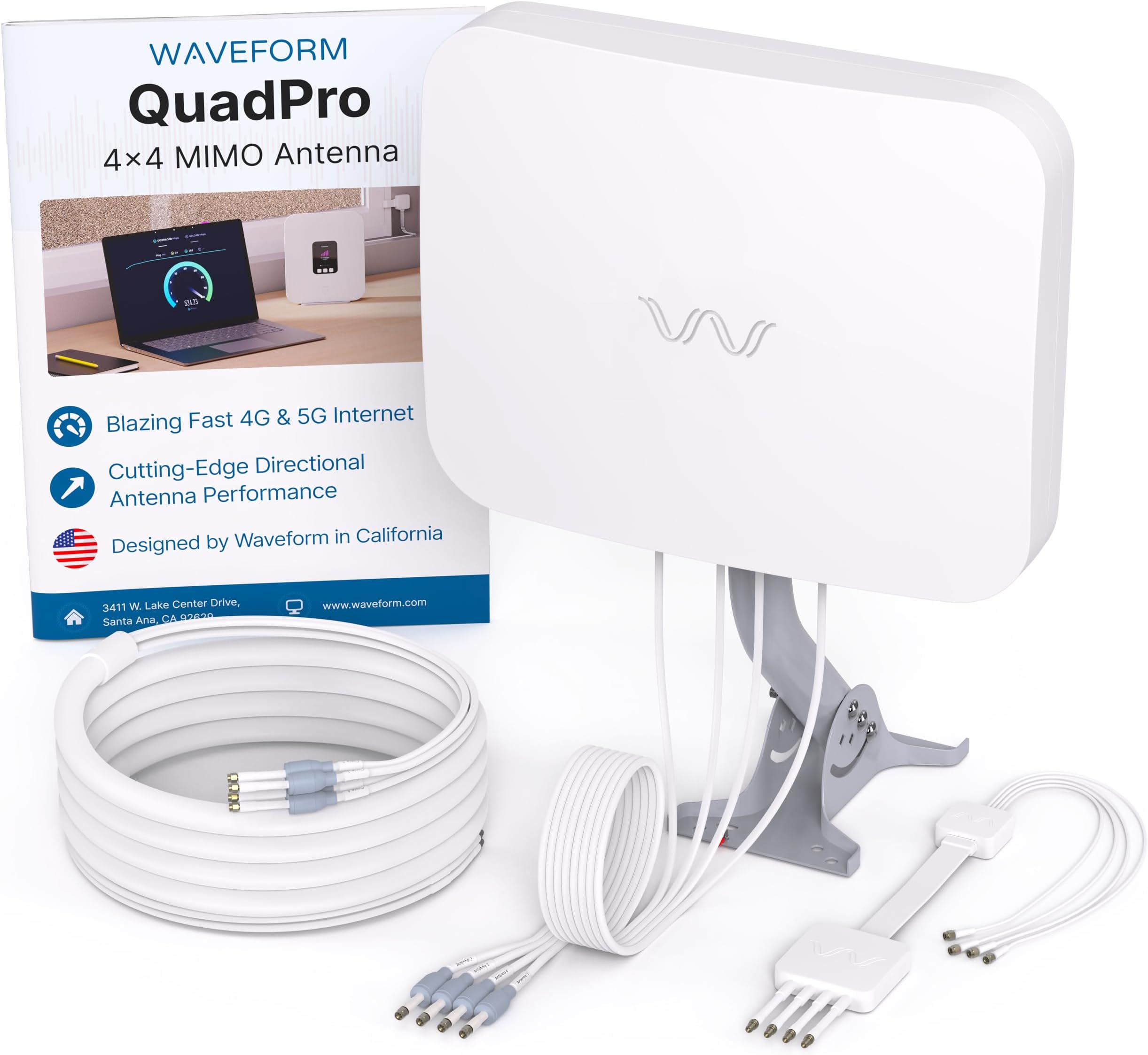
🚀 Elevate your 5G game with Waveform QuadPro — don’t just connect, dominate!
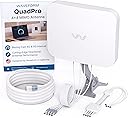
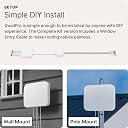
The Waveform QuadPro 4x4 MIMO Signal Boosting Panel Antenna Kit is a premium external antenna designed to dramatically enhance 4G and 5G internet speeds and reliability. Supporting all major US carriers with up to 9.1 dBi gain across a wide frequency range, it comes as a complete DIY kit featuring a unique window entry cable and mounting hardware for easy, no-drill installation. Ideal for T-Mobile Home Internet, Verizon, and AT&T gateways, it delivers measurable improvements in download/upload speeds, signal stability, and latency—perfect for professionals demanding consistent, high-performance connectivity.


| ASIN | B0CTRW5SLP |
| Antenna | Radio |
| AntennaDescription | Radio |
| Best Sellers Rank | #73 in Computer Networking Antennas |
| Brand | Waveform |
| Color | White |
| Customer Reviews | 4.5 out of 5 stars 704 Reviews |
| Global Trade Identification Number | 00198168042939 |
| Impedance | 50 Ohms |
| Item Weight | 2.28 Kilograms |
| Manufacturer | Waveform |
| Maximum Range | 3 Feet |
| Mfr Part Number | QPRO-2U |
| Model Number | Complete Kit w/ 20' Cable & Window Entry |
| Number of Channels | 4 |
| Unit Count | 1.0 Count |
| Warranty Description | 3 Year Manufacturer Warranty |
B**G
Outstanding Performance Upgrade – Real, Measurable Results
I purchased the Waveform QuadPro 4×4 MIMO antenna to improve our AT&T Internet Air connection, and the results have been nothing short of excellent. Before installing the QuadPro, our speeds were inconsistent—especially on upload—and signal quality fluctuated depending on time of day and network conditions. After installing the QuadPro (mounted outdoors and properly aimed), we saw immediate and measurable improvements: - Download speeds doubled, now consistently around 250 Mbps - Upload speeds increased dramatically, very consistently tripling compared to before - We now see 17–22 Mbps upload on a regular basis - Signal quality (SINR) and overall stability improved noticeably - Far fewer drops, less band switching, and much more reliable performance under load This wasn’t just a speed test win—the connection feels better in everyday use. Video calls are stable, uploads no longer stall, and performance is consistent throughout the day. The build quality is excellent, the documentation is clear, and the antenna does exactly what it’s designed to do: improve both signal strength and signal quality, which is especially critical for 5G and fixed wireless setups. If you’re on cellular internet and serious about performance—especially upload stability—the QuadPro is absolutely worth it. This was one of the most impactful upgrades we’ve made to our home network. Highly recommended.
D**Y
Very impressed with this company, wish Tmobile hadnt been a letdown.
I’ve had the Waveform QuadPro 4x4 MIMO antenna installed for about 17 days now, and while my overall project didn't end with the result I hoped for, the product itself is excellent. The quality of the kit is impressive, and unlike many other sets I've purchased, they actually included high-quality tools that were genuinely useful throughout the setup process. Every single component I could possibly need was right there in the box, and the instruction manual was easily one of the best I have seen in a long time—it made the entire installation process very straightforward. The customer service team was also awesome and truly helpful when I reached out (even over text). Unfortunately, the 5G home internet connection didn't end up working out for my specific location, but I want to be clear that this was entirely due to issues with the T-Mobile network coverage in my area. Signal strength and stability with this antenna was great. The failure of the internet service had nothing to do with the antenna’s performance or build quality. Despite the service not working out, I have nothing but good things to say about the hardware and the company behind it. Great compatibility even included some more diy connection options.
M**3
A T-Mobile Home Internet lifesaver! Just be sure to place it properly
I live in Gerogia about an hour away from Atlanta. Where I am currently situated, I basically live in a ditch with poor phone service, especially in the basement. To make matters worse, the only local option for internet is Kinetic by Windstream, which from past experiences from friends and family is terrible with poor customer service. I was excited, if a bit skeptical, to try T-Mobile Home Internet and see how well it would work for me and my family. The experience without the antenna was mediocre at best. Once we figured out what the "optimal" position was for the gateway, we got around 50 Mbps download and 10 Mbps upload on the best day. The experience was hampered by constant drops that had me second-guessing whether this was the best option for internet. Enter the Waveform MIMO 4x4 Panel. I came across this antenna looking for solutions to the problems we were having and I was immediately in love with the in-depth instructions that Waveform provided to connect the antenna to the gateway. Considering I need a decent and constant internet connection for my current job, this seemed like a no-brainer purchase, especially with other users saying it drastically improved their speeds and stability. It's a bit on the expensive side, but my mentality was that if this would work with the gateway and provide me with the internet connection I need, then so be it. I'm happy to say that this antenna was worth every penny. Like I mentioned, the Waveform online setup guide for the T-Mobile Home Internet gateway (in this case, the black Arcadyan KVD21 model) is incredibly detailed and easy to follow. Opening the gateway itself was painful and connecting the tiny pins for the antenna was anxiety-inducing (I'm pretty sure I damaged one of the connectors on the board and I most definitely voided the warranty), but once everything was put in place and the cords were coming out of the gateway, the antenna was ready to go. I was worried the panel was a dud at first because I originally put it in the backyard since that was where the only 5G towers in my area were located, according to CellMapper. While the panel was in the backyard, the speed increased slightly on downloads to 75 Mbps at most, but the upload speed went down to around 5-10 Mbps. Even worse, the drops and ping were consistently horrible. It was arguably worse than the gateway performance BEFORE I installed the panel. It was a couple of days before the start of my new job, so I was left panicking that I didn't have the internet necessary to do my job and that we would be short nearly $400 even if I returned the panel (the damage fees from T-Mobile are ridiculous!). All hope seemed lost until I discovered a tool with the T-Mobile Internet app that allows you to determine where the position of the closest 5G tower is. According to the app, the best position for the gateway was actually near the FRONT of the house, which I didn't even consider since CellMapper didn't show any 5G towers in that direction! In a last-ditch move, I decided to move the panel to the front of the house just above the garage, running the panel cable through the attic and down into the garage to connect to the gateway. Now the internet works like a dream. Connecting my phone to the gateway wi-fi, I am now getting very consistent 300 Mbps download speeds (sometimes even higher!) and around 20 Mbps upload speeds, with the connection constantly showing "Good" at the bare minimum and the SINR on the LTE and 5G bands looking fantastic. It's amazing how one change in positioning can improve the panel's ability to provide fast internet speeds. And let me tell you, this panel performs above and beyond expectations. Credit to the folks at Waveform for making this thing and providing the instructions to make it work with my current situation. Provided you have the money, tech smarts and strong constitutions needed to put this panel together, I highly recommend it for those having trouble with their T-Mobile Home Internet! TL;DR, get this thing if you want to improve your T-Mobile Home Internet connectivity! Just a few things to keep in mind: - Be sure to read all the manuals, including the one provided with the panel and the guide on the Waveform website for the gateway you are using; everything you need to know is provided in incredible detail - Prepare to sweat if using this panel with the gateway; the gateway itself is hard to open and the panel connectors are tiny meaning they can be damaged if not handled correctly (not to mention the hefty damage fees!); this process is not for the faint-of-heart or for those who are less tech-savvy - Be prepared to pay a lot of money for this; in my case, it was worth it, but hopefully this will get discounted in the future so everybody can afford it - Use the positioning tool on the T-Mobile Internet app to determine where to put the panel; once I put the panel on the outside wall facing that location, everything worked perfectly (CellMapper was not helpful in my case) - To access the T-Mobile Internet positioning tool, follow these steps: 1. On the Home screen, click "More about connection quality" 2. Choose the "Launch placement assistant" option 3. Choose "Skip Video" after pressing "OK! Let's do this" 4. For best results, use the "Share location" option; this will allow you to use the camera to get a better idea of where the 5G signal is coming from 5. Choose the Camera option on the "Signal direction results" menu; the phone will then show you a fancy pink wave indicator indicating the position of the 5G signal; this is roughly where you will want the panel to be
J**N
Well-Engineered and It Works
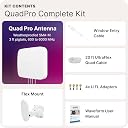
tl;dr - very well engineered and thoroughly thought-out product. It can help you a lot if you really need it, and even help some otherwise. I opted for the "complete kit" which included 40 feet worth of cabling and a window adapter. The product itself comes very well packaged and protected. Cable ends and any exposed bolts on the mount are covered with soft rubber "nibs" (?). Boxes and packages are well labeled. Documentation is very good, meaningful pictures and diagrams included. The hardware that comes for mounting is excellent, they ship multiple sizes of wall anchors and there is an extra or two for most bolts. They even provide wrenches, real ones - the 10 mm wrench has an open end and flexible socket end (which I could have used last week when replacing a car battery in our Honda). There are multiple sizes of wall anchors for mounting. The cable itself is well-insulated and the weatherproofing boots are solid (much better than the ones I got with some home cameras I bought). I'm guessing Waveform really, really does not want me to return the product. And the way they accomplished that was to make sure I had just about everything I needed to pull off a successful install. Ok, so... does it work? Yes! I live in North Texas and my house has a bunch of trees around it, which is awesome for shade, not so much for raking and cellular reception. I am on TMobile 5G home service using C660 gateway. The south side of my house, which faces toward the cell towers, does not have a useful window for me to put the gateway. The least bad place I found was a high spot in my living room, and the download speeds were okay, but the upload speeds were atrocious. Here are three speed scenarios. The first is the default of the gateway in the living room. The second was to put the modem outside near where I mounted the antenna. The third is the antenna. Scenario 1 - Gateway in living room, not near a window 322 Mbps download, 4 Mbps upload LTE received signal strength: poor Signal Received Quality: 5G good, LTE excellent, Signal Received Power: 5G poor, LTE poor Interference to Noise: 5G poor, LTE poor Scenario 2 - Gateway outside 500 Mbps download, 41 Mbps upload LTE received signal strength: good Signal Received Quality: 5G excellent, LTE excellent, Signal Received Power: 5G poor, LTE poor Interference to Noise: 5G excellent, LTE good Scenario 3 - Antenna 581 Mbps download, 69 Mbps upload LTE received signal strength: good Signal Received Quality: 5G excellent, LTE excellent, Signal Received Power: 5G good, LTE good Interference to Noise: 5G excellent, LTE good So, gateway in a bad place is bad. Gateway in a good place is much better, but even in my best case scenario, the Waveform had 10+% faster download and 50+% faster upload speeds. Some tips for folks who are installing this: - I attached the mount to a roof soffit. The provided anchors didn't work well because there wasn't enough wood for them to really "bite" into. Toggle bolts worked much better for me - When joining cable ends together, make sure to use the 8 mm wrench to tighten the connection before sliding the waterproof boots over. The boots take enough force that they can undo hand-tightened connections. If you see your benchmarks drop all of a sudden, this may be the cause (it happened to me) - Buy the window entry cable, even if you are not going to run the cable through a window. I spent a day or so piloting the antenna in different places around my house, and the window adapter can also be used to run the cable under a door (so you don't have to leave the door open while testing) - All of the cables have 1-4 labels, which is good, but they are not color coded or anything like that, so you really have to look carefully when connecting things - The well insulated cables do not flex a lot, even the ends that go into your gateway/modem. With TMobile's C660, the wires mount pointing up, so you will need to find your stand if you are not using already, and you will have to apply some gentle but firm force to get the cables positioned
A**R
Worth the money!!!
IT WORKS!!! Can’t get a land line so went with this set up. It improved speeds a lot, specially upload and stability, no more lagging while gaming. Comes with everything you need. After installation it only took a few minutes to find what was the best angle/direction to point it at.
D**D
Fantastic product with even better support
This antenna has been a godsend. When T-Mobile rolled out N41 in my area, my 5G TMHI became a nightmare. On N41, I could typically get tolerable download speeds, but I have 7 Nest cams constantly uploading and I need to be able to VPN into work without a painful lag, so I really need decent/stable upload speed which was non-existent. I must be in some sort of purgatory spot where the trash can wants to connect to N41 when it shouldn’t, so I tried tricking it back to N71 with very inconsistent success (i.e. obscuring the line-of-sight to the tower so it would fail back to N71). After teetering on the edge of calling it quits and ordering Starlink, I decided to give the 4x4 MIMO a try since it’s less expensive than dishy. My plan was to use the antenna to force N71 via some fiddling I saw on a youtube video, and if that didn’t work, I’d return the 4x4 MIMO and order Starlink. Long story short, the antenna boosted my N41 signal considerably so I didn’t pursue forcing N71. Here are some rough speeds pre/post antenna on N71/N41: Pre-antenna N71: ping~40ms; >100Mbps down; >20Mbps up Pre-antenna N41: terrible across the board - if I could do a speedtest successfully, the ping was >800ms; down may be ok; up was worse than dial-up Post-antenna N41: ping ~32ms; >150Mbps down; ~15Mbps up — and this has been very consistent - I’ve gone as high as 250Mbps down, but 150 is probably closer to the average Post-antenna N71: didn’t pursue I should also mention that I didn’t permanently install the MIMO antenna yet. It’s sitting next to the trash can pointing out my workshop window which has a low-e coating or something that attenuates the signal. What I’m trying to say is that I have seen incredible results with almost no effort and much room for further improvement. Also worth mentioning is that the N71 speeds I was seeing before the antenna were on a downward trend as T-Mobile brought more customers online in my area. That’s part of the reason I opted to stick with the improved N41 rather than trying to force N71 after getting the antenna. The Amazon listing probably mentions this somewhere, but the support folks at Waveform are fantastic. If you provide your address, they do a deep dive to figure out where your tower is and recommend the best orientation as well as the best mounting location on your property. If you aren’t familiar with cellmapper.net, this is absolutely critical, because the best antenna in the world isn’t going to do any good if it’s not pointed where it needs to be, and trial and error can be very frustrating. Even a few degrees can make a big difference. I considered buying this months ago, and I have been kicking myself for not pulling the trigger. If you’re on the fence, jump off and do it. I can guarantee you will not regret it. P.S. - read the install instructions carefully. The 4 little antenna cables are difficult/frustrating to attach (like extremely difficult), and I didn’t feed them through the bottom grate that you have to take off (and then put back on). Upon reassembly, my impatience got the best of me, so rather than go through connecting those 4 wires again, I just cut a hole in the grate with a Dremel and fed them through backwards. T-Mobile will probably rake me over the coals for that when I eventually have to return the trash can…I’m hoping that’s not anytime soon. And for the record - the difficulty is a function of the trash can design - not something Waveform has any control over. Thanks, Waveform!!!
J**E
Transforming My Internet Experience
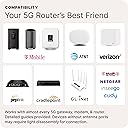
I recently upgraded to blazing fast 5G internet using the Waveform 4x4 MIMO Panel Antenna Kit, and I have to say it's been a game-changer for my internet connectivity. I'd give this kit a solid 4.5-star rating. Here's why: First and foremost, this kit is an all-in-one solution optimized for a simple DIY install. The package includes everything you need, from the antenna mount to various adapters like SMA, TS9, and U.Fl. The detailed installation guide made the setup process a breeze, and I was up and running in no time. It's a great option for those who prefer to take matters into their own hands. One standout feature of this kit is its support for T-Mobile 5G home internet. The detailed guides provided make it easy to connect to various TMHI gateways, including the Nokia 5G21, Arcadyan KVD21, and Sercomm Fast 56WW Gateways. This level of compatibility is a huge plus, ensuring that you can get the most out of your T-Mobile 5G internet service. What's truly impressive is the kit's compatibility with a wide range of modem and router manufacturers, including NETGEAR, PEPLINK, CRADLEPOINT, MOFI, and more. As long as there's a way to connect external antenna ports, the MIMO antennas in this kit can help you achieve dramatically faster internet connectivity. It's a versatile solution that can accommodate various setups. The ultra-high performance 4x4 MIMO technology ensures optimal 5G speeds. I installed this kit with my T-Mobile home internet, and the difference in upload and download speeds was remarkable. It provided a significant boost in performance, making streaming, online gaming, and video conferencing a seamless experience. It supports every 4G and 5G band from every major carrier, so you can trust it to deliver reliable and fast internet connectivity. The only minor issue I encountered was the length of the cable. It could have been longer to provide more flexibility in finding the ideal spot for the antenna without compromising the location of the indoor router receiver. However, even with this small setback, I managed to find a good spot that improved my speeds by around 60 percent, which is still a substantial upgrade. In summary, the Waveform 4x4 MIMO Panel Antenna Kit is an excellent investment for anyone looking to enhance their 5G internet experience. It's easy to install, compatible with various equipment, and delivers remarkable speed improvements. While the cable length could be improved, the overall performance and versatility of this kit make it a worthwhile purchase, and I highly recommend it to anyone seeking faster, more reliable 5G internet.
A**E
Can Make Huge Difference for Receiving T-Mobile Home Internet, with Patience and Trial and Error
I was eager to try out T-Mobile Home Internet when it recently became available in my location. The prospect of getting unlimited wireless internet using a single device that receives 5G cellular signals was very appealing. When I got the device and tried it out, though, the reception was very weak, no matter where in my house I placed the gateway. My house is surrounded by quite a few trees, which undoubtedly was a factor in reducing the signal quality. I tried various options to improve the signal, which was often as low as 1 Mbps download, or even worse. I called T-Mobile technical support to try to locate the best tower to aim at, and I tried two different cell signal boosters, neither of which helped at all. From watching YouTube, particularly the Nater Tater channel, I learned about this Waveform 4x4 MIMO panel antenna. I was reluctant to try this option, because it requires disassembling the T-Mobile gateway and installing several fairly delicate wires that have to be connected to the four leads of the antenna. After running out of other options, I plunged ahead with this approach, with great assistance from my wife, who is good at handling delicate electronic devices. She disassembled the gateway (we have the Arcadyan version of the T-Mobile gateway) and attached "pigtail" wires to the connectors inside the gateway, which are hard to reach and hard to attach wires to. Eventually, she achieved firm connections, and I started testing the antenna in various places around the house. To make a long story short, I finally settled on the location shown in my photo, which is a sort of balcony reached from the third floor of the house. After a couple of weeks of testing, I didn't notice enough improvement to make the service really usable, but then I happened to watch one of the Nater Tater YouTube videos, in which Nate mentioned an alternative order for attaching the four pigtails to the four antenna leads. That order is D-M-M1-M2. At first, that order didn't produce a real improvement, but then I turned the antenna in various directions to see what would happen, and I finally saw a dramatic improvement in download speeds. Now I get a maximum download speed of about 140 Mbps in the early morning, and it averages around 40-80 Mbps at different times of day and night. There still are some worse slowdowns in the afternoon, especially between 3:00 and 4:00 p.m., presumably because of deprioritization of internet signals when more people are using their T-Mobile cell phones. Overall, though, the T-Mobile wireless internet service is very useful whenever I need it, and I can now keep the service without feeling that the speeds are too slow. I can't say enough about the Waveform technical support staff, who were tremendously supportive during my weeks of testing, frustration, and trial and error. They offered several helpful suggestions, and even sent me an alternative type of antenna to test to see if that would bring an improvement. The only caveats I would mention are that, at least for me, it was not an easy task to disassemble the gateway and attach the antenna leads properly. You have to be patient and willing to do delicate and potentially frustrating work. Also, doing this may cause problems down the road when you ultimately return the gateway to T-Mobile, who clearly would not approve of taking the gateway apart in this manner. Also, it can be quite tricky to find the best location for the antenna and the best direction to point it in. In my case, I ended up purchasing an extension pole that can be inserted into the J-pole assembly that came with the antenna. When the antenna was attached to that pole, it was quite easy to turn the pole to change the direction of the antenna, to test how the signal approved in various directions. Overall, if, like me, you live in an area with marginal cell reception and a lot of trees, it can be very worthwhile to try this antenna, provided you are prepared to dedicate some effort over a period of time until you achieve success.
M**K
Transformed our internet connection.
We live in a rural area in Devon UK. Our internet connection has been dire we have to use a 4/5G router and have only been getting a download speed of about 12Mbs sometimes less. I was very unsure how effective this would be at solving the problem and it's quite a lot more expensive than other options. This has transformed our internet connection and are now getting upto 50Mbs. Its a quite a bit bigger than I expected and the cable is very thick, it make our previous antenna look like a toy. Thank you waveform! Very highly recomended.
R**O
Worth the cost
So, amazing antenna. My moms house had a very weak 5g/lte signal, we tried initially with an exterior omni 4x4 mimo but it didnt improve much. I was hesitant about the price of this antenna, but trust me, it's top notch, completely solved our issues, and came with EVERYTHING (minus lightning sure protection for the lines) we needed. The cable included is lomg and well sheilded in its protective sleeve. The hardware and adapters included provided for many configurations. My only gripe is that the provided instructions didn't give clear enough direction how to fit the Ubolts for the mast, the pictures were actually of another bracket fixed to the four pronged directional antenna. Other than that, very pleased, I would buy another one.
C**D
Amazing Product - Will be the Difference Between Not Enough Signal, and The Signal You Need!
This should be the only review of this product that you will need to read. I'm serious - I'll give you the complete low down on the Waveform QuadPro 4x4 MIMO Panel Antenna Kit. Here's my story. I work for a small marine company that has been forced to endure really crappy DSL from the sole telecommunications company in the area that provides wired telecommunications infrastructure to our location (yeah, I'm talking about Bell Canada). Capped at 50Mbps, which frequently dropped to under 5Mbps at various times throughout the day, we needed to find an alternative internet source. After much research, we discovered Rogers 5G for Business Internet. Advertised as capable of up to 500 Mbps down and 30 Mbps up, and priced competitively, it seemed like the best alternative we had. But I knew there was going to be an issue - signal strength. I knew this because, aside from having really crappy wire-based communications, we also exist in a virtual dead zone when it comes to wireless signals - we get almost no signal off the Bell towers, and very little signal from the Rogers towers. But I thought, well, might as well give it a shot - Rogers offers a 30 day trial to give their service a try, and if you aren't satisfied, you can pack up the modem and send it back to receive a full refund. So, I ordered the Rogers service and the next day the box arrived with the Nokia 5G Gateway 12 router/modem and a new sim card to pop inside. I inserted the Sim, powered up the modem and waited while it attempted to lock in a signal from the tower. Needless to say, it took what felt like forever, but it finally stopped blinking - indicating it had locked in. I fired up my laptop, connected to the new Nokia Wifi and immediately pulled up speedtest.net. I could tell by the length of time it took to load the page that the speed result was not going to be great. I hit "Go", and waited. First speed test came back with 23 Mbps down, 2.1 Mbps up. Ok, not promising, but at least it connected and got a signal. I read the small set of instructions that came with the device hoping for some advice on how I might achieve greater speeds. It suggested taking the modem and plugging it in near windows (my office is all windows and faces the direction of the closest tower), but I followed the directions and tried a dozen other locations in the dealership - upstairs, near windows, closer to the far end of the building - everywhere, hoping for better results. They did not come - the best speeds I could achieve were no higher than about 60 Mbps down, and 5.5 to 7.5 Mbps up. I was disappointed, to say the least. However, I figured there had to be a way to increase antenna power, and if I could do that, I could possibly get better speeds. So, I jumped onto ChatGPT and I asked it "how can I get stronger 5G internet signals with my new Rogers 5G for business internet package?" Immediately, it suggested looking for external antennas, but also noted that my Nokia router from Rogers did not have removable antennas (which I would need if I wanted to connect an external antenna to my system). ChatGPT, if you have used it before, always suggest a handful of products - typically ranging in quality/price from best/most expensive to ok/least expensive. Nothing was different here, it offered me 5 suggestions with the Waveform QuadPro 4x4 being the highest quality suggestion, but also the most expensive option as well. None the less, I wanted the best shot at success, so I logged into my amazon account, searched for the product, gasped when I saw the price, read the reviews, understood how the technology would theoretically work.....and hit the "Buy Now" button. It would arrive the next day, and what I always love about buying through Amazon - I knew I'd have 30 days to try it out, fiddle with it if need be, and if it didn't work, I'd get a full refund - no questions asked. However, I also knew that I would need a new modem/router with external/removable antennas, and after having a second conversation with ChatGPT, I decided on the GL-iNET EX3000 Puli AX modem/router - which cost almost as much as the Waveform QuadPro antenna kit! Now, if you've stuck with me this far, we are about to get into the nitty gritty of this new setup, and your patience with my story telling is about to pay off. Everything arrived the next day. I opened up the new GL-iNet router, plugged in the rogers sim, fired it up and tried the service using the normal antennas that came in the router box - no discernable difference- still capped out at about 50 - 60 Mbps - certainly not worth a $550.00 layout for the router as it did not improve anything over the included Nokia router from Rogers. I stared at the Waveform Box on the ground, sighed deeply....and then decided to give it a go. I opened the box, gave the installation instructions a quick once over and then grabbed the mount kit, walked out the front door with my ladder in hand. We have a front entrance way arch that is about 10 feet high and I decided I would mount the antenna at the top of that arch - it kept it within 20 feet of where I would enter the building with the cabling and attach it to my new router. Installation was easy, it's basically the same arm you would get with a satellite installation from Bell or Dish or DirectTV. Mount the arm, then mount the antenna to that arm. The antenna attachment allows for easy alignment and can be adjusted both sideways, and up/down. Once I got the antenna mounted, I then ran the wiring back inside the building to my router. There are 4 antenna leads that come from the Waveform antenna, and I discovered that the way you plug them into your router matters. Lead 1 needs to go to the Antenna labelled "Main" on the router. Lead 2 goes to the DIV/GNSS connector. Leads 3 and 4 can then plug into MIMO 1 and MIMO 2 - HOWEVER, after much experimentation, I found that plugging Lead 4 into MIMO 1 and Lead 3 into MIMO 2 worked best and resulted in best speed results. The other two antenna's are for WIFI and you should simply use the antenna's provided by GL-iNet in the box for those two. Once I got all of that figured out, this is where YOUR patience really gets tested. I'm not kidding - be prepared for several hours of slow, meticulous, documented aiming of your new antenna. The first day I spent 3 to 4 hours on the ladder. Use your cell phone, connect to the GL-iNet Wifi and login to the router's configuration page. On the first page you will see your cellular connection overview. It will list things like your 5G provider, IMEI, Active Sim (yes, it is a dual sim router and you can use one or two sims), your signal strength (Poor, Good, Excellent), and Sim Card Settings. However, the page you want access to while testing your antenna direction, is achieved by clicking on the "View more Information" link located directly below the "Sim Card Settings". Once you click into that link you will be presented with all of the info you need access to in order to discover and zone in on the best direction of your antenna. On this page, scroll down to the section labelled "Cells". It is here that you are presented with LTE signal and NR5G signal results - you will use these while aiming your antenna. Now, my understanding is that some 5G systems/services might work a little differently, but Rogers system works in NSA mode (Non-Stand Alone), which means the device uses an LTE connection to communicate with the network's "brain" (the core) while layering on a 5G signal to provide the actual high-speed data download. Some 5G providers use SA (Stand Alone) systems, which don't rely on LTE signals at all, but in my case, LTE is relied upon, on top of the 5G signal. This means I need to achieve strong LTE signals, along with strong 5G signals in order to achieve best speeds. I'm not going to lie, this reliance on LTE adds an additional layer of difficulty when trying to find the best direction for your antenna. Using the "More Info" page, you will slowly turn your antenna 1/4 of an inch at a time, pausing in between each movement and hitting "Refresh" on your browser to get updated signal readings from the "More Info" page. When it comes to 5G signals, there are three main numbers you will want to look at: RSRP (This number measures raw Signal Strength) - you want the highest number (closest to zero) that you can achieve. For reference, if you achieve higher than -80dBm, you probably live extremely close to the tower and you will likely be able to achieve the highest possible speeds. Likewise, if you are lower than -110 dBM, you will struggle to make a connection, and even if you do, your results will be bad (when I was connected to the Nokia modem/router, my RSRP readings were around -113to -115 dBm). However, there are a couple of other numbers you need to be aware of, and they can greatly impact your results as well. Perhaps the most important number is the SINR number. SINR is MORE important than RSRP when it comes to achieving your best speeds. SINR measures the Clarity of the signal relative to the background noise/interference. It will not matter how strong your RSRP signal strength is if your SINR clarity result is low - you will receive crappy speeds if you don't have a good SINR result. In this regard, you are looking for numbers higher than zero - the higher, the better. So, above 20 dB and you are laughing - speeds will be lightning fast. 12-19 dB, you are in a really good spot and while you probably won't achieve maximum speeds, you can expect a decent result. 0 to 12 dB, you will possibly have a connection, but it won't be terribly reliable and you could experience drop outs or lag. So, you're aiming for 12 dB or greater if possible, combined with an RSRP between -80 to -105 dBm. There is another number that is measured called the RSRQ - which essentially measures "noise" on the signal. With this, you are looking for numbers closer to 0. If you can achieve -9 dB or better, you will be in good shape, if you achieve -10 to -14, you should still be ok for most business activities, -15 to -20 dB will cause some issues, and below that - forget about it. However, if you can achieve decent RSRP and SINR results, your RSRQ numbers will be fine, which is why you should only be focusing on the SINR and RSRP numbers while pointing your antenna. Ok, after several hours, I found my best direction for achieving my best 5G SINR and RSRP results. I had achieved RSRP of -98 (a full 15 - 17 dBm higher than my Nokia connection), and a SINR of 17 (My Nokia SINR numbers were typically under 10 dB). I got pretty excited, until I tested my speeds - not as low as the nokia results, but still in the 120 Mbps range. Not bad I suppose - double what my Nokia modem was giving me, but could I justify the $1300 spend between the Waveform Antenna and GL-iNet router for 120 Mbps?? I'm not sure what my boss would have said, but she hired me for a reason - I am a like a dog to a bone when I am trying to achieve results, and 120 Mbps was not going to cut it. So, I consulted ChatGPT again, and quickly found out that on systems like the one that Rogers uses, the LTE signal also needs to be healthy in order to achieve the best speeds. It also informed me that while I had achieved a significant improvement in my RSRP and SINR signals when compared to my Nokia results, I would not likely be able to achieve the maximum 500 Mbps speeds that the Rogers 5G system said could be possible....and that I should expect a 200 to 250 Mbps range. Ok, I would be very happy if I could achieve 250 Mbps - that would be 5 x faster than my current Bell DSL connection that provided 50 Mbps at the best of times and only 5 Mbps at certain times of the day! But right now, I was only getting 100 to 120 Mbps. But it was getting dark, so I decided to leave it for the following day. That night I did a little more research and discovered that finding that sweet spot where LTE signal was good AND 5g signal was good could be very tricky to find. I don't really understand technically why this is, but apparently these signals can travel at different heights?? Yeah, it didn't make sense to me either, but the advice I kept seeing was "slide the antenna up or down a foot", and try adjusting the angle up or down for the antenna a little bit at a time to find the sweet spot. Yeah, I wasn't looking forward to this either - I foresaw several more hours on the ladder. The next morning I climbed the ladder again, re-connected my phone to the wifi, logged back into the wifi admin page, and clicked on "View more Information" to get started again on re-positioning my antenna to obtain the best "combined" signals. When it comes to LTE signals, you're focusing on the same two results again - RSRP and SINR - and you are looking for the same results - the higher these numbers are, the better. What you will quickly realize is that once you find an amazing LTE result, you will most likely discover that your 5G result is not so great anymore - not necessarily unusable, but essentially the result flip flops and you still end up with less than optimized speeds. I played around with this for about an hour, with no great result. So, I decided to try the recommendation of moving the antenna up a foot. Surprisingly, this did make a difference - I was able to get much closer results between the LTE and 5G signals, BUT, the fine-tuning really happened once I got the direction right, and then I started to adjust the up/down angle of the antenna. I found that I needed to angle the antenna upwards about 15 degrees before I realized the optimum signal strength and quality between the LTE and 5G cells. In the end I achieved LTE RSRP of -99 and SINR of 17 AND 5G RSRP of -99 and SINR of 14. These results have produced download speeds up to 265 Mbps and upload speeds up to 26.5 Mbps. These results can vary through the day due to traffic on the tower, but I never drop below 100 Mbps down and 10 Mbps up. I will also mention that LTE and 5G bands matter - look into it. In my case, the LTE band always wanted to lock in on Band 66, but I found that I get better speeds and LTE signal rates on Band 2. Likewise with 5G, it would lock in on Band 78 sometimes, but I get best results on Band 77. So, I used the "Band Masking" settings located under "Sim Card Settings" to block out all other bands other than Band 2 on LTE and Band 77 on 5G - thus forcing the modem to lock onto Band 2 and Band 77. There is absolutely no doubt in my mind that I would have been able to achieve these speed improvements without the Waveform QuadPro 4x4 MIMO Panel Antenna Kit. It helped me achieve much higher signal gains than otherwise possible, and proved to be worth it's high cost when compared to it's competitors. This further re-enforces the old adage "you get what you pay for." There is one side note I would like to offer here. Most of the modems that come with these 5G services that have internal antennas - you can typically take them apart, find the internal antenna plugs/connectors and purchase pigtail adapters that you can run to the external of the antenna, which will then allow you to plug in the leads from the Waveform QuadPro. I was able to achieve this, which I had initially hoped would allow me to return the GL-iNet router and save myself $550.00. HOWEVER, even though I could get the external leads plugged into my Nokia modem, I ran into other issues where the Nokia firmware did not give me the ability to configure the settings that I had access to on the GL-iNet router. However, it is possible that you will not need access to some of those settings, and if that is the case, those pigtails are usually only about $10 for the pack of 4 - which is a hell of a lot cheaper than the $550 you would spend on the GL-iNet router. Bottom Line - This Waveform QuadPro Antenna Kit is second to none! If it cannot improve your signal/data throughput, then I highly doubt any other product can either. Buy It! You won't be disappointed.
P**T
Excellent Quality - but didn't work for me
Excellent Quality kit. Really helpful support too - but sadly this did ZERO to improve my signal. Made it worse in fact, so had to return it. I'm sure it will work for some people, just not my setup.
C**7
Works with Rogers 5G home internet
I'm a little over 2km from closest tower, and signal strength on the 5G and LTE bands are now solid and more consistent. Used to drop out during snowstorms, no more!
Trustpilot
1 week ago
3 weeks ago