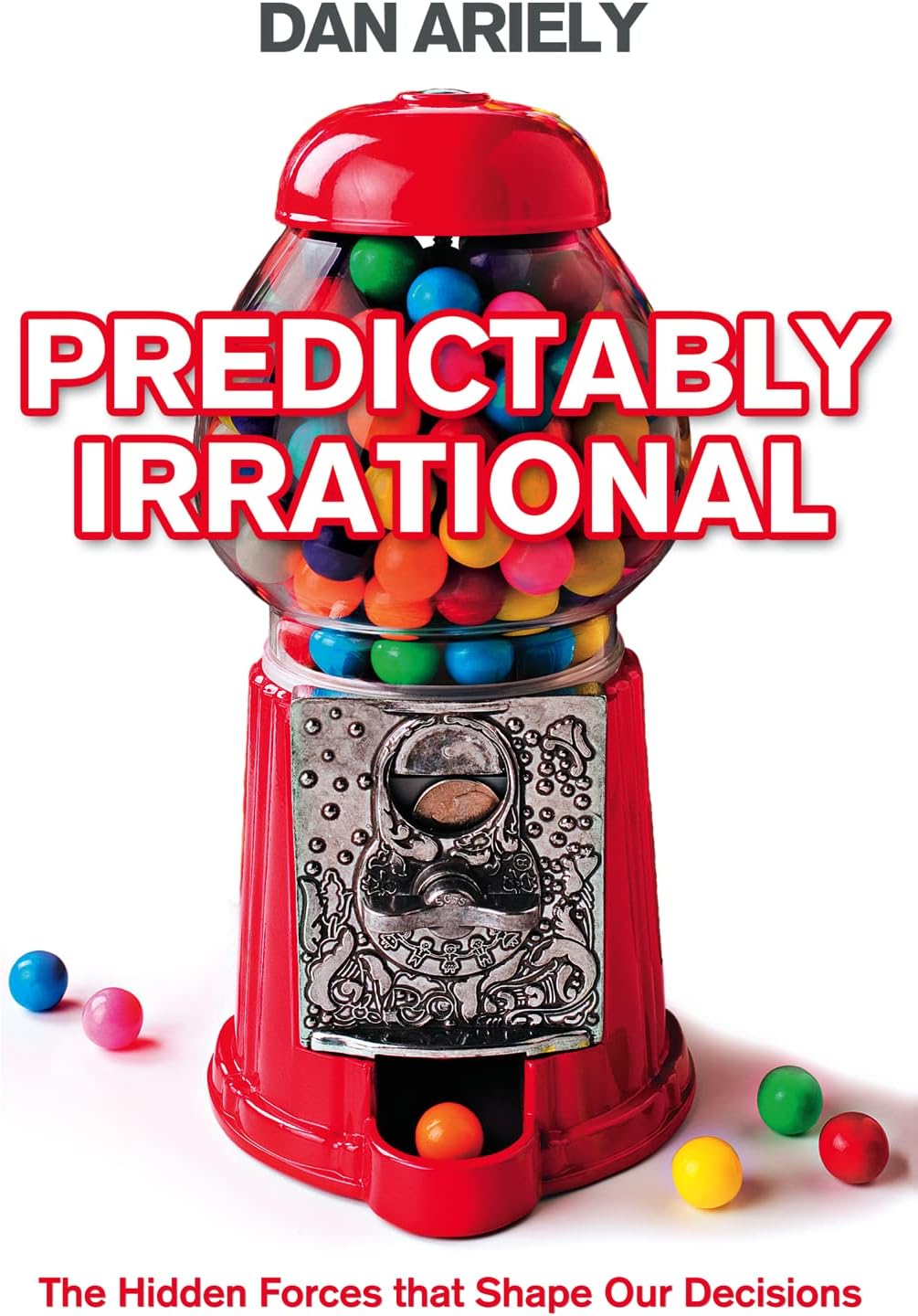



Predictably Irrational: The Hidden Forces That Shape Our Decisions
Product ID: 50436883
Buy anything from 5,000+ international stores. One checkout price. No surprise fees. Join 2M+ shoppers on Desertcart.
Desertcart purchases this item on your behalf and handles shipping, customs, and support to Israel.
Buy Predictably Irrational: The Hidden Forces That Shape Our Decisions 1 by Ariely, Dan (ISBN: 9780062796417) from desertcart's Book Store. Everyday low prices and free delivery on eligible orders. Review: An incredibly engaging and thought-provoking read. - I know nothing about economics or business and usually waste my time on various volumes of chicklit but I saw a few videos of the author Dan Ariely talking about cognitive illusions and was immediately drawn to this book. It's fascinating and written in such an engaging way. Reviewers of this book are right - it's not an academic paper and there is some generalisation. However, I think as a pop psychology book, it is necessary to be more general and a lot less specific than one would be in a research-led paper. I read a similar book called "Freakonomics" recently too but it really pales in comparison to this mainly because Ariely conducts his own experiments which give us first hand insight into his frankly ingeniously inventive methods of researching human behaviour without it being obvious to the participant. It's also written in a very humourous and self-deprecating way. The structure and language is so accessible and clear which can't be said for academic writing. I think he puts a personal perspecitve on the conclusions of all his experiments and rather than presenting this self-righteously, he gives some great, humourous examples of how he has also been susceptible to irrationality. I'm trying to write a balanced review but I can't really think of anything negative to say about this book so that's why I'm givng it five stars. Review: Good, with caveats - As others have mentioned, this book does suffer in comparison somewhat to Dubner and Levitt's wonderful Freakonomics: A Rogue Economist Explores the Hidden Side of Everything . For me at least the foremost reason is that this is one of those books that would benefit from having a European edition. Much of the cultural context and the examples are highly US-centric. Indeed, I suspect some of the behavioural experiments performed might elicit different results in Europe, but this doesn't seem to have pervaded this work. and this is odd, considering the author is not a native of the US [Note: any European behavioural economists or research students might care to reflect on this for a moment and wonder if there is any research mileage here]. Many of the experiments are interesting in a limited way, but manage to have rather localised results extrapolated to reach some questionable conclusions. And he does sometimes have a tendency to be rather unsubtle and repetitious in hammering home a point, as if he's writing for a particularly dim first-year undergraduate: the first chapter is a case in point. If all this sounds like a litany of whinges, please don't let it put you off, because this is actually a very interesting book. Ariely generally writes in an engaging, crisp and sometimes witty style. His explanations are concise and mostly work pretty well in a non-academic context. While you may not agree with everything you read here (in fact, some of it I vehemently disagreed with) you might at least begin to ask yourself questions that you may not have stopped to consider. You may even start to notice some of the things Ariely talks about a little more closely. That can't be a bad thing. [I wanted to give this 3 and a half stars, but have rounded up to four because 3 sounds rather harsher than it deserves]
| ASIN | 0007256531 |
| Best Sellers Rank | 10,067 in Books ( See Top 100 in Books ) 114 in Philosophy (Books) 125 in Professional Finance 134 in Psychological Schools of Thought |
| Customer reviews | 4.4 4.4 out of 5 stars (10,961) |
| Dimensions | 13 x 2.54 x 19.71 cm |
| Edition | 1st |
| ISBN-10 | 0062796410 |
| ISBN-13 | 978-0062796417 |
| Item weight | 1.05 kg |
| Language | English |
| Print length | 353 pages |
| Publication date | 1 Jun. 2009 |
| Publisher | Harper |
U**S
An incredibly engaging and thought-provoking read.
I know nothing about economics or business and usually waste my time on various volumes of chicklit but I saw a few videos of the author Dan Ariely talking about cognitive illusions and was immediately drawn to this book. It's fascinating and written in such an engaging way. Reviewers of this book are right - it's not an academic paper and there is some generalisation. However, I think as a pop psychology book, it is necessary to be more general and a lot less specific than one would be in a research-led paper. I read a similar book called "Freakonomics" recently too but it really pales in comparison to this mainly because Ariely conducts his own experiments which give us first hand insight into his frankly ingeniously inventive methods of researching human behaviour without it being obvious to the participant. It's also written in a very humourous and self-deprecating way. The structure and language is so accessible and clear which can't be said for academic writing. I think he puts a personal perspecitve on the conclusions of all his experiments and rather than presenting this self-righteously, he gives some great, humourous examples of how he has also been susceptible to irrationality. I'm trying to write a balanced review but I can't really think of anything negative to say about this book so that's why I'm givng it five stars.
D**S
Good, with caveats
As others have mentioned, this book does suffer in comparison somewhat to Dubner and Levitt's wonderful Freakonomics: A Rogue Economist Explores the Hidden Side of Everything . For me at least the foremost reason is that this is one of those books that would benefit from having a European edition. Much of the cultural context and the examples are highly US-centric. Indeed, I suspect some of the behavioural experiments performed might elicit different results in Europe, but this doesn't seem to have pervaded this work. and this is odd, considering the author is not a native of the US [Note: any European behavioural economists or research students might care to reflect on this for a moment and wonder if there is any research mileage here]. Many of the experiments are interesting in a limited way, but manage to have rather localised results extrapolated to reach some questionable conclusions. And he does sometimes have a tendency to be rather unsubtle and repetitious in hammering home a point, as if he's writing for a particularly dim first-year undergraduate: the first chapter is a case in point. If all this sounds like a litany of whinges, please don't let it put you off, because this is actually a very interesting book. Ariely generally writes in an engaging, crisp and sometimes witty style. His explanations are concise and mostly work pretty well in a non-academic context. While you may not agree with everything you read here (in fact, some of it I vehemently disagreed with) you might at least begin to ask yourself questions that you may not have stopped to consider. You may even start to notice some of the things Ariely talks about a little more closely. That can't be a bad thing. [I wanted to give this 3 and a half stars, but have rounded up to four because 3 sounds rather harsher than it deserves]
S**F
Very readable and Interesting
I found this book very interesting. Irrationality. Why we just do stuff sometimes without thinking. Where did that decision come from? The author and his team did several studies of pre-designed experiments to obtain a result that is sometimes predictable even though those participating are unaware of the experiment. Take the obsession with Free things. I loved this one. They set up a stand, displayed two chocolate brands, the expensive one was Lindt Chocolate. They charged 15 cents for the Lindt and 1 cent for the less expensive one. Most people chose to pay 15 cents for the Lindt chocolate. They then reduced it by 1 cent each thereby making the less popular, cheaper brand, Free. They displayed the chocolates 14 cents for 1 piece of Lindt and Free for the cheaper brand. The response was overwhelming. A huge increase chose the Free one over the Lindt. Totally irrational at face value considering a drop of 1 cent in price. There are chapters about, honesty(a particular favourite of the author), possessions, relationships and many others. Another personal favourite of mine was the amusing chapter on heightened emotional states and then answering a questionaire in that state. The obvious and easily created state was to arouse the young mail students and have them try answer the same questions in a heated emotional state. 'Will you now continue without any protection?' .... erh .... yes. Oh but you said 'no' in your cold rational state of mind before. Fortunately, the laptop was given protection, 'just in case'. What endeared me to the book and author, was the fact that the author spend many years recovering from third degree burns all over his body. Being wrapped in bandages and suits for many years he felt detached from society in many ways. He thus became an observer of human behaviour. Like an alien visitor. Thereby turning a very painful process into something extremely interesting and positive. He has a section about pain and his personal thoughts on quick removal of bandages over slower less painful removal of bandages. I could almost touch that horrific ordeal he went through. What I will take from this book is to recognise irrational behaviour more easily in myself and others. Also to know when I might be manipulated by different forces in one way or another. Finally be wary of making some decisions in a heightened emotional state:)
C**.
"Predictably Irrational: The Hidden Forces That Shape Our Decisions" by Ariely Ariely (PI), was an interesting read, and deserves to be looked at by economist, psychologist, marketer, or just people looking to improve their selves alike. It follows the trend, set by Freakonomics, by Steven Levitt and Stephen Dubner, in discussion of esoteric economic concepts, but without the academese that tends to keep casual readers away. I found myself personally engrossed while reading this novel due to the parallels of irrational behavior I discovered I also exhibited and will be actively correcting. The following three I believe have sentimental value to me and I feel are genuinely worth discussing. Zero cost irrationality as described by PI is the concept that reviews the large bias humans show towards "free." I put free in quotations as I am using the term loosely in this context as often the decision chosen is not without cost, and in relative terms, it is often not the option that held the most value per unit of the exchanging intermediary item. In fact, just a few hours before writing this brief review, I purchased three Publix cloth shopping bags that I had no intention of purchasing beforehand, but because they were buy three get one free. I can say in earnest, without that free offer, I would have completely shrugged off the Publix bag, to purchase at another time. A potential solution to this problem, derived from a specific example he mentions within the chapter, is to mentally give the "free" item a price, even one as low as one penny. This, surprisingly, nullifies the zero cost irrationality for most individuals, allowing for proper cost-benefit analysis of the additional item or offer. Procrastination, or the giving up of long-term goals for immediate gratification, this desire for immediate satisfaction permeates particularly strongly throughout American culture. The effect of this national procrastination can be seen by abhorrently low national saving rate, or more implicitly or healthcare system that is more reactive than proactive. Though I personally am not a pure procrastinator, in fact many would consider me an extrovert, I believe that there quite a bit I still put off that I do so exactly because I fail to properly evaluate the opportunity cost of the long term benefit of said action. For example, I did a quick back of an envelope calculation of me putting of my savings to next year, rather than not starting when I begun work two years ago. This three wait has cost me over half a million dollars (Assumptions: Roth IRA, with locked six percent APR, maturing in fifty years). I have begun taking Ariely's advice, and setting hard deadlines for many things, such as this particular book review which I gave myself exactly the day after completing the book to complete, no exceptions and no excuses. The final personal irrationality I've found plaguing my decision making has been that of `keeping doors open,' or not being able to stand the idea of closing our alternative options. My irrational in my context, has to do with maybe not a plethora of options, as emphasized within the book, but rather when I am down to two options that have to deal with something within the social sphere. Case in point, I would fret over the decision of whether I should continue to chase after a girl or letting her go, or going to a party where I would probably feel uncomfortable or not, though these examples may seem simple to an someone else, I struggled with these decisions constantly. Often than not, I found myself unable to take the choice that errs on the side of negative (deciding to stay home, or leave the girl alone) as I felt doing so eliminates a multitude of options without producing any new ones of benefit. I am curious to whether how much confidence has to do with the exact experiment presented within the book. I speculate if participants were required to self select as confident, or perhaps anchored to think of confidence, if such decisions become easier. I wonder this, since many my such decision-making gridlocks underlie a lack of self confidence, perhaps those with more of it at the time of the test may change results. In sum, Ariely's solution, as I interpret it, the cure for procrastination is really premised by self-confidence, where one sets long term goals and bravely commits to them. The book discussed around 14 irrationalities in total across 13 chapters, each holding a slight new scope of human cognizance to gain. The three above mentioned irrationalities after a deep introspective look, I felt held the most personal utility. I genuinely I have a new lens to the world. I genuinely believe that holds the potential to enrich the perspective of most readers as well, no matter their relative amount of academic background on the subject.
A**N
El contenido es muy bueno y no aburre en ningún momento! Si te interesa conocer sobre cómo funciona la toma de decisiones y lo ilógico que llegamos a ser este libro es para ti. Solo que tal vez cómpralo a otro vendedor o editorial, ciertas páginas estaban mal impresas y dificultaba mucho la lectura.
J**A
A**K
it arrived a little late, guess its because of the holiday. despite that everything is okay.
O**T
I liked this book a lot. The author is an experienced and widely acclaimed Scholar of behavioural economics or, I would say, social sciences, because many of the experiments and findings he reports go beyond what I had so far encountered in the behavioural economics literature. He explains some of the foundations of concepts that behavioural economics - and particularly my field, development finance - often uses, such as 'dual self', underestimating risks of tomorrow, rationalising away sub-optimal choices, and the like. At the same time, he invites some deeper thinking about the principal-philosophical implications of These findings. A great, personally written book that wonderfully adds detailed research perspective to Kahneman's 'Thinking - fast and slow' and Thaler/Sunstein's 'Nudge'.
Trustpilot
1 week ago
3 days ago