We remain fully operational. Our teams are working around the clock to ensure your deliveries continue safely.

DOWNLOAD THE APP


Copyright © 2025 Desertcart Holdings Limited
DOWNLOAD THE APP
Buy anything from 5,000+ international stores. One checkout price. No surprise fees. Join 2M+ shoppers on Desertcart.
Desertcart purchases this item on your behalf and handles shipping, customs, and support to Israel.
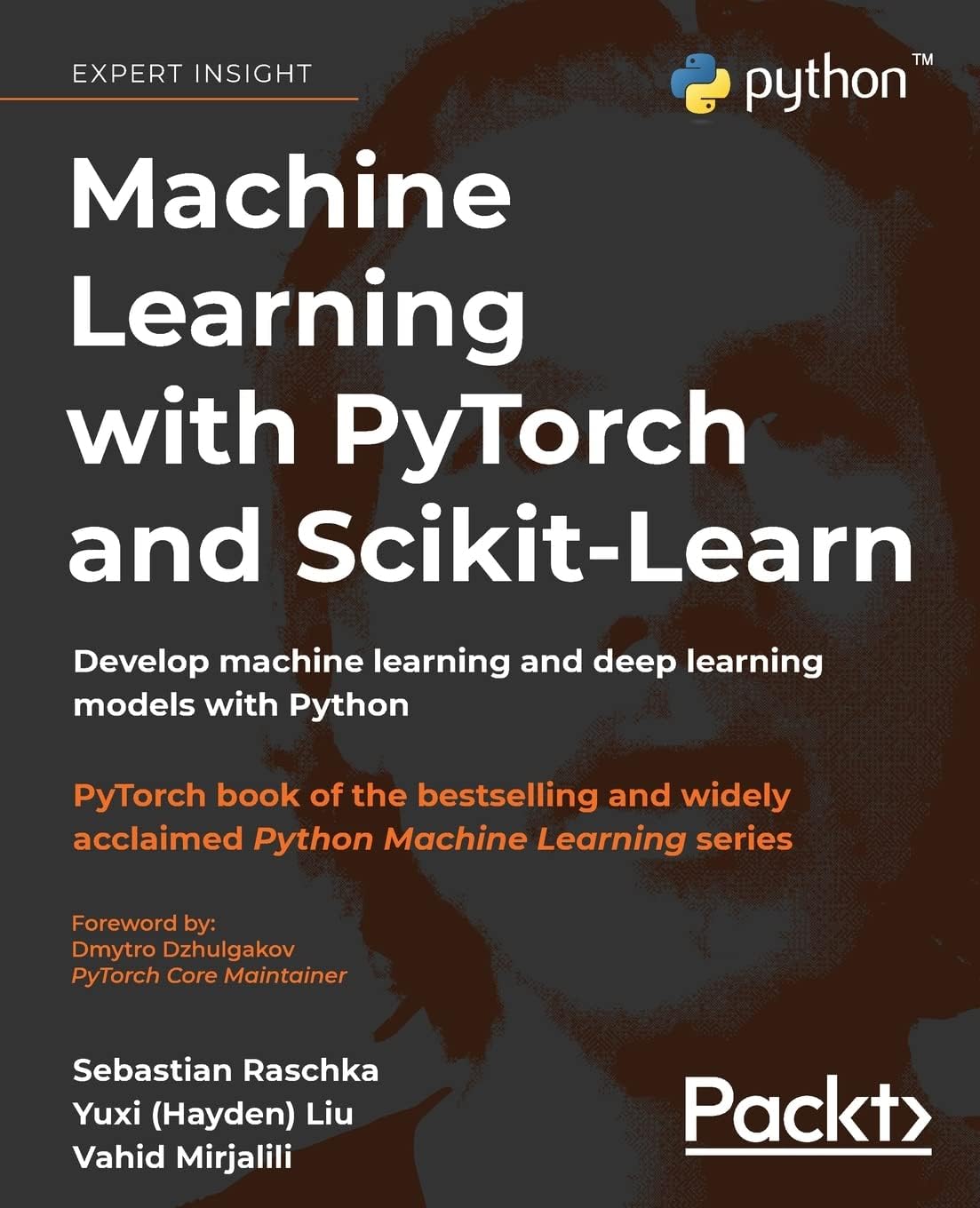
Buy Packt Machine Learning with PyTorch and Scikit-Learn: Develop machine learning and deep learning models with Python by Raschka, Sebastian, Liu, Yuxi (Hayden), Mirjalili, Vahid online on desertcart.ae at best prices. ✓ Fast and free shipping ✓ free returns ✓ cash on delivery available on eligible purchase. Review: Great book for beginners - The only drawback is the use of toy datasets. The author should have added a one mega project that includes the concepts covered in the book. Yet great book that will make a difference to beginners Review: Book with black and white pages - Such an expensive book and then u give a black and white book with only cover page in color.



| Best Sellers Rank | #71,632 in Books ( See Top 100 in Books ) #427 in Computer Science #883 in Mathematics #7,492 in Higher & Continuing Education Textbooks |
| Customer reviews | 4.6 4.6 out of 5 stars (423) |
| Dimensions | 19.05 x 4.45 x 23.5 cm |
| Edition | Standard Edition |
| ISBN-10 | 1801819319 |
| ISBN-13 | 978-1801819312 |
| Item weight | 1.41 Kilograms |
| Language | English |
| Print length | 774 pages |
| Publication date | 25 February 2022 |
| Publisher | Packt Publishing |
M**D
Great book for beginners
The only drawback is the use of toy datasets. The author should have added a one mega project that includes the concepts covered in the book. Yet great book that will make a difference to beginners
R**X
Book with black and white pages
Such an expensive book and then u give a black and white book with only cover page in color.
A**R
I have used Sebastian Raschka's books in my teaching at the University Of Oxford before As usual, this book is excellent in its technical detail and thoroughness. However, it could also help to make PyTorch more mainstream. PyTorch has been gaining traction, but still mostly in the academic / research community. PyTorch has some excellent libraries (such as fast.ai) but still the world of PyTorch is a bit away from traditional Python for ML But by taking an approach of Scikit-Learn and PyTorch, this book could introduce PyTorch to a larger/mainstream audience of SKLearn users using a familiar paradigm. On first impressions, technically, the book is very much an enhancement of the previous book from Sebastian also (ex now includes transformers and GANs). Finally, I am also interested in PyTorch from the perspective of the metaverse. So, all in all an excellent - must read book - another great reference book from the author
L**I
Veryyyyyyyyy goood
I**K
everyone need this book i loved
D**S
The book is as described.
P**R
This is a great book on machine learning. Topics covered are extensive - from beginner level to advanced topics including math behind different algorithms. However, not "all" algorithms are covered. Please go through the table of contents. The first part - 11 chapters - covers machine learning concepts and second part covers advanced topics with Pytorch. There are lots of excellent code and they work!! The quality of the book I received is excellent. I have gone through all 742 pages, and it has held up very well!! I used Jupyter notebook to run all examples. I created a new notebook and copied and pasted the code and ran them. This approach worked very well for me. At the same time, I could experiment with my take on the code snippets and definitely added to my knowledge. Only issue I have is on the second part of the book discussing PyTorch: (1) Some packages are a bit older version: e.g., transformer 4.9.1 whereas current version is 4.48+. It took some tweaking/recoding to get the examples working. (2) There is not much discussion on why certain architecture was chosen - e.g., number of layers, is there a rule of thumb on how to improve performance by changing these parameters? Even with CUDA the code run for a long time. Therefore, experimenting with different values of parameters become too time consuming. (3) On the same note, if I can achieve test accuracy of 90%+ using logistic regression and almost the same (perhaps one or two percent better with PyTorch with IMDB movie review dataset and that two much faster why should I use PyTorch for this dataset? Obviously, PyTorch is for certain types of problems. Discussions can be included by not adding to the exhaustive (and apt) contents. Personally I was disappointed by lack of any example on time series. Must have for ML practitioner as a reference and guide.
Trustpilot
2 weeks ago
2 weeks ago