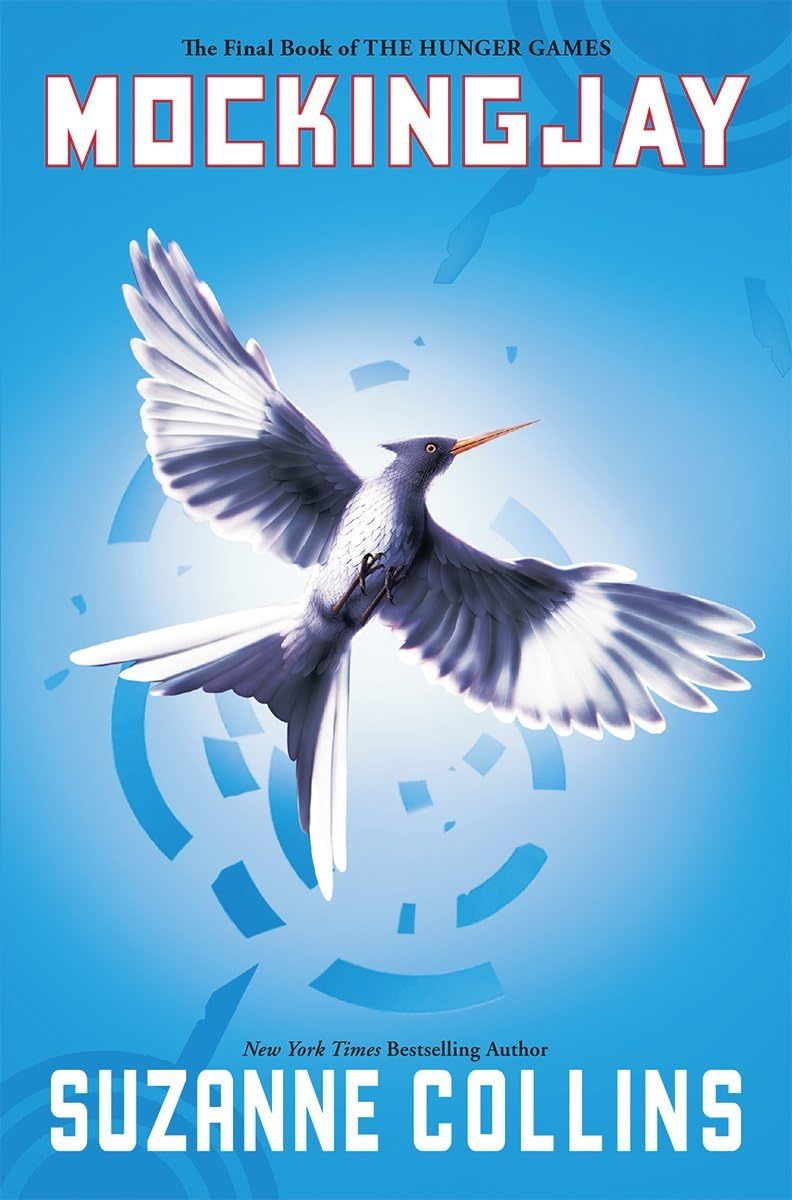
Mockingjay
Product ID: 290334
🏆Bestseller with 99,956 reviews
📚3rd book in iconic trilogy
🔥Katniss, the girl on fire
Desertcart purchases this item on your behalf and handles shipping, customs, and support to Israel.
🔥 Own the revolution — don’t miss the book that redefined YA dystopia!
Mockingjay is the thrilling third installment of Suzanne Collins's Hunger Games trilogy, chronicling Katniss Everdeen’s transformation into the symbol of rebellion. This used paperback edition is in good condition and offers a compelling, mature conclusion to a worldwide bestselling series with over 99,000 rave reviews and top rankings in Teen & Young Adult categories.


| Best Sellers Rank | #1,559 in Books ( See Top 100 in Books ) #3 in Teen & Young Adult Fiction on Physical & Emotional Abuse (Books) #5 in Teen & Young Adult Survival Stories #8 in Teen & Young Adult Science Fiction Action & Adventure |
| Customer Reviews | 4.6 out of 5 stars 100,733 Reviews |
C**S
A beautifully haunting--and ultimately satisfying--conclusion to a brilliant series
Alert: spoilers abound. The overall pattern of the Hunger Games series is a familiar one to the genre: an ordinary individual (albeit one with some unordinary talents) is thrown into extraordinary circumstances, faces and overcomes an immediate threat to personal survival that turns into a much broader conflict in which this person plays a central part. Some of my favorite books or series follow this motif: Lord of the Rings, Harry Potter, Dune, Ender's Game, Star Wars, the Hyperion series, His Dark Materials ... the list goes on and on. It is much easier to begin such a series than it is to end one. The beginning is easy, because the scope is smaller: a compelling mystery or situation, an enigmatic or charismatic hero or heroine, a seemingly insurmountable menace ... it all makes for good drama, pregnant with potential promise, with the details to be filled in later. A successful ending is much harder, and even amongst the works I listed earlier, some were able to achieve a successful ending better than others. This is because by the end of such works, the scope has enlarged, the world is bigger: for an author, it is easy for plot lines to spiral out of control (the post-Ender's Game trilogy and the finale of His Dark Materials come to mind) or for the ending to seem too implausibly 'pat', too "happily ever after" to do justice to the difficult journey trekked by the characters we grew close to. And yet, it is safer for an author to hew to the latter course, as there is something innately human about the desire to root for the "one man against the universe" who triumphs over all odds, beats the bad guy, and gets the girl (or boy) and the gold too, as improbable as it might be. That's why we love action movies, even though most deserve the caveat "as long as you don't think about it too much ..." This is why I loved Mockingjay, and found Suzanne Collins' ending to this series to be a remarkably brave choice. The "easy way out" was starkly apparent: Katniss could have saved Peeta (in a unique twist on the 'damsel in distress' motif--I must say, I found the choice of a female protagonist to be remarkably smart on Collins' part and refreshing for the genre), killed the bad guy, and they all could have lived happily ever after (with the man of her choosing). On some level, that might have still been a satisfying ending. But Collins' aim is to raise questions, strip assumptions bare, and leave the reader burned and bothered about the fundamental nature of reality, and of war most specifically. Actions have lasting repercussions, wounds and fear do not simply fade away during the chapter break. For me, the fact that Katniss attempts to run away from her demons makes her extraordinarily real. She has been beaten, stabbed, shot, blown up, poisoned, and tortured; she has killed and watched her closest friends and family be tortured and killed, while bearing responsibility at least in part for these actions; she has endured the genocide of her people. If this did not break her, how could she still be considered human? I would ask the critics who wished for a more stoic Katniss what they would have done in her shoes. Particularly given that the weight of Katniss' burden becomes increasingly weighty as Mockingjay continues and it becomes more and more clear that the liberators are fundamentally little different from the oppressors; a new regime under Coin would be no better--and perhaps worse in some ways--than one under Snow. One might be able to tolerate the pain and death if one believed it would lead to a brighter future, but this does not seem to be true had District 13 become the new masters of Panem. The "mission to kill Snow", which would have ended in the predictable 'triumphant victory of good over evil' in the hands of a less-skilled author quickly became a brilliantly perverse mockery of this trite motif, as it quickly becomes clear that Coin has sent Katniss to die along with some other people Coin viewed as a threat (all while keeping the cameras rolling for usable shots of 'the martyrdom of the Mockingjay'). The manner of Prim's death is also particularly heartbreaking, as is the realization that the revolution is really just the Hunger Games on a larger scale--whether orchestrated by Snow or by Coin, there is only one winner (and it is most decidedly not the superficial "winning tribute" of the Games). Both Snow and Coin's manipulation of reality, through propaganda and the use of the Hunger Games and the revolution as "reality TV" was also chilling, resulting in the need for the main characters to constantly question what was 'real' and what was 'not real': made up for the games, or the propaganda, or the war. As a reader, that moment when Katniss shifted her arrow, sending Coin to her death, was cathartic. She chose a 'third way' of sorts, a choice that meant true freedom and liberation for Panem (even if it potentially meant her own death). Even in this moment, Katniss has likely been manipulated (by Snow, and probably even more importantly by Paylor, whose decision to let Katniss speak to Snow set the final events in motion ... and resulted in Paylor assuming the presidency). Yet, at worst, this 'manipulation' served to fully reveal the truth, allowing Katniss to make a true, fully-informed choice. As if to validate the rightness of this choice, the book ends with the indication that a 'new normal' has been created, one more hopeful than could have been possible under either Snow or Coin. True to form, the wounds remain; yet, life goes on. Through her sacrifice and pain, Katniss has created a better world for the next generation; she has also chosen (wisely I believe) the partner with whom together they can make each other whole. The dynamic between Katniss and Peeta was one of the most important and interesting aspects of the entire series, so personally I found it gratifying to see them together at the end, starting a new family (although even this slight nod to convention was tempered by the need to explain their nightmares and roles in the days of Capitol rule to their children). A more subdued and melancholy ending than is typical for this genre, but one that is ultimately true to its characters and the situations they faced: "happy ever after" is for the 'propos' and Capitol newscasts, not reality. Not understanding this fact would make us little better than the viewers in the Capitol watching the Hunger Games for entertainment, seeing the individuals not as people but as 'characters' there to simply give us a good show. Collins expects and demands more of us. After a long and painful journey, a satisfying, if bittersweet, ending to an emotional, intelligent, and wonderful series that I look forward to going back and re-reading at some point in the future. The Hunger Games series more than met my expectations and has gone down as one of my all-time favorite series that I can highly recommend to others. 5 stars, easily.
T**6
A realistic and gritty conclusion to a great dystopian series
Katniss Everdeen is recovering from her escape from the latest Hunger Games, which required the winners of the previous Games to participate. The rebels came in and rescued her and Finnick Odair from the breached dome, leaving the other tributes in the clutches of President Snow. President Coin of District 13 wants Katniss to become the face of the revolution. She has already gained fame from the Games and the tour following it. This could be instrumental in the downfall of the Capitol and President Snow. After negotiating freedom for the captured tributes and the privilege of killing Snow herself, Katniss reluctantly agrees. She doesn't realize until later that being such a symbol costs her more than she bargained for. She has to decide how much of herself and her loved ones she is willing to sacrifice for this cause. As time goes on, a beaten and defeated Peeta is paraded in the media as Katniss becomes a stronger driving force for the rebels. How long can Katniss focus on her goal when Peeta is obviously suffering? Will she survive long enough to see the rebellion to the end? I was disappointed to read Catching Fire so soon after it came out because I had to wait so long to read the last book. I finally got to read it recently and I was very pleased with it. It had its flaws along the way, but overall it was a satisfying and realistic end to the trilogy. The thing that is prominently featured in this book is war. In the other books, there were the actual games, which were like a tiny microcosm version of a war, in the first book and in the second book it was all about media exposure and how to appear in the public. The third book is a combination of the first two. The actual war shown in the novel is much more bleak and realistic than the carefully controlled atmosphere of the Games. It's a necessary evil in this book because you can't hope to change anything major in that society without it. The power of the media figures strongly as well as in previous books. Her position as a symbol for the rebellion helps other rebels and has a strong effect on the public at large. It also shows that her position hasn't really changed all that much from the beginning. She's still a pawn for someone to move around and use for their advantage. Katniss has to decide whether or not it's worth it to be under the control of the rebels or under that of the capitol. This is a realistic view that any governing power is going to have its problems and corruption because it's run by humans. The characters we have to come to know are very much changed in this book. They have all been forced to grow up at a young age and when someone witnesses such awful things, they can't help but be changed. If they had stayed the same, I would call it bad writing because it would just be unrealistic. Katniss is still the kick-ass heroine, but she is injured and scarred, physically and mentally. She is weakened and does act uncharacteristically while hiding in closets and running scared. I think the "uncharacteristic" behavior is a symptom of war and happens to real soldiers, as seen with things like PTSD. Her hero journey comes at a price. When she's finished with the war, assuming she survives, how is she going to move on with her life? She has to pick up the shattered pieces of herself and find a way to move on. This is one of the most realistic aspects of the book and many don't like it, but I think it makes the book go from good to excellent. Although it's still on Katniss' mind, the love triangle between Gale, Katniss, and Peeta is pushed to the background and rightfully so. With so many people's lives on the line, why would one girl's romantic antics take precedence? The one aspect of the novel that I didn't like was that a certain character was thrown under the proverbial bus, making Katniss' romantic choice very easy. Other than that, the book was excellent. The realistic and depressing angle the book goes in shatters any hope of any idyllic happy ending Katniss might have had. It makes reading the novel exciting because you never know what's going to happen. I've read a great many reviews where the writer complains about how depressing, horrible, and disturbing this book is. Just because it's a YA novel doesn't mean that it has to be all rainbows and glitter all the time. Deal with it or don't read it. So, if you liked the previous Hunger Games books and aren't afraid of a little bleakness, I would encourage you to read this. If not, you can go read something with rainbows, unicorns, and possibly some glittery vampires.
L**S
Mockingjay - 4 Stars
Warning! This review is written differently then all my other reviews. It does contain spoilers throughout, but you will get a warning once spoilers will begin. The third and final book in the Hunger Games trilogy - Mockingjay has been one of the most anticipated books of fans of this much loved series. The first two books - The Hunger Games and Catching Fire - told a story rich in characters we all fell in love with and rooted for from beginning to end. With the release of Mockingjay readers were more then excited to find out the conclusion to this epic tale. Giving Mockingjay the 4 stars that I did was in fact a hard choice to make. Writing this review is tough. I thought giving myself a few days or longer might clear away the questions I had to make writing this easier, which needless to say didn't work out as planned. I usually don't write a review with spoilers, nor do I write reviews where I talk things out at such length, but it needed to be done and this time there's just no way around it. So, please know that from this point on I will be addressing key points that will give things away - so be warned there will be SOME spoilers laced throughout! ****Spoiler Alert**** First, I have to say that I read half of this book with my breath held and the other half with a kind of, the only way I can explain it was that I was lost. The characters felt so different from where we left them in Catching Fire that at times it was hard to recognize them from the previous two books. Katniss didn't seem like her normal fighting self. And I often wondered if that was because she questioned Coin and if she even wondered if things would be different with Coin as president. In the beginning of the book when they are trying to talk Katniss into being the Mockingjay there was a conversation with Coin that made me believe she felt she not only didn't have much of a choice in the matter but that she questioned just what Coin's true motives are behind everything. Is this why Katniss wasn't her normal fighting self? Was she just tired of running a race in a never ending up hill battle where she then believed no matter what she did the way of the world would never change? Or did she believe there was nothing she, just one teenage girl could really do to make positive changes in the world of Panem? Or was it the fact that she was pretty much injured throughout the whole book? The lack of Peeta was also hard and what little interaction these two had I enjoyed more so then I did with her and Gale. I found Gale to be more then lost within Mockingjay, and found how easily he went from the hunter, gather and provider to uncaring and cold soldier a bit too easily. I mean everything with the mountain and his answer to how to take it down was more then callous and shocking to say the least. However the flip side is, Panem is a rough place to live and was Gale finally pushed over the edge too? Still, either way you look at this, it just didn't feel like "Gale" to me. Sad but true. The ending was shocking. I felt it was rushed by many pages and left more holes in it then Swiss cheese. I mean, Gale is a HUGE character and to leave his story so open ended was wrong and extremely harsh. There was no closure with Gale - he's there one page and gone the next. I felt that Katniss's mother was selfish on so many levels. I understand all that her mother has gone through from before the beginning of book one, however Katniss has suffered through SO much for her whole family and all the people within Panem and her mother can't take a trip back to their home to make sure if her now only daughter is alright? That just didn't sit well with me and actually made me frustrated. I mean common! Look at all Katniss did and all she survived for the love of her family! And yes, I know Peeta and Haymitch had more of a hand in keeping Katniss alive then I'm giving credit here, however I'm really talking about how her relationship with her mother was within those last few pages of this book. These were the main aspects of the book that I didn't agree with or understand. However, I did give Mockingjay 4 stars and now that I worked through all the negativity and got that out of the way, I believe that in all reviews, the ending should focus on the good and that's just what I plan to do here. Peeta being tortured was a given, this wasn't a good thing, but... let me explain - anyone who reads Mockingjay will know its coming. However the degree to which this is done is not only epic but fit with the one character that I felt never changed - and that was Snow. Everything that was shocking to me in this whole series is what I found as part of the best of the best. Peeta being tortured and just how he was tortured was not only a key part in his story as mentioned above, it was so true to Snow that anything less then this just would have been far off course for this ruthless character. The struggles in Peeta because of just how he was tortured, and then within his relationship with Katniss - it opened up and showed a different side to the two. I might not have liked what I saw, but if you think back to their relationship throughout the whole trilogy this was just another uphill battle they are forced to climb to figure out what their relationship meant to each other. The story did give me many conclusions and endings to main and subplots. Where there might have been some holes, however there were answers and endings - both good and bad. The good surpassed the bad. The wedding between Finnick and Annie gave hope to everyone that was much needed throughout all of Panem. The little bits of strength that Katniss gains from Finnick were nuggets of gold within the pages of Mockingjay. Finnick, while suffering alone was able to rise above everything to be there for Katniss when she needed to be pulled up and out of the haze I often found her in. Collins writing was there shining through again in Mockingjay, and while I didn't agree with many parts of this conclusion, sometimes a clear happy ending just isn't in the cards and that alone is sometimes need and often is refreshing in books. In each of the three titles there had to be bad to get through to the good and it's the same with Mockingjay. I recently read something about how people are upset with the Epilogue and I can see where some would feel it was forced and some might find it a cop out. Yet I've read it a couple of times and I go back and forth on this one. Today I see how wonderful it is. For me, it shows that all Katniss struggled for wasn't lost. That in the end she won. Peeta won and that in the end they both found just want they needed in the world and each other. That nothing is perfect and everything isn't easy and sometimes you have to struggle to get to the good in life. All in all, Collins has written another book that many will be thinking and talking about for a long time to come. With the end of any much beloved trilogy or series there's always a chance people will be upset because of how things ended and without a doubt there might be people not pleased by various things in this book. There might be things I didn't agree with, nor understand; however, in the end, I do have to say that the good outweighed the bad. I'll be suggesting these books for a long time to come to other fellow readers and I'll look forward to rereading each of these books numerous times. I'm more then looking forward to seeing just what Collins writes next. Enjoy. For more info and reviews please visit my Book Review Blog here - [...]
R**.
Bleak and Beautiful
If you liked The Hunger Games and Catching Fire, this book may not be for you. This review will contain spoilers. Okay, let me back up. I loved Mockingjay. But I think I loved it for reasons that a lot of other people didn't like it. Namely that it broke conventions and moved out of the comfort zone that the previous two books sit nicely in. It's hard to call 'Children murdering each other in an arena for the enjoyment of the masses' a comfort zone. But considering how disturbing the premise of the story is, the writing style and content of the first two books were clearly written in a safe way that were meant to appeal more to younger teens. This is not to say I (being in my early 20's) did not enjoy the first two books, but while reading them I got the same feeling I get when watching an action movie with lots of killing but little blood. There was that loss of immersion because the content did not match up nicely with the mood. In a kids movie, for instance, if a child breaks their arm let's say, it isn't necessary to explain the wound in detail, because the focus of a kids movie is not going to be about the injury, but rather the consequences of the injury. In a book like The Hunger Games or Catching Fire, though, the injury or kill should be in your face, to provide that contrast between the self-absorbed Capitol citizens and the horrendous nature of the Hunger Games themselves. To me, when that level of detail is added, it really brings the seriousness of the book's reality to the forefront, and when the writing is reserved, so is my emotional connection to it. Mockingjay is very much a departure from the previous two books, and even though it has a couple of problems, they are forgivable to me because the rest of the book is so masterful. First off, Mockingjay is very dark, which is something I wanted from the first two books. It was hinted at, but the author never really brought me to those depths along with Katniss. Here though, there are points in which it is so dark I almost wished they'd give me a little light. And you really don't get any until the end. It could not have been as easy book to write, especially since it was so different from the previous two, and I imagine the author knew she was going to be alienating some fans of the first two, but I give her a lot of credit for that. Secondly, because of the way the second book ends and this one begins, the whole love triangle thing that I thought was so unnecessary really isn't an issue throughout most of this book. Those two aspects are the two main reasons that this book really worked for me. It was almost like the author took my two biggest complaints from the first two and did away with both of them, allowing this trilogy to become what I wanted it to be from the beginning. Because of this, though, I know that there were probably a lot of unhappy readers when this book was finished. I can't call anyone else wrong, really, or myself right. This is just what I took away from Mockingjay, and for me, it was pretty fantastic. I can easily see how other readers might have been left feeling like 'No seriously, where's the real third book?' Thirdly, the characterization in this book really stuck with me. Having seen a lot of movies and read a lot of books, you get to know cliches in stories pretty well. There are the general ones that everyone seems to know about, but over time you start to develop your own. There are broad cliches and ones suited to different genres and so on and so forth. But one of the other things that I loved about Mockingjay was that even though there were some overt cliches (and let's be honest, few things are original anymore and it is hard to avoid cliches), there were also some very surprising instances towards the end and I was pleasantly surprised by them. Most importantly, I have read quite a few reviews that talk about how Katniss never really came into her own. She never started to make decisions on her own. In The Hunger Games, as the books opens you are told she is essentially very emotionally damaged, by the physical absence of her father, and then the emotional absence of her mother. Katniss becomes the sole provider for the family. She is a very flawed person, and as the trilogy goes on, instead of overcoming obstacles, she seems, more often than not, to get run over by them. At the end of Mockingjay I began to hope (as did she) that she would just die, because she was so tortured and damaged that it would have been a relief to find a release from all the suffering. But there was nothing. However, although I agree that Katniss never became the consummate hero, I did think that there was a climax of sorts, with her internal struggle to assert control over her life. I am referring to the execution at the end. Katniss finally makes a decision on her own, knowing that the consequence will be death. She truly believes that her action will end her own life, and she does it anyways. I think the only problem with the scene is that her emotional feeling is not something that is explored by the author. Even though there is really only one reason why she does what she does, I felt that it could have been explored even a little bit. And even afterwards no one asks why she did it, as if they all know why. But if that's the case, then why didn't they do something about it? That's my only real gripe about the story. I have also heard a lot of complaints about the ending. How it was much too fast, and not enough time was given to explaining what became of all the characters. And especially that they were unhappy about the way in which Katniss and Peeta ended up together. But I have to say, the Katniss-Gale-Peeta triangle was annoying from the get for me. It was an unwelcome distraction at the end of book one and all throughout book two. I liked that things did not end happily-ever-after. And I know those who complain about the ending weren't necessarily looking for some fairy-tale ending, I guess for me, I just really connected with the idea that life can leave you damaged, and you just can't recover from some things. You just do you best to get on with your life the best you can. And in the case of Katniss and Peeta, it made sense to me that they would end up together. They both experienced horror in multiple forms, they were both left very broken, so to me it was logical that they would end up together. I liked that things were left a bit unresolved, like they have to deal with their past on a daily basis, but that regardless of it, they have made the best of their lives that they could. If they had made some progress at the end, it would really have felt unrealistic. I liked that they really only returned to "normal" from being completely ravaged, instead of turning into emotional stones and brushing everything off. Their lives had holes, their bodies were burnt and tortured, but they emerged from the other side and continued surviving. All in all, I would recommend reading the first two books just to get to this one. And nothing against the first two. They are both very good for what they are.
A**S
WOW
EDITED below to add my comments in response to another review as requested by comments here. The most powerful book in the series, Collins dives straight in to the realities of rebellion and war. At times hard to read, Mockingjay unflinchingly portrays war as it is... characters fighting over how far is to far in war, loss of innocence and innocent lives, knowing which side you are fighting for, along with the role media propaganda plays. Collins set out to tell kids in a way they can understand, the realities of war behind the images we see on TV. She succeeded... and even more so she succeeded without a particular left or right wing slant to the book, which is rare for these types of works. It is dark for YA, but it is also real and in that reality is it's value as a read for teens, who in 5 or less years could be on frontlines themselves. What makes this book so powerful is the characters that Collins creates. Over the course of the 3 books you grow to know and love them, so seeing bad things happen to them, or them make bad decisions or grow apart hurts. But this speaks to the mastery of the work. If it wasn't so good, you wouldn't care so much. In a story about war the relationships will be tested, people will be lost, and yes, people will be broken. It could not have been any different and still be the story about the realities of war that Collins wanted to tell. Highly recommend this entire series. ***************** Below my comments in response to Suzanne G's great review (link below): ***************** http://www.amazon.com/review/R1R6D1DAM9L0ZF/ref=cm_cd_pg_pg2?ie=UTF8&asin=0439023513&cdForum=Fx229UU4T33F95N&cdPage=2&cdThread=Tx2F3UH15I2LUG3&store=books#wasThisHelpful I think your review is one of the most coherent and thoughtful of the negative reviews, but I still can't bring myself to agree entirely with it. One of the more minor reasons is your use of the phrase "anti-war." This book is anything but anti-war. It is clearly laid out in the two preceding books all the reasons there must be a war, that war is the only option. Life in Panem is greatly improved after the war. A true anti-war piece of literature would have found other options besides war, or would have made post war life bleaker as a result of war. I think to reduce the message to "anti-war" or "war is awful" cheapens it. Instead this book examines the realities of war, not just that war is awful but things such as the moral relativism that occurs in times of war. Gale's idea for the nut is a great example of this. For me this is where Gale crossed the line, but it could also be equally well argued that the Nut had to be either captured or destroyed for the rebels to ever win the war and since capture was impossible, Gale's plan was the only way to prevent further loss of lives and protect against the Capitol's rule. You can see this as well in the argument of the double bomb when Katniss is questioning Beetee and Gale about "playing from the Capitol's handbook" (at what point do we become the evil we fight against), but you also see her rationalizing it post-argument and wondering why she is so against it if it can defeat the Capitol. You made a comment about there being too much talk of strategy but I think in the strategy discussions is where you saw so much revealing info about who Katniss was and why, why Coin wasn't the solution, and why Katniss and Gale couldn't be together. The dynamic between Gale and Katniss is so interesting in this book because they have such different perspectives upon entering the war. One of the reasons Katniss is so impotent for part of this book (drugged, hiding, crying) is because she is terrified to make any decision at all. This is well in line with what I would expect of any character who had every decision she made in HG and CF backfire to unintended consequences that only hurt those around her. This puts her in stark contrast to her longtime friend, Gale who is not afraid of making tough decisions but has never had to live with the results of them (until the end of MJ). Gale has had to fight hard for the survival of his family, he has been forced to work in the mines he hates, been beaten and whipped. He has had to watch as the girl he loved fell for another because of the Capitol's games. Yet he has never been given the opportunity to know any Capitol people closely or to truly fight back and likewise has never had to feel the ramifications (particularly as they affect others) of his actions against them. Katniss, on the other hand, has had the opportunity to know what it is like after you kill. She understands the ramifications of her actions. She knows that your actions don't always bring about the intended consequences. She has had the chance to know, and come to care for people in the Capitol, thus humanizing her enemy. You said something about Katniss being in no position to judge Gale, but I never thought she was judging him. She understood his decisions even when she didn't agree with them (and found herself wondering why she didn't agree). I think she would have made the same decisions as Gale had she not had the experiences she had, that led her to understand things Gale could not (such as how it felt having to live with those tough decisions). But she did have those experiences, and having had them she couldn't ignore them. You said in one of your comments that you expected to see the bond between Gale and Katniss, and I think that bond was there in the way they felt comfortable challenging one another (something they had always done and that Katniss didn't do with those who didn't have her trust) and in Gale's knowledge of how Katniss worked. But here is a relationship that was built from day 1 on survival of their families, where they always differed in their extremeness against the Capitol (Gale always being the more vocal, more extreme). And now they are placed in an environment where food and daily survival are a given for their families (who are not actively engaged in the rebellion, and are receiving food and care regardless of if Gale and Katniss provide it), and where the battle against the Capitol is their primary concern. So their reasons for being together are less, and the things that separate them are more noticeable, all their tender moments together are based on past memories, not current feelings. In battle they are partners, because that's what they've always been, partners protecting each others backs. But when Katniss needs someone she seeks out Finnick or Haymitch, because they (having experienced what she has) will get it. Here again is where I think Gale and Katniss were always a tragic love story. Because, if not for Katniss' time in the arena, they may have grown to love each other equally over the years in district 12, but they still couldn't have been together because without the time in the games and the rebellion, Katniss (firm in her decision to never marry or have children) would have never allowed herself to succumb to the love and actually be with Gale. Another complaint of yours, I think, was the treatment of Peeta and that Katniss barely fought for him. One, I think the fact that Peeta was hijacked (while making the book harder to read because it contained less of the tender moments from the previous 2) was what made Katniss truly come to appreciate Peeta. It gave her the opportunity to want the Peeta she had so often taken for granted and we see this in Katniss' feelings as they travel on their mission throughout the Capitol. Two, As far as why she didn't fight harder to get him back... well Katniss wasn't the most emotionally self-aware person. In HG on the train back to 12 she breaks Peeta's heart. And in the beginning of CF we find her wanting to be close with him again but not doing a damn thing about it, although everything in Peeta's nature says he would have forgiven her. So basically she spends 6 months letting Peeta mope, wanting him and doing nothing until Peeta makes the move to rebuild their relationship. Throughout CF we see her repeatedly pulling from him, because she doesn't think she deserves to have him since she will never fully commit to him (with the exception of the beach scene when she lets herself go but only to try and persuade him to save his life, and only temporarily giving in to her emotions). So no, I don't really find it out of character for her to not fight for him in MJ. I think it is completely her character. She thinks because she has decided on a life without a partner she has no right to fight for him. When hijacked Peeta confronts her about who she really is (you're a piece of work, aren't you"), she agrees with his assessment. So as much as she misses and wants the old Peeta who loved her and didn't see her cold, manipulative side, she can't find it within herself to particularly disagree with everything he sees in her now or to fight against that. This too is an interesting aspect of the story for me. Because yes pre-hijack Peeta loved her in a very self-sacrificing way. But what did he truly know of the real Katniss? He had loved her since the first time he saw her, without ever having an actual conversation with her, and by the time he got to know her, he was blinded to her faults by his love for her. Katniss only knew Peeta in terms of his loving her. She recognized his steadiness, and the hope and tenderness he brought to things, but it was always a given, she never sought to be good enough to earn it. Post-hijacking Peeta saw everything about Katniss her good, and her bad. Katniss couldn't take Peeta for granted anymore. So when they "grew together" IMO they grew to a much deeper love than they could have otherwise experienced. As far as Katniss's decision Peeta or Gale being made in the last 4 pages... to me it was clear from HG on that Peeta was always the choice... She felt things when kissing him she never felt with Gale, any moment of inhibition (sleep medicine, or semi-consiousness, etc) she found herself wanting Peeta, even after she so-called "chose" Gale in CF she was trying to talk herself out of wanting Peeta. So maybe that wasn't played out in the text officially until the last pages, but it is weaved throughout the books. I think from the moment you read the line referencing the meadow and "a place where Peeta's child would be safe" it is clear that the book will end with Peeta's child in a meadow. So even if it passed quickly in MJ it's was foreshadowed long before. I've read a lot calling it a "default ending" because Peeta was the one who came back. And true I don't think she would have ever chased him down. It wasn't her nature to chase a man, or to feel like she deserved a man like Peeta after all she had done. But after a time of healing ("slowly I came back to life"), and in particular healing alongside Peeta she is ready. I don't think anywhere is it evident that she is dead inside. For me, when she declares she loves Peeta that is her victory, her declaration that the war has ended. Because she never would allow herself to admit to love or have a partner under the Capitol's rule. It meant she had healed enough to allow herself to love and be loved and to have forgiven herself enough to have been deserving of love. She waited 15 more years to have kids because experience taught her that the incoming power may not be better than the old power. And to me I imagine those 15 years as the time it took to rebuild, and fully demolish the arenas and build the memorials (look at how we are 10 years past 9-11 with the memorial still under construction, rebuilding still happening, and the after effects still being fought, I think 15 years is realistic). Dead inside, means no emotions good or bad. Instead, Katniss very realistically has good days and bad days. She says "when the bad days come" (meaning that there are good days in between). She talks about the terror of being pregnant with her daughter (which is very real for someone having lost so many people she cared about), but she also talks about the joy of holding her daughter in her arms. Anyways, those are just my thoughts. I enjoyed your review and your comments a lot because it made me really examine why I felt the way I did about the book.
W**H
Words escaped me at first...
Having found myself finished with the series only moments ago, I still find I'm in a stupor, or would it be shock. Before writing my review I took a moment to read two one star ratings, wonder what they found lacking in this book, since I am still trying to figure if I do. The items found were that the ending is unsatisfactory because as I've deduced they didn't get the happily ever after that is evident in most books, but must be remembered for exactly what it is: Fictional; another item to be found would be that Katniss's character regressed as the book continued. I suppose if you're looking for the traditional compilation of words to form fiction and the happy ending in a book then this would be a disappointment. This book is fictional. It's emotional, spiritual, mental, and moral presentation is not. I did not write reviews for the first two books because for me, as amazing as they were they fall into the standard of the most books I've read: entertaining, new perspective, great characters and conflicts. This final book, however, I could not let pass without a review. This is my third thus far and I have lost count over how many books I've read and rated personally somewhere around 75 I believe (without a review even though many I gave 6/5 stars). They all tend to blend and overlap. First addressed grievance: character regression. Katniss does regress in character. As much as this may shock people who read books, you forget that not all humans are noble and giving. In fact I doubt any would be able to refute the claim that we all constantly think in terms of self preservation though we strive and often fail for nobler things (maybe not constantly, for that is unforgiving, but reliably on occasion). Her regression is necessary. I would consider this book as entertainment but none the less a fail and a book that is only so-so, no loss at not having read it, if Katniss did not experience this regression. This book presents the moral, emotional, and mental issues that make it real and perhaps unpleasant to swallow. It presents the question of how far can the human soul stretch, in morality and in justification for unjustifiable action, before it shatters (not break, shatter. A break in a ceramic vase can be easily glued and the hairline crack hidden, but shattered, no matter how reassembled or pulled back together will forever look fragile and be on the edge of breaking, similar to a soul). It calls to mind Nagasaki and Hiroshima. Second addressed grievance: No happy ending. Tell me truly, with all that the characters are put through in this book, is there really a possibility for a happy ending? The author could have rewritten it so, I have no doubt and be among the other few thousand others who I would never write a review for because they DIDN'T write a book worth that. I suppose for some this book has been made too real, for after all isn't a book meant to be fictional? Every book, somewhere has some truth engrained in it because authors are humans and humans will pull from what they know as true. Truth: war changes people. You don't go through hell and back without is touching your soul. For me the ending while, perhaps not satisfactory is just - or should I say the only true outcome that is available to our characters. It is right. Unhappily so, because it touches perhaps to close to reality when it's supposed to be fiction. I rated the book a five star. Do I like this book? No, because for me it lies a little to close to the truth. Will I read it again? I think never. So why give it a five? Because it's good enough to read once and leave that big of an impression. Would I recommend it? Mmmmhhh... I think that's the same as your buddy asking if he/she should or shouldn't join the marines. How can you say yes when you know it will change him or her forever, perhaps even kill him or her? How can you say no, when you're not willing to do it yourself, knowing full well someone has to defend your country, beliefs, way of life? Ultimately I would say no, for both. Because once you do either there is no going back.
L**Y
A Briilant End to an Awesome Trilogy
FIVE STARS! Read it! This book is a runaway train. The action is intense. The pacing is amazing. At times I wished the author would have paused for a moment so my brain could catch up, but Collins charged forward with Katniss, the hero, and I raced along to catch up. This book is brilliant. I was moved repeatedly. I laughed a bit. I teared up at the end. I loved it. And I'll read all three books again. I've read several reviews by other people complaining about specific aspects of the book. I cannot disagree more. Here's why. This book isn't about a fantasy romance like another trilogy. It's not about which boy will she pick. It's a condemnation of war, an exploration of the choices war forces on individuals and groups, and the effects of war on people's lives, especially the innocent. I'm sorry if you were expecting something different. Maybe you should check out the Twilight trilogy instead. You might not like the choices Collins made in her story, but I think she wanted to tell a specific story and did a great job telling it. ==== SPOLIER ALERT ==== ==== I AM GOING TO RUIN THE BOOK IF YOU HAVEN'T READ IT SO STOP HERE ==== Unlike in the arena in other books where Katniss is one combatant out of 24, in this book Katniss is just one girl a war that involves all of humanity. She has no real power to effect events in any real way until the war is over. We want her to be a queen, fearless and powerful, but she is just a pawn caught up in a war between two sides. I found this personally very painful to see my hero brought to this low and desperate place. Katniss wants to be powerful, she wants to make a difference, and she's rather delusional, I believe, to think she can assassinate President Snow and end the war. Maybe she could have done it, but I doubt it was ever Collins's intention for Katniss to end the war directly. If you think that Katniss isn't as damaged as Peeta and all of the other victors of the games in this book, you are woefully wrong. Each victor in this book is haunted by and struggles with serious demons. Katniss mourns the people she kills, directly and indirectly. She goes so far as to keep a mental list them. They haunt her dreams repeatedly. In the first book, The Captial forces her to kill in the arena. President Coin's new regime forces / asks her to kill again after the war ends. Coin's solution to ending the war was more Hunger Games. President Coin is the flip-side of President Snow. Katniss had to kill Coin to end the Hunger Games forever. Collins doesn't describe the soldiers in Katniss's 451 unit in great detail: Leeg 1 and Leeg 2 are sisters and soldiers with first names we never learn. I think this is intentional, not laziness, and an accurate depiction of soldiers. There are Tombs of Unknown Soldiers in countries around the world because countless soldiers fight and die and we don't know enough information about them to put names on a grave. That's reality, not lazy fiction. When I read the book, I didn't know if Katniss would end up with Gale or Peeta. I asked myself several times who I thought it would be and I could never decide. But having finished the book, the ending was logical. Peeta has a much stronger bond with her. He understands Katniss and her history in a way Gale never will. Furthermore, it's foreshadowed repeatedly towards the end of the last book. At the end of Chapter 22, when Katniss, Peeta, Gale, and the rest of 451 are crawling out of the sewers, Peeta is losing his mind again at this point. Katniss tries to calm Peeta down. In a moment of desperation, she kisses him. Katniss says, "Stay with me." Peeta snaps back to reality and replies, "Always." (CHILLS!) Later, when all the victors vote about future Hunger Games, Peeta has burn marks from the same explosion that burned Katniss. He stayed with her always. I don't believe Katniss can ever forgive Gale when he doesn't deny being responsible for killing Prim. "I don't know" is not the same as "I didn't do it." I think he feels guilty and she half-blames him. Prim's death was heart-breaking for me, not because I cared deeply for Prim, but because Katniss did. Katniss fought and suffered through three books to save Prim's life. By acting to avoid Prim's death, Katniss inadvertently created the circumstances of Prim's death. The war may have never happened if another girl's name had been chosen from District 12. If it did, Katniss and Prim certainly would have had a different place in it. I hated seeing all of Katniss's blood, sweat, and tears accomplishing nothing in the end. To me, Katniss returning to District 12 to live out her days wasn't some "And then they lived happily ever after..." tacked-on ending. I guess Collins could have stopped the story here, but she doesn't. Despite everything that happens, Katniss learns, in time, how to love again: first she loves Peeta, then she loves their children. This moral has been repeated in stories and songs for ages, and it's no less true here. FIVE STARS!
B**R
Torn about this book...
SPOILERS***************SPOILERS*****************SPOILERS * * * S P O I L E R S * * * Okay, on the one hand, I liked this book. Liked it enough that I couldn't stop reading because I NEEDED to know what happened--specifically to Peeta. I also liked what happened in the end...but...well... From the first page of The Hunger Games to the end of Mockingjay, the one thing, the one character that kept me reading was Peeta. I liked Katniss alright, but she wasn't what drew me into the series. Katniss, like many reviews are saying, was a pawn in this awful war. In the first 2 books she acted against the 'control'. She rebelled--which is WHY so many people looked up to her. Which is why they wanted her face to be the seal of their rebellion. It made sense. But here's where I feel Ms. Coillins made a grave mistake in Mockingjay...she eliminated the 'goodness' that had motivated Katniss to move forward even when she didn't want to during the games from her life. True, this whole series has been about fighting oppression and power. About fighting against a government set out to only make their own lives better, and I felt the first 2 books did that nicely. They were so dark, so horrifying, but inside all of that horror there was a spark of light, of sunshine, and that spark was Peeta and Prim--but mostly Peeta since he was there with her to remind her time and time again the type of goodness that was there to save. Peeta represented true goodness, love, compassion. He was what kept Katniss from falling over the edge into total darkness. He was her rock, her friend, and no matter how confused she felt--she loved him, even if she didn't know it yet. The failure in Mockingjay was that, Ms. Collins took that light away from Katniss. There was no goodness anymore, and therefore Katniss lost her own 'personal spark'. Yet, this was never alluded to in the story. We just saw Katniss growing weaker and weaker, and were never given a reason as to why. People are complaining about how 'soft' her character went and I completely agree. But what isn't being talked about is the reason why. The reason is that Ms. Collins all but removed Peeta from this story. I don't know about everyone else, but he was the only bright spot in this entire series for me. Everything was so dark and hopeless--except him. HE was the one the masses clung to. HIS words, HIS light, HIS goodness. He is what made Katniss look so incredible. It was his presence and words that did that. It is my opinion that she could not have risen to the level she was at without him--which is why she fell short in Mockingjay. The dynamic between them and what they accomplished together at both 'Games' was what drove the series for me. It wasn't even so much about the romance--although that DID add another human layer to this story which made it all that much more gut wrenching and true. All across the review boards, message boards, etc...the main thing people mused about was 'Who is Katniss going to choose? Gale or Peeta?' (And really, was there even a doubt as to who it would be? Who it needed to be?) Yet, we get to Mockingjay and the author COMPLETELY obliterated that theme. Sure, we all understand that the war was the main plot, but the HEART of any story is it's characters and their personal journey. Love being one that drives most stories. The love was all but absent here. Sure, we get a resolution, Katniss chooses in the end, but it doesn't FEEL good to the reader. We were given no 'reunion' scene. We were given no 'love-filled' embrace. We were TOLD, 'and this happened.' Not fulfilling. Not in the least. Readers need closure. It doesn't have to be a 'happily ever after' which would have been completely off base for this story. But we need to see that in spite of everything that had happened, everything that the characters have suffered, that it had been worth SOMETHING. That everything they fought for, everything so many people died for, was worth something in the end. I'm disappointed because it wasn't like that. It was more like 'Yes, I finally admitted to myself that Peeta was who I loved, then I had some babies with him because he wanted them.' Why, Suzanne Collins? Why? Why couldn't you let Katniss and Peeta be content afterward? Why couldn't it have ended with Katniss feeling at least somewhat like what they'd suffered had helped in some way. It ended with Katniss sounding just as depressed and unhappy as in the beginning--even though she had a wonderful husband and beautiful kids. I'm just...incredulous, I guess, that there couldn't even be a kernel of hope in the end. We all know this story wasn't a fairytale, and I prepared myself for bleakness. I just never imagined that I would get the ending I wanted (I was actually convinced Peeta would die and I'd be so incredibly mad that I'd throw the book into my fireplace), but that it would have such a sour note that I couldn't even be happy about it. I missed the dynamic between Peeta and Katniss so much. Only twice in the entire book did I feel ANY of that old spark (when he asked her, "You're still trying to protect me. Real or not real?" and when she kissed him to help him stay sane.) Twice in 400 pages. Characters and their relationship trump any and ALL fighting/gore/death--even in a war story because without that, readers don't care about the outcome of the war! This is where this novel fell short. The character relationships were completely annihilated. Gone. Ok, I guess I've ended my rant. I just feel like she could have ended the book the same, but could have made that hopelessness feeling go away just a little. Because what is life if there is no hope? This novel left the reader feeling empty, drained, and hopeless. Not even being able to care about what happened to those characters we'd grown to love.
T**.
Good read
Good book
S**A
A great read and an excellent trilogy all up
Firstly this is an affordable paperback edition. When I purchased it, it was on sale at $12. The Mockingjay shifts from survival in the arena to the brutal cost of war and revolution. The story becomes more about propaganda, trauma, and what happens when a resistance movement starts to mirror the cruelty of the regime it's trying to overthrow. It’s not a feel-good ending—but it's powerful, thought-provoking, and very real. Suzanne Collins has clearly done her homework. Her portrayal of totalitarianism, elite privilege, media manipulation, and obedience through comfort reflects historical realities. The Capitol citizens are chilling in how easily they turn a blind eye to suffering, so long as their lives remain untouched. And the series as a whole shows what survival under oppression looks like—and what it costs. This trilogy is suitable for adults too, don’t let the YA tag stop you from reading this series.
J**O
Excelente cierre de saga
Un libro crudo y muy entretenido. Un cierre magistral para una gran saga de la maestra Collins.
F**N
Courtesy of A Trillian Books
There's a war going on in Panem. Katniss is now living in District 13 - the one that no one knew existed - reunited with her mother, sister and Gale who escaped an attack on District 12. She has no idea what happened to Peeta following her rescue from the Quarter Quell arena and the rebels want her to be their Mockingjay - the face of the rebellion - to unite the districts against the Capitol. It was interesting to read about how District 13 differed from 12, with everything being very regimented and structured, and also to find out more about the first war in Panem - the one that led to the start of the Hunger Games to remind the people of the districts that the Capitol is in charge. The author doesn't hold back in writing about the aspects of war and the part where Katniss visits a hospital in one of the other districts is particularly heart-wrenching. There was a change in dynamics between the characters in this final part of the series. Katniss is more withdrawn into herself following everything that has happened, which is completely understandable. She spends more time with Finnick and Johanna, who she collaborated with during the previous Hunger Games, probably because they get how she's feeling more than most people can.. There's still the tension between Katniss, Gale and Peeta but it takes a different angle as this time Gale is the one who's around for more of the story and Peeta's not quite himself (I thought this was a great twist to the story, although I'm not going to reveal the cause of it). It's also interesting to see how the two boys react when they're together, knowing how they both feel about Katniss. A fantastic finish to an amazing series, Mockingjay was one of those books that I just couldn't put down. In fact, that was the case for all three books. I read the first two back to back but then put off reading this one for a while, I think because I didn't want it to end and because I didn't want to be disappointed by it. Fortunately that wasn't the case. I loved everything about this book. My only complaint ... the series being over.
S**B
Absolutely amazing
Incredible ending for a trilogy that surprised me from the first page in The Hunger Games. I think I'm going to have to start the Trilogy all over again !!!!
Trustpilot
1 month ago
2 days ago