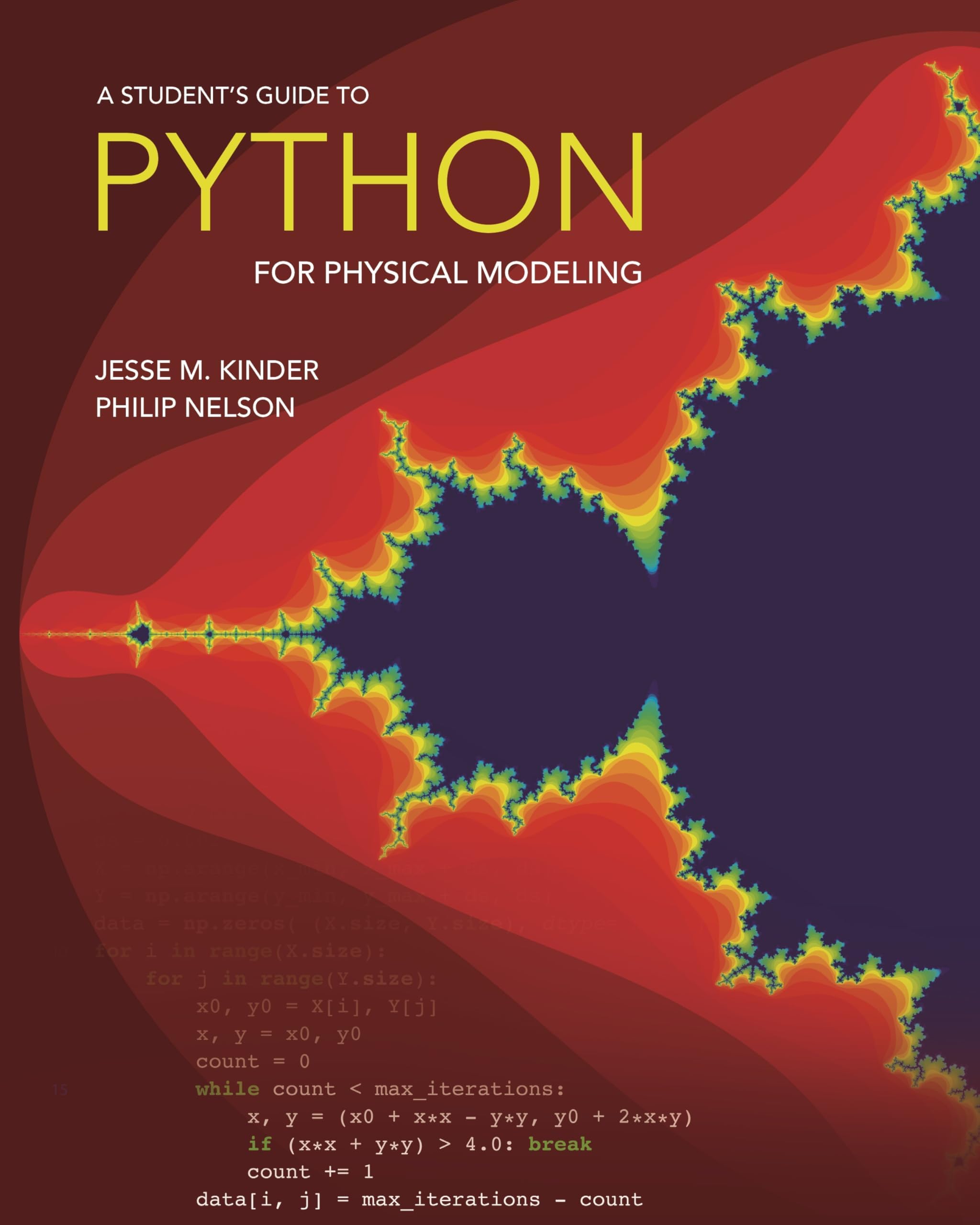
A Student's Guide to Python for Physical Modeling
Product ID: 28825557
Buy anything from 5,000+ international stores. One checkout price. No surprise fees. Join 2M+ shoppers on Desertcart.
Desertcart purchases this item on your behalf and handles shipping, customs, and support to Israel.
A Student's Guide to Python for Physical Modeling: 9780691170503: Computer Science Books @ desertcart.com Review: Great Quick Start - This is a great quick start for using python for string manipulation, matrix operations, plotting and other things. After working through this book I realized that I do not need matLab for the matrix operations that I need to do, numpy covers it for me YMMV. Also this is not a definitive python reference, as there are many python features that are not covered like the object oriented programming features of python. My recommendation get this book and get productive quickly. You may want to get a more detailed book to cover the other great features of python. Finally the authors do a great job pointing out what you need to do if you use python 3 or python 2.7. All of the code examples ran great on my Mac with Xcode. This book would also be a great intro to programming. Review: Good starter text - Not a bad quick starter to python for undergraduates in natural sciences and engineering. You will get an overview of programming basics and the necessary python libraries such as NumPy, SciPy, and Matplotlib. I do wish there was more content on the SymPy package.
| Best Sellers Rank | #3,093,413 in Books ( See Top 100 in Books ) #2,522 in Python Programming #3,295 in Computer Programming Languages #18,513 in Physics (Books) |
| Customer Reviews | 4.5 4.5 out of 5 stars (33) |
| Dimensions | 8 x 0.25 x 9.75 inches |
| ISBN-10 | 0691170509 |
| ISBN-13 | 978-0691170503 |
| Item Weight | 12 ounces |
| Language | English |
| Print length | 160 pages |
| Publication date | September 22, 2015 |
| Publisher | Princeton University Press |
S**5
Great Quick Start
This is a great quick start for using python for string manipulation, matrix operations, plotting and other things. After working through this book I realized that I do not need matLab for the matrix operations that I need to do, numpy covers it for me YMMV. Also this is not a definitive python reference, as there are many python features that are not covered like the object oriented programming features of python. My recommendation get this book and get productive quickly. You may want to get a more detailed book to cover the other great features of python. Finally the authors do a great job pointing out what you need to do if you use python 3 or python 2.7. All of the code examples ran great on my Mac with Xcode. This book would also be a great intro to programming.
M**C
Good starter text
Not a bad quick starter to python for undergraduates in natural sciences and engineering. You will get an overview of programming basics and the necessary python libraries such as NumPy, SciPy, and Matplotlib. I do wish there was more content on the SymPy package.
J**P
Great Intro Giude
Wonderful intro guide, the language is simple and the examples are easy enough to follow along to. If you really wanted to you could power through this in a few days and understand all of the content within. The code samples are also very clear and the blog that comes along with this book is a great addition.
D**R
As Python (the language) spreads
As Python (the language) spreads across the globe, this and others to follow become must reads
S**J
A perfect start
A perfect start for a beginner.
T**Z
Must buy.
Very good. Love it.
Z**N
Not as good as I expected
I bought this book based on the many positive reviews but when I read it, I did not get excited. The text is very dry and dense. Important syntax is usually not stated explicitly. For example, the discussion in section 2.2.6 is unclear and insufficient. The authors failed to explain that an assignment statement in Python does not copy an object, but binds a name to the object, and an object can have as many names (labels) as one sets. I am only up to page 25 and already found three errors/typos: 1) page 18: L.pop() will remove the first item in the list => L.pop() will remove the last item in the list 2) page 22: it useful => it is useful 3) page 25: N = np.size(A, 1) => N = np.size(A, 0) I cannot endure any such errors/typos for a textbook. I also don't like this kind of statements: "try XXX and explain the result". The purpose of buying a book to read is to make life easy. One may read a book without even touching a computer.
S**R
Excellent introduction to the basics
This is an excellent introduction to scientific programming with Python. I started from a base of no knowledge of Python and ended with a clear picture and working facility of how to carry out substantive scientific calculations with Python. The clear explanations, the associated data sets, and the problem sets make this the book of choice for people who want to dig in and start learning Python for scientific computing.
A**E
Das Büchlein liefert einen prima Einstieg. Es werden viele Themen soweit angerissen, dass man erstmal eine umfassende Übersicht zu Python mit all einen Zusätzen wie numpy, pandas, mathplotlib und einfacher auch pyplot, bekommt.
O**R
Very good book!
C**N
Good book to start with python programming. A lot of example and problems in the book.
Trustpilot
1 week ago
1 week ago