We remain fully operational. Our teams are working around the clock to ensure your deliveries continue safely.

DOWNLOAD THE APP


Copyright © 2025 Desertcart Holdings Limited
DOWNLOAD THE APP
Buy anything from 5,000+ international stores. One checkout price. No surprise fees. Join 2M+ shoppers on Desertcart.
Desertcart purchases this item on your behalf and handles shipping, customs, and support to Israel.
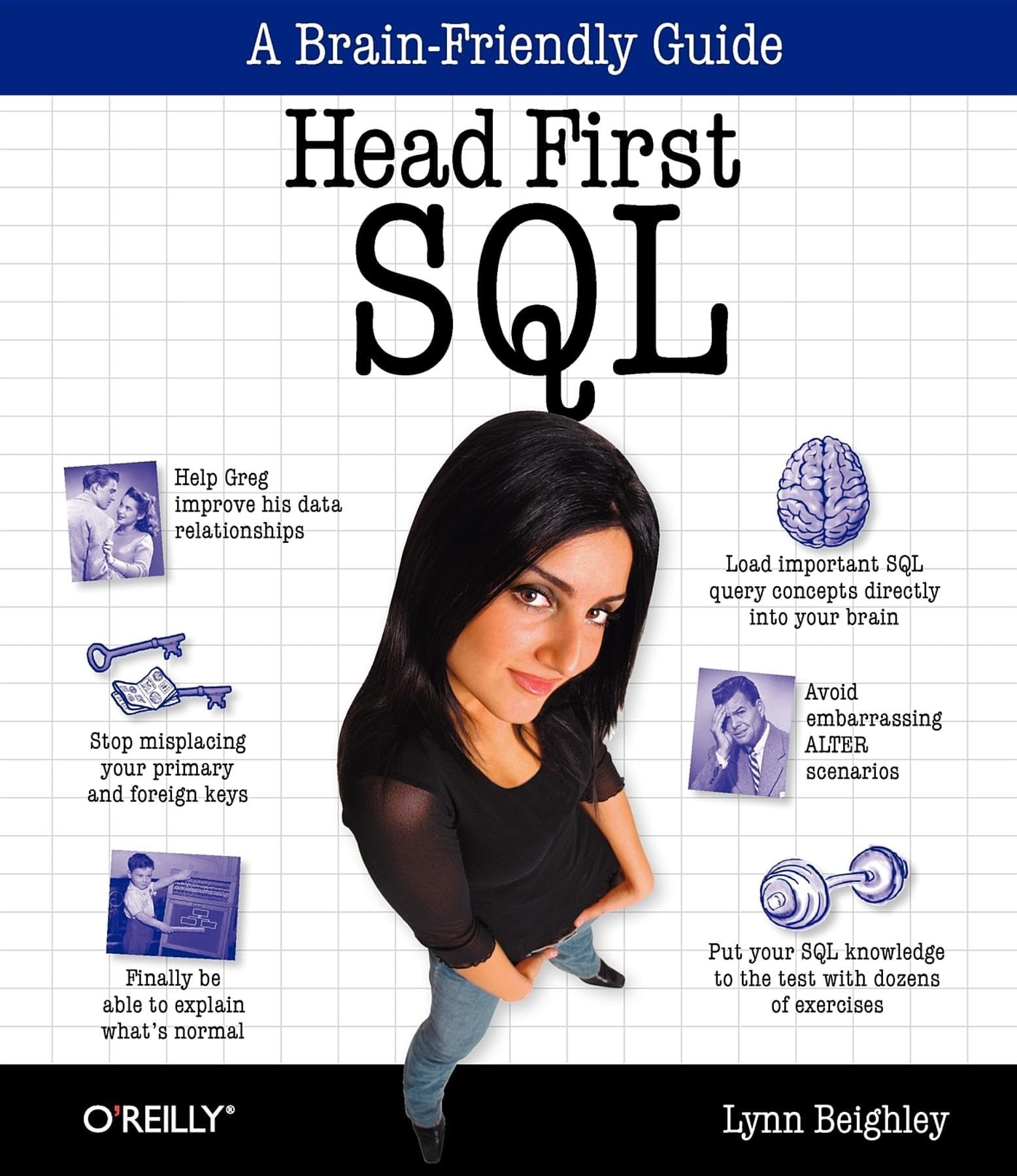
Head First SQL: Your Brain on SQL - A Learner's Guide [Beighley, Lynn] on desertcart.com. *FREE* shipping on qualifying offers. Head First SQL: Your Brain on SQL - A Learner's Guide Review: SQL for all - I like this book on just about every level. First of all, I'm not a Head First fan boy: they've laid a few eggs in some of their language/computing titles, and while I generally like the approach to learning they take, the content varies. That said, I am a big fan of this book. It provides a solid introduction to SQL from beginning to advanced concepts. I happen to use it with PHP, but it would fit equally well with SQL in other languages like ASP.NET/C# and PERL. SQL is not very big as languages go, but there's more than meets the eye to this language. Most importantly, Lynn Beighley takes the time to go through some key table-building concepts such as 'atomic data' and 'normal tables.' Further, she goes into great detail about creating and using relational data bases from setting up FOREIGN keys to using JOINs in data queries. She spends plenty of time with the CREATE statement in different contexts. Most SQL books, act as though you use tools like Visual Studio or MyPHPAdmin for creating tables, and so they do not 'waste time' with the CREATE statement for different types of tables. There's a problem in not visiting and revisiting CREATE when dealing with relational database management systems (RDBMS)--you don't understand the data and data types and hooks quite as well. Also, using CREATE, you can go from one tool to another without having to learn the protocol for each tool in the same or different language context. Her material on queries and sub-queries is in depth and the examples are sensible for the materials. While it's important to have some fun with the database examples in the HF series, it's also important to have examples that make sense, and hers do both. Likewise, her materials on ALTER are complete and helpful. Through all of these, she provides several SELECT examples and the many clauses (statements) that can be used with SELECT. Her chapter on security is quite good as well for an introduction to SQL capabilities in that area. I found only a couple of things I'd like to see changed. First, after some introductory INSERT examples, she seems to drop them as relevant further on in the book. Further INSERT examples would be quite helpful in the chapters on ALTER and with multiple tables. The multiple CREATE examples are golden, and if she'd do that with INSERT, it'd be most helpful. Second, at the very end of the book, she includes a 2-minute example of using PHP with MySQL. Yikes; she uses mysql instead of mysqli. Since at least 2004 when PHP 4.1.3 came out, the recommended PHP statement for MySQL work has been mysqli; not mysql -- the 'i' makes a big difference. Among other things, you can use a single statement to handle the connect information--url, username, password AND database name. Further, new terms like SERIAL are available in mysqli. Those two items would knock it down from a 5-star to a 4.5 star review, but I'd round up on this book any day. Review: Good beginner / intermediate guide to SQL - In typical Head First style, this book is a hip trip down SQL lane, gently imparting concepts and techniques that stick to your brain. The book elegantly mixes the core concepts of writing SQL with solid principles of database design (with more than a dash of good humor). There are tons of exercises and examples, which help you to not only understand the language concepts being taught, but you get a good sense of good (and bad) database design at the same time. The author reasons that we often times are called upon to work with or fix bad a database design, so the book teaches you just that. And of course, you learn how to create a good design at the same time. What it is not: A comprehensive SQL reference. It is based mostly on MySQL as a database (the recommended tool to use for completing exercises for this book), and the book teaches techniques that might not work in other databases. I used Microsoft SQL Server 2005 for my exercises, and I spent a lot of time looking up how to get some functions to work; in some cases MS has a slightly different structure, but in some cases there is no comparable function in MS SQL (of course, the opposite can be said about MySQL as well - MySQL can't do everything some other databases can). However, in the end, this aided in my learning about SQL, as well as learning about the strengths and weaknesses of the various databases. If you are a seasoned DBA or a SQL guru, stay away...you are there already. But if you just starting out, you can't go wrong with this book.







| Best Sellers Rank | #536,129 in Books ( See Top 100 in Books ) #5 in Other Databases #21 in MySQL Guides #55 in SQL |
| Customer Reviews | 4.4 out of 5 stars 341 Reviews |
B**Z
SQL for all
I like this book on just about every level. First of all, I'm not a Head First fan boy: they've laid a few eggs in some of their language/computing titles, and while I generally like the approach to learning they take, the content varies. That said, I am a big fan of this book. It provides a solid introduction to SQL from beginning to advanced concepts. I happen to use it with PHP, but it would fit equally well with SQL in other languages like ASP.NET/C# and PERL. SQL is not very big as languages go, but there's more than meets the eye to this language. Most importantly, Lynn Beighley takes the time to go through some key table-building concepts such as 'atomic data' and 'normal tables.' Further, she goes into great detail about creating and using relational data bases from setting up FOREIGN keys to using JOINs in data queries. She spends plenty of time with the CREATE statement in different contexts. Most SQL books, act as though you use tools like Visual Studio or MyPHPAdmin for creating tables, and so they do not 'waste time' with the CREATE statement for different types of tables. There's a problem in not visiting and revisiting CREATE when dealing with relational database management systems (RDBMS)--you don't understand the data and data types and hooks quite as well. Also, using CREATE, you can go from one tool to another without having to learn the protocol for each tool in the same or different language context. Her material on queries and sub-queries is in depth and the examples are sensible for the materials. While it's important to have some fun with the database examples in the HF series, it's also important to have examples that make sense, and hers do both. Likewise, her materials on ALTER are complete and helpful. Through all of these, she provides several SELECT examples and the many clauses (statements) that can be used with SELECT. Her chapter on security is quite good as well for an introduction to SQL capabilities in that area. I found only a couple of things I'd like to see changed. First, after some introductory INSERT examples, she seems to drop them as relevant further on in the book. Further INSERT examples would be quite helpful in the chapters on ALTER and with multiple tables. The multiple CREATE examples are golden, and if she'd do that with INSERT, it'd be most helpful. Second, at the very end of the book, she includes a 2-minute example of using PHP with MySQL. Yikes; she uses mysql instead of mysqli. Since at least 2004 when PHP 4.1.3 came out, the recommended PHP statement for MySQL work has been mysqli; not mysql -- the 'i' makes a big difference. Among other things, you can use a single statement to handle the connect information--url, username, password AND database name. Further, new terms like SERIAL are available in mysqli. Those two items would knock it down from a 5-star to a 4.5 star review, but I'd round up on this book any day.
S**Y
Good beginner / intermediate guide to SQL
In typical Head First style, this book is a hip trip down SQL lane, gently imparting concepts and techniques that stick to your brain. The book elegantly mixes the core concepts of writing SQL with solid principles of database design (with more than a dash of good humor). There are tons of exercises and examples, which help you to not only understand the language concepts being taught, but you get a good sense of good (and bad) database design at the same time. The author reasons that we often times are called upon to work with or fix bad a database design, so the book teaches you just that. And of course, you learn how to create a good design at the same time. What it is not: A comprehensive SQL reference. It is based mostly on MySQL as a database (the recommended tool to use for completing exercises for this book), and the book teaches techniques that might not work in other databases. I used Microsoft SQL Server 2005 for my exercises, and I spent a lot of time looking up how to get some functions to work; in some cases MS has a slightly different structure, but in some cases there is no comparable function in MS SQL (of course, the opposite can be said about MySQL as well - MySQL can't do everything some other databases can). However, in the end, this aided in my learning about SQL, as well as learning about the strengths and weaknesses of the various databases. If you are a seasoned DBA or a SQL guru, stay away...you are there already. But if you just starting out, you can't go wrong with this book.
A**V
Great Book for Basic SQL concepts
If there is one book in head first that deserves attention (apart from Servlets book) it is this. All the programming books are great anyways (Exception is Head First Design patterns, PLEASE DONT BUY that one!). SQL Head first helps in visually knowing what is going to happen, especially when running mutltiple OUTER JOINs and writing subqueries etc. Thanks to this book (and a combination of SQL Cookbook and SQL Tuning (for more advanced people)). Here are some of positives of this book : 1.) Starts out at very basic level (this can be annoying for some folks, who already know much of the stuff, but then this book is not for you then, try SQL Cookbook or SQL Tuning). I would still say this book can be kept as a good reference, as even seasoned people can be helped from visually organized "notes" in there. 2.) Advanced Select section is awesome, JOINS and subqueries and Associations are explained very well. (In this case diagrams help in better visualizing things and helped me understand and recall the concepts really well, After a long time i am not trying to "remember" what the syntax of a clause is in SQL, instead i just visualize things (an example of this would be a sum(xxx) and a group by ... and how the diagram illustrates it very neatly, if i want to use a complex JOIN query or a multiple group by, i don't have to google anymore). Cons : 1.) Some of topics could have been covered in a better way, example tuning etc. 2.) is @ medium level, for advanced topics i still refer to SQL cookbook or tuning book (by Dan). All in all it was a great buy for me. Regards Vyas, Anirudh
R**K
SQL Expained in detail
I've been dabbling in SQL on three databases for three years on two different projects. After doing this for so long I decided to get serious and clear away the misconceptions, bad advice, and the confusion. This book is just the way to get straightened out on the subject. I didn't know how much I didn't know about database design and database programming until I read this book. Now, I have learned a lot more and I owe most of it to this book's ability to build a coherent picture of the SQL world. I have seven previous books on databases from MySQL to Oracle to PostgreSQL to SQLite. They are very good books for their respective databases, but they don't introduce the general subject as well as this one. This is the book that I wish I had read first and I think that might be true for you as well. The database world is a hard place to join( pun intended ). Like writing kernel drivers and talking your boss into doing a Java or C# program for the first time, it takes perseverance and think tank intensity if you are on your own. It also takes all the friends you can gather, and this book is definitely your friend. Of course, it's wordy, a bit childish, and somewhat shallow. So what! It will guide you right toward your goal of learning SQL database usage without leaving out anything critical and without glossing over important concepts. I spent four days reading this book and I don't have any doubts that I now understand databases thoroughly. Now, I have returned to my previous books with a new understanding and better insight. I have a thorough framework in which to place my database design's details. I now know how to set up a proper interface for my designs from the beginning. No more fiddle and redesign until it works. My understanding of table normalization is able to determine when to fully normalize and when to leave a economic degree of flexibility in the table. I still have a programmer's view of the role of databases. I want the database to serve me, not serve as another source of grief. My designs have taken too long in the past to clean up and they had to go through many iterations before they were ready to release. I'm currently designing a stock tracking database and for the first time I'm able to put it all together once without having to redo it again and again. So, even though you may have dismissed this book in the past as juvenile or too silly, take another look and you might find the right mix of teaching and practice here to get your understanding of SQL and database design in good order for your next design.
C**R
Explains things perfectly.
If you're learning SQL whether on your own or for a class, this is it. It's illustrations and examples will keep you engaged and on track. It's very easy to learn from this book. Definitely would recommend.
C**E
A wonderful begginers book!
I had an upcoming mysql project at work, and it had been so long since I had used SQL I wanted a refresher. This book was amazing. If you've never read a Head First book, they have a real unique teaching method to keep you interested in the material and present it in a not-so-dry fashion, found with a lot of programming books (reference style). I have read many Head First books, and they are by far my most favorite programming "series" book. After reading through this book and it taught me most of what I needed to know to build the databases, tables, queries, sprocs, and optimizations for my project. Of course there will always be stuff not covered in books, but this really lays the foundation of the language that makes understanding any specific reference material for extended learning, easy. This book may or may not cover everything you need to know on SQL depending on the scope of your project, it certainly didn't for me, but thats the nature of these "beginner books". As such the book assumes you don't know SQL at all and is probably great for people who have never used it, or never even really programmed. It doesn't really favor a specific version like mysql, mssql, or oracle. It more shows you the standard ANSI SQL language and will notate special differences between the more popular SQL derivatives. A great book, that I highly recommend!
J**O
Could have used a few more months in development...
My first Head First book was Head First HTML with CSS & XHTML, and it was absolutely wonderful. Given that, I had very high hopes for Head First SQL as well, but I'm sad to say this book is very disappointing. I have two main complaints: the explanations in the book, and the typos. First off, I already studied a little SQL on my own a few months ago, mainly using websites and online tutorials. It's a fairly easy language to learn so I got pretty deep into it. I think it is for that reason only that I am able to follow along so well in Head First SQL. What I mean is, it seems to me that very little explanation is actually going on in the book. I understand the Head First method of teaching, but that doesn't have to preclude *any* kind of explanation at all. For the most part, the chapters in this book describe a bunch of different situations (Greg and his list of contacts, clowns traveling around town, donuts at different shops, etc.) and through these examples we are given a bunch of SQL queries. The problem is that only once or twice does the author actually stop to say "Ok, here is the structure of the SQL query we will use"...instead, she just throws a bunch of queries at us and I feel like I would be very lost if I hadn't already studied SQL a little bit previously. Instead of saying something like "You type the SELECT keyword, followed by your table name, followed by....." she just gives us the statement fully written. The problem I see with this is that it doesn't teach us how to construct our own. Our only real option is to pattern our own queries based on this single example she gives, rather than to know how to compose our queries from the ground up. (Sort of the whole teach a man to fish metaphor.) And as I mentioned, there are a ton of different examples she uses (contacts, clowns, donuts, movies, girl scouts, etc. etc.) that there is no consistency between the examples. Very early on we are encouraged to enter a bunch of data into our own SQL database on our computer, and you figure, Ok, we'll use this throughout the book to run tests on it. Nope, you'll hardly see this table again for a long time, so don't bother. What I liked about the HTML book was that the authors carried a project all the way through the book. Head First SQL does not have that consistency. Finally, the typos in this book are atrocious. There are a lot of little typos in grammar, which are annoying and unprofessional, but forgivable because we all know well enough what was meant (e.g. "then then you type"...well, we all know that one of those "then"s isn't meant to be there). But what is worse and less forgivable are all the technical typos that actually make the examples and crossword puzzles wrong and non-workable. This is ridiculous. There is a "thank you" in the beginning of the book that says without a certain editor's help, the book would have come out in 2008. After reading most of this book already, I truly believe it still wasn't ready to come and could have used a lot more proofreading. If I spot these errors just by my casual reading, then why can't the author and editors, whose job it is? Something tells me that this book was rushed to be released in 2007, and it shows in the quality.
I**S
A great book for a beginner learning MYSQL syntax
A great book for a beginner learning MYSQL syntax. It's engaging, interactive and a fun way to learn SQL. It's not like a typical SQL text book full of dry and dull reading. It's lean with lots of white space and doesn't overload a new learner. It feels more like an activities workbook. I wouldn't suggest it for someone who's already completely comfortable with SQL. When I started learning SQL, I started with much more technically complex books and if I could have a do-over, I would have definitely started with this one, it would have helped make the rest of it much easier to understand. One of the things I like is how each chapter builds on the last, and it flows together really well. A lot of the SQL books I've read, start with the SELECT statement. This one actually starts right in with creating a table, which makes sense... It's perfect for a beginner or someone with minimal experience.
Trustpilot
1 day ago
2 weeks ago