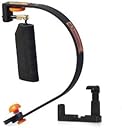
Lensse iSteady Compact Camera -CC Support System Steady Cam
Product ID: 1550770
👜Includes Carry Bag
📷Camera Compatibility
⚖️Sensitivity Adjustment
Desertcart purchases this item on your behalf and handles shipping, customs, and support to Israel.
🎥 Capture Every Moment Like a Pro!
The Lensse iSteady Compact Camera Stabilizer is designed for GoPro and compact cameras, featuring sensitivity adjustment, a built-in level for perfect alignment, and a carry bag for easy transport. Elevate your filming game with this essential tool for smooth, professional-quality footage.
C**H
Terrible
Ok So I did a lot of research into this type of camera stabilizer. Being that Lensse makes several models I was careful to read up on their products and specifically the technical aspects of weight and balance. Both My HD cameras are not heavy at all. That is the specific reason I chose this specific model. I have a nice flip knock off that takes pretty good HD video for what it is, I also have a cannon power shot 3500 IS that I really enjoy using for video. Now I realize neither camera is pro quality and both are basically point and shoot material, I also realize for the price this stabilizer might be lacking in some areas. The design is pretty common. There are many weak points to this design mainly the materials used which in IMO are trash. The Gimbel is somewhat ok the design is not perfect but for the price its really not any different than a lot of other similar models. The biggest issue is its flimsy. The main bar is covered in rubber and is no where near solid enough. the weights included are all the same you get 3. They have off set holes that allow you to swivel them to counter balance for offset. This is where things fail. While I can balance my camera it leans to one side. The weights do not extend far enough to counter the tilting of the entire assembly. If you add additional weight your only asking for trouble. It comes close to being straight but then its bottom heavy and and it sways. No matter how well you balance it, its a pendulum. Even with my other camera which did balance perfectly for this thing, it sways and swings like a pendulum clock for infinity. Again, i was VERY careful to choose this model based on the weight of my camera's in KG, ounces and pounds. This met all the criteria described by Lensse. Bottom line, It does not work. While using these devices is an art in itself and takes a LOT of practice the product has to start out designed well. This one is not. Its a cheap knock off. You can view videos all you want but honestly the entire Merlin design is flawed if you ask me. Its going to sway it going to take hours to balance and its not for light camera's. I know there are tons of videos on DYI merlin type devices, again don't waste your time. They all shake they all sway and they all are flawed. Now if your not really into doing a professional shoot I suppose you an build one or buy one of the other knock offs but don't expect much. I will be returning this and using the cash to build my own glide cam. While its not the same type of device I have seen DYI glidecam gear in action and even with its limitations it goes lightyears beyond what a merlin design can do. SO my advice is to avoid this. BTW if your looking for something for your phone, just build one it comes out cheaper when you find out a light phone or camera will not balance you wont be upset. If you MUST have this type of device I would only recommend it for a larger SLR. I would get a much much larger stabilizer but look around before you do. Most videos shot with the merlin designs are by folks who know the tricks in getting them to "appear" to do magic, when the dont' in reality.
B**N
READ THIS IF USING GOPRO HERO 3!!
The secret to balancing this with the GoPro Hero 3 is to use the short mount knob rather than the long one. The weights don't extend out far enough to counter the weight of the long knob. I got it perfectly balanced 3 different ways. First, with just "the frame" mount and one of the supplied weights. Second with the extended battery, the frame, and two of the supplied weights. Third was with the extended battery, the waterproof housing and all three weights. Each time the weights were angled back and to the left (in slightly different positions each time) but the camera had to be in a different location on the top rail. A tip is to mark each weight with a 1,2, or 3 and to mark the position it has to be in on the weight. Also, mark the cork rail on top so you know right where to line up your tripod mount each time with each configuration. Again, you have to use the short mount knob. I could not get it to balance with the long one. It's a little harder to screw in but it is possible. You also have to fine tune each combination to get it just right. The directions recommend to use as little weight as possible, that's why I started with just one weight, the frame, and no extended battery. I tried that for awhile and got it balanced but couldn't keep it steady. Too much jerking around. The entire assembly, camera and all was too light. When I stepped it up to the extended battery and the other cases, I got a lot better results with the little bit of extra weight. About the same out of both setups. I ultimately chose the extended battery and frame setup since I use that enclosure the least but you will have to mess with it and see what works best for you. I usually don't write reviews but this little thing can be very stressful and I would have loved to have known these things prior to trying to balance it. This assembly does make quite the difference in keeping steady once you get it dialed in. One last thing. If you're going to edit your videos, it makes a huge difference to slow-mo it down a bit. All in all, I'm happy with it. I'm sure there are nicer ones out there, but at this price this one is untouchable for value.
K**2
Check your camera’s mount point
If your camera’s tripod mounting point is off center of the camera, you probably cannot balance this with the supplied weights.I have a Canon S100. It is not possible to balance this camera as instructed with the supplied weights. However, if you rotate the camera 90 degrees (ie, sideways), then the camera’s center of gravity is more inline with the weights and you can successfully balance the setup. (however the bar might get in your way)Also, I found the supplied weights insufficient. You’ll probably need a set of smaller washers to supplement the supplied weights. I found two weights plus 2 small washers to be perfect. Get out the duct tape!Balancing is a real art. My approach was to start with a static level with the minimum amount of weight. Ex, if you manually tilt the camera in any direction, it should return to horizon level (pitch and roll). Then try the dynamic balance. Move the camera (once) quickly in the x direction (ie, away from you). If the bottom lags, then it has too much weight. Repeat in the y direction (side to side).Don’t forget, you can add and remove weights, rotate the weights, and move the camera back and forward. Try all!
Trustpilot
1 month ago
3 weeks ago