
Buy anything from 5,000+ international stores. One checkout price. No surprise fees. Join 2M+ shoppers on Desertcart.
Desertcart purchases this item on your behalf and handles shipping, customs, and support to Israel.
🔐 Crack the Code of Knowledge!
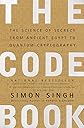
The Code Book is a comprehensive exploration of the history and science of cryptography, spanning from ancient Egyptian hieroglyphs to modern quantum encryption, making it an essential read for anyone interested in the evolution of secrecy and security.


| Best Sellers Rank | #33,355 in Books ( See Top 100 in Books ) #3 in Linguistics Reference #3 in Web Encryption #86 in History & Philosophy of Science (Books) |
| Customer Reviews | 4.6 out of 5 stars 2,211 Reviews |
M**T
Entertaining and enlightening
This is a very well written and entertaining book that covers codes from the earliest ones to quantum computer codes. I liked the balance between historical information and some details about how codes and ciphers are created and broken. The book is written for a general audience, but also contains a lot of somewhat technical information, but is not so mathematical as to be inaccessible for most readers. I highly recommend this book to anyone interested in codes, ciphers and some of the privacy issues that are entailed with the use and decryption of them. What is in the book – The book goes beyond many others in the area of codes and ciphers in that it discusses very up to date topics (at least up to 1999 when the book was written), such as the ciphers being used for Internet transactions and questions of privacy and code breaking. The book also covers material on the deciphering of hieroglyphics and Linear-B, which are not covered in other books on codes. I found the sections on the techniques used to decipher messages enciphered with a Vigenére table and the algorithms employed by the DES and RSA systems to be very clear and enlightening. The book contains information on the Enigma machine and the work at Bletchley Park in Britain to decipher the messages sent on it. However, this material is not as detailed as the material in books such as Budainsky’s “Battle of Wits”, Kahn’s “Seizing the Enigma” or Sebag-Montefiore’s “The Battle for the Code”, so if this is your primary interest I would direct you to these sources. However, if your interest is more general then I think that “The Code Book” is an excellent choice.
R**N
A Great Way To Start Digging Into Cryptography
I've been developing an interest in physics as well as cryptography. I was turned on to Singh's The Code Book simply because it mentioned quantum physics in the title, a happy intersection between my two new hobby subjects. Soon after cracking it open, I realized that I'd picked up one of my favorite books in the past few years. Singh does a great job of laying out the history of cryptography (code writing) and cryptanalysis (code breaking, essentially) as well as explaining the logic behind each of the codes he discusses. It's a fascinating history that builds and builds upon itself, making it clear to the reader how the cryptography readily available to him/her now was born. All the while, Singh's explanation of the thought behind the codes is clear enough for a non-math major to quickly grasp (i.e. myself). I admit that the subject matter was right up my alley and this might not be the case for everyone, but I feel Singh's ability to weave a narrative into a convoluted subject (as it would be) is excellent and warrants a pick up. The history is sturdy enough to support just about any reader and the analysis of the logic is clear and simple to latch on to, even as it delves into some deeper details. In all, this was a great read and I'd highly recommend picking it up.
F**N
The Code Book--Masterpiece of Historical Significance & Present Secure Communications Quandaries.
From describing very descriptive ancient codes to the fascinating world of quantum computing this author touches on it all with very well illustrated examples to help clarify a very difficult and highly complex subject of cryptanalysis--- with its modern employment of linguists, mathematicians, and computer engineers. It's an ongoing quest to keep our PRIVACY from intrusions of all sources such as governments, business competitors, or prying eyes. There are many privacy issues that both governments and private citizens alike must face in today's technological world. These questions are posed and answered in many ways within the book. One caveat---recalling what our esteemed Statesman Benjamin Franklin once expressed---"Any one who will trade freedom for security deserves neither" The quandary is how government protects its citizens from acts of terror or how citizens may be protected by a tyrannical government--read this book Simon Singh has produced a manuscript that not only gives one a deeper insight into the world of cryptanalysis from a historical prospective but also the men and women involved in this complex field of science through out the ages,----the brilliant people from various and varied walks of life who have contributed immensely to this science past and present . It covers the humanist aspect from those involved with their various idiosyncrasies of behavior from the selling of data to foreign powers as well as personal behavior that could cause one to be blackmailed by enemies. This book is a can of worms in many respects since it opens up to the reader a world fraught with possible invasion of privacy -one of the most fundamental rights we should all hold dear--especially in America--and what avenues we have at our disposal to solve these dilemmas. The writing style Simon uses to explain the complex theories and problems that code breakers or code makers must use is exemplary and easily understood for the average layman--although he helps to have some advanced understanding of the sciences ---but it is not necessary in comprehending what the author conveys in this book. I found the Appendix in the rear especially helpful in my study of the very basic science of cryptanalysis as well as his simple examples on how it all pieces together to form the whole picture. Even though this book was written in 1999--- for those of us who are concerned about CURRENT EVENTS in this science the last chapter offers deeper insights and may be used as a springboard to investigate further developments of cryptanalysis and how we may apply it to our everyday life of sending emails, buying merchandize or researching various subjects. While the wide world of the internet has opened our vast horizons to knowledge and communications within a multitude of domains ---rest assure there is an army of cryptanalyst struggling to keep our messages and correspondence secure daily---or at least we HOPE THERE IS--or we may involve ourselves with political action to ensure our freedom of privacy?
G**E
For people that enjoy the history and science genres
For people that enjoy the history and science genres, this is the perfect book. You get a balance of the history of ciphers and encryption over the course of human history while also learning about the technical details of how ciphers and encryption work (and how they are broken). The Code Book is extremely well written and after finishing it you really do feel like you learned something. Some other great aspects of this book are a Cipher Challenge at the end which allows you to test your codebreaking skills as well as multiple appendices for those who want to go even deeper into the technical areas of ciphers and encryption. My only complaint about this book is that it's aging. It was written in 1999, and the world of computing has changed a lot from 1999-2018. But don't let this fact deter you from reading The Code Book. The historical cipher/encryption knowledge that you learn about in the World Wars and the dawn of computing are very interesting. Even if you only want to focus on the modern aspects of encryption, I still recommend reading this book and then picking up something more modern after.
P**L
Awesome
Great read!!
R**T
Everything you wanted to know about the history of encryption.
The author covered everything there is to know about cryptography, enciphering, and encryption that existed at the time of publishing. While heavy on the science and details, it is easy to follow and worth it. Good source for research.
D**S
Shhhhhh!
Like all narrative non-fictional works that, eventually in this case, deal with technical subjects whose details are beyond the scope of the non-specialist reader, this book attempts to strike a balance between two extremes, between a book so chock-full of technical detail that it reads like a textbook and a book that skimps so completely on the heart of the matter at hand that it can only be described as fluff. Singh has done a remarkable job in balancing the two here, it seems to me, and the book is worth any reader's time whose interest is piqued by cryptography. Singh is singularly aided by his subject matter here. This book was recommended to me by a fellow poster on a crossword puzzle blog which I frequent, as a daily solver of the New York Times crossword. The discussions on the blog vary from the whimsical to the technical with all manner of things mooted. So goes Singh's book as well. But what makes this possible is that cryptography and cryptanalysis, for most of human history, has been no more complex, au fond, than a very difficult crossword puzzle. And one is not surprised to see a crossword used during WWII by the British to test potential candidates for work at top secret Bletchley Park, which was responsible for cracking Germany's "Enigma" code. The crossword is provided in the book and was jolly fun to solve. It seems to me that up to the Vigenère polyalphabetic coding, known for centuries as "le chiffre indéchifferable", anyone with an interest in this book could understand and create such a cipher and write an encrypted message in it. Indeed, it's in deciphering such messages without the "keyword" that the technical going gets somewhat involved and perhaps beyond the ken of some readers not familiar with basic statistical analysis, and, not coincidentally, this decipherment of such encryptions is where maths starts to predominate. But it's certainly not difficult to understand the concept of how these encryptions are deciphered, it's merely very tedious and painstaking to do it as Charles Babbage finally did in the 19th Century. Up to this point, for this reader in any event, no trade-off was necessary and Singh is free to fill his tale of codes and ciphers with histories which hinge upon them, starting with the life and death of Mary, Queen of Scots. Also, he makes an elegant segue in the tale of how the Linear B tablets were finally translated, and the toing and froing of certain egotistical archaeologists etc. - It should be noted here the final decipherment and translation of Linear B was the cumulative work of men (and one woman) of genius who were linguistic prodigies. - Again, pass the 19th century and the non-specialist becomes more than a tad lost in the, literally and figuratively, nuts and bolts of Enigma machines and multi-lingual scholarship and fluency. Thus, it's no surprise that the ending of the book was the weakest part for me. Though it must be said that Singh goes out of his way to use "Alice, Bob, Eve" analogies to make the concepts clearer most effectively, being able to do what the main players in the tale are doing is far beyond the amateur's grasp. Also, the book is thirteen years old and the final sections dealing with computer encryption seem a bit dated already. In sum though, a very pleasing, well-written book about the perennial human need to keep matters secret.
P**G
Fascinating read
My old boss used to keep a copy of this lying around in the office (think, "throne room"), and I eventually read the whole thing. It was a well written, fascinating and well paced read of the history and technology of cryptography. That was years ago. I recently decided to buy my own copy and give a re-read.
P**P
One of my favourite books
Great book for tech and non-tech people, into or not into mathematics. The story of cryptography, its developments and improvements is told in a very easy to understand way, the reader can dig into the theories to learn them or just read through and enjoy the facts. It basically teaches, in a historical context, how each method was developed, broken and improved, with practical examples. If you are a developer and into some maths, I definitely recommend the reading, it will add some skills.
C**N
An awesome history about codes.
A facsinating book about encryption and codes. It mingles both history and technicity. Didn't realise that codes were so important among history. Recommend it !
M**A
Just Buy It !
If you've recently got into encoding/decoding or have found Morse code interesting and want to know more of the kind, or just for the sake of understanding Robert Langdon better, whatever the reason is - for beginners this book is the best ! Not only will you get to know so much about ciphers and their history from this book, you'll also get to experience the fun yourself by creating your own encrypted language ! This book can't, can never, fail to capture the attention, imagination, and curiosity of the reader, he/she will be fascinated for sure. As for the Amazon services, the delivery, condition of the book and price, all are perfect.
G**Z
Increíble, divertido, fácil de leer
Me gusto mucho! Soy fanático de los enigmas y con este libro exploré una historia secreta que no sabía.
ジ**ー
Classic
Great read and a must have for anyone interested in cryptography.
Trustpilot
3 weeks ago
2 weeks ago