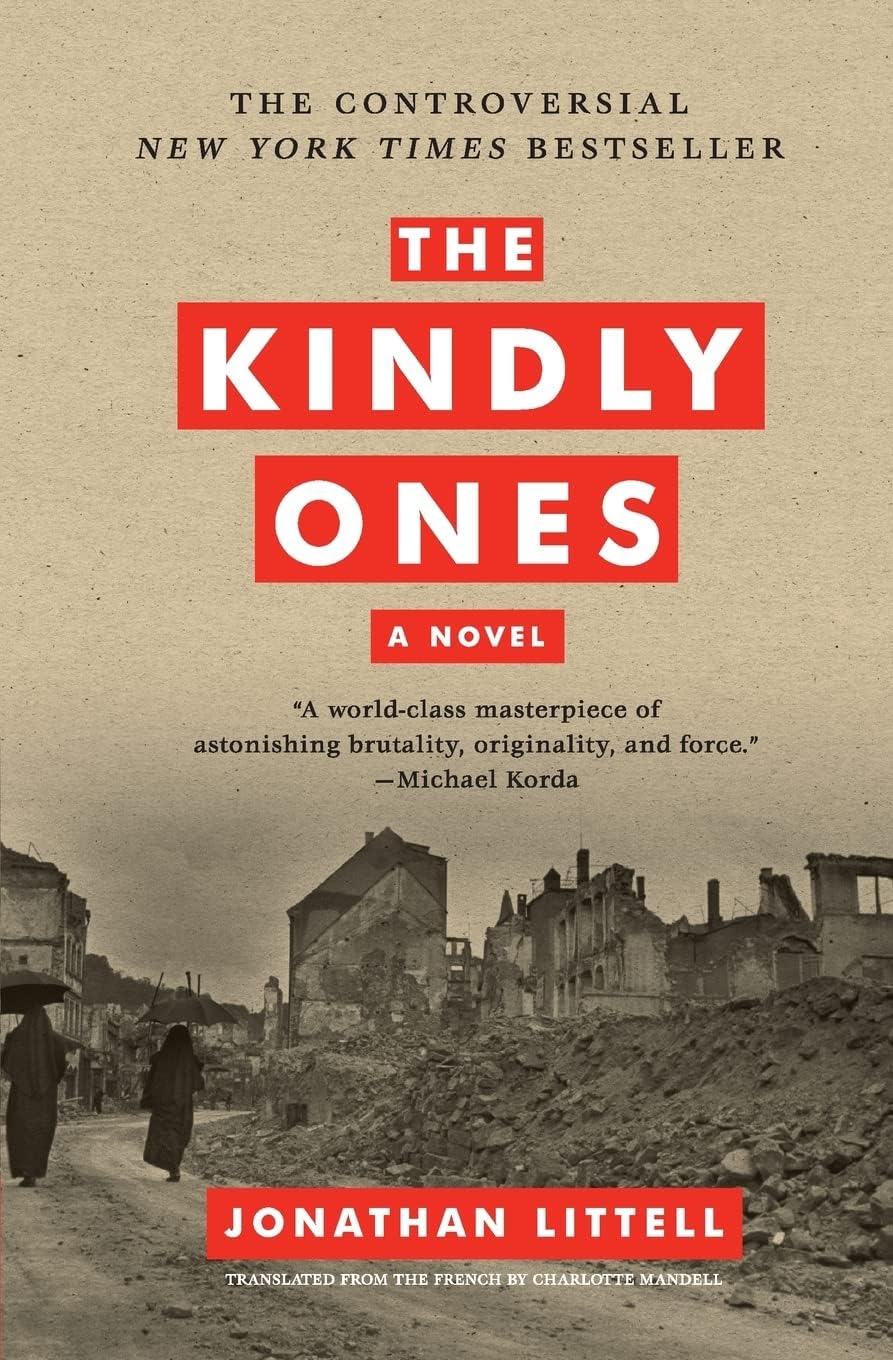

desertcart.com: The Kindly Ones: A Novel: 9780061353468: Littell, Jonathan: Books Review: Gotterdammerung - To begin, let me simply congratulate all who have accomplished the feat of reading this novel, whatever your views on it. For it is truly otherworldly in its ensorcelling vision, and, like some bewitching, daemonic potion brewed and spewed from the bowels of the Earth, incites real nightmares, cold sweats and waking spells of horror. Just casually glance over these reviews and note how many of the brave readers admit to having nightmares from the reading of it. And yet, it is magnificent, scholarly, erudite, mesmerising, and therein lies our problem and wonder. Let's start with the title: The Kindly Ones or the Eumenides from Greek myth. In Aeschylus' trilogy of plays, Orestia, it is the euphemism bestowed upon the Erinys, or Furies at the end of the plays in the hopes of appeasing these supernatural beings. They are given a home beneath the Acropolis by Athena and promised that they will be honoured by the Athenians with this new appellation and no longer treated with fear and loathing. One wonders just how long such supernatural beings will be appeased by these blandishments, and both men and the society that they have created threatened again by what is buried underneath. The entire novel deals with the terrors of what happens when they are released from their gemutlich abode and return to their true form, and it is unrelenting. It is a credit to Jonathan Littell's wizardly prose and his success in creating such a compromised narrator, Maximillian Aue, that from first to last page we scarcely think of our author, 21st Century Franco-American Jewish author Littell at all, so pulled in are we by Aue and the talons of the Furies - so Dante depicts them anyway. The novel, as many readers have noted, raises more questions than it answers; and it is so exhausting and exhaustive that a reviewer such as myself can only cover what I see as the two most piquant themes here: The first is the supposed "inhumanity" of the educated, cultured Nazis such as Aue who turn into killers, mass murderers, torturers, and, as one reviewer here has it, in the case of Aue, psychopathic sexual monsters, all described in the gripping detail of twisted pink intestines in the snow, the smashed crania of children and merde, merde and more merde. The sight of it, the smell of it and, yes, even the taste of it are so richly depicted that it becomes a psychosexual motif in the book for all we'd rather not know about ourselves. About all this, our narrator has several pointed passages: "There was a lot of talk, after the war, in trying to explain what had happened, about inhumanity. But I am sorry, there is no such thing as inhumanity. There is only humanity and more humanity." And, in the first chapter, so much resembling Baudelaire in Le Fleurs Du Mal: "But the ordinary men that make up the State - especially in unstable times - now there's the real danger. The real danger for mankind is me, is you." There are many other passages of this sort. But let me move on to the second more important, more encompassing point raised by this work by taking a cue from this last quote: What exactly is an "ordinary man"? A great part of the book is taken up by Aue's surreal, hallucinogenic, poetic passages describing his incestuous love for his twin sister Una. The themes in these passages of the book, of which Aue's homosexuality always seemed to me to be a symptom, make up the heart of the work and, indeed, as several astute reviewers have pointed out here, prevents it from being a meticulously researched "bombs and bunkers" book. A few professional reviewers have mentioned that this obsession seems to be "metaphysical" without explicating what they mean exactly. Aue explicates very well a philosophy with which every close reader of Plato, Plotinus, Shelley and Yeats will be very familiar. Here are some of the more pointed passages: "It wasn't just the question of my sister; it was vaster than that, it was the entire course of events, the wretchedness of the body and of desire, the decisions you make and on which you can't go back, the very meaning you choose to give this thing that's called, perhaps wrongly, your life." At the sight of dying, wounded soldiers crying for their mothers on the battlefield, Aue reflects: "Still, somehow I wondered if behind that mother there was not another one, the mother of the child I had been before something was irredeemably broken. I too would probably writhe and cry out for that mother. And if not for her, it would be for her womb, the one from before the light, the diseased, sordid sick light of day." Compare this to a stanza from the fourth of Yeats "Crazy Jane" poems: "A lonely ghost the ghost is That to God shall come; I -- love's skein upon the ground, My body in the tomb -- Shall leap into the light lost In my mother's womb." Briefly, and I don't have space to go into all this in an already overly long review, this is the "fall from the light" that each human's soul experiences upon birth in Neo-Platonic philosophy from what Shelley calls our "antenatal paradise." For the school's greatest philosopher, Plotinus, the object in life is a return to that "other light." But Aue is more pessimistic. Perhaps there is no return. One is reminded again of Yeats, from his poetic translation of another Greek play, "Oedipus At Colonus": "Never to have lived is best, ancient writers say; Never to have drawn the breath of life, never to have looked into the eye of day; The second best's a gay goodnight and quickly turn away." Or, as it may chance, slowly close this monstrous, bewildering book which fully lives up to the claims for it as art, art as a criticism of life. Review: A VISION OF HELL - Whoever said "War is Hell" knew whereof he spoke and, verily, The Kindly Ones - Jonathan Littell's magnum opus about a fictional SS officer during the reign of the Third Reich - is a vision of Hell. And a horrifying blend of fact and fiction. . . . A word of caution at the outset: This is a book you perchance might want to read to appreciate the author's artistry, or his virtuosity (as there can be no doubt that at least on some level this book is a masterpiece), or his grasp of history, or his understanding or "sense" of how things really were in Nazi Germany (or even merely as an intellectual challenge), but I assure you: This is NOT a book you will want to read for pleasure, or enjoyment, or entertainment. This is a laborious and arduous read. And for oh-so-many reasons. This book will exact from you a hefty investment - one of time, of mental effort and of emotional fortitude. The sheer size/volume of this book is staggering: 975 pages plus. My goodness, I can't even imagine the undertaking necessary to conceptualize the framework of this complex story, let alone flesh it out and compose it in such painstaking detail, as it must have taken a year to simply type it! It is massive! Mr. Littell is quite the adroit writer. (As well, Charlotte Mandell, who performed the translation of this tome into English from its original French, is to be commended.) This is a high school English teacher's dream, inasmuch as the reader - even a "serious" one - will encounter words - in both English AND German, in fact - that will have him scurrying to consult Webster! The vocabulary and syntax are often formidable. I strongly recommend reading this book with a dictionary handy. No, TWO dictionaries: one for English, and one for German-to-English translations as there are italicized German words sprinkled liberally throughout. (Footnotes might have been helpful here or at least a German glossary in the back.) Moreover, the sheer density of the prose is something to reckon with. Some passages go on for pages without a paragraph break; others go on for pages without so much as a period! The manner in which dialogue is conveyed is also rather unorthodox (and frankly sometimes confusing). The titles and ranks of the various military personnel and organizations described will have any reader's head spinning. This is where the glossary that does exist at the back of the book will come in handy. Your head will hurt trying to distinguish (and pronounce) the names of the various levels of military bureaucracy (and be forewarned, there is bureaucracy aplenty here!). The word obersturmbannführer, for instance, does not easily roll off the tongue (even when one is reading silently). And the reader will need a score card to keep track of the multitudinous characters that cross the protagonist's path as he traverses Europe. Finally, and most significantly, this book takes a great emotional toll owing to its subject matter and graphic depictions. There are some scenes that are so stomach-churning I had my regrets early on that I had even embarked on this read. One particularly jarring image, for example, describes a blood-splattered soldier laughing maniacally while he sits legless in the middle of the street after a bombing. There is a similar image much later on of another bombing victim (this one civilian) whose stockings remain intact, but whose head is missing from her torso. (The scenes that take place in Russia and in Auschwitz are things I don't care to touch upon in this review; anyone even peripherally familiar with WWII can well imagine the atrocities.) Then there are the overly vivid (sometimes verging on the pornographic) descriptions of the main character's various gastric upsets and, shall we say, perverse sexual inclinations. All in all, this book requires a strong stomach. Not for the squeamish or faint of heart, to be sure. When I finished this book my first instinct was to pick up a book of much lighter fare for my next literary excursion. . . . On to the story itself: The Kindly Ones tells the tale of one Maximilian Aue, a cultured, educated and not unintelligent young man who – instead of following his heart to become an artist or musician – throws his lot in with the Nazis and rises through the ranks. Despite his underlying talents, he is a deeply flawed individual with a complicated psyche who becomes more and more unbalanced and unhinged as the book reaches its shattering conclusion. Over the course of this story the main character’s military assignments take him from the killing fields of wintertime Stalingrad, to the allied bombing and decimation of Berlin, to the death-march during the evacuation of Auschwitz. (In the waning days of the war, when it looked to the Nazis that all was lost, they marched the inmates out of the concentration camp, not wanting their “prisoners” to fall into the hands of their Russian enemies.) It is significant to note that as an SS officer, Maximilian never actually engages in murder (not in an official capacity anyway), but by his very position is complicit in the genocide that took place during this black time in human history. The sickening rationalizations for this genocide, antisemitism and other barbarity are legion. There is one portion of the book which goes on for pages and pages and pages detailing the deliberations on the question of whether certain Jews living in the mountains of Eastern Europe (“Bergjuden”) qualify as “true” Jews “worthy” of being exterminated. The debate rages ad nauseum, and I do mean that literally. There is another section, which takes place during the Auschwitz phase of the book – also going on for multiple pages – where various political/military personnel (including Aue, who is there more or less in the capacity of an efficiency expert) quibble over the most cost-effective way to keep the starving concentration camp workers alive just long enough to be most productive to the Reich as slave labor. The protagonist is the quintessential sociopath in his lack of a conscience and his tepid post-war explanations. (“There is no such thing as inhumanity, only humanity.”) But I think where the author really did an outstanding job, in the course of telling the story of this particular individual Maximilian Aue, was his attempt to get into the Nazi mentality, something that most civilized human beings cannot comprehend. One of the things that I took away from reading this book was a tremendous and overwhelming sadness contemplating the immense human and bureaucratic effort entailed in the slaughter of a people and in the destruction of a continent. All that human effort that could have been put into something positive for mankind channeled instead into something so nefarious. That to me is the greatest tragedy. At the same time, one of the most uncomfortable aspects of this book lies in Aue’s assertion in the prologue (which in fact takes place after the war as he’s looking back) that given the right circumstances, we are all capable of doing what he did. This book is so multi-layered and multi-faceted that it provides much fodder for discussion. One analysis that I found of interest was the comparison/contrast between the Nazis (National Socialists) and the “Bolsheviks,” avowed enemies with something ironically in common: The author points out that the Russians make distinctions upon the basis of class, while the Nazis make distinctions on the basis of race. Regardless, I can’t wrap my head around the Nazi declaration of the Jews as “enemies” of Germany (or later on their description as a “resource” of the Reich for the benefit of their slave labor.) During all this heavy stuff, there are also various subplots to Aue’s tale concerning his twisted relationship with his sister, his homosexual lifestyle (notwithstanding his relationship with a woman by the name of Helene and in fact his later marriage to a different woman) and the brutal murder of his parents for which he is placed under investigation and pursued around Europe. There is, in my opinion, enough material contained here that any one of these subplots could have made for an entirely separate book. The last two chapters of this book are like a descent into depravity. We have the main character traipsing through a war-ravaged and corpse-strewn landscape. And then we have an ending like a frenzied fever-dream with elements including a bizarre assault on Hitler himself (whom he meets during an awards ceremony in the bunker), his attempted escape through the flooded Berlin subway, the re-appearance of the two detectives who have been pursuing him for the murder of his parents, the never-saw-it-coming murder of his friend, and the final crescendo in the Berlin Zoo among dying and fleeing animals. It is impossible to distinguish between reality and hallucination; we suspect more of the latter (since Aue at an earlier point in the story sustained a serious head wound), but given the war-time context, who’s to say. After all, to come full circle: War is Hell. I’m hard-pressed to place a rating on this book. It was no doubt a masterful piece of authorship (although I heartily agree with one of the oft-cited criticisms that it is way too long). I can’t say I “enjoyed” this book, but I feel it is unfair of me to put a rating on Littell’s grand achievement in writing it.


| Best Sellers Rank | #167,049 in Books ( See Top 100 in Books ) #417 in Military Historical Fiction #886 in War Fiction (Books) #4,258 in Literary Fiction (Books) |
| Customer Reviews | 4.2 out of 5 stars 783 Reviews |
D**S
Gotterdammerung
To begin, let me simply congratulate all who have accomplished the feat of reading this novel, whatever your views on it. For it is truly otherworldly in its ensorcelling vision, and, like some bewitching, daemonic potion brewed and spewed from the bowels of the Earth, incites real nightmares, cold sweats and waking spells of horror. Just casually glance over these reviews and note how many of the brave readers admit to having nightmares from the reading of it. And yet, it is magnificent, scholarly, erudite, mesmerising, and therein lies our problem and wonder. Let's start with the title: The Kindly Ones or the Eumenides from Greek myth. In Aeschylus' trilogy of plays, Orestia, it is the euphemism bestowed upon the Erinys, or Furies at the end of the plays in the hopes of appeasing these supernatural beings. They are given a home beneath the Acropolis by Athena and promised that they will be honoured by the Athenians with this new appellation and no longer treated with fear and loathing. One wonders just how long such supernatural beings will be appeased by these blandishments, and both men and the society that they have created threatened again by what is buried underneath. The entire novel deals with the terrors of what happens when they are released from their gemutlich abode and return to their true form, and it is unrelenting. It is a credit to Jonathan Littell's wizardly prose and his success in creating such a compromised narrator, Maximillian Aue, that from first to last page we scarcely think of our author, 21st Century Franco-American Jewish author Littell at all, so pulled in are we by Aue and the talons of the Furies - so Dante depicts them anyway. The novel, as many readers have noted, raises more questions than it answers; and it is so exhausting and exhaustive that a reviewer such as myself can only cover what I see as the two most piquant themes here: The first is the supposed "inhumanity" of the educated, cultured Nazis such as Aue who turn into killers, mass murderers, torturers, and, as one reviewer here has it, in the case of Aue, psychopathic sexual monsters, all described in the gripping detail of twisted pink intestines in the snow, the smashed crania of children and merde, merde and more merde. The sight of it, the smell of it and, yes, even the taste of it are so richly depicted that it becomes a psychosexual motif in the book for all we'd rather not know about ourselves. About all this, our narrator has several pointed passages: "There was a lot of talk, after the war, in trying to explain what had happened, about inhumanity. But I am sorry, there is no such thing as inhumanity. There is only humanity and more humanity." And, in the first chapter, so much resembling Baudelaire in Le Fleurs Du Mal: "But the ordinary men that make up the State - especially in unstable times - now there's the real danger. The real danger for mankind is me, is you." There are many other passages of this sort. But let me move on to the second more important, more encompassing point raised by this work by taking a cue from this last quote: What exactly is an "ordinary man"? A great part of the book is taken up by Aue's surreal, hallucinogenic, poetic passages describing his incestuous love for his twin sister Una. The themes in these passages of the book, of which Aue's homosexuality always seemed to me to be a symptom, make up the heart of the work and, indeed, as several astute reviewers have pointed out here, prevents it from being a meticulously researched "bombs and bunkers" book. A few professional reviewers have mentioned that this obsession seems to be "metaphysical" without explicating what they mean exactly. Aue explicates very well a philosophy with which every close reader of Plato, Plotinus, Shelley and Yeats will be very familiar. Here are some of the more pointed passages: "It wasn't just the question of my sister; it was vaster than that, it was the entire course of events, the wretchedness of the body and of desire, the decisions you make and on which you can't go back, the very meaning you choose to give this thing that's called, perhaps wrongly, your life." At the sight of dying, wounded soldiers crying for their mothers on the battlefield, Aue reflects: "Still, somehow I wondered if behind that mother there was not another one, the mother of the child I had been before something was irredeemably broken. I too would probably writhe and cry out for that mother. And if not for her, it would be for her womb, the one from before the light, the diseased, sordid sick light of day." Compare this to a stanza from the fourth of Yeats "Crazy Jane" poems: "A lonely ghost the ghost is That to God shall come; I -- love's skein upon the ground, My body in the tomb -- Shall leap into the light lost In my mother's womb." Briefly, and I don't have space to go into all this in an already overly long review, this is the "fall from the light" that each human's soul experiences upon birth in Neo-Platonic philosophy from what Shelley calls our "antenatal paradise." For the school's greatest philosopher, Plotinus, the object in life is a return to that "other light." But Aue is more pessimistic. Perhaps there is no return. One is reminded again of Yeats, from his poetic translation of another Greek play, "Oedipus At Colonus": "Never to have lived is best, ancient writers say; Never to have drawn the breath of life, never to have looked into the eye of day; The second best's a gay goodnight and quickly turn away." Or, as it may chance, slowly close this monstrous, bewildering book which fully lives up to the claims for it as art, art as a criticism of life.
L**S
A VISION OF HELL
Whoever said "War is Hell" knew whereof he spoke and, verily, The Kindly Ones - Jonathan Littell's magnum opus about a fictional SS officer during the reign of the Third Reich - is a vision of Hell. And a horrifying blend of fact and fiction. . . . A word of caution at the outset: This is a book you perchance might want to read to appreciate the author's artistry, or his virtuosity (as there can be no doubt that at least on some level this book is a masterpiece), or his grasp of history, or his understanding or "sense" of how things really were in Nazi Germany (or even merely as an intellectual challenge), but I assure you: This is NOT a book you will want to read for pleasure, or enjoyment, or entertainment. This is a laborious and arduous read. And for oh-so-many reasons. This book will exact from you a hefty investment - one of time, of mental effort and of emotional fortitude. The sheer size/volume of this book is staggering: 975 pages plus. My goodness, I can't even imagine the undertaking necessary to conceptualize the framework of this complex story, let alone flesh it out and compose it in such painstaking detail, as it must have taken a year to simply type it! It is massive! Mr. Littell is quite the adroit writer. (As well, Charlotte Mandell, who performed the translation of this tome into English from its original French, is to be commended.) This is a high school English teacher's dream, inasmuch as the reader - even a "serious" one - will encounter words - in both English AND German, in fact - that will have him scurrying to consult Webster! The vocabulary and syntax are often formidable. I strongly recommend reading this book with a dictionary handy. No, TWO dictionaries: one for English, and one for German-to-English translations as there are italicized German words sprinkled liberally throughout. (Footnotes might have been helpful here or at least a German glossary in the back.) Moreover, the sheer density of the prose is something to reckon with. Some passages go on for pages without a paragraph break; others go on for pages without so much as a period! The manner in which dialogue is conveyed is also rather unorthodox (and frankly sometimes confusing). The titles and ranks of the various military personnel and organizations described will have any reader's head spinning. This is where the glossary that does exist at the back of the book will come in handy. Your head will hurt trying to distinguish (and pronounce) the names of the various levels of military bureaucracy (and be forewarned, there is bureaucracy aplenty here!). The word obersturmbannführer, for instance, does not easily roll off the tongue (even when one is reading silently). And the reader will need a score card to keep track of the multitudinous characters that cross the protagonist's path as he traverses Europe. Finally, and most significantly, this book takes a great emotional toll owing to its subject matter and graphic depictions. There are some scenes that are so stomach-churning I had my regrets early on that I had even embarked on this read. One particularly jarring image, for example, describes a blood-splattered soldier laughing maniacally while he sits legless in the middle of the street after a bombing. There is a similar image much later on of another bombing victim (this one civilian) whose stockings remain intact, but whose head is missing from her torso. (The scenes that take place in Russia and in Auschwitz are things I don't care to touch upon in this review; anyone even peripherally familiar with WWII can well imagine the atrocities.) Then there are the overly vivid (sometimes verging on the pornographic) descriptions of the main character's various gastric upsets and, shall we say, perverse sexual inclinations. All in all, this book requires a strong stomach. Not for the squeamish or faint of heart, to be sure. When I finished this book my first instinct was to pick up a book of much lighter fare for my next literary excursion. . . . On to the story itself: The Kindly Ones tells the tale of one Maximilian Aue, a cultured, educated and not unintelligent young man who – instead of following his heart to become an artist or musician – throws his lot in with the Nazis and rises through the ranks. Despite his underlying talents, he is a deeply flawed individual with a complicated psyche who becomes more and more unbalanced and unhinged as the book reaches its shattering conclusion. Over the course of this story the main character’s military assignments take him from the killing fields of wintertime Stalingrad, to the allied bombing and decimation of Berlin, to the death-march during the evacuation of Auschwitz. (In the waning days of the war, when it looked to the Nazis that all was lost, they marched the inmates out of the concentration camp, not wanting their “prisoners” to fall into the hands of their Russian enemies.) It is significant to note that as an SS officer, Maximilian never actually engages in murder (not in an official capacity anyway), but by his very position is complicit in the genocide that took place during this black time in human history. The sickening rationalizations for this genocide, antisemitism and other barbarity are legion. There is one portion of the book which goes on for pages and pages and pages detailing the deliberations on the question of whether certain Jews living in the mountains of Eastern Europe (“Bergjuden”) qualify as “true” Jews “worthy” of being exterminated. The debate rages ad nauseum, and I do mean that literally. There is another section, which takes place during the Auschwitz phase of the book – also going on for multiple pages – where various political/military personnel (including Aue, who is there more or less in the capacity of an efficiency expert) quibble over the most cost-effective way to keep the starving concentration camp workers alive just long enough to be most productive to the Reich as slave labor. The protagonist is the quintessential sociopath in his lack of a conscience and his tepid post-war explanations. (“There is no such thing as inhumanity, only humanity.”) But I think where the author really did an outstanding job, in the course of telling the story of this particular individual Maximilian Aue, was his attempt to get into the Nazi mentality, something that most civilized human beings cannot comprehend. One of the things that I took away from reading this book was a tremendous and overwhelming sadness contemplating the immense human and bureaucratic effort entailed in the slaughter of a people and in the destruction of a continent. All that human effort that could have been put into something positive for mankind channeled instead into something so nefarious. That to me is the greatest tragedy. At the same time, one of the most uncomfortable aspects of this book lies in Aue’s assertion in the prologue (which in fact takes place after the war as he’s looking back) that given the right circumstances, we are all capable of doing what he did. This book is so multi-layered and multi-faceted that it provides much fodder for discussion. One analysis that I found of interest was the comparison/contrast between the Nazis (National Socialists) and the “Bolsheviks,” avowed enemies with something ironically in common: The author points out that the Russians make distinctions upon the basis of class, while the Nazis make distinctions on the basis of race. Regardless, I can’t wrap my head around the Nazi declaration of the Jews as “enemies” of Germany (or later on their description as a “resource” of the Reich for the benefit of their slave labor.) During all this heavy stuff, there are also various subplots to Aue’s tale concerning his twisted relationship with his sister, his homosexual lifestyle (notwithstanding his relationship with a woman by the name of Helene and in fact his later marriage to a different woman) and the brutal murder of his parents for which he is placed under investigation and pursued around Europe. There is, in my opinion, enough material contained here that any one of these subplots could have made for an entirely separate book. The last two chapters of this book are like a descent into depravity. We have the main character traipsing through a war-ravaged and corpse-strewn landscape. And then we have an ending like a frenzied fever-dream with elements including a bizarre assault on Hitler himself (whom he meets during an awards ceremony in the bunker), his attempted escape through the flooded Berlin subway, the re-appearance of the two detectives who have been pursuing him for the murder of his parents, the never-saw-it-coming murder of his friend, and the final crescendo in the Berlin Zoo among dying and fleeing animals. It is impossible to distinguish between reality and hallucination; we suspect more of the latter (since Aue at an earlier point in the story sustained a serious head wound), but given the war-time context, who’s to say. After all, to come full circle: War is Hell. I’m hard-pressed to place a rating on this book. It was no doubt a masterful piece of authorship (although I heartily agree with one of the oft-cited criticisms that it is way too long). I can’t say I “enjoyed” this book, but I feel it is unfair of me to put a rating on Littell’s grand achievement in writing it.
J**R
A Great, Difficult, and Frightening Novel
A surface summary of this novel is this: The protagonist is a young gay man who joins the Nazi party and becomes a member of the SD after he obtains his law doctorate. He serves on the Eastern Front and is part of what Americans understand as the Holocaust. It is written in the first person of Dr. Max Aue. He recounts historically accurate events and names from the Holocaust while the character undergoes tremendous psychological changes. Aue also provides descriptions and his perception of other people - victims and perpetrators - and throws the reader into the chaos of the Eastern Front and the Final Solution. Many readers will find the author's description of these events to be sickening and digusting. They are. However, this is a novel about human nature, specifically about the transformations in Max Aue and in others he observes. This is a novel about how the Local, the situation, overwhelms people and inches them into performing more and more disgusting actions while trying to remain human. The novel forces the reader to understand the incredible power of the situation on people. It also does an excellent job of presenting these changes in a most believable fashion. If you can contain your horror at the Final Solution and put yourself in the Local, you will find yourself torn between what you think you are and what you might actually do in such a time. More difficult about this story is how Max reveals himself over nearly 1,000 pages. He was more than a bit off before he joined the Party and the SD. His childhood presents itself as another Local that is horrible and would force children to make terrible choices while so young. And then, of course, Max is gay and this is Nazi Germany. If you think times are hard now, try to imagine living as a gay man in Germany in the 30s and 40s. While the book is nearly 1,000 long, if it had been formatted traditionally, it would be several hundred pages longers. Jonathan Littell runs dialog within a paragraph rather than separating each line with a carriage return. It is somewhat difficult the way Cormac McCarthy can be with his format and punctuation. This is a crushing novel. It forces you to think the unthinkable about yourself. You can easily toss the book precisely because it is so disgusting in the events it narrates, but then you evade yourself. What would you have done if you had been someone like Max in Nazi Germany? Many reviews of this express the horror of it and they are correct. They quit too soon. This is the toughest kind of existential novel you will ever encounter. Forget whether a character faces life or death decisions. This is about living in a world where you cannot escape making life or death decisions every day. This is not a beach read or a good read. This is a challenge to your humanity and philosophy of life.
M**�
Office politics in hell
The persistent question about the Holocaust is how Germany, such a cultured, civilized nation, could decide--in the 20th century, no less--that the life of the nation depended upon wiping out all of Jewry. Littell confronts this dichotomy through the person of his narrator, Max Aue. Aue is knowledgeable about and interested in art, literature, philosophy and, most of all, classical music. But he is also a mid-level SS functionary and a cog in the machinery of death. He observes and writes reports about the Einsatzgruppen mass shootings, and selections and crematoria in the death camps. He regularly meets with Heinrich Himmler, Adolf Eichmann, Albert Speer and other big names in the history of the Nazis' genocide. Aue suffers severe gastrointestinal illness from his field work, but he never connects it to the horror of what he observes. He believes in National Socialism and the Final Solution. When he becomes friendly with a linguist who tells him that Nazi racial science is utter hogwash, Aue responds that he has been given something to think about and wishes to return to the discussion, but he is saved from the necessity when his friend is killed. Instead, he continues to plod along in his career path and blandly reports it all to us in this lengthy novel. So what's it all about? I came to the conclusion that, in essence, this is a history of the management of the worst corporation ever. A corporation whose mission is the most spectacularly wrong-headed and horrific thing imaginable---but whose failure to achieve its goal is attributable to those most prosaic banes of so many companies: office politics and the Peter Principle. All the various functionaries spend most of their time squabbling with each other for position or to try to achieve whatever they think the Führer's will is. Since they are all petty men of limited imagination and intelligence, of course it's all a complete schweinerei, as Aue likes to call it. Does that mean this is another novel whose point is the banality of evil? Not exactly. Aue is not just some Aryan in an SS uniform. He is one screwed-up bizarro. He has a sexual fixation on his twin sister, with whom he had childhood incestuous relationship, broken up by his mother and stepfather. He often digresses from his tales of another lousy day at work into lengthy, hair-raising descriptions of violence, repulsive bodily functions and sexual perversions, real and imagined. Littell is not the first author to try to connect Nazism with sexually-related mental illness. It makes a sort of sense. It's somehow easier to understand the Holocaust if we tell ourselves that those Nazis weren't like normal people; they were a bunch of sickos. But I think this detracts from the story. Littell could lose all of the psychosexual and endless scatological stuff and have a much more powerful narrative. Aue's screwed-up psyche gets in the way of Littell's point that there is not, in fact, some bright-line difference between normal, ordinary people and those who can participate in unspeakable horrors. Littell does an excellent job of showing how Germans involved in the genocide become increasingly desensitized and brutalized. It's unfortunate that this, the most powerful part of the book, becomes obscured by Aue's psychosis and his escalating perversity, including a ridiculously over-the-top murder subplot. Still, despite its huge flaws, this is a tremendously ambitious book, well worth reading.
S**K
A masterpiece of Holocaust fiction
It is rather implausible that an SS officer involved in the Holocaust would write a memoir of his crimes, at least not one that was thoughtful and truthful. So Littell invents one. Unlike most actual German memoirs from WWII, Littell's main character, Max Aue, does not hide behind justifications or equivocations like "We were only following orders" or "Our leaders deceived us." Aue believes in what he is doing as a true believer, a Nazi who trusts Hitler and his plan for Germany and Europe, including the extermination of Jews, communists and other "enemies" of the German people. Yet Aue is not presented as some rabid dog, some unquestioning monster. He is intelligent, and as he participates in the slaughter, he searches for answers to his doubts and instinctual revulsion at the mass murder he is involved in. Of course, Aue is not a sympathetic character, one we are meant to have compassion for; when faced with blatant rejections of Nazi methods, he defends their policies as correct and necessary. But through his narration we see how a human being is able to take part in genocide, to grapple with and see through inhuman cruelty to innocent men, women and children. For anyone who has learned about the Holocaust, we inevitably ask, "How could so many people do something so senseless and horrible?" Littell dares to take us inside the mind of such a person. In terms of historicity, the book is clearly the work of meticulous research. Several historical figures, German and French, appear, from Adolf Eichmann to Adolf Hitler. Some of these scenes seem surreal, but make sense as the book descends into madness as the war itself goes from a methodical march of terror to total anarchy. As others have noted, the book is rather transgressive with its descriptions of sex, vomiting and bodily fluids. I was expecting something as graphic as American Psycho but Littell is not quite as gratuitous as that. However, Aue's homosexuality and incestuous feelings also serve no real purpose. It feels more like the cliche of the refined and effeminate villain; a whip held in a velvet glove. Granted, these qualities make Aue more interesting than a bland bureaucrat like Eichmann, but they needlessly add shock value to a book about the most shocking event of the 20th century. The only part of the book that turned my stomach was the Babi Yar massacre. Celebrated in France but virtually unread in the USA, this book is not meant for a mass audience. Not many people want to step inside the head of a mass murderer. Like watching a movie about Hitler's last days in his bunker, we feel no compassion for the people on the screen, and we know how the story ends. But there is something dark and powerful in capturing the psyche behind the perpetuators of the Holocaust, as well as something uplifting that even devoted Nazis, when butchering their victims, could not resist seeing their own family members in the faces of the people they killed. There is a solidarity in humanity that transcends any ideology, no matter how powerful or hateful.
D**A
“The agony of the devoured animal is always far greater than the pleasure of the devourer”
The Kindly Ones is an extraordinary novel. Despite its size (nearly 1,000 pages) and contents (an unflinching examination of mass atrocity) it managed to be a bestseller in France, while in the US it has barely received any notice. This is a great loss to the Anglosphere. I’ve read many historical texts on Nazism, Stalingrad and World War II atrocities, but by creating a narrative by one of the perpetrators of the atrocities, Littell manages to create a vital and intense text out of material that is too often the fodder of History Channel documentaries or pompous tomes. We are drawn deep into the Nazi mindset by the narrator and at times we nearly sympathize with the him, such as in chapters on whether the Jews of the Caucasus “need” to be executed or not based on Linguistic analyses, or exactly how many calories are needed to keep a concentration camp inmate alive. The narrator appears to be on the better side of events, even as we temporarily forget why such appalling questions are even being considered. At the same time, it becomes clear that the protagonist, an unreliable narrator at best, is increasingly unhinged and lives a life heavily imbued with fantasy: murder and incest blend together in a parallel to the Nazi regime which also displays openly the fierce libido of totalitarian systems. This book is uncomfortable reading, but that is exactly what it should be. Highly recommended.
J**N
An unorthodox, unsettling story about an exceptionally unappealing person
I should preface this review by suggesting that this book is not for everyone. If you don't have at least a passing interest in and understanding of Germany's experience in WWII, much of the story will make even less sense than it already does. You also need to be able to distance yourself from the main character who tells the story in first person. Dr. Aue is a thoroughly convincing socio/psychopath who is able to navigate the political minefield of the wartime SS (Gestapo - State Police) and thrive, while harboring several gigantic personal secrets that could destroy his career. You almost need to remind yourself not to feel sorry for the man while trying to understand why he acts as he does. This may seem like an unusual caution, but when you read the character's words you find yourself sucked into his worldview and feel almost incriminated in his (and Germany's) crimes. I have never read a book like this - for one thing the formatting is VERY strange, with looong paragraphs of conversations between characters formatted without the customary breaks that delineate which person is speaking. I don't know if this is because it is a translation (but other translations follow the customary style, why not this?) or if it is something unique to this author or publishing house. In any case, it makes it a little more difficult to tell who is speaking and overall is difficult to read. This is one reason for the lack of a 5th star. The other reason is that the author almost seamlessly brings you into the inner thoughts and dreams of the main character to the point where there are several times when you are unsure whether what you are reading is a flight of fancy, a dream, or just Dr. Aue's twisted take on reality. I think it is safe to say that in some sense the main character is insane, so sometimes it is difficult to tell exactly what is going on. Occasionally these dreams or speculations go on for far too many pages, re-revealing things about the man that we already know. Much of this dreamlife is explicitly sexual and by the third or fourth or eighth episode, page upon page upon page of sadistic homoerotic fantasy seems excessive. Yeah, I get it - he's gay, he's crazy, he's a psychopath. However he also lives an incredible life, with an amazing twist at the end where he commits an assault on someone that is truly inspired. In the end, this is a fascinating book that might change the way you think. Ultimately, I think it shows that the more you understand or learn about a person, the harder it is to render a strict black/white, good/evil judgement about them. In the end, our assessment of him is irrelevant. Even though we know how everything is going to turn out, we want to see how this person manages it, how a crazy person makes his way through an entirely crazy situation.
D**N
A tough but irresistible read
Full disclosure, I am a Jew, a Holocaust survivor (Bergen Belsen) and a well-informed student of the period. This should be a book whose pages I wouldn't impose on the litter box. Alas, I found "The Kindly Ones" irresistible and was cranking up my Kindle at every opportunity to read on. Max Aue an intelligent, well read and totally committed National Socialist has some nasty habits. He screws his sister, kills mom and stepdad and abuses his ass in all sorts of ways beyond the norm. I wondered why the author felt killing Jews wasn't sufficient to establish his Nazi street creds, but then I am not a writer. But the book is so compelling even though it wanders here and there and could well have been edited to half its print version heft. Those steeped in the literature of the Holocaust will immediately recognize that "The Kindly Ones" is incredibly well researched. It is positively "scholarly." The names of well known an less well known perpetrators pop from the pages in places and settings that, literary license aside, resound with authenticity. As much as I found the thought to be repellent, I found myself gaining some additional insights into the Nazi mentality. This book has been praised and trashed. I was prepared to write off my download investment after the first chapter. Instead, I got my money's worth.
ترست بايلوت
منذ 5 أيام
منذ أسبوعين