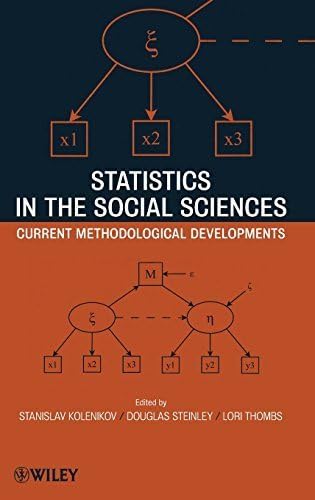
Statistics in the Social Sciences: Current Methodological Developments 1st edition by Kolenikov, Stanislav, Thombs, Lori, Steinley, Douglas (2010) Hardcover
Product ID: 802478816
Buy anything from 5,000+ international stores. One checkout price. No surprise fees. Join 2M+ shoppers on Desertcart.
Desertcart purchases this item on your behalf and handles shipping, customs, and support to Israel.
Buy Statistics in the Social Sciences: Current Methodological Developments 1st edition by Kolenikov, Stanislav, Thombs, Lori, Steinley, Douglas (2010) Hardcover by (ISBN: ) from desertcart's Book Store. Everyday low prices and free delivery on eligible orders. Review: This book grew out of a conference held in 2006 - it's taken a while to get to press, but this doesn't detract from (most of) the chapters. The editors should be applauded for having collected chapters from some of the best known researchers in quantitative social science. I was most interested in the first two chapters, on structural equation models. Chapter 1 (Bentler and Savalei) provides a brief review of what we might think of as 'conventional' structural equation models, and chapter 2 (Bollen, Bauer, Christ, Edwards) then covers the extensions - things like multilevel SEMN, mixture models and complex samples. Neither of these chapters are long (28 and 44 pages, respectively) but both give clear summaries of the issues, and hence form a useful reference - the sort of thing I like to mine for a pithy quote when I need to make a point briefly. I'm less familiar with the techniques in the next couple of chapters. Chapter 3 (Hubert, Kohn, Steinley) is order-constrained proximity matrix represenations. Chapter 4 is multiobjective multidimensional scaling (Brusco, Stahl, Cradit). Although I don't know much about these, I kind of like having them on my shelf so if I'm asked, I can at least say something sensible, before I persuade the person asking to go elsewhere. Chapter 5 is something of a change in tack and a rather long title - Critical differences in Bayesian and non-Bayesian inference and non-Bayesian inference, and why the former is better (Gill). It's a nicely written (although equation heavy, for my taste) description of Bayesian statistics. Does the world need another chapter/article explaining why we should all be Bayesians? Perhaps not, but this is as good as any other chapter I've read - although I'd be tempted to disagree with the title - there are times and places where it's good to be Bayesian, but it seems to me that it's not always necessary. (I'd also argue that Bayesian thinking is already employed in science, it's just not called that.) Chapter 6 I found a little incongruous, it looks more like a journal article than a book chapter. It's called "A bootstrap test of shape invariance across distributions" (and it's by Rouder, Speckman, Steinley, Pratte, and Morey), the title pretty much tells you everything you need to know, except that it's used for reaction times. The length of time between the conference and publication has harmed chapter 7 the most; chapter 7 will also stand the test of time less well than the others. It's on Statistical Software for the Social Sciences and it's by Hilbe. The trouble is that it tries to give very up to date information, for example, the prices of software, and these change. Even if the price doesn't change, the software does - it describes the capabilities of SPSS 16 which has changed its name to PASW and then (almost) back to IBM SPSS, and is on version 18. Similarly, Stata version 9 is described, version 11 was released last year. There's a short chapter at the end that I can summarize as "Statisticians should hang out with social scientists more. And vice versa." Two other minor gripes: It's expensive for a short book - $80 for a 200 page book makes 40 cents a page; I understand that they're not exactly expecting to outsell Harry Potter, but given that the authors and editors who do all the work get paid (I'm guessing) around about nothing, that's a lot. Second, the chapter authors aren't listed until the end of the chapters. Maybe it's me, but I want to know who wrote it when I'm flicking through. Overall, I think that this is a useful reference that I'll be referring back to.
| ASIN | B010WFB0CY |
| Customer reviews | 4.0 4.0 out of 5 stars (1) |
| Language | English |
J**S
This book grew out of a conference held in 2006 - it's taken a while to get to press, but this doesn't detract from (most of) the chapters. The editors should be applauded for having collected chapters from some of the best known researchers in quantitative social science. I was most interested in the first two chapters, on structural equation models. Chapter 1 (Bentler and Savalei) provides a brief review of what we might think of as 'conventional' structural equation models, and chapter 2 (Bollen, Bauer, Christ, Edwards) then covers the extensions - things like multilevel SEMN, mixture models and complex samples. Neither of these chapters are long (28 and 44 pages, respectively) but both give clear summaries of the issues, and hence form a useful reference - the sort of thing I like to mine for a pithy quote when I need to make a point briefly. I'm less familiar with the techniques in the next couple of chapters. Chapter 3 (Hubert, Kohn, Steinley) is order-constrained proximity matrix represenations. Chapter 4 is multiobjective multidimensional scaling (Brusco, Stahl, Cradit). Although I don't know much about these, I kind of like having them on my shelf so if I'm asked, I can at least say something sensible, before I persuade the person asking to go elsewhere. Chapter 5 is something of a change in tack and a rather long title - Critical differences in Bayesian and non-Bayesian inference and non-Bayesian inference, and why the former is better (Gill). It's a nicely written (although equation heavy, for my taste) description of Bayesian statistics. Does the world need another chapter/article explaining why we should all be Bayesians? Perhaps not, but this is as good as any other chapter I've read - although I'd be tempted to disagree with the title - there are times and places where it's good to be Bayesian, but it seems to me that it's not always necessary. (I'd also argue that Bayesian thinking is already employed in science, it's just not called that.) Chapter 6 I found a little incongruous, it looks more like a journal article than a book chapter. It's called "A bootstrap test of shape invariance across distributions" (and it's by Rouder, Speckman, Steinley, Pratte, and Morey), the title pretty much tells you everything you need to know, except that it's used for reaction times. The length of time between the conference and publication has harmed chapter 7 the most; chapter 7 will also stand the test of time less well than the others. It's on Statistical Software for the Social Sciences and it's by Hilbe. The trouble is that it tries to give very up to date information, for example, the prices of software, and these change. Even if the price doesn't change, the software does - it describes the capabilities of SPSS 16 which has changed its name to PASW and then (almost) back to IBM SPSS, and is on version 18. Similarly, Stata version 9 is described, version 11 was released last year. There's a short chapter at the end that I can summarize as "Statisticians should hang out with social scientists more. And vice versa." Two other minor gripes: It's expensive for a short book - $80 for a 200 page book makes 40 cents a page; I understand that they're not exactly expecting to outsell Harry Potter, but given that the authors and editors who do all the work get paid (I'm guessing) around about nothing, that's a lot. Second, the chapter authors aren't listed until the end of the chapters. Maybe it's me, but I want to know who wrote it when I'm flicking through. Overall, I think that this is a useful reference that I'll be referring back to.
Trustpilot
3 weeks ago
3 days ago