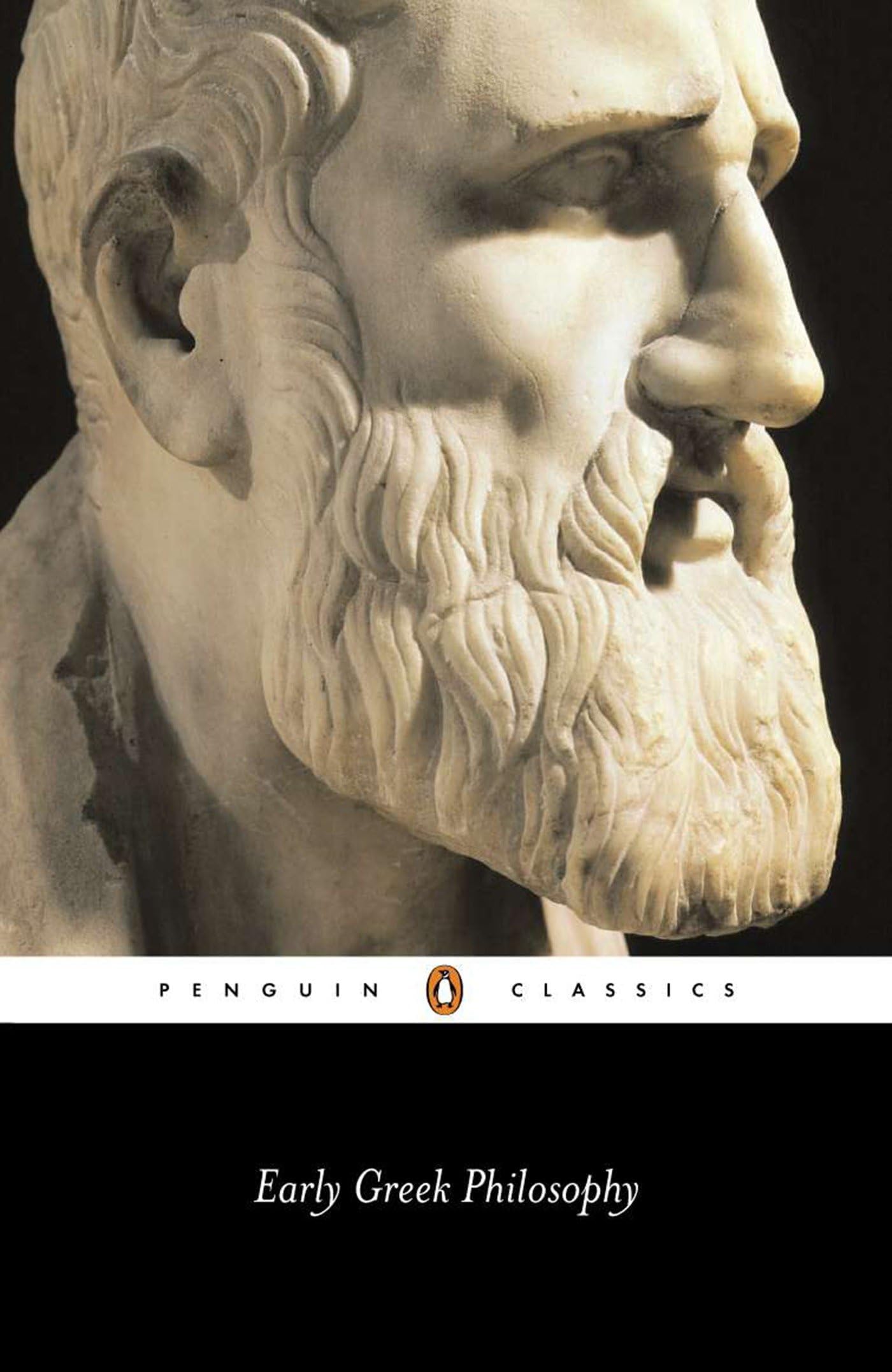
Early Greek Philosophy
Desertcart purchases this item on your behalf and handles shipping, customs, and support to Israel.
Description
This anthology presents the early sages of Western philosophy and science who paved the way for Plato and Aristotle and their successors. Democritus's atomic theory of matter, Zeno's dazzling "proofs" that motion is impossible, Pythagorean insights into mathematics, Heraclitus's haunting and enigmatic epigrams-all form part of a revolution in human thought that relied on reasoning, forged the first scientific vocabulary, and laid the foundations of Western philosophy. Jonathan Barnes has painstakingly brought together the surviving Presocratic fragments in their original contexts, utilizing the latest research and a newly discovered major papyrus of Empedocles. Review: Five Stars - Great book....superb... Review: Over charging - Book was over charged than printed price.
Specifications
| Best Sellers Rank | #163,170 in Books ( See Top 100 in Books ) #574 in Ancient History (Books) #918 in European History (Books) #59,811 in Literature & Fiction (Books) |
| Customer Reviews | 4.6 out of 5 stars 164 Reviews |
Reviews
S**L
Five Stars
Great book....superb...
A**R
Over charging
Book was over charged than printed price.
E**O
Worthless
A heavily edited book with virtually nothing about the writers it's supposed to contain.
A**A
Une bonne introduction aux philosophes présocratiques
Une introduction à la fois vivante et bien documentée aux fragments des philosophes présocratiques. Ouvrage relativement récent et malheureusement peu connu en France
P**I
Great book.
Awesome reading
R**S
Degree requirement
Required for coursework for 2nd year of philosophy degree, well presented with introduction and notes
G**L
thinkers like Thales, Anaximander
The early Greek philosophers, thinkers like Thales, Anaximander, Pythagoras, Parmenides, Zeno, Empedocles, Leucippus, are foundational for the Western intellectual tradition. I couldn't imagine a better book then this one on the subject. Below are a few quotes from Jonathan Barnes's excellent 40 page introduction along with my brief comments: "First and most simply, the Presocratics invented the very idea of science and philosophy. They hit upon that special way of looking at the world which is the scientific and rational way. They saw the world as something ordered and intelligible, its history following an explicable course and its different parts arranged in a comprehensible system. The world was not a random collection of bits, its history was not an arbitrary jumble of events." ---------- This is central to their spirit of inquiry, an approach compatible with a modern physicist or chemist. "Nor was the world a series of events determined by the will or the caprice of the gods. The Presocratics were not atheists: they allowed the god into their brave new world, and some of them attempted to produce an improved and rationalized theology in place of the anthropomorphic divinities of the Olympian pantheon. But their theology had little to do with religion, and they removed most of the traditional functions of the gods. Their thunder was no longer the growling of a minatory Zeus." ----------- Again, the Presocratics have kindred spirits in the science departments at modern universities. Jonathan Barnes goes on to write how the Presocratics explained the world in ways that were systematic and economical, that is, these early philosophers wanted to "explain as much as possible in terms of as little as possible." Some of their key concepts were order (kosmos), nature (phusis), origins (arche) , and reason (logos). --------- These Greek words are supercharged with meaning. I used one English word for simplicity sake. How supercharged? The author does a fine job elaborating. The words of the Presocratics have come down to us as fragments. Here are several of my favorites: Xenophanes "But if cows and horses or lions had hands and drew with their hands or made the things men make, then horses would draw the forms of gods like horses, cows like cows, and each would make their bodies similar in shape to their own." Heraclitus "The uncomprehending, when they hear, are like the deaf. To them applies the saying: though present they are absent." Democritus "To a wise man the whole earth is accessible; for the country of a great soul is the whole world." "The desire for more destroys what is present - like Aesop's dog." "One should tell the truth, not speak at length."
Common Questions
Trustpilot