
قم بتنزيل التطبيق


معلومات عنا
حقوق الطبع والنشر © 2024 Desertcart Holdings Limited
قم بتنزيل التطبيق
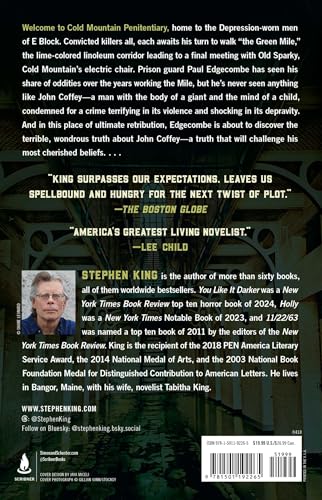

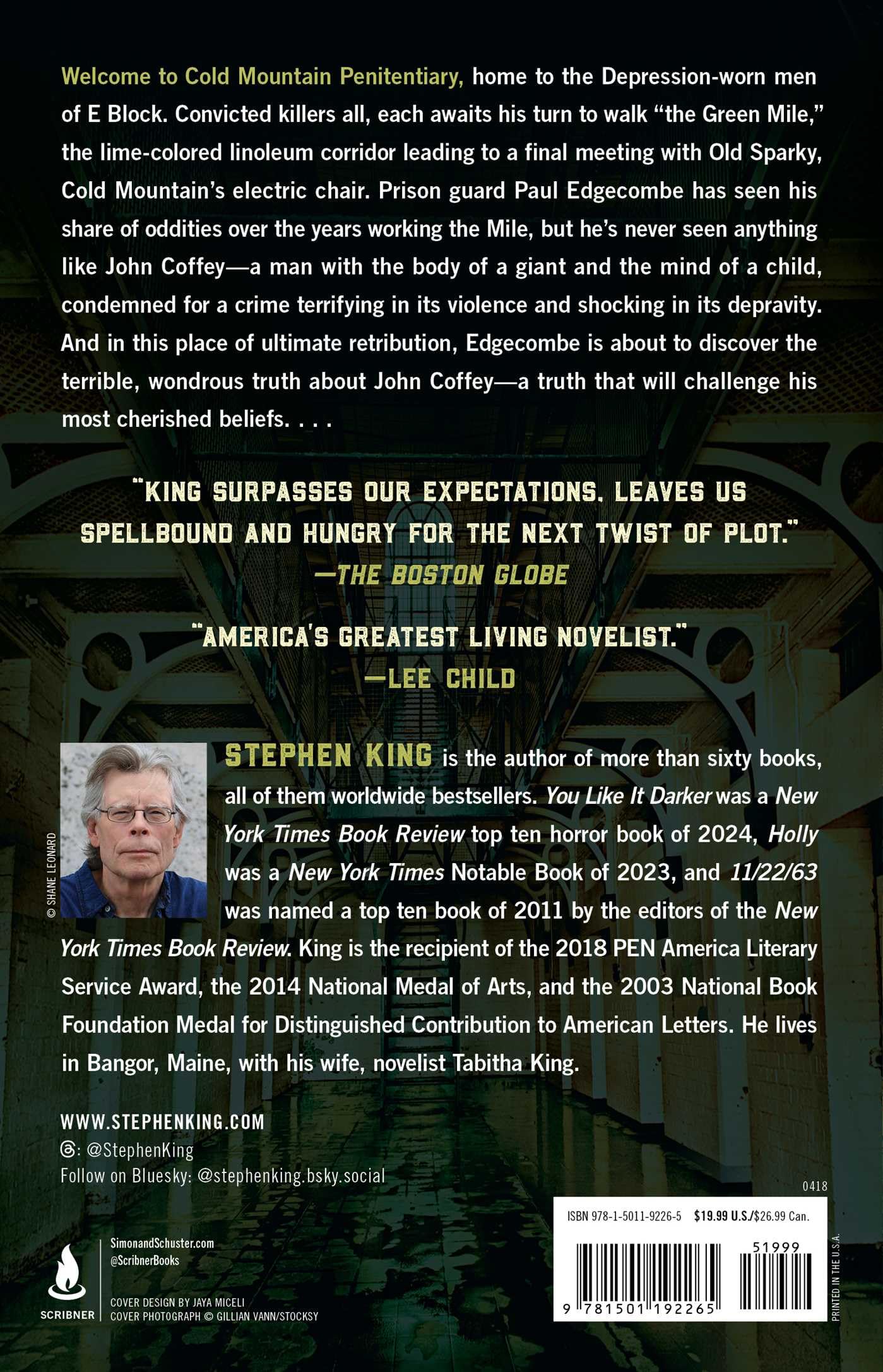

desertcart.com: The Green Mile: The Complete Serial Novel: 9781501192265: King, Stephen: Books Review: Walking the Green Mile After Mockingbird - After finishing To Kill a Mockingbird, I decided to read The Green Mile because both stories take place around the same time period. I wanted to continue exploring that world and see how different writers depict justice and humanity in the 1930s. My first challenge was the language. Stephen King’s style included strong Southern dialects and expressions I wasn’t familiar with, which slowed me down. I switched to the Russian translation, but it felt dull and lifeless—the emotional depth just wasn’t there. So I went back to the English version, and after about a hundred pages I started to understand more and more. I read faster, enjoyed it deeply, and soon couldn’t stop. The story completely drew me in. I found myself thinking about it all the time, visualizing the prison block, the guards, and their humanity. The themes haunted me—they were heavy, emotional, and deeply psychological. The novel works on several layers: life in the nursing home where an old Paul Edgecombe reflects on his past, the death row cell block where moral lines blur, and the intense spiritual symbolism that threads through everything. King’s imagination is enormous. I still wonder how he managed to weave together so many powerful moments, all connected like puzzle pieces. While reading, there were times when I was overwhelmed with emotion. I cried when John Coffey healed Melinda—it was such a moment of grace in a place full of death. I truly believed that Paul and his team might somehow help John escape. But then John spoke with such heartbreaking exhaustion, saying he was tired of the pain and cruelty in the world, tired of hearing and feeling so much suffering that it hurt like shards of glass in his mind. His words captured the unbearable emotional weight he carried. That moment shattered me; it was both devastating and beautiful. Both To Kill a Mockingbird and The Green Mile are about injustice set against the backdrop of 1930s America, yet King’s story feels more intense and direct. To Kill a Mockingbird won the Pulitzer Prize for its brilliant portrayal of racial and moral conflict, but The Green Mile goes even deeper into the heart of human cruelty and compassion. In both stories, the Black characters—John Coffey and Tom Robinson—represent goodness and innocence, while many white characters embody prejudice, fear, and ignorance. I am deeply glad I read these two books one after the other. They mirror each other, and together they taught me something vital about empathy and the complexity of justice. The Green Mile is not only a psychological thriller; it’s also a story about mercy, sacrifice, and the unbearable beauty of kindness in the face of despair. It’s one of those books that stays with you long after you finish the last page. Review: A Classic That's Still Amazing - If you've seen the award-winning movie with Tom Hanks, then by and large, you know exactly what to expect from this book. That's not to say you shouldn't read this book for fear it will be redundant. In fact, I would almost advise you to watch the movie first, then read the book. The movie recreates the novel almost scene for scene, so much so that, barring some minor omissions, the movie quotes much of the dialogue verbatim. I say watch the movie first because when you read the book, you'll compulsively imagine each of the characters using the actor that portrayed them in the film. Each actor that was cast was PERFECT for the character as they're described in "The Green Mile", so for those who have trouble transforming words into a face and accent, the movie helps out a lot. A word of caution though: while 3/4s of the novel is translated to film almost perfectly, the movie cuts out multiple scenes that occur later in the book, and ultimately changes the ending quite extensively ... and that's for the better. The final scenes in the book are good, without a doubt, but in comparison to the film, somewhat lacking for dramatic impact. Additionally, there is a chapter at the very end of the book that, really, can just be ignored, as it feels tacked on and doesn't add anything to the rest of the story. If you're familiar with, and have read Stephen King's work, then in many ways you know what to expect from this novel: dialogue, including slang and vernacular, are handled beautifully in this novel, and as always, makes you feel like someone you know is relating this story to you. In the case of "The Green Mile", this is especially true since this is one of King's only books to use the first person perspective throughout. And it's not simply that instead of a lot of third person phrasing it uses first person phrasing, but that the narrator himself is truly a character both within and outside the story. What I mean by this is that "The Green Mile" takes the format of an old man recalling, bit by bit, his experiences from 60 years prior. As would be befitting of something like this, this means the narrative is frequently interjected with frank opinions, incongruous recollections, and general use of slang that makes it feel exactly like a real person is recalling a real set of memories. To some this might make the story somewhat confusing; at times, the narrative doubles back on itself (though this is mostly an artifict of the conversion from serial novella to one piece novel), and each chapter begins in the present day before flipping back to the 1930s. Unlike many of King's novels, this story is largely devoid of any monsters, aliens, or magical happenings. In fact, other than a few scenes (possibly a half-dozen in number or so), this story reads mostly as a period piece centered around one strange man's time on death row. But this isn't a bad thing at all; this story is still incredibly compelling, reading like a combination of a character study and a classic mystery tale. The eventual plot twist heigtens the drama and throws things for a loop, which makes the conclusion of both the 1930s plot, and the current day plot nothing short of memorable to a degree that might bring forth a few tears. I would definitely advise that you leave yourself an hour or so to read right through the final chapters of the novel to avoid interrupting the pace and emotional impact.




| Best Sellers Rank | #9,978 in Books ( See Top 100 in Books ) #32 in TV, Movie & Game Tie-In Fiction #67 in Horror Occult & Supernatural #918 in Suspense Thrillers |
| Customer Reviews | 4.8 4.8 out of 5 stars (15,218) |
| Dimensions | 5.31 x 1 x 8.25 inches |
| Edition | Reprint |
| ISBN-10 | 1501192264 |
| ISBN-13 | 978-1501192265 |
| Item Weight | 11.2 ounces |
| Language | English |
| Print length | 432 pages |
| Publication date | April 17, 2018 |
| Publisher | Scribner |
V**N
Walking the Green Mile After Mockingbird
After finishing To Kill a Mockingbird, I decided to read The Green Mile because both stories take place around the same time period. I wanted to continue exploring that world and see how different writers depict justice and humanity in the 1930s. My first challenge was the language. Stephen King’s style included strong Southern dialects and expressions I wasn’t familiar with, which slowed me down. I switched to the Russian translation, but it felt dull and lifeless—the emotional depth just wasn’t there. So I went back to the English version, and after about a hundred pages I started to understand more and more. I read faster, enjoyed it deeply, and soon couldn’t stop. The story completely drew me in. I found myself thinking about it all the time, visualizing the prison block, the guards, and their humanity. The themes haunted me—they were heavy, emotional, and deeply psychological. The novel works on several layers: life in the nursing home where an old Paul Edgecombe reflects on his past, the death row cell block where moral lines blur, and the intense spiritual symbolism that threads through everything. King’s imagination is enormous. I still wonder how he managed to weave together so many powerful moments, all connected like puzzle pieces. While reading, there were times when I was overwhelmed with emotion. I cried when John Coffey healed Melinda—it was such a moment of grace in a place full of death. I truly believed that Paul and his team might somehow help John escape. But then John spoke with such heartbreaking exhaustion, saying he was tired of the pain and cruelty in the world, tired of hearing and feeling so much suffering that it hurt like shards of glass in his mind. His words captured the unbearable emotional weight he carried. That moment shattered me; it was both devastating and beautiful. Both To Kill a Mockingbird and The Green Mile are about injustice set against the backdrop of 1930s America, yet King’s story feels more intense and direct. To Kill a Mockingbird won the Pulitzer Prize for its brilliant portrayal of racial and moral conflict, but The Green Mile goes even deeper into the heart of human cruelty and compassion. In both stories, the Black characters—John Coffey and Tom Robinson—represent goodness and innocence, while many white characters embody prejudice, fear, and ignorance. I am deeply glad I read these two books one after the other. They mirror each other, and together they taught me something vital about empathy and the complexity of justice. The Green Mile is not only a psychological thriller; it’s also a story about mercy, sacrifice, and the unbearable beauty of kindness in the face of despair. It’s one of those books that stays with you long after you finish the last page.
A**Y
A Classic That's Still Amazing
If you've seen the award-winning movie with Tom Hanks, then by and large, you know exactly what to expect from this book. That's not to say you shouldn't read this book for fear it will be redundant. In fact, I would almost advise you to watch the movie first, then read the book. The movie recreates the novel almost scene for scene, so much so that, barring some minor omissions, the movie quotes much of the dialogue verbatim. I say watch the movie first because when you read the book, you'll compulsively imagine each of the characters using the actor that portrayed them in the film. Each actor that was cast was PERFECT for the character as they're described in "The Green Mile", so for those who have trouble transforming words into a face and accent, the movie helps out a lot. A word of caution though: while 3/4s of the novel is translated to film almost perfectly, the movie cuts out multiple scenes that occur later in the book, and ultimately changes the ending quite extensively ... and that's for the better. The final scenes in the book are good, without a doubt, but in comparison to the film, somewhat lacking for dramatic impact. Additionally, there is a chapter at the very end of the book that, really, can just be ignored, as it feels tacked on and doesn't add anything to the rest of the story. If you're familiar with, and have read Stephen King's work, then in many ways you know what to expect from this novel: dialogue, including slang and vernacular, are handled beautifully in this novel, and as always, makes you feel like someone you know is relating this story to you. In the case of "The Green Mile", this is especially true since this is one of King's only books to use the first person perspective throughout. And it's not simply that instead of a lot of third person phrasing it uses first person phrasing, but that the narrator himself is truly a character both within and outside the story. What I mean by this is that "The Green Mile" takes the format of an old man recalling, bit by bit, his experiences from 60 years prior. As would be befitting of something like this, this means the narrative is frequently interjected with frank opinions, incongruous recollections, and general use of slang that makes it feel exactly like a real person is recalling a real set of memories. To some this might make the story somewhat confusing; at times, the narrative doubles back on itself (though this is mostly an artifict of the conversion from serial novella to one piece novel), and each chapter begins in the present day before flipping back to the 1930s. Unlike many of King's novels, this story is largely devoid of any monsters, aliens, or magical happenings. In fact, other than a few scenes (possibly a half-dozen in number or so), this story reads mostly as a period piece centered around one strange man's time on death row. But this isn't a bad thing at all; this story is still incredibly compelling, reading like a combination of a character study and a classic mystery tale. The eventual plot twist heigtens the drama and throws things for a loop, which makes the conclusion of both the 1930s plot, and the current day plot nothing short of memorable to a degree that might bring forth a few tears. I would definitely advise that you leave yourself an hour or so to read right through the final chapters of the novel to avoid interrupting the pace and emotional impact.
V**E
I've really enjoyed this one, and I watched the movie first. I totally recommend it
ひ**ん
映画の感動をより深く味わいました。Stephen Kingの小説はどれもいいですね。
D**D
Excellent book.
E**K
I couldn’t finish it……
C**L
Livros de Stephen King são excelentes e este é muito bom.
ترست بايلوت
منذ أسبوعين
منذ 3 أيام