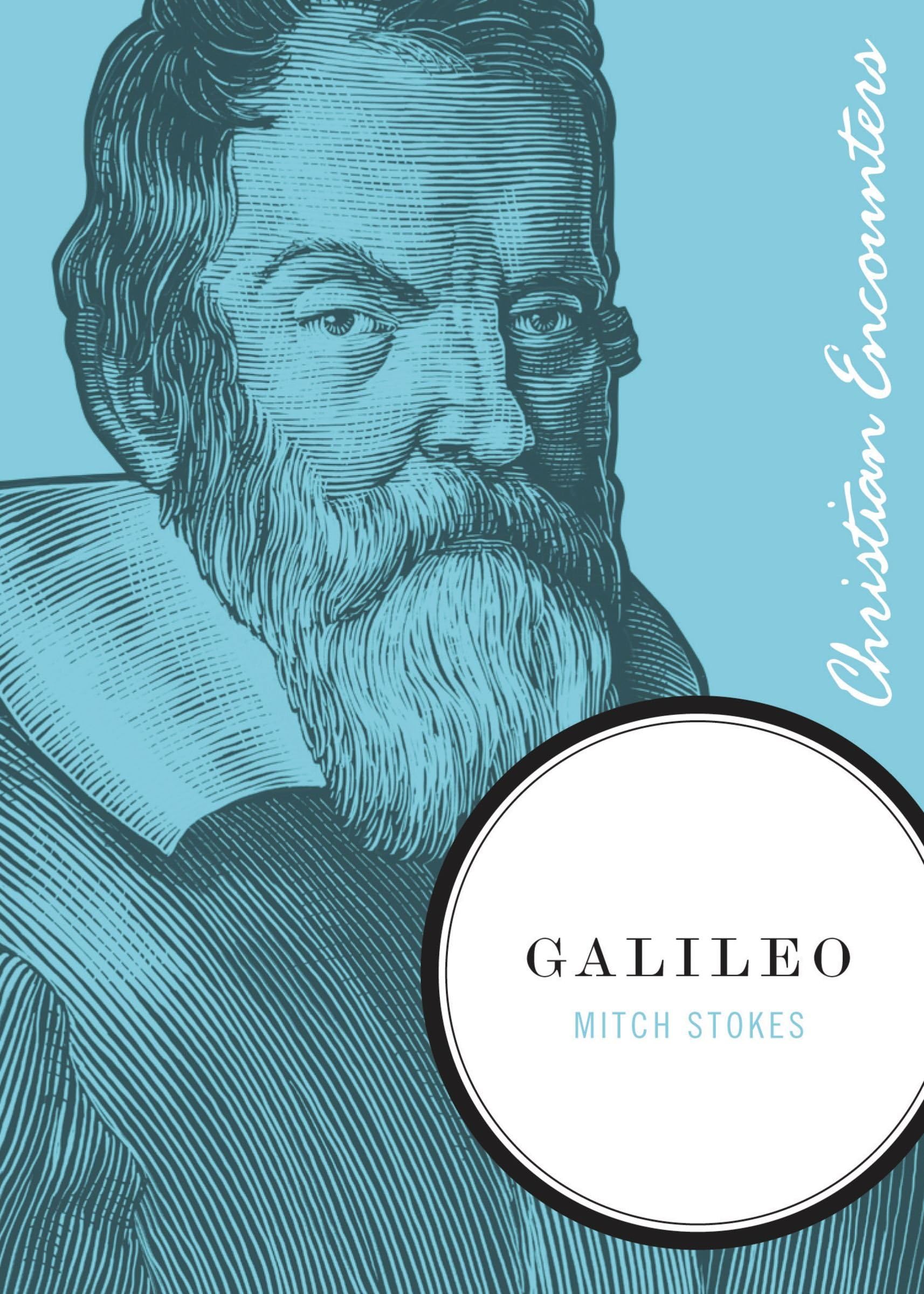
Galileo (Christian Encounters)
Product ID: 59183050
Desertcart purchases this item on your behalf and handles shipping, customs, and support to Israel.
We learn about life through the lives of others. Their experiences, their trials, their adventures become our schools, our chapels, our playgrounds. Christian Encounters, a series of biographies from Thomas Nelson Publishers, highlights important lives from all ages and areas of the Church through prose as accessible and concise as it is personal and engaging. Some are familiar faces. Others are unexpected guests. Whether the person is Galileo, William F. Buckley, John Bunyan, or Isaac Newton, we are now living in the world that they created and understand both it and ourselves better in the light of their lives. Their relationships, struggles, prayers, and desires uniquely illuminate our shared experience. HERO OR HERETIC? GENIUS OR BLASPHEMER? It's no mystery how profound a role Galileo played in the Scientific Revolution. Less explored is the Italian innovator's sincere, guiding faith in God. In this exhaustively researched biography that reads like a page-turning novel, Mitch Stokes draws on his expertise in philosophy, logic, math, and science to attune modern ears with Galileo's controversial genius. Emerging from the same Florentine milieu that produced Dante, da Vinci, Machiavelli, Michelangelo, Amerigo Vespuci, Galileo questioned with a persistence that spurred his world toward an unabating era of discovery. Stokes confronts the myth that Galileo's stance on heliocentricity stood astride a church vs. science divide and explores his calculations for the dimensions of Dante's hell, his understanding of motion, and his invention of the pendulum clock. To read this volume is to journey through Galileo's remarkable life: from his inquisitive childhood to his dying days, when, although blind and decrepit, he soldiered on, dictating mathematical thoughts and mentoring young proteges. Review: More Galileo - Interesting approach covering a very interesting man of science and his times. Well presented and documented. There's always more to this many times told tale. Review: Galileo: An Italian Genius - "On February 19, 1616, at the behest of the pope, the Holy Office of the Inquisition asked a panel of eleven1595550313_l theologians to judge the following Copernican theses." The thesis was stated as follows: The sun is the center of the world and hence immovable of local motion. The earth is not the center of the world, nor immovable but moves according to the whole of itself, also with a diurnal motion. The papal lynch mob responded in kind by suggesting that the immobility of the sun, was "foolish and absurd in philosophy, and formally heretical, inasmuch as it expressly contradicts the doctrine of the Holy Scripture in many passages, both in their literal meaning and according to the general interpretation of the Fathers and Doctors." The second thesis was judged in similar fashion: "... To receive the same censure in philosophy and, as regards theological truth, to be at least erroneous in faith." These are the matters before the Roman Catholic Church in the early 17th century, just over 100 years after the thunderbolt that struck when Luther hammered his 95 thesis on the castle door for public dispute. Luther's action was considered treasonous and heretical and was consequently labeled as a heretic and labeled by the Pope Leo XV as a "wild boar in the vineyard." As a result, Luther is hunted for the remainder of his days. Evidently, bad habits die hard because Rome is still on the hunt in the 17th century - only this time, their target is the brilliant scientist, Galileo. Galileo by Mitch Stokes is a fascinating account of a man who sought to reconcile the universals and the particulars. He was not only a sharp scientist (some consider him to be the most influential in the history of western thought), he also had a keen philosophical mind and a heart for the Scriptures. Stokes guides readers on a fairly comprehensive tour of the Italian genius. He chronicles his days as a boy and discusses the influence of his father, his life as a university student, and ultimately his career as a university professor. But the most interesting part of the tale has to do with Galileo's defense of Copernicus, the German astronomer who set forth a heliocentric vision of the universe. This vision bravely displaced the earth from the center and moved the sun to "center" stage. Initially, Rome was content to simply put up with the heliocentric model, (even though the church essentially prohibited the promotion of Copernicanism in a 1616 edict), so long as it was presented as mere "mathematical tool." Galileo was not content was this clever arrangement - even as his friend made his ascent to the papal throne - Pope Urban VIII. The publication of Galileo's book, Dialogue prompted a firestorm that led the Pope to order a special Commission to investigate the contents of the book. The controversy eventually escalated which resulted in "an outburst of rage" from the Pope who remarked that Galileo had "entered the most dangerous ground there was." Ultimately, Pope Urban accused Galileo of betraying his trust. As a result, he refused to allow Galileo to speak to him personally. Evidently, Galileo forgot that the Pope speaks ex cathedra!




| Best Sellers Rank | #971,946 in Books ( See Top 100 in Books ) #998 in Science & Religion (Books) #1,248 in Scientist Biographies #4,141 in Religious Leader Biographies |
| Customer Reviews | 4.3 out of 5 stars 66 Reviews |
K**R
More Galileo
Interesting approach covering a very interesting man of science and his times. Well presented and documented. There's always more to this many times told tale.
D**E
Galileo: An Italian Genius
"On February 19, 1616, at the behest of the pope, the Holy Office of the Inquisition asked a panel of eleven1595550313_l theologians to judge the following Copernican theses." The thesis was stated as follows: The sun is the center of the world and hence immovable of local motion. The earth is not the center of the world, nor immovable but moves according to the whole of itself, also with a diurnal motion. The papal lynch mob responded in kind by suggesting that the immobility of the sun, was "foolish and absurd in philosophy, and formally heretical, inasmuch as it expressly contradicts the doctrine of the Holy Scripture in many passages, both in their literal meaning and according to the general interpretation of the Fathers and Doctors." The second thesis was judged in similar fashion: "... To receive the same censure in philosophy and, as regards theological truth, to be at least erroneous in faith." These are the matters before the Roman Catholic Church in the early 17th century, just over 100 years after the thunderbolt that struck when Luther hammered his 95 thesis on the castle door for public dispute. Luther's action was considered treasonous and heretical and was consequently labeled as a heretic and labeled by the Pope Leo XV as a "wild boar in the vineyard." As a result, Luther is hunted for the remainder of his days. Evidently, bad habits die hard because Rome is still on the hunt in the 17th century - only this time, their target is the brilliant scientist, Galileo. Galileo by Mitch Stokes is a fascinating account of a man who sought to reconcile the universals and the particulars. He was not only a sharp scientist (some consider him to be the most influential in the history of western thought), he also had a keen philosophical mind and a heart for the Scriptures. Stokes guides readers on a fairly comprehensive tour of the Italian genius. He chronicles his days as a boy and discusses the influence of his father, his life as a university student, and ultimately his career as a university professor. But the most interesting part of the tale has to do with Galileo's defense of Copernicus, the German astronomer who set forth a heliocentric vision of the universe. This vision bravely displaced the earth from the center and moved the sun to "center" stage. Initially, Rome was content to simply put up with the heliocentric model, (even though the church essentially prohibited the promotion of Copernicanism in a 1616 edict), so long as it was presented as mere "mathematical tool." Galileo was not content was this clever arrangement - even as his friend made his ascent to the papal throne - Pope Urban VIII. The publication of Galileo's book, Dialogue prompted a firestorm that led the Pope to order a special Commission to investigate the contents of the book. The controversy eventually escalated which resulted in "an outburst of rage" from the Pope who remarked that Galileo had "entered the most dangerous ground there was." Ultimately, Pope Urban accused Galileo of betraying his trust. As a result, he refused to allow Galileo to speak to him personally. Evidently, Galileo forgot that the Pope speaks ex cathedra!
M**S
Loved this book.
I just finished the book Galileo by Mitch Stokes from the Christian Encounters Series. I received this book from BookSneeze. I am going to start this review by telling you that I immensely enjoyed this book. I don't normally read biographies, but I was drawn to this one because I feel some small amount of kindred with all mathematicians. I can't say that I had any specific curiosity about Galileo in particular, but all of the historical scientists and mathematicians grab some measure of my attention. As I started this book, I noticed immediately a couple of things about the author, Mitch Stokes. First, I noticed the amount of work that must have gone into this book from the immense amount of footnoting. The book ends with the 16 pages of referenced footnotes. When an author goes to that much effort to validate what he is saying, you walk away feeling like you have read an accurate account and not simply one author's opinion. The second thing I noticed about the author is his, for lack of a better word, personableness. I don't think that is a real word, at least the spell-checker is telling me that it isn't, but that's the best I could do. I tell you this because I felt, while I was reading this, as if I was hearing the story from a close friend of Galileo's, someone who really knew him, and someone who cared about his story. To be able to write about someone in such a way that you walk away feeling you got all of the historical facts in an accurate manner and at the same time you feel as though you were talking to an acquaintance is a hefty task. Whether or not Mitch Stokes was attempting to accomplish that goal or not, I have no idea, but that is how I walked away from this book. This leads me to my next point, because of this book, I have a new appreciation for Galileo. As much as Galileo was a scientist and sought to have his mathematics and his science to correlate perfectly with the observable world, he also had great respect for the church. This book included example after example where Galileo demonstrated his submission to the authority of the church. This is one area where the legends have misconstrued the reality of the story. In Galileo's book, titled Dialogue, he begins to draw to a conclusion his arguments for Copernicanism by also stating that there is an argument before which one "must fall silent." I know that if asked whether God in His infinite power and wisdom could have conferred upon the watery element its observed reciprocating motion using some other means than moving its containing vessels, both of you would reply that He could have, and that He would have known how to do this in many ways which are unthinkable to our minds. From this I forthwith conclude that, this being so, it would be excessive boldness for anyone to limit and restrict the Divine power and wisdom to some particular fancy of his own. In other words, Galileo, after arguing for the motion of the earth (which we now know is true) by saying that the tides were caused by the motion of the earth (which they aren't, they are caused by the gravity of the moon) he states that what he has observed could be explained in an infinite number of other ways because there is an infinitely powerful God. Galileo also argued for the church (or at least the believers) to be able to give a believable account for what they hold to be true from scripture. He put it this way (by quoting Augustine): The distressing thing is not so much that an erring man [i.e., the believer] should be laughed at, but that our authors [of scripture] should be thought by outsiders to believe such things, and should be criticized and rejected ignorant, to the great detriment for those whose salvation we care about. For how can they believe our books in regard to the resurrection of the dead, the hope of eternal life, and the kingdom of heaven, when they catch a Christian committing an error about something they know very well, when they declare false his opinion taken from those books, and when they find these full of fallacies in regard to things they have already been able to observe or to establish by unquestionable argument? This way of thinking presents some challenges and hurdles when considering the consensus science that is around today. Anyway... Read this book. It is worth the time.
D**M
A Cliffs Note biography with irritating editorialising
First off, two notes/disclosures: Firstly, I was not familiar with the Christian Encounters series before purchasing this book and did not quite get what I thought I would be getting, and, secondly, I myself am not a Christian. That said, I liked this book and I disliked it. Pros: It is a concise biography and a quick read; the chapters are short, the style clear --perhaps even a bit overly simple. I did learn a few new things about Galileo, and I did find the mild rebuttals to the typical "Galileo was persecuted because he was a scientist" story interesting; this wasn't something I'd thought about much, before. Cons: There are just too many "jokes" (mostly as sarcastic comments) sprinkled throughout the book. Yes, math is hard and, yes, science is "sciency" and, yes, people who like math and science are sometimes oddballs. But the jokes get old and at some point it begins to feel like the author is either condescending to the reader or presenting math/science as something "those other people do." Cons "the second": My second complaint is due to my not being a Christian, so I'm separating it; obviously, a book in the "Christian Encounters" series is not aimed at me. That said, I do feel like there was too much editorializing along the lines of "well, obviously this all wouldn't work if it weren't designed that way." Wink, wink, nudge, nudge. I think the effect of this was magnified because of the above mentioned snarkiness re: math being hard, etc. Again, it condescends to the reader to joke, "Hey, math is hard and people who do it are a bit off!" and then say a few pages later, "Hey, but we all know the math wouldn't work unless it was all designed so well." Overall, a decent short biography, but with a number of stylistic/presentation flaws, and aimed at a specific audience.
R**E
Galileo
I recently read a book for review that I found absolutely intriguing. The book was my Mitch Stokes titled `Galileo' and is part of the `Christian Encounter' series. The book was a biography of sorts and did an excellent job of connecting the reader to the person, age and events of this historical figure. One of the misconceptions that many have (and I had) was that Galileo was on a quest against Christianity. In fact, quite the opposite was true. Galileo held both the Church and Scripture in high regard and, as he on many occasions would reiterate, the scripture is inspired and infallible. He always kept that before him as he progressed through his "investigations". What was really in conflict was the view that the Church took concerning the celestial structure and function. The problem from the very beginning was that the Church embraced a pagan's philosophy of the universe. The church had embraced Aristotle's terrestrial (and the Ptolemaic celestial theory of) physics and philosophy which obviously did not take into account any biblical statements concerning the universe (if they did the world would not have been flat for so long). Early on, Aristotle became the one-man-band and civilization embraced everything Aristotle (i.e. logic, rhetoric, poetry, ethics, physics, zoology, cosmology, and metaphysics. As such, the wisdom of the day said that the earth was the center of the universe and everything rotated around it as based on the Ptolemaic system. However, Galileo became convinced of a theory more along the lines of Copernicus' theory, which simply put, puts the Sun at the center of the celestial spheres, though not necessarily as the celestial center. The Church, however, was stuck on interpreting the Scripture, for the most part, on face-value. This brought Galileo in conflict with passages like Joshua 10:12-13, "At that time Joshua spoke to the LORD in the day when the LORD gave the Amorites over to the sons of Israel, and he said in the sight of Israel, "Sun, stand still at Gibeon, and moon, in the Valley of Aijalon." And the sun stood still, and the moon stopped, until the nation took vengeance on their enemies. Is this not written in the Book of Jashar? The sun stopped in the midst of heaven and did not hurry to set for about a whole day." The Church took a literal stand which made the earth (at least) the center for the sun and thus the Aristotelian understanding was consistent with the scripture. This was the Church's official stance. Galileo however, argued that since both nature and the scripture were revelation from God they each functioned in accord with one another. The Scripture was not primarily a work of scientific facts as it was a detail revealing of the personal God in relation to man. They do not oppose, they compliment. Galileo said, "Though Scripture cannot err...some of its interpreters and expositors can sometimes err in various ways. One of these would be very serious and very frequent, namely, to want to limit oneself always to the literal meaning of the words; for there would thus emerge not only various contradictions but also serious heresies and blasphemies..." Galileo clearly believed, depending on the topic, that the Scripture doesn't always speak literally. The battle, therefore, wasn't about faith vs. non-faith. It was about taking the scripture and scientific fact and showing how the two speak in unison to the God of creation. The error wasn't necessarily on Galileo's side. It was on the Church's side. They embraced the humanist and self-sufficient philosopher's theory and made it dogma. And when that happens, old habits die hard. The book itself is a very easy read. The font size looks like 12 pt. There are about 29 lines to a page and the book is very well written. The book sizes 7 in. x 5 in. x .5 in. If you like history, science, philosophy or theology there should be enough to keep your interests all the way through. As a minister and a lover of history this was right up my alley. I would definitely recommend this read. Disclosure of Material Connection: I received this book free from the publisher through the BookSneeze®.com <[...]> book review bloggers program. I was not required to write a positive review. The opinions I have expressed are my own. I am disclosing this in accordance with the Federal Trade Commission's 16 CFR, Part 255
C**T
A Solid Purchase
Probably the best book that I'm going to read on a guy like Galileo, but really, who's really like him? I was surprised by how informative historically this book was, and I really like it. He was such an interesting guy and I wouldn't have known it had I not seen a review on a blog I frequent. Definitely worth the price on a Kindle, which works great. Great job, author!
A**Y
Galileo Galilei
Galileo (Christian Encounters Series) Galileo. The name itself is likely to be immediately recognizable by most youth and adults today. It is often that he is the subject of science textbooks and even modern debates. Mitch Stokes' excellent biography is part of the Christian Encounters series which also includes his contribution on Isaac Newton. In this biography Stokes explores the controversial and misunderstood genius of Galileo Galilei. In 1564 when Galileo was born. He was seemingly a young man who couldn't get his act together and struggled financially most of his adult life. The year he was born is the same year that witnessed the birth of Shakespeare and the deaths of John Calvin and Michaelangelo. He emerged from the Florentine tradition that produced such men as Machiavelli, Vespucci, and da Vinci. Galileo's father, Vicenzio Galilei, passed on to his son a Aristotelian view of things. Stokes also notes that "We can identify perhaps ten people in the world who held Copernicus' view between 1543 and 1600. It seems that Galileo was one of those ten." (pg 67) Often Galileo is used as a hero of martyrdom. This was especially so during the Enlightenment era. Stokes suggests that portrait is historically inaccurate. In fact, Galileo states, "none...have spoken with more piety or with greater zeal for the Church than I."(pg. 3) Galileo was devout to his faith even until death. While mathematics was lacking in his time, his contention concerned the interpretation of Scriptures. His biggest mistake may have been his interaction with Pope Urban VIII whom, in his description of Galileo stated: "He did not fear to make sport of me." (pg. 165) Although some mistakenly think so that contention was never couched in a secular science versus religion debate. In 1981 Pope John Paul II formed an interdisciplinary commission to investigate the nagging affair of Galileo. A long eleven years later, in 1992, the report materialized. The report summary is worth a thousand words: "It is in the historical and cultural framework, far removed from our own times, the Galileo's judges, incapable of dissociating faith from age-old cosmology, believed, quite wrongly, that the adoption of the Copernican revolution, in fact not yet definitely proven, was such as to undermine Catholic tradition and that it was their duty to forbid its being taught. This subjective error of judgement, so clear to us today, led them to a disciplinary measure from which Galileo "had much to suffer." These mistakes must be frankly recognized, as you, Holy Father, have requested." (pg. 194) Prior to his death men such as Thomas Hobbes and John Milton would visit Galileo. Ironically, Galileo died on January 8, 1642 the same year Isaac Newton was born on a small farm in England. Newton's work published in 1687, The Principia, would cause greater acceptance of the Copernican system for which Galileo was told could not exist. Indeed, ten years after Newton's death the body of Galileo was moved from a small room under a bell tower to a tomb, finally built, near Michaelangelo's and Machiavelli's tomb's in Saint Croce's basilica. Galileo (Christian Encounters Series)
C**E
Great Christian Biography
Galileo is the first I've read in the Christian Encounters series. I love Christian biographies--they encourage me to be more for God and they show me that amazing people weren't perfect and often fell short. They had their own problems but God still used them to do glorious, amazing things. Galileo was a man like that. He wouldn't bow down to "the Church" of his day or the scientific community when their beliefs and ideas were wrong. No one wanted to believe the earth was round, whether that was true or not. They didn't want anyone questioning their long held traditions because of the control those traditions and thoughts held over the people. Thinking of this book makes me think of the scripture, "Let God be true and every man a liar." Perhaps you didn't realize Galileo was a Christian. After all, he was excommunicated by the church as a heretic. Well, so were Martin Luther and William Tyndale, who defied the Catholic church around the same time. They brought about the Protestant Reformation and brought the Word of God to the common people. This book opened up my eyes about this amazing man. He not only made amazing strides in Science and Mathematics, but was also a man whose "love of words would change the style of Italian literature." A man after my own heart! In more ways than one... I didn't realize before that Galileo was a Christian but that doesn't surprise me--the way the public education system has completely rewritten history and removed any mention of true Christianity is despicable. Judge a man not by what the religious "leaders" of his day did or believed in, but judge him by his own words and actions. After he was condemned as a heretic by the church, he wrote: This afflicts me less than people may think possible, for I have two sources of perpetual comfort--first, that in my writings there cannot be found the faintest shadow of irreverence toward the Holy Church; and second, the testimony of my own conscience, which only I and God in Heaven thoroughly know. And He knows that in this cause for which I suffer, though many might have spoken with more learning, none, not even the ancient Fathers, have spoken with more piety or greater zeal for the Church than I. I found the various Christian quotes to be just as interesting as the amazing discoveries of Galileo. He obviously had strong convictions as a Christian and as a Scientist. He was not arguing for secular Science over the Bible--he believed his Scientific ideas and his Christian ideas were both true. I like books like this that reveal that God and Science aren't incompatible--after all, any Scientific truth will never contradict the Truth of God's Word because He is the Creator of both. I received this book for free from Booksneeze to facilitate an honest and thoughtful review.
Trustpilot
1 month ago
2 months ago