Some deliveries may take a little longer than usual due to regional shipping conditions.

قم بتنزيل التطبيق


معلومات عنا
حقوق الطبع والنشر © 2024 Desertcart Holdings Limited
قم بتنزيل التطبيق
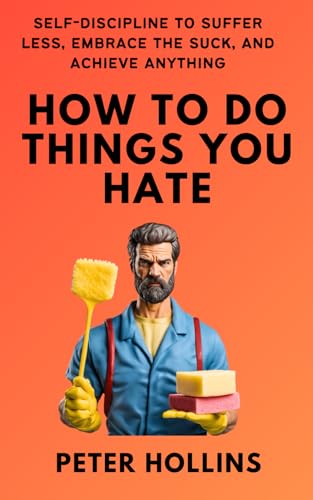


How To Do Things You Hate: Self-Discipline to Suffer Less, Embrace the Suck, and Achieve Anything (Live a Disciplined Life) [Hollins, Peter] on desertcart.com. *FREE* shipping on qualifying offers. How To Do Things You Hate: Self-Discipline to Suffer Less, Embrace the Suck, and Achieve Anything (Live a Disciplined Life) Review: A Trouble-Shooting No-Nonsense Handbook On Laziness - Peter Hollins is not a warm and squishy bestselling author but boy is this man “deep.” He’s a trouble-shooting no-nonsense human psychology researcher and claims to be a dedicated student of the human condition. This is an easy-to-read, engaging handbook on what he terms, “Laziness Literacy.” The truth is there are underlying causes of laziness that make you loathe what you’re doing. Have you ever thought or been accused of being lazy because you detest doing something and you won’t do it? Think about this: When you say you hate something, it may be a signal that you’re sabotaging yourself. Peter invites the reader to look at their troubling situations and procrastination with the neutral eyes of an investigator to approach a solution. “You procrastinate for a reason. Understand that reason and you give yourself a real chance to do something different.” Hollins discusses all types of behavior that could appear as laziness and he provides quick(-ish) solutions for these behaviors. Here are some examples of symptoms of laziness: 1) Confusion – You know you should do something, but because you don’t know what to do, you don’t do anything. 2) Fear – You become paralyzed. You avoid a perceived negative outcome and you don’t do anything. 3) Fixed Mindset – Unconsciously you feel stupid and save yourself the embarrassment. You give up because you’re not a fully-fledged accomplished (fill in the blank). Rather than endure the learning process, you don’t do anything. 4) Fatigue – Not interpreting the difference between mental and physical tiredness. Therefore, if you don’t properly get rest and change your energy levels, you end up too tired, and you don’t do anything. 5) Apathy – A passivity mask of aggression, anger, hostility defiance, and resentment all designed to make sure you don’t do anything. 6) Self-Belief – Beating up on yourself constantly. Because you believe these lies, you don’t do anything. 7) Loss of Heart – Discouragement and loss of hope. Feeling “poor me” undermines any motivation to act. So why bother? You do nothing. 8) Comfort Orientation – Prefers comfort over effort. You do anything as long as it’s fun. But soon the fun doesn’t stay fun because in the back of your mind is that nagging knowing you’re not doing what you should be doing. Peter’s recipe for working through doing what you hate is changing your mindset by reframing your ‘hate’ as curiosity, willingness, and self-compassion. Methods of cultivating these healthy habits are at your disposal with his sure-fire guidance. His focus is on living wisely, functioning holistically, couched in spirituality, and influenced by the Shaolin Monks. “The ultimate goal is for the new behavior to be intrinsically rewarding and continue naturally.” Peter Hollins will steer you reliably out of your “I hate this” pothole. Review: Great read and very helpful! - I absolutely love this book! It differentiates between a procrastinator and being lazy and also not having self-discipline. I like that a lot because I was always labeled lazy by myself and found that it's really just other things going on. He gives some steps on how to improve your life and get past these issues and there's a lot of scientific data in there as well to prove what he's saying. I learned a lot and am starting to put what he said to practice and it seems to be helping! Glad I bought this book!



| ASIN | B0CGL4NLQ2 |
| Best Sellers Rank | #265,890 in Books ( See Top 100 in Books ) #161 in Popular Applied Psychology #692 in Decision-Making & Problem Solving #2,339 in Personal Transformation Self-Help |
| Book 16 of 20 | Live a Disciplined Life |
| Customer Reviews | 4.3 4.3 out of 5 stars (253) |
| Dimensions | 5 x 0.43 x 8 inches |
| ISBN-13 | 979-8859337934 |
| Item Weight | 6.7 ounces |
| Language | English |
| Print length | 188 pages |
| Publication date | August 28, 2023 |
| Publisher | Independently published |
D**S
A Trouble-Shooting No-Nonsense Handbook On Laziness
Peter Hollins is not a warm and squishy bestselling author but boy is this man “deep.” He’s a trouble-shooting no-nonsense human psychology researcher and claims to be a dedicated student of the human condition. This is an easy-to-read, engaging handbook on what he terms, “Laziness Literacy.” The truth is there are underlying causes of laziness that make you loathe what you’re doing. Have you ever thought or been accused of being lazy because you detest doing something and you won’t do it? Think about this: When you say you hate something, it may be a signal that you’re sabotaging yourself. Peter invites the reader to look at their troubling situations and procrastination with the neutral eyes of an investigator to approach a solution. “You procrastinate for a reason. Understand that reason and you give yourself a real chance to do something different.” Hollins discusses all types of behavior that could appear as laziness and he provides quick(-ish) solutions for these behaviors. Here are some examples of symptoms of laziness: 1) Confusion – You know you should do something, but because you don’t know what to do, you don’t do anything. 2) Fear – You become paralyzed. You avoid a perceived negative outcome and you don’t do anything. 3) Fixed Mindset – Unconsciously you feel stupid and save yourself the embarrassment. You give up because you’re not a fully-fledged accomplished (fill in the blank). Rather than endure the learning process, you don’t do anything. 4) Fatigue – Not interpreting the difference between mental and physical tiredness. Therefore, if you don’t properly get rest and change your energy levels, you end up too tired, and you don’t do anything. 5) Apathy – A passivity mask of aggression, anger, hostility defiance, and resentment all designed to make sure you don’t do anything. 6) Self-Belief – Beating up on yourself constantly. Because you believe these lies, you don’t do anything. 7) Loss of Heart – Discouragement and loss of hope. Feeling “poor me” undermines any motivation to act. So why bother? You do nothing. 8) Comfort Orientation – Prefers comfort over effort. You do anything as long as it’s fun. But soon the fun doesn’t stay fun because in the back of your mind is that nagging knowing you’re not doing what you should be doing. Peter’s recipe for working through doing what you hate is changing your mindset by reframing your ‘hate’ as curiosity, willingness, and self-compassion. Methods of cultivating these healthy habits are at your disposal with his sure-fire guidance. His focus is on living wisely, functioning holistically, couched in spirituality, and influenced by the Shaolin Monks. “The ultimate goal is for the new behavior to be intrinsically rewarding and continue naturally.” Peter Hollins will steer you reliably out of your “I hate this” pothole.
D**7
Great read and very helpful!
I absolutely love this book! It differentiates between a procrastinator and being lazy and also not having self-discipline. I like that a lot because I was always labeled lazy by myself and found that it's really just other things going on. He gives some steps on how to improve your life and get past these issues and there's a lot of scientific data in there as well to prove what he's saying. I learned a lot and am starting to put what he said to practice and it seems to be helping! Glad I bought this book!
J**O
This Book Changed My Life
I read this book over Christmas break, at a very low point when I was physically and mentally drained after a taxing year at a job I didn't enjoy, only to find that I would need to forfeit Christmas vacation to travel halfway around the world to take care of a property in need of repair (I'm a landlord) and then travel to another place to spend time with relatives that could potentially be filled with drama. This book taught me to not shrink back from the hard things ahead, but rather accept them, remove self-criticisms, and not add any additional "darts" to an already painful situation. It introduced ACT, Acceptance Commitment Therapy, and distilled this huge topic into a section within a chapter. Learning this alone taught me to accept my circumstances, remove the self-judgment or ruminations of what could be, have a sharper focus on my values in light of the obstacles involved, reframe my perceptions, choose a mindset that is more helpful instead of harmful in light of the situation, and commit to action, knowing that action puts me into a positive loop. It also points out a very wise life advice, one among many you can find in the book: "The easier we make our lives, the less able we are to tolerate things that are not easy." Comfort is a trap, and we can do things that can shield us from "comfort creep," which can stunt our growth. I'm writing this as Lent approaches, and I can see this book being useful on the path to renewal. I also bought another book from Peter Hollins as I'm re-reading this one. That book is "41 Self-Discipline Habits: For Slackers, Avoiders, & Couch Potatoes." But yes, I strongly recommend "How To Do Things You Hate." Despite the innocuous cover, this book offers some powerful, life-changing wisdom, delivered in the clearest language, and with the most practical steps.
A**R
Help for your motivational challenges
I needed to hear this message./ Helpful for us procrastinators and unmotivated weirdos. I got the audio book and I listen to it all the time.
P**N
Very clear and informative
I found this book very helpful.
A**R
Good Tips - Difficult Read
This book is a good intro into mindfulness practices. The book gives relatable examples to various thought processes to showcase the value of mindful and intentional living. I did find the sentence structure to be a bit challenging. My partner and I read aloud together for a few minutes before bed each night and as we were reading this book we found ourselves getting tongue tied and needing to re-read some sections.
L**S
Fantastic read
This taught me so much about what we have deemed as “lazy”
M**Y
Book summary: Just do the thing you hate.
Pros -Direct and to the point with regard to methods to tackle things you hate -Acknowledges there’s not one right way to approach the problem Cons -Barely reads as written by a human. Style is pretty staccato so the flow is poor -All the methods flow together, so determining which to apply and when is tough As you read the book you find yourself wondering if maybe even reading this book to figure out how to do things you hate is itself a waste of time, and I can’t decide if that’s good or bad. Ultimately, you can save yourself the reading time and money by just doing the thing you hate and realizing that there’s no hidden font of motivation in this book, as acknowledged by the author himself.
A**A
Good quick read on what’s important to get things done. Recommended especially if you don’t know much about the topic as it points to some interesting references.
L**H
Very interesting to read. I learned a lot about how you can do things you hate and it makes it easier to cope with this type of burden.
T**N
Excellent service, value for money and fast delivery!!!
R**B
I struggled for awhile with this one because reading is one of the things I hate doing. But there’s some good insight in there. I think the book repeats a lot of stuff. I think the author was trying to place you in some kind of meditative state likened to that of a crossed legged operation where a wiseman may or may not be slapping you’re shoulder with a long bamboo stick while repeating something like ‘breathe’. It is also possible that he just didn't have a whole lot to say so he repeated stuff. Or maybe he writes a lot of music and I’m over the chorus. The book starts out like a story from a white girl, there’s lots of silly psychological terms and exciting categories for you to grow attached to. You can basically pick and choose from all the terms as to who you are as an individual and what type of temperament and ambition you have. You know, tiktok millennial stuff. When you finally get past the self gloating chapters where you define your exact strain of ADHD or whatever, there is some good insight and perspective as to why we lose our ambition for dull activities. Eventually I forgot almost everything I read, but I heard someone say ‘Just do the thing sad’, and I think that helped more. I do recall enjoying reading the book though.
R**M
do not procrastinate. Just acknowledge and accept your mood and emotions. And move forward with a task. That is pretty much the whole book.
ترست بايلوت
منذ شهر
منذ 4 أيام