🎤 Elevate your smart audio projects with the ultimate ESP32-Audio-Kit!
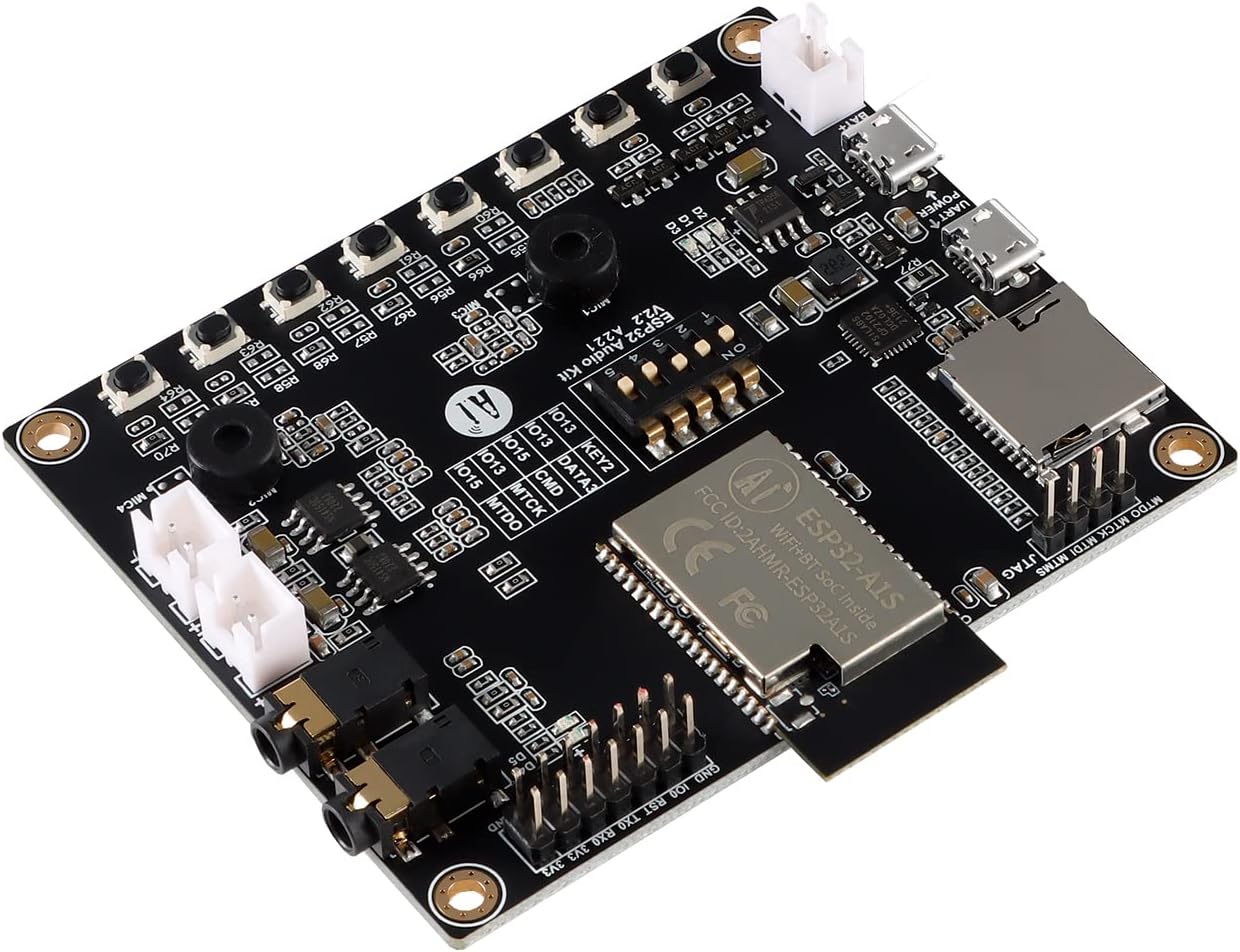
The ESP32-Audio-Kit V2.2 is a compact, high-performance audio development board featuring a dual-core 32-bit CPU, integrated ES8388 audio codec, and onboard WiFi plus Bluetooth 4.2 connectivity. Designed for rapid prototyping, it supports multiple audio formats and streaming protocols, making it ideal for smart home audio devices, voice assistants, and IoT audio applications.


| ASIN | B0B63KZ6C1 |
| Best Sellers Rank | #1,662 in Single Board Computers (Computers & Accessories) |
| Brand | EC Buying |
| Customer Reviews | 3.1 3.1 out of 5 stars (28) |
| Date First Available | July 8, 2022 |
| Item Dimensions LxWxH | 3.23 x 2.87 x 0.01 inches |
| Item Weight | 1.48 ounces |
| Manufacturer | EC Buying |
| Number of Processors | 2 |
| Operating System | FreeRTOS |
| Processor Brand | Espressif |
| Product Dimensions | 3.23 x 2.87 x 0.01 inches |
| RAM | SPI Flash |
| Series | ESP32-Audio-Kit |
| Wireless Type | Bluetooth |
J**G
Fits and works perfectly
It is well designed and works very well. You might need to buy some GPIO bus extenders, though, if you want to put a hat over it.
H**E
No software support
Beware: This AiThinker ESP-32 board has no software support. No documented pin routing to the HAL and Codec, no documented Codec, and no working software support library. This board will not work with the ESP-ADF and ESP-IDF libraries out of the box.
A**N
Excellent board - had up and running in 5 min - Library matters!
I do agree the mfg, seller etc should steer people to the right libraries to get this off of the ground easier. I found the library before I found the board so in my case the longest part was waiting 2 days for the board to arrive. Go to Git Hub and find Arduino-Audio-Tools and look under Audio Kit and you're good to go in Arduino IDE - piece of cake. I got the board for the same reason as the library author. It makes trying new things painless without constantly having to rewire breadboards. There's a bunch of buttons, dip switches (pay attention to them when using the library code it's usually commented at the top of the code as to required dip switch settings). Things I'd change (and will be on mine) is that the JST headers point vertical when the usb, sd and audio jacks are horizontal. The other thing is the BLINDING green led. I may remove or see about a stronger smd resistor.
L**P
Poor documentation makes product unusable.
I was looking for an audio board. This looked promising. This is a lower-cost “knock-off” ESP32 audio board built to be compatible with Espressif’s audio framework, but it is not an official Espressif reference board. As a result, it depends on emulating supported boards rather than being directly supported itself. This inherently increases the need for clear documentation or a prior association with the company’s products. Given the steep learning curve associated with learning a poorly documented clone, this is the definition of a 2-star product. The product technically works but is inherently far from useful due to lack of product definition. In particular, it relies heavily on the reader already understanding Espressif’s ESP-ADF ecosystem, board selection conventions, and how to reconcile hardware revisions that are similar but not identical to official reference designs. This is “ok” except that the board is not identical to Espressif and the difference is not explained. The only supplied documentation is a flimsy GitHub site that is silent on the critical differences between their product and Espressif’s. For example, users must configure the framework to act as if an Espressif board is present, without being given essential documentation. The instructions describe what to change, but not why, and they don’t provide a complete, pinned, known-good configuration. If anything differs (hardware revision, framework version, or toolchain update), troubleshooting quickly becomes guesswork. Beginners fail outright, more experienced users start cussing, no one has fun. This product might be wonderful in an industrial environment or buried in a product, but as a standalone product it is sub-optimal.
D**N
Good board once you find documentation
I have used several of these boards. I agree with what others said. Once you get it working and figure out how it works, it works well. Except, there is very little documentation. Another person here mentioned " Search for esp-adf-component-ai-thinker-esp32-a1s on github", that helps a ton, I also saw some examples like "historyphone github" search hardware v2 uses this board and has platformio all setup. Once configured the SD card, headphone jack, and speaker amp work well. You can configure it to be an wifi access point and server web pages off the sd card easily.
N**N
Great Squeezelite Player
Easy to install esp32 squeezelite. Hooked up to my lms, and even has a built in amplifier.
M**.
ZERO DOCUMENTATION
This board comes with absolutely no documentation, and finding any seems to be impossible. Returned.
T**M
WiFi Speaker
Good quality boards to use for home built WiFi speakers.
J**T
The documentation one finds is somewhat scarce. The idea to couple some of the few externally available pins with LEDs and others with on board buttons is most disturbing. One can only use most pins by cutting lines in the board. But that aside it works perfectly fine for me for a couple of months now. I play mp3 from the SD card and web streams to speaker and (or) headphones. I sort of connected an RFID reader to start playing the files/folders from SD... BUT due to the lack of pins I put a microbit between this board and the RFID reader. So: if you are prepared to go through a considerable pile of hazzle and disappointment you get a very cool device at a fair price.
ترست بايلوت
منذ شهر
منذ يوم واحد