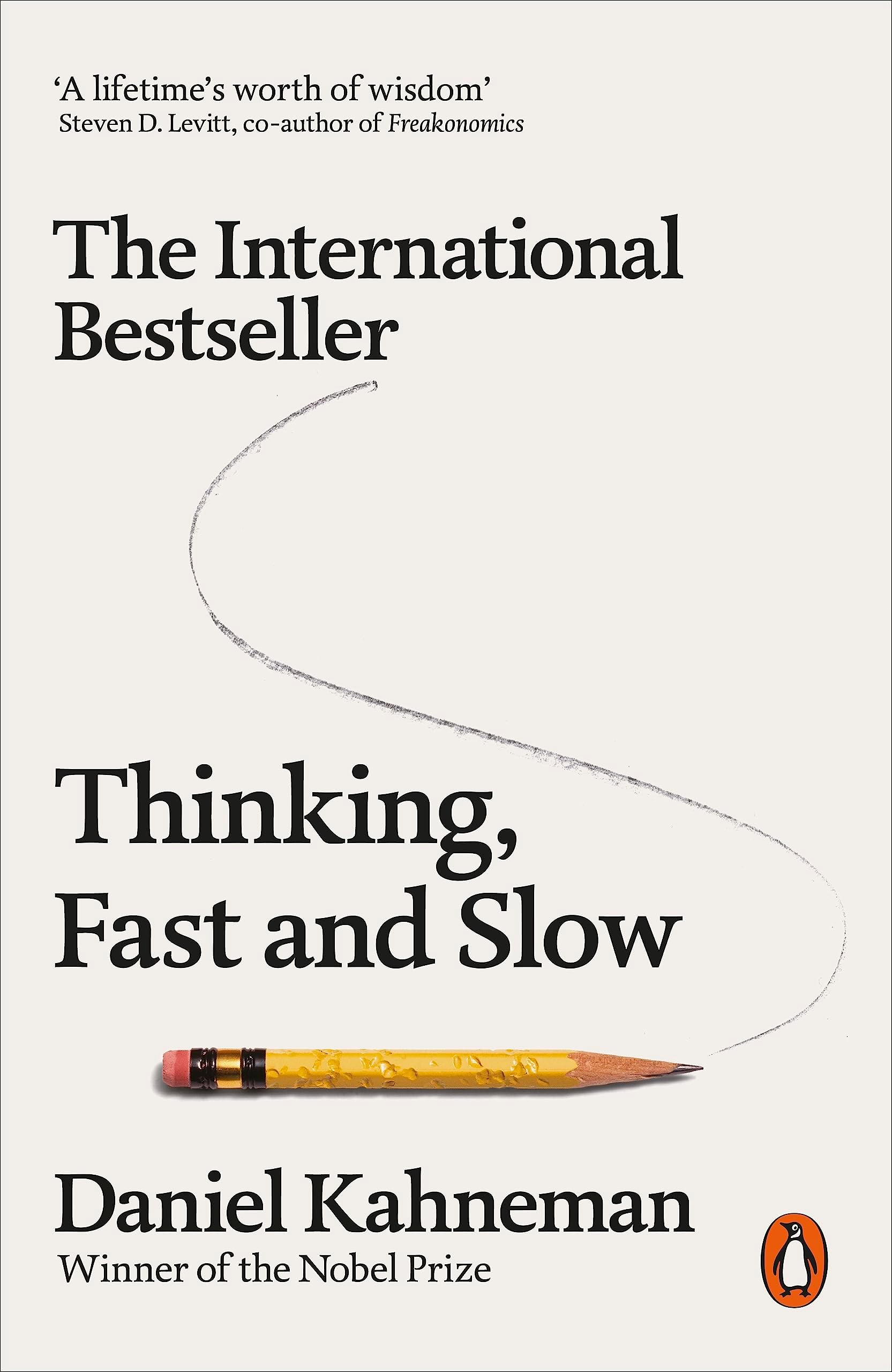
Thinking, Fast and Slow: Daniel Kahneman
Product ID: 48081343
Desertcart purchases this item on your behalf and handles shipping, customs, and support to Israel.
One of the most influential books of the 21st century: the ground-breaking psychology classic - over 10 million copies sold - that changed the way we think about thinking 'There have been many good books on human rationality and irrationality, but only one masterpiece. That masterpiece is Thinking, Fast and Slow ' Financial Times ‘Will be remembered hundreds of years from now’ David Brooks, The New York Times Why do we make the decisions we do? Nobel Prize winner Daniel Kahneman revolutionised our understanding of human behaviour with Thinking, Fast and Slow . Distilling his life's work, Kahneman showed that there are two ways we make choices: fast, intuitive thinking, and slow, rational thinking. His book reveals how our minds are tripped up by error, bias and prejudice (even when we think we are being logical) and gives practical techniques that enable us all to improve our decision-making. This profound exploration of the marvels and limitations of the human mind has had a lasting impact on how we see ourselves. ‘Stunningly profound… A lifetime's worth of wisdom presented in a manner that is simple and engaging ’ Steven D. Levitt, author of Freakonomics Review: When is an intuition a simplifying heuristic or an expert solution? That is the cue of recognition, nigh a formula Grasshopper! - Stemming from the author's Nobel prize winning scholarly research on the simplifying short-cuts of intuitive thinking (systematic errors) and then decision making under uncertainty both published in Science Journal, the book is a series of thought experiments that sets out to counter the prevailing rational-agent model of the world (Bernoulli's utility errors) that humans have consistent preferences and know how to maximise them. Instead, Prospect Theory shows that important choices are prone to the relativity of shifting reference points (context) and formulations of inconsequential features within a situation such that human preferences struggle to become reality-bound. In particular our decisions are susceptible to heuristic (short-cutting) or cognitive illusory biases - an inconsistency that is built in to the design of our minds, for example, the 'duration neglect' of time (less is more effect) in recounting a story by the Remembering Self, as opposed to sequentially by the Experiencing Self. Prospect Theory is based on the well known dominance of threat/escape (negativity) over opportunity/approach (positivity) as a natural tendency or hard wired response towards risk adversity that Kahneman's grandmother would have acknowledged. Today this bias is explored by behavioural economics (psychophysics) and the science of neuroeconomics - in trying to understand what a person's brain does while they make safe or risky decisions. It would appear that there are two species of homo sapiens: those who think like "Econs" - who can compare broad principles and processes 'across subjects', like spread betters (broad framing) in trades of exchange; and "Humans" who are swayed optimistically or pessimistically in terms of conviction and fairness by having attachments to material usage (narrow framing) and a whole host of cognitive illusions, e.g. to name but a very few: the endowment effect, sunk cost fallacy and entitlement. Kahnmann argues that these two different ways of relating to the world are heavily predicated by a fundamental split in the brain's wet-ware architecture delineated by two complementary but opposing perspectives: System 1 is described as the Inside View: it is "fast" HARE-like intuitive thought processes that jump to best-case scenario and plausible conclusions based on recent events and current context (priming) using automatic perceptual memory reactions or simple heuristic intuitions or substitutions. These are usually affect-based associations or prototypical intensity matches (trying to compare different categories, e.g. apples or stake?). System 1 is susceptible to emotional framing and prefers the sure choice over the gamble (risk adverse) when the outcomes are good but tends to accept the gamble (risk seeking) when all outcomes are negative. System 1 is 'frame-bound' to descriptions of reality rather than reality itself and can reverse preferences based on how information is presented, i.e. is open to persuasion. Therefore, instead of truly expert intuitions System 1 thrives on correlations of coherence (elegance), certainty (conviction) and causality (fact) rather than evidential truth. System 1 has a tendency to believe, confirm (well known bias), infer or induce the general from the particular (causal stereotype). System 1 does not compute base rates of probability, the influence of random luck or mere statistics as correlation (decorrelation error) or the regression to the mean (causality error). System 1's weakness is the brain's propensity to succumb to over-confidence and hindsight in the resemblance, coherence and plausibility of flimsy evidence of the moment acronymically termed WYSIATI (What You See Is All There Is) at the expense of System 2 probability. To succumb is human as so humbly shown throughout the book which has no bounds to profession, institution, MENSA level or social standing. Maybe Gurdjieff was right when he noticed that the majority of humans are sheep-like. System 2 on the other hand is the Outside View that attempts to factor in Rumsfeld's "unknown unknowns" by using realistic baselines of reference classes. It makes choices that are 'reality-bound' regardless of presentation of facts or emotional framing and can be regarded as "slow" RAT-like controlled focus and energy sapping intention, the kind used in effort-full integral, statistical and complex reasoning using distributional information based on probability, uncertainty and doubt. However System 2 is also prone to error especially in the service of System 1 and even though it has the capability with application not to confuse mere correlation with causation and deduce the particular from the general, it can be blocked when otherwise engaged, indolent or full of pride! As Kahneman puts it "...the ease at which we stop thinking is rather troubling" and what may appear to be compelling is not always right especially when the ego - the executive regulator of will power and concentration - is depleted of energy, or conversely when it is in a good mood of cognitive ease (not stress) deriving from situations of 'mere exposure' (repetition and familiarity). Experiments have repeatedly shown that cognitive aptitude and self-control are in direct correlation, and biases of intuition are in constant need of regulation which can be hard work such as uncovering one's outcome bias (part hindsight bias and halo effect) based on the cognitive ease with which one lays claim to causal 'narrative fallacies' (Taleb) rather than "adjusting" to statistical random events born out of luck! So.. Do not expect a fun and "simples" read if you want clarity in to how impulses become voluntary actions and impressions and feelings and inclinations so readily become beliefs, attitudes and intentions (when endorsed by System 2). The solution.. Kahneman makes the special plea that our higher-minded intuitive statistician of System 2 take over the art of decision-making and wise judgement in "accurate choice diagnosis" to minimise the "errors in the design of the machinery of cognition." We should learn to recognise situations in which significant mistakes are likely by making the time and putting in the analytical effort to avoid them especially when the stakes are high - usually when a situation is unfamiliar and there is no time to collect more information. 'Thinking Fast and Slow' practically equips the reader with sufficient understanding to approach reasoning situations applying a certain amount of logic in order to balance and counter our intuitive illusions. For example recognising the Texas sharp shooter fallacy (decorrelation error) or de-constructing a representative heuristic (stereotype) in one's day-to-day affairs should be regarded as a reasonable approach to life even by any non-scientific yard stick. In another example, the System 2 objectivity of a risk policy is one remedy against the System 1 biases inherent in the illusion of optimists who think they are prudent, and pessimists who become overly cautious missing out on positive opportunities - however marginal a proposition may appear at first. One chapter called "Taming Intuitive Predictions" is particularly inspiring when it comes to corrections of faulty thinking. A reasonable procedure for systematic bias in significant decision-making situations where there is only modest validity (validity illusion) especially in-between subjects is explored. For example, when one has to decide between two candidates, be they job interviewees or start up companies as so often happens the evidence is weak but the emotional impression left by System 1 is strong. Kahneman recommends that when WYSIATI to be very wary of System 1's neglect of base rates and insensitivity to the quality of information. The law of small numbers states that there is more chance of an extreme outcome with a small sample of information in that the candidate that performs well at first with least evidence have a tendency not to be able to keep up this up over the longer term (once employed) due to the vagaries of talent and luck, i.e. there is a regression towards the mean. The candidate with the greater referential proof but less persuasive power on the day is the surer bet in the long term. However, how often can it be said that such a scenario presents itself in life, when the short term effect is chosen over the long term bet? Possibly a cheeky pertinant example here is the choice of Moyes over Mourinho as the recently installed Man Utd manager! A good choice of bad choice? There are many examples shown in low validity environments of statistical algorithms (Meehl pattern) showing up failed real world assumptions revealing in the process the illusion of skill and hunches to make long-term predictions. Many of these are based on clinical predictions of trained professionals, some that serve important selection criteria of interviewing practices which have great significance. Flawed stories from the past that shape our views of the present world and expectations of the future are very seductive especially when combined with the halo effect and making global evaluations rather than specific ratings. For example one's belief in the latest block busting management tool adopted by a new CEO has been statistically shown to be only a 10% improvement at best over random guess work. Another example of a leadership group challenge to select Israeli army leaders from cadets in order to reveal their "true natures" produced forecasts that were inaccurate after observing only one hour of their behaviour in an artificial situation - this was put down to the illusion of validity via the representation heuristic and non regressive weak evidence. Slightly more worryingly, the same can be said for the illusory skills of selling and buying stock persistently over time. It has shown that there is a narrative being played within the minds of the traders: they think they are making sensible educated guesses when the exposed truth is that their success in long term predictability is based on luck - a fact that is deeply ingrained in the culture of the industry with false credit being "taken" in bonuses!! Kahneman pulls no punches about the masters of the universe and I am inclined to believe in the pedigree of his analysis!! According to Kahneman so-called experts - and he is slightly derisive in his use of the term - in trying to justify their ability to assess masses of complexity as a host of mini-skills can produce unreliable judgements, especially long term forecasts (e.g planning fallacy) due to the inconsistency of extreme context (low or zero-validity environments with non regular practice) - a System 1 type error. Any final decision should be left to an independent person with the assessment of a simple equally weighted formula which is shown to be more accurate than if the interviewer also makes a final decision who is susceptible to personal impression and "taste"..(see wine vintage predictions). The best an expert can do is anticipate the near future using cues of recognition and then know the limits of their validity rather than make random hits based on subjectively compelling intuitions that are false. "Practice makes perfect" is the well known saying though the heuristics of judgement (coherence, cognitive ease and overconfidence) are invoked in low validity environments by those who do not know what they are doing (the illusion of validity). Looking at other similar books on sale, "You are Not So Smart" for example by David McRaney is a more accessible introduction to the same subject but clearly rests on Kahneman's giant shoulders who with his erstwhile colleagues would appear to have informed the subject area in every conceivable direction. It is hard not to do justice to such a brilliant book with a rather longish review. This is certainly one of the top ten books I have ever read for the benefits of rational perseverance and real world knowledgeable insights and seems to be part of a trend or rash of human friendly Econ (System 2) research emanating out of the USA at the moment. For example, recently 2013 Nobel winning economics research by R Shiller demonstrates that there are predictable regularities in assets markets over longer time periods, while E Fama makes the observation that there is no predictability in the short run. In summary, "following our intuitions is more natural, and 'somehow' more pleasant than acting against them" and we usually end up with products of our extreme predictions, i.e. overly optimistic or pessimistic, since they are statistically non-regressive by not taking account of a base rate (probability) or regression towards the mean (self correcting fluctuations in scores over time). The slow steady pace of the TORTOISE might be considered the right pace to take our judgements but we are prone not to give the necessary time and perspective in a busy and obtuse world. The division of labour and conflict between the two Systems of the mind can lead to either cognitive illusion (i.e. prejudice/bias) or if we are lucky wise judgement in a synthesis of intuition and cognition (called TORTOISE thinking by Dobransky in his book Quitting the Rat Race). Close your eyes and imagine the future ONLY after a disciplined collection of objective information unless of course you happen to have expert recognition, which is referred to in Gladwell's book on subject called Blink, but then your eyes are still open and liable to be deceived. Kahneman's way seems so much wiser but harder nonetheless. The art and science of decision-making just got so much more interesting in the coming world of artificial intelligence! Review: What You See Is All That Is... - Excellent book. Has really left me stumped. This is by no means light reading. It is a wonderful and enlightening voyage through the human mind and consciousness, topics which never fail to intrigue me. Overall Kahneman seems to have developed the System 1 and System 2 thought processes. I call system 1, originating creations or Primaries. System 2 I refer to a Secondaries. Secondaries are re-examinations of originating creations. They often change the way we think and perceive and although most of us tend to operate through a System 2 consciousness, it is far from foolproof as you will fast discover when reading this book. At the time of writing this review I am still only half way through the book so I intend to return with a more thorough review in time. However the book invites the reader to assess your own thinking in clear and unambiguous language and is a superb introduction to self psychology or possibly spiritualistic examination. As Kahneman says WYSIATI - What You See Is All That Is. To appreciate the essence of WYSIATI you really need to read the book as it would take a book to explain it here. But once you grasp the essence that what we see tends to get reinterpreted by us with the assistance of outside forces (including System 2 thinking) such that we 'very often' ignore the reality with which we are faced and reinterpret a new reality which better suits our preferences. The book covers immense areas of daily life from assessments of news and people through to routine decision making and interactions. As an investor I originally bought this to help in assessing the financial markets. It is without doubt in my top 10 must reads for anyone interested in Investing, politics, human associations, theory, psychology, academia or indeed simply daily life routine. I can honestly say it will change the way you view your own thinking and it will shed light on how other people think. UPDATE: well I am now about 75% through this gem of a book and even more impressed than before. Kahneman has given me a lot to think about and it all fits in neatly with my own studies on spiritualism and dimensions. I think he comes close to being able to follow this book up with the next stage which is an analysis of the origins of System 1 and System 2 thinking. Although the book explores the two concepts of thought, it does not address 'where' these emanate from in sufficient detail. Is that because he does not want to preach or perhaps he is still working in that theory. Anyway - more on that later. But for now I came across a fabulous piece of advice on page 264 that I have to share - the PreMortem. This is advocated by Gary Klein and in a nutshell it goes as follows: When an organisation has come to an important decision but has not formally committed itself, Klein proposes gathering for as brief session a group of individuals who are knowledgeable about that decision. The premise of the session is a short speech "imagine that we are a year into the future, we implemented the plan as it now exists. The outcome was a disaster. Please take 5-10 minutes to write a brief history of the disaster" Now apply that to any decision you make in your own life, be it starting a new business venture, buying a house, getting married, or indeed divorced; the insights that this wee little exercise can produce should improve productivity and decision making manyfold in almost anyone. As I stated before, this book should help any reader (who can understand the concepts) to stop, and assess the thinker rather than the thought. I regret to say that I will be back again with another update soon....! sorry to bore you


| Best Sellers Rank | 765 in Books ( See Top 100 in Books ) 9 in Higher Education of Biological Sciences 11 in Scientific Psychology & Psychiatry 11 in Practical & Motivational Self Help |
| Customer Reviews | 4.5 out of 5 stars 47,591 Reviews |
J**E
When is an intuition a simplifying heuristic or an expert solution? That is the cue of recognition, nigh a formula Grasshopper!
Stemming from the author's Nobel prize winning scholarly research on the simplifying short-cuts of intuitive thinking (systematic errors) and then decision making under uncertainty both published in Science Journal, the book is a series of thought experiments that sets out to counter the prevailing rational-agent model of the world (Bernoulli's utility errors) that humans have consistent preferences and know how to maximise them. Instead, Prospect Theory shows that important choices are prone to the relativity of shifting reference points (context) and formulations of inconsequential features within a situation such that human preferences struggle to become reality-bound. In particular our decisions are susceptible to heuristic (short-cutting) or cognitive illusory biases - an inconsistency that is built in to the design of our minds, for example, the 'duration neglect' of time (less is more effect) in recounting a story by the Remembering Self, as opposed to sequentially by the Experiencing Self. Prospect Theory is based on the well known dominance of threat/escape (negativity) over opportunity/approach (positivity) as a natural tendency or hard wired response towards risk adversity that Kahneman's grandmother would have acknowledged. Today this bias is explored by behavioural economics (psychophysics) and the science of neuroeconomics - in trying to understand what a person's brain does while they make safe or risky decisions. It would appear that there are two species of homo sapiens: those who think like "Econs" - who can compare broad principles and processes 'across subjects', like spread betters (broad framing) in trades of exchange; and "Humans" who are swayed optimistically or pessimistically in terms of conviction and fairness by having attachments to material usage (narrow framing) and a whole host of cognitive illusions, e.g. to name but a very few: the endowment effect, sunk cost fallacy and entitlement. Kahnmann argues that these two different ways of relating to the world are heavily predicated by a fundamental split in the brain's wet-ware architecture delineated by two complementary but opposing perspectives: System 1 is described as the Inside View: it is "fast" HARE-like intuitive thought processes that jump to best-case scenario and plausible conclusions based on recent events and current context (priming) using automatic perceptual memory reactions or simple heuristic intuitions or substitutions. These are usually affect-based associations or prototypical intensity matches (trying to compare different categories, e.g. apples or stake?). System 1 is susceptible to emotional framing and prefers the sure choice over the gamble (risk adverse) when the outcomes are good but tends to accept the gamble (risk seeking) when all outcomes are negative. System 1 is 'frame-bound' to descriptions of reality rather than reality itself and can reverse preferences based on how information is presented, i.e. is open to persuasion. Therefore, instead of truly expert intuitions System 1 thrives on correlations of coherence (elegance), certainty (conviction) and causality (fact) rather than evidential truth. System 1 has a tendency to believe, confirm (well known bias), infer or induce the general from the particular (causal stereotype). System 1 does not compute base rates of probability, the influence of random luck or mere statistics as correlation (decorrelation error) or the regression to the mean (causality error). System 1's weakness is the brain's propensity to succumb to over-confidence and hindsight in the resemblance, coherence and plausibility of flimsy evidence of the moment acronymically termed WYSIATI (What You See Is All There Is) at the expense of System 2 probability. To succumb is human as so humbly shown throughout the book which has no bounds to profession, institution, MENSA level or social standing. Maybe Gurdjieff was right when he noticed that the majority of humans are sheep-like. System 2 on the other hand is the Outside View that attempts to factor in Rumsfeld's "unknown unknowns" by using realistic baselines of reference classes. It makes choices that are 'reality-bound' regardless of presentation of facts or emotional framing and can be regarded as "slow" RAT-like controlled focus and energy sapping intention, the kind used in effort-full integral, statistical and complex reasoning using distributional information based on probability, uncertainty and doubt. However System 2 is also prone to error especially in the service of System 1 and even though it has the capability with application not to confuse mere correlation with causation and deduce the particular from the general, it can be blocked when otherwise engaged, indolent or full of pride! As Kahneman puts it "...the ease at which we stop thinking is rather troubling" and what may appear to be compelling is not always right especially when the ego - the executive regulator of will power and concentration - is depleted of energy, or conversely when it is in a good mood of cognitive ease (not stress) deriving from situations of 'mere exposure' (repetition and familiarity). Experiments have repeatedly shown that cognitive aptitude and self-control are in direct correlation, and biases of intuition are in constant need of regulation which can be hard work such as uncovering one's outcome bias (part hindsight bias and halo effect) based on the cognitive ease with which one lays claim to causal 'narrative fallacies' (Taleb) rather than "adjusting" to statistical random events born out of luck! So.. Do not expect a fun and "simples" read if you want clarity in to how impulses become voluntary actions and impressions and feelings and inclinations so readily become beliefs, attitudes and intentions (when endorsed by System 2). The solution.. Kahneman makes the special plea that our higher-minded intuitive statistician of System 2 take over the art of decision-making and wise judgement in "accurate choice diagnosis" to minimise the "errors in the design of the machinery of cognition." We should learn to recognise situations in which significant mistakes are likely by making the time and putting in the analytical effort to avoid them especially when the stakes are high - usually when a situation is unfamiliar and there is no time to collect more information. 'Thinking Fast and Slow' practically equips the reader with sufficient understanding to approach reasoning situations applying a certain amount of logic in order to balance and counter our intuitive illusions. For example recognising the Texas sharp shooter fallacy (decorrelation error) or de-constructing a representative heuristic (stereotype) in one's day-to-day affairs should be regarded as a reasonable approach to life even by any non-scientific yard stick. In another example, the System 2 objectivity of a risk policy is one remedy against the System 1 biases inherent in the illusion of optimists who think they are prudent, and pessimists who become overly cautious missing out on positive opportunities - however marginal a proposition may appear at first. One chapter called "Taming Intuitive Predictions" is particularly inspiring when it comes to corrections of faulty thinking. A reasonable procedure for systematic bias in significant decision-making situations where there is only modest validity (validity illusion) especially in-between subjects is explored. For example, when one has to decide between two candidates, be they job interviewees or start up companies as so often happens the evidence is weak but the emotional impression left by System 1 is strong. Kahneman recommends that when WYSIATI to be very wary of System 1's neglect of base rates and insensitivity to the quality of information. The law of small numbers states that there is more chance of an extreme outcome with a small sample of information in that the candidate that performs well at first with least evidence have a tendency not to be able to keep up this up over the longer term (once employed) due to the vagaries of talent and luck, i.e. there is a regression towards the mean. The candidate with the greater referential proof but less persuasive power on the day is the surer bet in the long term. However, how often can it be said that such a scenario presents itself in life, when the short term effect is chosen over the long term bet? Possibly a cheeky pertinant example here is the choice of Moyes over Mourinho as the recently installed Man Utd manager! A good choice of bad choice? There are many examples shown in low validity environments of statistical algorithms (Meehl pattern) showing up failed real world assumptions revealing in the process the illusion of skill and hunches to make long-term predictions. Many of these are based on clinical predictions of trained professionals, some that serve important selection criteria of interviewing practices which have great significance. Flawed stories from the past that shape our views of the present world and expectations of the future are very seductive especially when combined with the halo effect and making global evaluations rather than specific ratings. For example one's belief in the latest block busting management tool adopted by a new CEO has been statistically shown to be only a 10% improvement at best over random guess work. Another example of a leadership group challenge to select Israeli army leaders from cadets in order to reveal their "true natures" produced forecasts that were inaccurate after observing only one hour of their behaviour in an artificial situation - this was put down to the illusion of validity via the representation heuristic and non regressive weak evidence. Slightly more worryingly, the same can be said for the illusory skills of selling and buying stock persistently over time. It has shown that there is a narrative being played within the minds of the traders: they think they are making sensible educated guesses when the exposed truth is that their success in long term predictability is based on luck - a fact that is deeply ingrained in the culture of the industry with false credit being "taken" in bonuses!! Kahneman pulls no punches about the masters of the universe and I am inclined to believe in the pedigree of his analysis!! According to Kahneman so-called experts - and he is slightly derisive in his use of the term - in trying to justify their ability to assess masses of complexity as a host of mini-skills can produce unreliable judgements, especially long term forecasts (e.g planning fallacy) due to the inconsistency of extreme context (low or zero-validity environments with non regular practice) - a System 1 type error. Any final decision should be left to an independent person with the assessment of a simple equally weighted formula which is shown to be more accurate than if the interviewer also makes a final decision who is susceptible to personal impression and "taste"..(see wine vintage predictions). The best an expert can do is anticipate the near future using cues of recognition and then know the limits of their validity rather than make random hits based on subjectively compelling intuitions that are false. "Practice makes perfect" is the well known saying though the heuristics of judgement (coherence, cognitive ease and overconfidence) are invoked in low validity environments by those who do not know what they are doing (the illusion of validity). Looking at other similar books on sale, "You are Not So Smart" for example by David McRaney is a more accessible introduction to the same subject but clearly rests on Kahneman's giant shoulders who with his erstwhile colleagues would appear to have informed the subject area in every conceivable direction. It is hard not to do justice to such a brilliant book with a rather longish review. This is certainly one of the top ten books I have ever read for the benefits of rational perseverance and real world knowledgeable insights and seems to be part of a trend or rash of human friendly Econ (System 2) research emanating out of the USA at the moment. For example, recently 2013 Nobel winning economics research by R Shiller demonstrates that there are predictable regularities in assets markets over longer time periods, while E Fama makes the observation that there is no predictability in the short run. In summary, "following our intuitions is more natural, and 'somehow' more pleasant than acting against them" and we usually end up with products of our extreme predictions, i.e. overly optimistic or pessimistic, since they are statistically non-regressive by not taking account of a base rate (probability) or regression towards the mean (self correcting fluctuations in scores over time). The slow steady pace of the TORTOISE might be considered the right pace to take our judgements but we are prone not to give the necessary time and perspective in a busy and obtuse world. The division of labour and conflict between the two Systems of the mind can lead to either cognitive illusion (i.e. prejudice/bias) or if we are lucky wise judgement in a synthesis of intuition and cognition (called TORTOISE thinking by Dobransky in his book Quitting the Rat Race). Close your eyes and imagine the future ONLY after a disciplined collection of objective information unless of course you happen to have expert recognition, which is referred to in Gladwell's book on subject called Blink, but then your eyes are still open and liable to be deceived. Kahneman's way seems so much wiser but harder nonetheless. The art and science of decision-making just got so much more interesting in the coming world of artificial intelligence!
N**Y
What You See Is All That Is...
Excellent book. Has really left me stumped. This is by no means light reading. It is a wonderful and enlightening voyage through the human mind and consciousness, topics which never fail to intrigue me. Overall Kahneman seems to have developed the System 1 and System 2 thought processes. I call system 1, originating creations or Primaries. System 2 I refer to a Secondaries. Secondaries are re-examinations of originating creations. They often change the way we think and perceive and although most of us tend to operate through a System 2 consciousness, it is far from foolproof as you will fast discover when reading this book. At the time of writing this review I am still only half way through the book so I intend to return with a more thorough review in time. However the book invites the reader to assess your own thinking in clear and unambiguous language and is a superb introduction to self psychology or possibly spiritualistic examination. As Kahneman says WYSIATI - What You See Is All That Is. To appreciate the essence of WYSIATI you really need to read the book as it would take a book to explain it here. But once you grasp the essence that what we see tends to get reinterpreted by us with the assistance of outside forces (including System 2 thinking) such that we 'very often' ignore the reality with which we are faced and reinterpret a new reality which better suits our preferences. The book covers immense areas of daily life from assessments of news and people through to routine decision making and interactions. As an investor I originally bought this to help in assessing the financial markets. It is without doubt in my top 10 must reads for anyone interested in Investing, politics, human associations, theory, psychology, academia or indeed simply daily life routine. I can honestly say it will change the way you view your own thinking and it will shed light on how other people think. UPDATE: well I am now about 75% through this gem of a book and even more impressed than before. Kahneman has given me a lot to think about and it all fits in neatly with my own studies on spiritualism and dimensions. I think he comes close to being able to follow this book up with the next stage which is an analysis of the origins of System 1 and System 2 thinking. Although the book explores the two concepts of thought, it does not address 'where' these emanate from in sufficient detail. Is that because he does not want to preach or perhaps he is still working in that theory. Anyway - more on that later. But for now I came across a fabulous piece of advice on page 264 that I have to share - the PreMortem. This is advocated by Gary Klein and in a nutshell it goes as follows: When an organisation has come to an important decision but has not formally committed itself, Klein proposes gathering for as brief session a group of individuals who are knowledgeable about that decision. The premise of the session is a short speech "imagine that we are a year into the future, we implemented the plan as it now exists. The outcome was a disaster. Please take 5-10 minutes to write a brief history of the disaster" Now apply that to any decision you make in your own life, be it starting a new business venture, buying a house, getting married, or indeed divorced; the insights that this wee little exercise can produce should improve productivity and decision making manyfold in almost anyone. As I stated before, this book should help any reader (who can understand the concepts) to stop, and assess the thinker rather than the thought. I regret to say that I will be back again with another update soon....! sorry to bore you
E**Y
Starts well
This book starts by being intriguing and stimulating, and deserves to be read. The chapters are short, the writing is clear, the arguments supported by examples of behavioural studies, and each chapter usefully ends with a few colloquial statements that sum up what has been said. However, halfway through, the book appears to lose itself, whether by fault of verbosity, repetition, loss of structure of argument, fewer references to work by others, or just sheer volume, I’m not sure. In any case, the reader finishes the book thinking of the cited example of the scratch at the end of disc that dominates the memory of the whole. Where was the editor in all this? The first part of the book is worth it, however. It turns out that we possess two types of thinking, default System 1 (fast) and System 2 (slow). Between them they determine how we react and make decisions. The book exposes many behavioural studies concerning the relationship between psychology and economics, and the competition between these two disciplines to explain people’s actions and decisions, including a brief mention of the new discipline of neuroeconomics. According to the author, we are primitive in the art of prediction. We lack methodology. We suffer from illusions of validity. Why does, on one side, someone decide to sell a stock, and on the other another decides to buy it? The evidence shows that more active stock sellers have worse results. Studies show that forecasts by doctors, investment advisors, sports analysts, politicians, economists and myriads of other professionals don’t compare favourably with machine prediction. I would add the element of ‘destructive cleverness’ whereby people tend to apply their expertise in other non-relevant areas to a problem that exists within a different set of givens, contributing factors, and noise factors that need to be properly appreciated. People perhaps tend to think too often out of the box because of lack of familiarity with a subject, and are invariably inconsistent in doing so. The art of decision making needs to be demystified. It needs to be transformed into a more scientifically and factually-based procedure. Might justice be better delivered by computer? Planning fallacies include over-optimism in costs and time due to only taking the inside view and failing to refer to references classes. Optimism is the life blood of entrepreneurs, and only 35% of businesses in the USA survive 5 years. There is the notion of optimistic martyrs; firms that fail, market fodder, if you like, yet signal new markets to more qualified competitors. Potentially dangerous groupthink can be moderated by carrying out a pre-mortem; asking participants to write a reason why a project might have failed (the discipline of FMEA in industrial language). We learn of hedonometry that quantifies pleasure and pain. We have a less unfavourable memory of pain if it tails off at the end. Our memory of an experience may not be the same as during the experience (example of a scratch at the end of a record). There is a difference between the experiencing and remembering selves. In summing up someone’s life we are over influenced by how it ends. One Unpleasant Index survey of women yielded double for child-rearing than watching TV, which was the same level as socialising. Being alone is more pleasurable than the presence of an immediate boss. Increasing focus is being placed on the measurement of well-being. Above a certain salary (quoted as $75,000 in high-cost areas) affluence does not improve a feeling of well-being, possibly, it is argued, because richer people no longer have the opportunity to enjoy in the same way the small pleasures of life (bars of chocolate). The author focuses on System 1, for which the cardinal rule is WYSIATI – what you see is all there is. It is impulsive, intuitive, our minds appear over-influenced by bias and spin. It is rarely indifferent to emotional words (a ‘survival chance’ of 90% is preferred to a ‘mortality rate’ of 10%). It jumps to conclusions, and can even govern important decisions depending upon how a problem is presented. Intuition requires training in skills (a top class chess player requires about 10,000 hours of practice). Reminding people of their mortality increases the appeal of authoritarian ideas. There is the Lady Macbeth Effect whereby when people feel their soul is stained they have the desire to clean themselves. The Florida Effect was illustrated when students, who had been encouraged to think of words related to old age, walked more slowly down a corridor. When we place a pen crosswise in our mouth, thereby forcing a smile, we tend to think more favourably of things. The Halo Effect occurs, for example, when people like a president’s politics because they like his voice and appearance. In the Availability Cascade, biases, popular reactions and exaggerated fears (often influenced by the media and popular reactions) influence policy. We are unduly worried about unlikely events, for example when a teenage daughter is late at night. Terrorism speaks directly to System 1 even though, even in the worst cases, it may be responsible for nowhere near the number of deaths by car accident. In decisions related to numbers, there is an Anchor Effect whereby a suggested value influences our decision. Hindsight bias causes us to blame the intelligence services for 9/11. System 1, in effect, tries to make sense of the world, to stereotype, making it predictable and explicable and overestimating predictability. It even breeds overconfidence. It averages instead of adds. People will assign less value to a larger set of dinner crockery that contains some broken items than a smaller set of the same quality but with no broken items. We tempt to rationalise the past in order to predict the future. We suffer from theory-induced blindness. The Endowment Effect provokes an aversion to loss and determines economic behaviour. We may be prepared to sell, but only at a higher price than buy (the ratio is higher in the USA than the UK). People who are poor see a small amount of income as a reduced loss rather than a gain. The brain has a rapid mechanism to detect threats, but no such thing for good events. The negative trumps the positive. A single cockroach will destroy the appeal of a bowl of cherries, but a single cherry will have no effect on a bowl of cockroaches. A stable marital relationship has been found to require at least 5:1 ratio of good interactions to bad ones. A friendship that may take years to develop can be destroyed with one single action. Golfers try harder to avoid a bogie than to gain a birdie. In relation to rational probability, our decisions are skewed negatively near 100% and positively near 0%. People attach value to gains or losses rather than wealth. System 1 makes us overweigh improbable outcomes unless we have prior experience. We tend to overestimate our chances and overweigh estimates. People tend to be risk averse in potential gains and risk-seeking in potential losses. The Sunk Cost fallacy keeps people for too long in poor jobs, unhappy marriages, and unpromising research projects. We tend to reinvest in a project in which we are already implicated, even if the prospects have deteriorated, rather than divert out effort into a more promising venture, so as not be part of a failure. We are reluctant to cut our losses. We tend to be risk-averse and environmental and safety laws, for example, are set up to protect us, yet these laws might have prevented development of the airplane, x-rays, open-heart surgery. We prepare ourselves for the feeling of regret. We avoid being too hopeful about a potential football win. People more readily forgo a discount than pay a surcharge even when the end result is identical. System 2 includes rational thinking and reasoning, but it is inherently lazy. To counteract the negative effects of System 1 determining a choice, we can ask ourselves to produce more arguments to support it. Disbelieving something is hard work. Governments making decisions bases solely on hard facts and statistics as opposed to popular reactions.
G**S
A good book which deserves to be read slowly
Psychology meets economics in this powerful book. Kahneman won a nobel price for his work in behavioural economics - and from this book, it's clear why. Human's aren't stupid; nor irrational - we're just not computing machines like "Econ man" from economics textbooks. Here are a few ways in which decisions in the real world differ from what standard economics predicts (he's done experiments which prove what's below): - Anchors. "Ghandi wasn't 100 when he died, but how old was he?" Your mind is anchored to "100" - and you'll guess a higher age than otherwise. That's also the reason prices start high in a flea market or business negotiation. "Anchor opposites" also work - cross-examining a witness on a irrelevant weakness will cause the jury to disbelieve the wider story. - Lack of processing power. A long list of positive features actually reduces the sales of a car (more than that confuses). If you list 6 things you're good at you feel positive: if you list 12 things, you feel bad about yourself. Thinking is hard work. "Students unwillingness to deduce the particular from the general was matched only by their willingness to infer the general from the particular". Human's are rubbish at small percentages- we don't distinguish between a 0.1% and a 0.01% chance. - Vivid imagery. "8 out of 10 cats prefer Whiskas" - is statistically proven to promote sales better than "80% of cats prefer Whiskas." Your mind sees 8 cats, it cannot see 80%. Similarly "1 out of 1000 people will die of this disease" makes people more concerned than "0.1% of people will die from this disease". A print-out of a pair of eyes above an honesty box for coffee has a greater effect than a sign asking people to pay. - Cause and effect. Our brain is programmed to find them - even when none exists. There's zero correlation between fund manager's decisions and whether they make money or not (he's done the maths proving this) - they think there is (when they win) and they think it's not their fault when they lose. - "Illusion of validity". Formulas are a better predictor of job success than interviews (and neither is good). Also true in medicine. We're too confident in our personal judgements. 65% of new business fail within 5 years, but 33% of entrepreneurs think their odds of failing are zero. In unpredictable topics like politics and economics, experts are statistically no better at predictions than lay-men, but they hold their views with greater conviction (which makes them better talking heads on TV). - Lack of energy = poor decisions. In a controlled experiment, judges decide to give parole 65% of the time after lunch - against virtually zero before lunch, and a daily average of 35%. Lack of sleep makes you a bad decision maker, as does being "ego depleted" (when you're in constant state of stress - e.g. you don't get on with your boss). - Familiarity. Gives you positive feelings towards the person/topic - even if you don't know it. Advertising works. In high probability outcomes of gains, we become risk averse (we prefer a 100% chance of winning $100 to a 90% chance of winning 120 - which is why people often settle out of court). But he opposite is true when risks are low (which explains lotteries). But when we're looking at high probability of losses, we become risk seeking (think of Nick Leeson), and when faced with a low probability of a loss, we are risk averse (which explains insurance, and why we fret over unlikely events like dying in a terrorist attack). A good book which deserves to be read slowly.
M**A
Human mind
Fascinating read into how the mind works
B**G
Still a great read, but needs a new edition
For reasons I can’t remember, I didn’t read this pop psychology title at the time of its 2011 publication. (I was really surprised it was that recent - in my mind it was about 20 years old.) Had I done so, I would have loved it. I used to hoover up these books describing all the ways our brains mislead us (even though I found it difficult to remember the vast swathes of different effects and the many biases that were being described). And there’s still a lot to enjoy here. But… It’s impossible now to read a book like this that is based on a whole host of small and/or poorly sampled experiments without being all too aware of the replication crisis. For example, Kahneman’s chapter on priming has been described as a 'train wreck', based as it is on a set of experiments that have almost all been discredited. Not only does this concern apply where you happen to know these details, it prompts (surely a psychological effect that Kahneman would be able to write about) suspicion when presented with some findings where I don’t know how good the trial was. For example, we’re told of an example where participants were presented with two lists of characteristics, three good, three bad. These were applied to two 'people', one with the good attributes listed first, the other leading with the bad ones. Apparently, because of the halo effect, when the good ones were closer to the name, people thought the person was better. But surely this would also apply if people assumed the common convention of putting more significant attributes earlier in a list? There's a reason that questionnaires shuffle up the order of choices when be asked to pick out a few - early ones are given priority. But it's nothing to do with closeness in layout to the thing being considered. You could put the name at the end, after the list of attributes and still get the same effect. This is an entertaining read of its kind, though, as is often case with a book looking at psychological biases, it covers too many and after a while they get absorbed into a mental mush. But the replication crisis demands a 'start again from scratch, please' rating. I'd be interested to see a new edition taking this into account.
A**I
Academic book
Academic book. They summarized most of his journals on this book.
T**E
What you see is not all there is
The important premise of this thought provoking book is that the human mind is far less rational than we are led to believe. This is partly due to evolutionary pressures and the dichotomy that exists within the way we think. This conclusion Kahneman proceeds to assert represents a major challenge to well excepted models of human behaviour such as the rational agent theory of decision making, and the expected utility theory of economics. Kahneman argues that far from being rational and consistent, the human mind is prone to biases and heuristics (short cuts) in the manner in which it thinks about and creates models of the world. He proceeds to attempt to create a lexicon of such faults in our thinking with the worthy aim of creating a metalanguage which can be used to recognise, discuss and ultimately limit the effect of such biases and heuristics in the decision making processes of individuals, institutions and societies. Thus the reader is introduced to many labels for concepts with which they are familiar or have had experience of without previously having the vocabulary to adequately think about and discuss them. Without a common language to label and discuss the mind's shortcomings, it is impossible to effectively identify inconsistencies in thinking and seek ways of overcoming them. Notions of 'substitution', 'cognitive ease', 'accessibility', associative memory,' 'loss aversion', 'peak -end effect', 'duration neglect' and 'priming' may initially sound arcane but are brilliantly elicited from the reader's own experiences, compelling them to question their own beliefs and the internal consistencies of their values. Crucially, Kahneman suggests ways of overcoming mental biases and heuristics e.g. the use of the 'outside view' to overcome the 'planning fallacy' and self imposed regression to the mean when predicting financial or performance success. Concepts are introduced and revisited throughout the book, being expertly cross referenced to new ideas thus consolidating and deepening the reader's understanding. Particularly effective in this respect is the use of reflective questions and humorous sound bites at the end of each chapter. Perhaps the only fault of this book is the lack of a glossary to which the reader can continually refer. Whilst the contribution of Prospect Theory to economics and decision making is self evident, Kahneman interestingly raises many political and philosophical considerations towards the end of the book. Perhaps most notable in this is his notion of the 'experiencing self' versus 'the remembering self' and the implications for medical practices for instance. The break down in the rational agent model also has major implications for politicians, notably those in favour of a free market approach to economic growth and welfare provision. This book has much to advice politicians and public servants on such diverse issues as: how to encourage saving for old age, organ donation and on how to frame questions in referendums.
V**H
As per my expectations
Hard cover. Very good quality. Finished reading first two chapters. The book essentially talks about how the mind works. This is helpful in identifying our biases and actively countering them. So definitely a read for those who are interested in understanding how does our brain impact our actions.
H**S
How to reconcile our two mental systems, and capitalize on the best each has to offer
Thoughtful, applicable, insightful, entertaining. I enjoyed dissecting the numerous thought experiments and studies for merit that I could apply to my everyday thinking. System 1 and System 2 form the backbone of this book. System 1 is impulsive, and provides heuristic and intuitive guesses and reactions to stimuli without prompting. It can't be turned off. Why You See Is All There Is (WYSIATI). But it's also responsible for remarkably well-tuned intuitions, fast information-processing, "muscle memory," pattern-matching, intensity matching, face & situation recognition, and much of what makes human minds human. Author Daniel Kahneman points out situations in which System 1 is scientifically poor, including statistics (like the difference between 0.01% and 0.001%), random events, weighting time & duration in retrospect. System 2 is more calculated, requires devoted effort and concentration in rationalizing & making decisions. It assigns value to past events, keeps score, questions bias, and carries out more intensive, deliberate calculations involving more data. It's like fetching data from main memory, rather than relying on the cache. Kahneman's prose is rich with examples and experimental case studies, from visceral phenomena like pleasure vs. pain tolerance, and the tendency to derive general from specific, rather than the specific from the general (statistic).... to logic fallacies like optimism in planning, misjudging statistics, underestimating sampling, and sunk costs. He gives simple, easy-to-remember names to a lot of the phenomena he observed in studies, like the peak-end rule that describes how humans tend to judge pain or pleasure of a past event based on an average of how it ended and the peak of the experience, neglecting duration. He also provides solutions and checks & balances that can help us reduce bias, where possible. For example, to mitigate the planning fallacy, he writes: 1.) Identify an appropriate reference class. 2.) Obtain the statistics of the reference class. Use the statistics to generate a baseline prediction. 3.) Use specific information about the case to adjust the baseline prediction, if there are particular reasons to expect the optimistic bias to be more of less pronounced in this project than in others of the same type. The author's life experiences, from serving as an evaluator in the Israeli defense forces to publishing papers as a professor, inform many of the studies and give them a human element and interest to which I could easily relate. I also appreciate his emotion, adding exclamation points to the observations that surprised him, or proved him wrong. He writes in an unassuming, humble, curious way that made each anecdote or cited study a joy to read. Finally, I thought he -- and his editors -- divided the book brilliantly. Chapters are short, usually 8~16 pages, and they always concentrate on some nugget or fallacy that could be later referenced by a single term, like "anchoring," "regression to the mean," "the fourfold pattern," or "the halo effect." He builds up knowledge brick by brick, experiment by experiment, that after a few nights of reading, you begin to recognize fallacies and patterns in everyday life by the terms Kahneman has assigned to them. My favorite part of each chapter is the end: a short section of quotations that describe and use key terms from the chapter, in an everyday, relatable way. There are too many topics and quotes to list them all. Some of my favorites: "The best we can do is a compromise: learn to recognize situations in which mistakes are likely and try harder to avoid significant mistakes when the stakes are high. The premise of this book is that it is easier to recognize other people's mistakes than our own." "Self-control requires attention and effort." "His System 1 constructed a story, and his System 2 believed it. It happens to all of us." "They didn't want more information that might spoil their story. WYSIATI." "We often compute much more than we want or need. I call this excess computation the mental shotgun. It is impossible to aim at a single point with a shotgun because it shoots pellets that scatter, and it seems almost equally difficult for System 1 not to do more than System 2 charges it to do." "Money-primed people become more independent than they would be without the associative trigger." "He was asked whether he thought the company was financially sound, but he couldn't forget that he likes their product." "Our aim in the negotiation is to get them anchored on this number." "Let's make it clear that if that is their proposal, the negotiations are over. We do not want to start there." "When the evidence is weak, one should stick with the base rates." "They added a cheap gift to the expensive product, and made the whole deal less attractive. Less is more in this case." "System 1 can deal with stories in which the elements are causally linked, but it is weak in statistical reasoning." "The experiment shows that individuals feel relieved of responsibility when they know that others have heard the same request for help." "We can't assume that they will really learn anything from mere statistics. Let's show them one or two representative individual cases to influence their System 1." "But those with the most knowledge are often less reliable. The reason is that the person who acquires more knowledge develops an enhanced illusion of her skill and becomes unrealistically overconfident." "The question is not whether these experts are well trained. It is whether their world is predictable." "The research suggests a surprising conclusion: to maximize predictive accuracy, final decisions should be left to formulas, especially in low-validity environments." "In this view, people often (but not always) take on risky projects because they are overly optimistic about the odds they face." "A well-run organization will reward planners for precise execution and penalize them for failing to anticipate difficulties, and for failing to allow for difficulties that they could not have anticipated --the unknown unknowns." "She is the victim of a planning fallacy. She's assuming a best-case scenario, but there are too many different ways for the plan to fail, and she cannot foresee them all." "He weighs losses about twice as much as gains, which is normal." "Think like a trader! You win a few, you lose a few." "Decision makers tend to prefer the sure thing over the gamble (they are risk averse) when the outcomes are good. They tend to reject the sure thing and accept the gamble (they are risk seeking) when both outcomes are negative." "We are hanging on to that stock just to avoid closing our mental account at a loss. It's the disposition effect." "The salesperson showed me the most expensive car seat and said it was the safest, and I could not bring myself to buy the cheaper model. It felt like a taboo tradeoff." "Did he really have an opportunity to learn? How quick and how clear was the feedback he received on his judgments?" "We want pain to be brief and pleasure to last. But our memory, a function of System 1, has evolved to represent the most intense moment of an episode of pain or pleasure (the peak) and the feelings when the episode was at its end. A memory that neglects duration will not serve our preference for long pleasure and short pains." There are many, many more. Read the book for yourself and enjoy the wisdom!
M**S
Un ouvrage de référence, à lire et à méditer en prenant son temps
Même si l'expression est un cliché, disons-le sans hésitation : ce livre est un must. D'abord, songez au prestige que vous vous attirerez en glissant, au hasard d'une conversation, que vous êtes en train de lire un ouvrage signé d'un prix Nobel d'économie ! Mais surtout, cet ouvrage constitue une plongée des plus passionnantes dans les arcanes de l'esprit humain, sous la conduite d'un guide qui, en plus de sa profonde érudition et de son expertise, n'oublie jamais d'être accessible, pratique, voire drôle ! Plus d'une fois, au détour d'une page, vous vous surprendrez à penser : « Bien sûr, c'est cela ! », tant les démonstrations de Daniel Kahneman font écho à notre expérience quotidienne, aux mécanismes psychiques avec lesquels nous nous débattons dans notre for intérieur. Au fil des chapitres, l'auteur passe en revue les merveilles et les nombreux travers de la pensée intuitive, cette « star masquée » qui, sans que nous le réalisions, prend bien souvent le dessus sur notre esprit rationnel : hyper-sensibilité à l'environnement extérieur et à une kyrielle de biais (effet de halo, excès de confiance, etc.), tendance à poser ses conclusions d'emblée et à chercher ensuite les raisons qui les justifient, oubli des principes statistiques les plus élémentaires... Sans être inaccessible, le chapitre sur la théorie des perspectives - le domaine qui a valu à l'auteur son prix Nobel - est plus pointu et s'adresse aux lecteurs soucieux d'entrer dans le détail d'une théorie à la pointe des réflexions actuelles sur la prise de décision. Fort de ses plus de 500 pages, ce livre est un ouvrage de référence, à lire et à méditer en prenant son temps, car un contenu d'une telle richesse ne se digère pas en quelques heures.
Y**O
⭐️⭐️⭐️⭐️⭐️ wissenschaftlich fundiert, kulturell prägend, intellektuell bereichernd.
⭐️⭐️⭐️⭐️⭐️ (5/5) „Thinking, Fast and Slow“ – Meilenstein der Psychologie und Ökonomie 📌 Kurzfazit Kahneman, Nobelpreisträger für Wirtschaft, fasst in diesem Werk jahrzehntelange Forschung zu kognitiven Verzerrungen, Entscheidungsfindung und Heuristiken zusammen. Er erklärt die Dynamik zwischen zwei Denksystemen – dem schnellen, intuitiven „System 1“ und dem langsamen, analytischen „System 2“. Das Buch ist ein Standardwerk für alle, die verstehen wollen, warum Menschen oft irrational entscheiden. 📚 Inhalt in Kürze System 1: schnell, automatisch, intuitiv System 2: langsam, reflektiert, kontrolliert Heuristiken und Biases: Verfügbarkeitsheuristik, Anker-Effekt, Verlustaversion, Overconfidence Anwendungen: Wirtschaft, Politik, Alltagsentscheidungen Erklärung, warum klassische ökonomische Modelle (Homo oeconomicus) nicht ausreichen 🔬 Wissenschaftliche Relevanz Stärken: Umfassende Darstellung der Arbeit von Kahneman & Tversky – Grundlage der Verhaltensökonomie. Beeinflusst Ökonomie, Psychologie, Politikwissenschaft, Medizin und Management. Viele Erkenntnisse empirisch mehrfach bestätigt. Schwächen: Kritik in den letzten Jahren an der Replizierbarkeit mancher sozialpsychologischer Studien. Sehr dicht und anspruchsvoll geschrieben – kein „leichter“ Ratgeber. 👉 Fazit Wissenschaft: Trotz Kritik an einzelnen Studien bleibt das Buch ein wissenschaftlicher Eckpfeiler, weil es ein Paradigma veränderte. 🌍 Kulturelle Relevanz Weltbestseller, über 10 Mio. verkaufte Exemplare. Hat das Denken über Rationalität, Politik, Wirtschaft und Finanzen verändert. Populär in Management- und Leadership-Literatur, aber auch in Journalismus und Politik zitiert. Hat Begriffe wie „System 1 & 2“ in den kulturellen Mainstream gebracht. 💭 Meine persönliche Meinung Positiv: Tiefgründig, brillant, lehrreich. Eines der wenigen Bücher, die wirklich das Denken verändern können. Kritisch: Stellenweise schwerfällig, fast akademisch – nicht jedermanns Lesestil. Für mich: Pflichtlektüre, wenn man menschliches Verhalten verstehen will – intellektuell fordernd, aber lohnend. 🎯 Fazit Thinking, Fast and Slow ist ein epochales Werk, das die Psychologie und Wirtschaft nachhaltig geprägt hat. Es erklärt, warum wir oft systematisch falsch entscheiden – und liefert ein Vokabular, um darüber nachzudenken. ⭐️⭐️⭐️⭐️⭐️ – 5 von 5 Sternen Weil: wissenschaftlich fundiert, kulturell prägend, intellektuell bereichernd.
A**I
Must-read
Surprising, unsettling, enlightening. Thank goodness for authors like this, who open our minds, challenge our prejudices, and break down our preconceptions.
Trustpilot
5 days ago
2 days ago