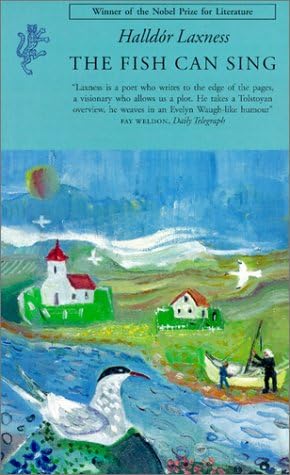
The Fish Can Sing
Product ID: 47116119
Buy anything from 5,000+ international stores. One checkout price. No surprise fees. Join 2M+ shoppers on Desertcart.
Desertcart purchases this item on your behalf and handles shipping, customs, and support to Israel.
Alfgrim was an abandoned child whose mother gave birth to him in the turf cottage of Bjorn of Brekkukot, the fisherman, on the outskirts of Reykjavk. This is the tale of Alfgrim's boyhood and youth in the home of his grandparents in the early years of the twentieth century. It is a hospitable place, where dignified understatement is the norm and everything from a lumpfish to a Bible has a fixed price that never changes. When Alfgrim goes to school and begins to learn Latin and music, he comes into contact with new attitudes toward the currencies of gold and language. The reigning spirit in this new world is the singer Gardar Holm, whose fantastic successes throughout the world have become a source of pride to his countrymen. Alfgrim's encounters with the singer only serve to make Gardar and his fame more mysterious and ambiguous. A beautifully crafted tale by Iceland's finest writer. Review: Wise and sweet and old - At first the setting of this strange land to me and the archaic stilted language and time, maybe early 20th?, was off-putting. But the story grows in character and charm. Loved it by the end. Review: Highly enjoyable - This is a highly enjoyable book. It tells an interesting story in very poetic language. I paticularly like the way the narrator describes the main character's falling in love. This is an examplary novel about being someone in life without losing your own identity on the way there.
| Best Sellers Rank | #7,036,550 in Books ( See Top 100 in Books ) #13,142 in Literary Fiction (Books) |
| Customer Reviews | 4.4 out of 5 stars 336 Reviews |
M**E
Wise and sweet and old
At first the setting of this strange land to me and the archaic stilted language and time, maybe early 20th?, was off-putting. But the story grows in character and charm. Loved it by the end.
L**S
Highly enjoyable
This is a highly enjoyable book. It tells an interesting story in very poetic language. I paticularly like the way the narrator describes the main character's falling in love. This is an examplary novel about being someone in life without losing your own identity on the way there.
F**E
Home is...
Halldór Laxness is undoubtedly Iceland's most famous writer. The story goes that he was in the middle of writing "Brekkukotsannall" - translated (surprisingly) as The Fish Can Sing - when he was awarded the Nobel Prize for literature (in 1955). Did this recognition change the way he completed the novel? May be, maybe not. Still, reading it with that knowledge in the back of my mind, the novel turns for me into much more that the intimate portrait of a "family", a small village community at the turn of the last century and a coming-of-age story of a young orphan boy, Alfgrimur. Couched in the narrator's stream of consciousness, gracefully integrating the child's view of his world with that of his older, reflective self, we discover the narrator/author's insightful musings on tradition and modernity, loyalty and betrayal, poverty and wealth, obscurity and celebrity. In his descriptions of people and place, Laxness's affecting sense of irony often makes light of the precarious situation in which most of the traditionally-minded locals in the "village" find themselves. The closely-knit community - fishermen, former navy men, the local priest, and the "old women" who look after them all - at the outskirts of what will eventually become Iceland's capital, Reykjavik - are lovingly portrayed and contrasted with the up-and-coming, wealthier merchant class that threatens the perceived peaceful and harmonious life of the community. The latter also represent the pro-Danes group as well as the influence of the wider world; a world that will threaten the livelihood of the local fishermen, like Bjorn of Brekkukot, Alfgrimur's grandfather... Young Alfgrimur lives, in his own words, a happy childhood, despite the fact that he was abandoned by his mother and left at Brekkukot shortly after birth... He is happiest when fishing with his grandfather; closest to the old woman he calls "grandmother", even though he knows "nothing about her". Brekkukot, an old turf cottage, is an unofficial guesthouse where various short- or long-term visitors are staying: some come to die and are buried in the nearby church yard, others live out their retirement and others are just transients. All share the cramped place and even beds in the "midloft"; it is the social centre of Alfgrimur's odd "family". The novel starts with a series of short, unconnected chapters, more like vignettes, through which the older narrator introduces the odd collection of "guests" in Brekkukot and some of the neighbours; all of them appear totally normal to young Alfgrimur and fill his notion of his "world". His and the wider world come together, in a way, for Alfgrimur at least, in the person of Gardar Holm, the famous son of the village, turned world-traveling opera singer. He returns from time to time to Reykjavik and, surprisingly or maybe not, strikes some kind of friendship with young Alfgrimur. In turn, the boy admires the older man, even embarks on teaching himself to sing the funeral hymn as well as Schubert's "Der Erlkönig". However, his idol is not all that he seems to be and Alfgrimur over time learns more lessons from their encounters than he realizes for a long time. I must admit that I took quite some time before I was able to engage with the novel and its characters. Its richness and beauty only really came together for me after I finished the last page and went back, picking out sections and chapters, reflecting on the underlying themes of the novel, exploring its depth and wisdom. [Friederike Knabe]
M**N
Icelandic literature in translation
excellent translation of Laxness' novel
K**R
Philosophy as farce
This novel is a narrative of the life of an Icelandic boy, a diary of episodes about his life and the zany characters he encounters. Superficially, it is a coming of age story for both the boy and his country. More seriously, it is philosophy as farce, with a lot of self-deprecating humor for both the protagonist and his country. It can best be appreciated as satire, though it wears thin in places for me, too much repetition. It was written in the 1950s by an Icelandic Nobel laureate and carries the strong feel of time and place, not so much as history, but apology. If you like slapstick and the columnist Dave Barry, the humor may appeal to you. The philosophical rants of some of the characters were interesting, but not enough to hold my attention well.
S**9
The Fish Can Sing by Halldor Laxness
The Fish Can Sing is an odd little novel about a talented yet humble young man in Iceland. Laxness paints a broad canvas here before settling into the novel's plot; we learn countless small details of everyday life in a small Icelandic village, nearby the capital that is itself a tiny blip on the world map. Everything is warm and inviting, albeit slightly peculiar, and as it continues we become more familiar with the narrator, Alfgrimur. As a protagonist he is nothing special, but the book's strength lies more in its themes and patterns than in characterization. As he matures he forms a surprising bond with his country's biggest star, the famous singer Gathar Holm. Holm travels the world and lives a life of ostensible luxury, yet the closer Alfgrimur grows to him the more he sees fame as fleeting and inauthentic. This is the book that Laxness was working on when he won the Nobel Prize, to date the only person from his country to have done so, and has a strange beauty to it that is borne from his obvious love for Iceland. Every character here is good-hearted; gone is the brooding protagonist of Independent People, or the Dickensian, conspiratorial villains in World Light. Even the book's gloomiest figure, Holm, is aloof yet always supportive to little Alfgrimur. As Iceland was in the world spotlight, from there emerged this modest, charming and thoroughly Scandinavian book professing its author's intense loyalty to it. This isn't Laxness' best work, but is filled with a certain something that makes it stand out in his ouvre.
S**A
Beautifully written and translated
I loved this book. The unusual characters are well drawn with a sympathetic humor not often found . I assume that a great deal of the book is autobiographical. It reminded me of my youth when all I wanted to do while growing up was work in a dress shop. The main protagonist in this book always says he just wants to be a fisherman like his guardian but he is much too talented and is gently guided by the whole community into a more challenging career. The only thing I regret is that we see so little of Iceland; but then I suppose in midwinter it is always in darkness and maybe scenery is not something of importance in Iceland. We do get a feeling of freshness but the characters are the main event here. I recommend this book without any reservations.
L**R
A fictional account in Iceland
Traveling to Iceland, I learned that this is one of the eminent novelists of Iceland. I appreciated it for describing the land in a fictional view. It arrived in good condition.
W**R
A house full of welcome and warmth
I had just read Independent People by the same author and turned to this novel not wanting to leave Iceland just yet. Where Independent People is dark and brooding in The Fish Can Sing the story is warm and humorous. The former's characters have impoverished lives yet we can identify with their universal feelings and emotions. The main characters in "Fish" are no less poor but seen through the eyes of the main character this financial poverty is almost a virtue, counteracted by the emotional wealth.
M**I
bello e molto originale
Prende un po' di tempo entrare nella Storia. Ma poi e veramente affascinante... Personaggi molto forti e sempre Positivi. La musica onnipresente ma estranea
A**R
beautiful book, arrived fast
my favorite writer
L**N
Weird and wonderful
Having recently been to Iceland and visited Halldor Laxness’ home, I was keen to read one of his works. As the blurb says, it is a weird and wonderful novel. I enjoyed the quirkiness and humour in his style of writing, and I think I understand the meaning of the story. Worth a read.
T**Y
A great universal joyful writer
Iceland and Ireland only differ by one letter, and it's Flann O'Brtien that I'm first of all reminded by in the hilarious and merciless humour of Halldor Laxness when he writes of his ain folk, the plain people of Iceland. But here is a kinder, more universal writer, and this story of an idyllic childhood lived in poverty and extreme eccentricity and hospitality, and of a vocation for song is an absolute delight.
Trustpilot
5 days ago
2 weeks ago