Desertcart purchases this item on your behalf and handles shipping, customs, and support to Israel.
☕ Elevate your coffee game with precision, power, and style!
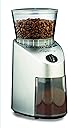
The Capresso 560.04 Infinity Conical Burr Grinder delivers commercial-grade grinding precision with 16 adjustable settings, a slow gear motor that reduces heat and noise, and a large 8.8-ounce bean hopper. Its durable stainless steel burrs preserve coffee aroma while the removable burr design ensures easy cleaning. Perfect for millennial professionals seeking consistent, café-quality coffee at home with minimal fuss.


| ASIN | B001QTVXCS |
| Best Sellers Rank | #141,091 in Home & Kitchen ( See Top 100 in Home & Kitchen ) #57 in Burr Coffee Grinders |
| Brand | Capresso |
| Brand Name | Capresso |
| Capacity | 8.5 ounces |
| Color | Stainless Steel |
| Customer Reviews | 4.2 out of 5 stars 2,761 Reviews |
| Global Trade Identification Number | 00794151401679, 00844819013390 |
| Included Components | Grinder |
| Item Dimensions L x W x H | 5"L x 7.75"W x 10.5"H |
| Item Type Name | Burr Grinder |
| Item Weight | 3 pounds |
| Manufacturer | Capresso |
| Manufacturer Part Number | 560.04 |
| Manufacturer Warranty Description | 1-year limited manufacturer's warranty |
| Material | Acrylonitrile Butadiene Styrene (ABS) , Stainless Steel |
| Material Type | Acrylonitrile Butadiene Styrene (ABS), Stainless Steel |
| Model Number | 560.04 |
| Number of Items | 1 |
| Product Dimensions | 5"L x 7.75"W x 10.5"H |
| Recommended Uses For Product | Commercial-grade |
| Style | Grinder |
| Style Name | Grinder |
| UPC | 844819013390 794151401679 |
| Unit Count | 1 Count |
| Wattage | 100 |
J**R
Near-ideal coffee mill for home use
My thanks to other reviewers -- whose comments regarding the wide selection of coffee mills enabled me to make the fortunate selection of the Capresso 560 Infinity Conical Burr Grinder, Brushed Silver, 8.5-Ounce . Having used it almost every day for several weeks, I find hardly anything negative to say about this unit (but see below), but the scope of this review does not extend to making espresso or other brews requiring special types of beans or especially fine grounds. Other reviewers have noted the major positives of theCapresso 560. For example, the motor speed is geared-down, thus slowing the speed of the rotating (lower) burr, which in turn reduces noise, reduces heating of the beans during milling, and reduces shattering of the beans and thereby gives more uniformity of the size of the grounds. As others have noted, the coarseness/fineness of the grind is easily adjusted over a very wide range, with a very high degree of control. This mill is obviously well built. It will not be the cause if you don't get an unbeatable cup of coffee. If, as formerly I did, you use one of the blade-type coffee grinders, you may have noticed that it results in a grind with a lot of very fine particles due to bean shattering by the violent impact of the blades, and as a consequence you may have experienced, as I did, a tendency of the brewing filter on your coffee maker to become unduly clogged and even to overflow for that reason. With the Capresso burr grinder, this problem is much reduced if not eliminated (although I have yet to use the mill's finest settings for the grind). Now some further points. Though some of what follows might be interpreted as negative, such an interpretation really would be unjustified, since, as I try to indicate, all of the issues raised are easily nullified. First, a basic point is just this: a little time spent in gaining familiarity with the unit's construction and operational behavior pays off (there IS a learning curve with this unit). Just bite the bullet and spend the time required to understand the user instructions. Second, a potential problem arises with this unit if you put the upper burr into place upside down (proper cleaning of the mill requires removal of the upper burr). Through inattention I somehow made this mistake (once) and had to resort to Capresso customer service (which had the answer with no hesitation, suggesting that it may be a more common mistake than one might have thought) to find out how to get it back out (tip: looking down on the top of the mill, notice the large, black outer ring that surrounds the burrs and use a butter knife in the obvious slot to turn the ring in a counter-clockwise direction to release the upside-down upper burr). Perhaps most people would never fall into this avoidable trap, but I mention it just in case it saved anybody from having this happen. As to cleaning the unit after milling, I have found this to be straightforward and reasonably easy. Third, this unit has a problem with static electricity. But this is evidently the case with just about all noncommercial coffee mills -- as one discovers in reading the reviews of a number of the grinders/mills offered on the Amazon site. In the case of the Capresso 560.04, and probably in the case of most any other mill, there are easy solutions to this problem, and I will now describe mine at some length. The behavior of static electricity, even for those of us with a background in physics, can seem quite bizarre. For one thing, as one learns in studying the laws and principles of electricity in science classes, static electric charges generated internally necessarily appear instantly (and I mean VERY quickly) on the "outside" surface of an object whenever the object is completely surrounded by a nonconducting medium (note the key word "surface") -- and an equal and opposite charge will be simultaneously created on the facing surface of the external objects in the vicinity. But the outside surface of the coffee mill is altered and becomes rather complex when you move the grounds receptacle (hereafter "the cup") from its position on the "inside" of the mill body to the "outside" or even partially to the "outside". Moreover, when you touch the mill, you and the mill together become, as far as the static electricity is concerned, one continuous object with the total charge (which is completely harmless) distributed over your body and the mill together -- excluding only the place(s) of contact between the two. Note: this short, perhaps overly simplified explanation of static electricity in the context of the mill is not intended to be beyond the possibility of any critique or amplification by professional physicists, but should suffice for the purpose at hand. The problem of the static charge on the mill can be solved by waiting long enough for the charge to dissipate into the environment, but this can take an inconveniently long time, especially in dry air. A better solution to the problem is to carry the charge away to the general environment or directly to an earth ground via a conductor. I implemented the latter remedy, and it works very well. One version of this remedy, easily implemented, is to use a length of wire (insulated or not) to conduct the charge to ground: with my fingers, I just hold one bare end of the grounded wire against the outside of the unit and, as I pull the cup out, I continue holding the end of the wire and bring it into contact with the "inside" surface of the cup AND the "inside" surface of the opening in the mill body itself (i.e., the opening, or docking port, where the cup fits). This discharges the whole unit (including my body), so that now the coffee grounds (i.e., those on the surface layer in the cup), which also would have become charged, are not forced (by the mutual repulsion of the charges they would have accumulated) to fly to, and distribute themselves annoyingly over, nearby surfaces. It's best not to get hung up on what is "inside" and what is "outside", because the charges just follow the laws of electricity and move around extremely rapidly due to mutual repulsion/attraction to wherever these laws dictate: the instantaneous distribution and the complex movement of the charges is way beyond direct detection by human senses -- although the hair on your arm may produce a sensation due to the forces arising from the attraction between the static charges on the hair and the opposite charges on external surfaces nearby. (Note that the static charge that will build up on the mill during grinding is completely harmless to a human, if it is noticeable at all.) Still another version of the remedy, which will be described next, offers more operational convenience but involves applying some aluminum duct-sealing tape to a few places in/on the unit. The aluminum tape I refer to is adhesive-backed and is available at heating/plumbing supply stores, or at other stores like Home Depot, Lowe's, or Ace Hardware. Just be sure you get the type of tape whose metal surface is bare and not coated with a nonconducting film. You can verify that the surface is bare metal by using a cheap ohmmeter or continuity tester. This alternative remedy is simple and easy to implement, is very effective, does not much affect the appearance of the unit, and, as I see it, presents no undesirable results of any kind. To implement this remedy, I applied three narrow strips of the conducting tape (a quarter inch wide, say; width is not important, except for ease of handling) as shown in the two photos that I uploaded to the product page. [For completeness, or to supplement the photos, the present paragraph describes how to apply the strips of conducting tape. Skip this paragraph if the photos are adequately informative. In what follows I will be referring to (a) the walls of the cup and (b) the walls of the docking port (i.e., the chamber in the mill body where the cup fits). First I describe the two strips of tape to be applied to the cup. One of the two strips of tape is affixed, by its own adhesive backing, to the cup so as to make a conducting path from a point at the top left of the inside of its back wall (call this point A) up and over the lip of the cup straight down to a point B at the bottom left part of its outside rear wall. The second strip starts at point B (make sure it overlaps the first strip) and runs horizontally from there along the outside wall of the cup to a point C at the bottom front corner of the left side of the cup. So much for the cup. Now I describe the third strip of tape, which will be applied to the inside of the docking port. This third strip is applied for a half inch or so along the bottom left rear wall of the docking port, and runs horizontally from there towards the front of the mill body, and finally wraps around the front corner to the outside of the mill body, leaving about a half inch of the tape exposed on the outside of the mill body. This strip is positioned in such a way that it makes contact with the other strip (the second strip as described above) -- which was applied along the bottom outside of the left wall of the cup. Make sure all three strips are completely affixed with their adhesive backing along their entire length. This completes the written description of the conducting tape application, but it's easier to understand all this by simply looking at the photos. Please note that there is a reason why I specified that the second and third strips of tape should run along the bottom of the cup and the docking port, respectively, in such a way that they can be in contact with each other continually as the cup is being pulled out of the docking port: this configuration allows no static charges to build up or persist anywhere in/on the unit while the cup is being removed.] Having described how to apply the strips of conducting tape, I now describe how they work. I still have a grounded wire that I can momentarily touch to the small segment of tape that I left exposed on the front bottom left side of the mill's body, as described above. This exposed segment is barely visible in one of the photos. The momentary, simultaneous contact between your fingers and the tape and the grounded wire instantly carries away all of the static charge in/on the unit, and completely eliminates the static electricity problem. But note that any subsequent rubbing of the mill's body or the cup can build up another charge, just as rubbing a cat with a silk cloth will build up a charge. In that event, just touch the ground wire to the exposed segment of tape and your fingers simultaneously while the cup is in place in the mill body. But wait: with the strips of conducting tape in place as described, the grounded wire may not even be necessary! Apparently, the above-described conducting path alone is sufficient to eliminate the problem of static charging of the whole device (or at least the unbalanced charge between you and the mill), although local conditions may bear on this conclusion (for example, whenever the air is very dry and the user is wearing insulated shoes and the counter/table top is highly nonconducting; under these conditions the grounded wire probably would need to be used, with the user merely needing to touch the mill and the wire simultaneously). Your own experience will lead you to your own conclusion as to whether/when you need to use the grounded wire. My experience is that merely touching the exposed segment of tape on the body of the mill (assuming all strips of tape are affixed as described above) while removing the cup completely eliminates the static charge mismatch, and thus completely solves this unit's problem with static electricity. Other folks may well come up with other ways (and there are many equivalent variants) to handle the static charges. Finally, to recap, this coffee mill is terrific. I liked it so much I bought another one as a gift for my son. The only definite suggestion I could offer to Capresso to make this product all but perfect would be to design it somehow to eliminate the (unbalanced) buildup of static electricity in the first place. For the record, I have no conflict of interest in contributing this review. I hope readers find it worthwhile, and comments would be welcome. [Note (13 February 2013): thanks to a reader who kindly provided me a tip on uploading the two photos I mentioned in the review. These photos can be accessed from the product page.]
M**R
Very impressed with this mid-range coffee grinder.
This is my 3rd burr grinder (I don't count the choppers, that's not a grinder). First was a hand crank. it did a good job, slower than tar. Second was a cheap electric high speed grinder (I think it was around $35). It lasted about 4-5 years. Very noisy. Did a good job, but lots of inconsistency in the grind size. Lots of Static cling. Very messy. This last one was worth every penny. I LOVE IT!! Very quiet compared to what I was used to. The grind is very, very consistent (no powder and no large chunks mixed in). Very little static cling like i noticed in some reviews(at least not enough that i feel like i need to wipe it down with a dryer sheet). Very easy to clean the inside of the grinder. Been using for almost a week and haven't noticed any stray coffee grounds on the counter (YA!). I have this coffee maker: Behmor 5393 Brazen Plus Temperature Control Coffee Maker. Together with this grinder I feel I am getting the best possible coffee for my investments. Very happy i moved up to the $90 price range coffee grinder. I Cant see any reason i would ever consider buying one more expensive than this. This one seems perfect for my needs. The only drawback I can think of is I'm not sure if it would do a course enough grind for a French Press. I started in the middle of the grind scale and that was WAY too fine for drip coffee. I ended up on the far side of course setting for drip coffee. I'm pretty sure it will grind fine enough for any espresso maker needs. Like I said, its perfect for my needs :)
A**S
Quality that lasts
Love this grinder. Can grind nice and fine and is quieter than all the other options. I have had one for about 10 years, which is so rare these days.
E**N
One design flaw... but it's compensated
An excellent conical burr grinder from Turkish to Percolator grinds which provides consistent, even grinds at minimal noise. If you're in the market for a new grinder, consider this one. It is an excellent machine in nearly every respect: from aestheticism to performance. Compact. It fits nicely in the corner of my kitchen without taking valuable counter space. Stylish. The brush silver finish is attractive and the curved edges give it modern appeal. Timer. The dial timer is easy to turn, and operates on seconds instead of the many mislabeled 'cups' setting. It goes higher than you'll likely ever need. If you set the timer too long, you turn the hopper (instead of the dial), which although may take getting use to ensures the longevity of the timing mechanism. Hopper. The hopper can hold about 1/2 pound of coffee, but I (and the manufacturers) recommend not keeping your coffee in the hopper. (Since it is clear, sunlight can penetrate and prematurely age your coffee, and it is more susceptible to oxygen if it remains in the hopper. And it will drop extra beans into the burrs, adding certain oils that will age the machine. The hopper has an excellent design which drops the beans into the grind chamber and limits their shooting back out. Ground coffee chamber. This can often be the most annoying part of a machine. The design on the Capresso alleviates many of the issues other grinders face, while adding one of its own. Many chambers have hard angles/corners where coffee can be trapped. Whether its the design or the plastic used, the Capresso does not suffer the same fate. it is easy to dislodge any coffee that finds its way to the fringe edge. There is no lid; it fits perfectly flush into the machine which removes some more of those edges. However, the angled front overlaps the sides and creates small crevasses where the coffee can rest. Although it does not get stuck there, if you aren't paying attention it can cause coffee grounds to dump onto your counter. I just shake the chamber so that all the grounds are in the larger portion and then dump into my filter. Conical Burr Grinding chamber. This is, unfortunately, the worst part of the grinder... though not in the ways you would likely think. The burrs do their job excellently! It gives me a flawless, consistent grind before pushing it into the final chamber. The rubber seal ensures that all the beans come into the chamber easily. The exit, however, is not so effortless. After the grinder finishes its job, some grounds remain in the chamber which makes cleaning a regular process. You can limit the amount of remains by lifting and smacking the grinder a few times, but it doesn't take all of it. Some grounds still remain at the base of the burrs with no exit... You actually have to twist and lift the hopper out, then lift out the burr mechanism... then take the brush Capresso includes with the machine and brush the grounds into the final chamber. I should note that this process is *simple.* It is not difficult. The design makes it impossible to misplace either the hopper or the burrs (unless you break the hopper in the process), but it is still extra work. Additionally, the removable nature of the burrs means any maintenance/replacement in the future should be an easy process; and so an annoying reality makes an helpful insurance feature. But it is still that: annoying. **Especially beware if you use dark-roast beans!** Dark roasted beans have less density (and become more dust when ground) and they get *everywhere* inside the machine. I used them once in this machine and spent the next fifteen minutes trying to clean out the grounds. I can't even imagine if I had tried to grind them on an espresso/Turkish setting! I would like to see this chamber problem remedied in the future, but I know that the compact nature of the grinder limits additional funnels (and additional funnels would increase the cleaning difficulty!), but I also wish I wasn't told to clean the machine 1/day. I actually clean it about once a week. All in all, this grinder is an excellent for-home grinder at a good price. If you're not looking to spend $500-$1000 for a home machine... this one offers quality for economy. And if you're thinking "What does he mean 'economy?!" then you will be more pleased with this grinder than you can imagine.
L**Y
Voice of Experience
In contrast to most product reviews you read on Amazon I actually have months of experience with this grinder. So let me start off with the good news: It does a good job grinding coffee and the noise level is not objectionable (at least to me). But it has two problems: The 1st is only an annoyance: They didn't do anything about the static electric charge that normally builds up and so you will have ground coffee all over your counter. The second problem is more serious: Every 2 to 3 batches I have to take the machine apart and clean out the discharge chute which is blocked up solid with coffee grounds. It's a 20 - 30 minute job. The problem is that the chute is too small and has sharp angles that naturally restrict easy flow of the grounds. In other words it's poorly designed. They *could* redesign their machines so they work properly but I see that they're taking a different, potentially more profitable route. Their grinders are now packaged (at extra cost) with a "Grinder Cleaner" to "solve" this flow problem. In other words they "fixed" the problem by getting you hooked on a "cleaner" that costs you $5 a shot to use. Over time they'll make more money on their cleaner than they make on the grinder! A "cleaner" that they won't tell you what's in it!!! No thanks, Capresso, I think i'll look for a grinder that doesn't require me to use a mystery substance "cleaner twice a month. (IE: $120 / yr!)
T**N
Excellent, long lasting grinder
I purchased my grinder 6 years and have used it daily since. I have been very satisfied with the quality and evenness of the grind. After about 4 years of use, I noticed that sometimes it seemed to slip a bit with the volume of beans I was grinding, and the final measurement was off. I considered buying a new grinder at the time, but never did. After a few weeks, the issue seemed to resolved itself. And then a few days ago I dropped it while cleaning the counter - it wasn't a long drop, just a foot to the counter, but it hit in a bad way, knocked the cylinder out, and cracked an essential piece off, and now it doesn't properly fit so won't operate. So, I purchased a pound of pre-ground beans to contemplate my next purchase. Will I buy the same unit again? The price is right. I think it's an excellent value for a burr grinder. Some people have complained about cleaning, and I agree that it's a bit messy - gets loose grinds on the counter. It's hard to pour the ground's neatly into the brewing receptacle too. But the complaints I have seen for some about having to clean out the internal pieces or it gets gummed up are not at all true for me. I have not once, in 6 years, cleaned out any of the internal mechanisms of the grinder, and I have never had a problem. Likewise, I store beans in the drum - I fill it full, do a fresh grind each time I make coffee, repeat until empty, and the fill the whole drum again. With my level of coffee drinking, it takes about 5 days to grind the whole drum, and I have no concerns about flavor differences between storing in the drum vs. in the coffee bag or a coffee cannister (I use both for the remaining supply). And the precision is excellent. I use two settings; a fine ground when I do a pour over coffee 3 times a week when I head to the pool for a morning workout. I do the largest possible course grind the rest of the week for my French press coffee. I'm very satisfied with both. Settings are easy to use. So yes, I will be buying the exact same grinder a second time. Will this one last 6 years or longer? I just have to be careful not to drop it.
T**P
Longevity - Follow Up
Wanted a conical burr grinder for my espresso but didn't want to spend a few hundred dollars. So I looked for the most inexpensive one I could find. Took a chance on this one and it's great. I was using a metal flat disc type grinder which was OK but the coffee I make using this grinder is discernibly superior in taste. Only had it a few weeks but it performs beautifully. The sound is whisper quiet compared to my old grinder. You start the thing by turning a knob to a value you have to determine with a little trial and error procedure. I put it around 2 1/2 to 3 and it gives me enough coffee to make a double shot of espresso. It's an odd type timer, reminds me of an old kitchen timer we used years ago to make a 3 minute egg. Has a retro feel to it, kind of nice if you know what I mean. All in all I am very happy with it and would recommend it if you want the advantages of a conical grinder without spending a small fortune. Thought I would add to this review. Had the unit 4 1/2 years now. It’s used twice a day, every day and still going strong. So if you have any doubts about how it does over the long haul, forget it. Customer service is great also. I broke the grind catcher recently. Dropped it on a tile floor. Contacted Capresso and had a new one in a few days for 3 bucks and a modest shipping fee. I’ve had this grinder going on 6 years. Thought some would be interested in how long it lasts. It’s still going strong. The espresso grind is the same as it was when new. I would highly recommend this for anyone looking for a burr grinder and not having to spend a fortune for it. I forgot to mention. I use this grinder EVERY day twice a day. Double shot in the morning, double shot after dinner.
C**R
Plastic parts break easily
I started out really liking this grinder. It has a large bean hopper and can grind up a good amount of beans in one run. We drink buckets of coffee here, so it's important for us to have a grinder that doesn't overheat and stop after a few runs. I was really hopeful for this one as I've had a few that burned out right away. The problem with the Capresso Infinity is that there are little plastic cutouts that have to be aligned properly when screwing in the hopper after cleaning. If you, as I did, twist it in such a way that these crack or break, which is easy to do, the entire thing no longer works. This happened to me after only a month. Fortunately, I'd saved my old, smaller grinder and have returned to that one. It's so wasteful to have a heavy-duty grinder made with such a wimpy plastic feature that it's unusable long before the motor wears out.
J**E
buena tecnologia.
magnifica molienda, silencioso y eficiente.
E**B
Excellent
I bought this in 2015 and still going strong!! Use regularly... It's pretty quiet, quite fast and produces an even grind. Only complaint, static on the beans makes it messy to clean... Recently bought a new one for my boyfriend, a different brand but same price. That one is junk in comparison!! So loud and constantly stops.. Get this one.
E**Y
Great coffee grinder
Our previous grinder was extremely loud and messy. I just got tired of the noise and cleaning up the mess. After looking at reviews and checking out how they are made, ordered the Capresso. What a treat! Works like a charm. Grinds the beans in half the time, it’s quiet and no mess to clean up. I highly recommend this coffee grinder. Easy to use, easy to take apart if you need to clean it. I haven’t had to do that yet tho.
J**Ú
Gran producto, mala empaquetación
Es un producto muy bueno, es un poco mejor la calidad del molido con respecto a molinos más baratos (50-80 dólares) y los acabados son muy estéticos y dan la perspectiva de ser premium incluyendo el plástico. El problema es que el mecanismo para hacer que muela el grano depende de una parte muuuy delgada del contenedor de PLASTICO que tiene que embonar en molino. Cualquier daño a esa parte tan delgada y el molino no va a funcionar, lo cual me parece una muy mala decisión de diseño pues el mío venía quebrado desde el empaque de fábrica, obviamente por lo delicado de esa fábrica. He logrado hacerlo funcionar uniendo el plástico con cinta pero obviamente no voy a poderle dar mantenimiento pues en el momento en el que lo saque se va a estropear todo. Muy mal diseño.
T**A
Es buen producto por la relación calidad precio.
Estuve investigando reseñas tras reseñas para llegar a este molino. Pros: Precio, eléctrico, es "Burr" (muelas). Contras: Tiene un rango limitado de molidos, no te molerá tan fino como para un espresso en máqunia no-presuizada aunque si lo llega a moler bien para las máquinas presurizadas, tampoco te molerá tan grueso para un cold brew. En general si haces tu café en máquinas con filtro presurizado (Que son las de espresso económicas como la Philip Saeco Poemia) te hará el trabajo sin problema. Si utilizas métodos manuales como aeropress, v60, kalita, chemex,v60 o ya sea cafetera funciona muy bien. Le doy 4 estrellas por las pequeñas limitantes que tiene peor considero que sigue siendo un buen molino para uso casero.
Trustpilot
3 weeks ago
1 day ago