We remain fully operational. Our teams are working around the clock to ensure your deliveries continue safely.

قم بتنزيل التطبيق


معلومات عنا
حقوق الطبع والنشر © 2024 Desertcart Holdings Limited
قم بتنزيل التطبيق
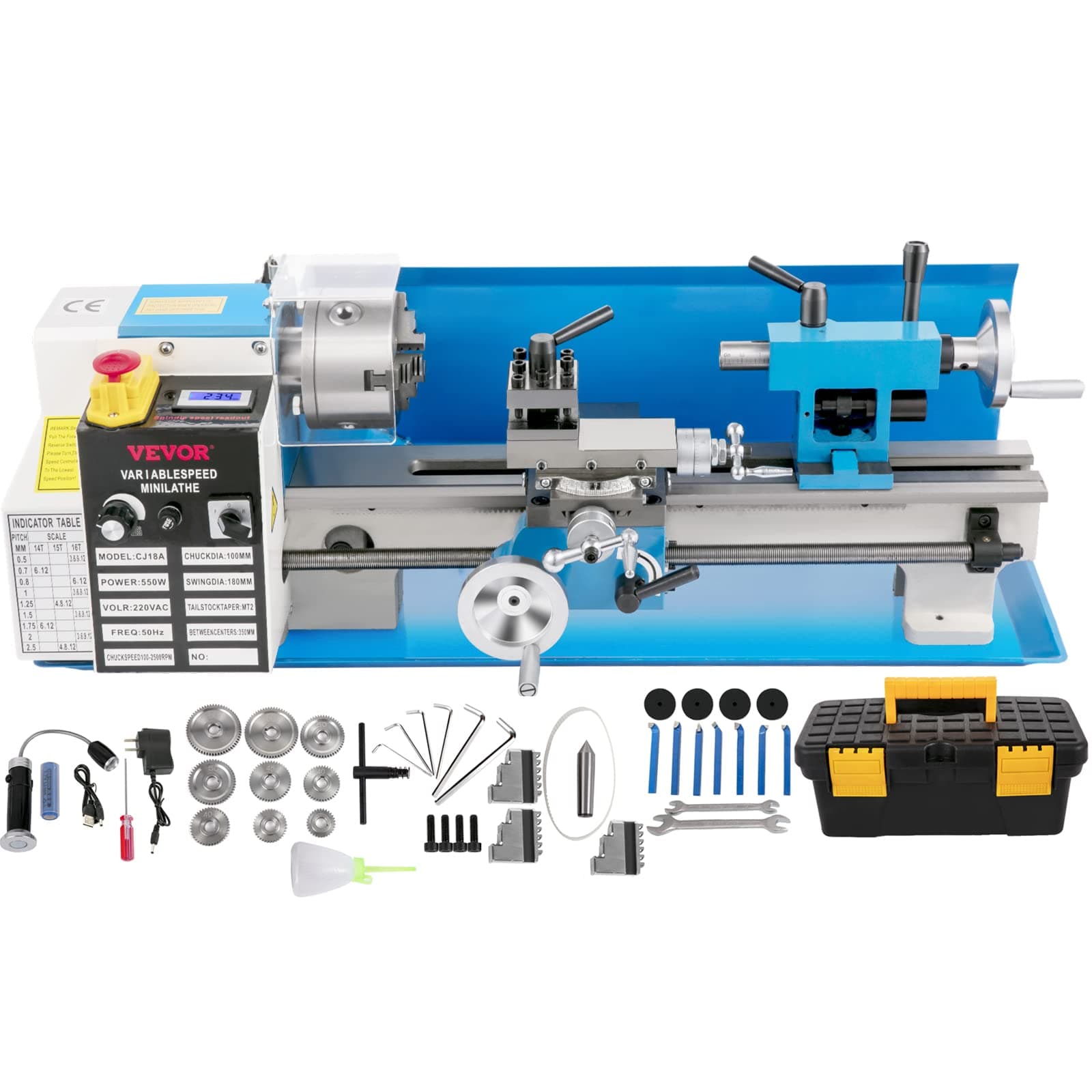
⚙️ Turn your workshop into a precision powerhouse — don’t get left behind!
The VEVOR 7"x14" Benchtop Metal Lathe combines a powerful 550W motor with a precision 4-inch 3-jaw chuck and a digital speed display ranging from 50 to 2500 RPM. Designed for professionals and serious hobbyists, it features metal gears, an aluminum handwheel, and a 4-way quick change tool post for versatile, efficient metal turning. Safety is enhanced with an automatic power-off switch and integrated LED lighting, making it ideal for detailed projects requiring accuracy and control.


| ASIN | B09FDVMYXS |
| Best Sellers Rank | #70,570 in Tools & Home Improvement ( See Top 100 in Tools & Home Improvement ) #1 in Power Metal Lathes |
| Brand Name | VEVOR |
| Capacity | 4 Inches |
| Compatible Devices | Lathe |
| Customer Reviews | 3.8 3.8 out of 5 stars (348) |
| Handle Type | handle |
| Included Components | Metal Lathe |
| Item Diameter | 4 Inches |
| Item Type Name | Mini Metal Lathe |
| Item Weight | 103 Pounds |
| Lock Type | Manual, Independent |
| Manufacturer | VEVOR |
| Manufacturer Part Number | SJ7X14JSMNCC550W0618MC |
| Material Type | Metal |
| Model Number | 7"x14" |
| Thread Size | M12x1.5 |
| UPC | 700721028726 197988721710 |
| Unit Count | 1.0 Count |
J**E
Nice Little Lathe at a Very Competitive Price!
Fast shipment from the vendor & very professional! I would recommend this machine to any of my friends. It's a great bargain for its size class. The machine arrived undamaged. Everything appears to be working as it should. Tolerances and runouts are as advertised and will not require much, if any adjustment. It's just a nice little lathe! Machines packed for overseas transport are usually covered with clear cosmoline or something similar. This unit was no exception. Expect to get several shop towels saturated wiping off the bulk of it, then use WD-40 to dissolve and wipe off any of it that remains. It's also a good idea to check the gears for detritis like wood chips and styrofoam that popped off the inside of the crate due to stapling of the crate at the factory to prepare the machine for transport. The stiff, brown grease on the gears in the drive train is for lubrication. As long as it's clean, there's no need to remove it. I plan to keep it well lubricated and use Vactra way oil on the various gibs, dovetails, and Morse tapers. Regular oiling of the lead screws and bearings that have oil ports is best practice and the machine should last for many years if you take care of it. Swarf it down at the end of every work session and when you expect to leave it sitting idle for extended periods of time. One thing that's often overlooked by newcomers is shimming the lathe bed. If you want to maintain tighter tolerances and minimize errors, shim the legs of the lathe bed to remove any twists. The rubber feet supplied with the lathe are not helpful in this regard. Bolt the lathe feet to a heavy bench and add shims. YouTube has several good videos showing how to do this. As to the several comments about the motor not running, READ THE INSTRUCTIONS!. There are several interlocks on this machine. The plastic cover over the lathe chuck has an interlock to ensure it is closed. The motor will not run if the cover is open. The Forward and Reverse switch on the front of the unit has to be set to the desired direction or the switch will trip out. And ALWAYS be sure to stop the machine when changing gears or directions. This thing isn't like a vehicle. Any time the gears or direction are changed, ensure the chuck is not turning! One other thing worth mentioning is that tachometer sensor under the end cover has to be close (but not touching) the left end of the lathe shaft. The small metal studs must clear the tachometer sensor. But if the sensor is too far away, the tachometer might register the rotational speed as something other than what it actually is. When I first turned on my machine, mine was reading about half the correct value. This is easy to fix by pushing the sensor a little closer to the shaft encoders, the small studs surrounding the end of the shaft. I have also seen a few people complaining about the lathe tools. These are brazed carbide cutters and need to be correctly sharpened before using. As with most brazed carbide cutters, it's up to the user to profile and sharpen them as needed before using them. You will likely also need to shim them in the tool holder to center them up to your workpiece. The lathe tool muti-tool holder will allow several cutter sizes. The ones in the included kit are 10mm x 10mm. If the cutter isn't lined up with with the vertical center of the workpiece, then watch some Youtube videos that explain how to do it. There is plenty of support for these machines on the Internet. If you have trouble finding videos, remember these all use similar parts that are made in the same factories in China. I agree that the multi-tool holder is a bit lacking and perhaps even more than a little clumsy. And depending on the metal you are working with, brazed carbide cutters might not be the best choice. They are typically used for cutting mild steel. Materials like high speed steel (HSS), titanium nitride, or cobalt steel cutter tools might be a better choice for other metals. It's just a budget tool holder with some general purpose tools for those who might not need anything better. There are lots of tool manufacturers with thousands of specialized tools available. Several recommendations are Shars Tool, Harvey Tools, and Tormach. There are several after-market quick change tool holders that will fit this machine with little or no modification. Remember, you are at liberty to add after-market parts and modify this machine as you desire. For small shop and hobbyist work, it's impossible to guess what every end user might need or expect. So watch videos, read books from the old timers, and ask questions. Someone will likely have a solution for whatever you may encounter. Also, remember that the larger the machine, the greater the cost for the tooling and work holding attachments. The cost of tooling and add-ons goes up exponentially with size of the machine. Many production shops that are trying to reduce turnaround time will expect more than the mini lathes and mini mills are capable of. If you expect the small machines to plow through the toughest metals with just a few passes, they just aren't capable of doing so. But most are capable of doing a decent job if you aren't in a hurry, take shallower cuts, use the right cutting tools, and don't have a long line of customers waiting. If you don't believe me, then look at what some of the so-called "model engineers" do with these things and even smaller machines of various brands. A good place to start is with the Home Shop Machinist books by Village Press, Inc if you are here in the US, and with lathe and mill books from Fox Chapel Books if you are in the UK or other countries. Amazon has both available.
P**N
Marginal Quality
Received in good condition, well packaged. All components were there, nothing missing. After cleaning the awful grease that covered everything and properly lubricated everything, I set in to make measurements and adjustments. The headstock runout was about 1thou, kind of expected for these cheap lathes. Ways were flat to about 1 thou after shimming and mounting to a heavy bench. The tail stock is absolute junk … it was 25 thou out of alignment. I could adjust the horizontal alignment, but the vertical was too high so nothing could be done to correct it other than machining the guide that sits on the ways. Unfortunately, the design is lame and the stock sits on an angle instead of sitting flat on the ways. To properly correct this, I’d need a 90deg chamfer bit for my mill but didn’t have one. I milled the opposite side to lower the stock so I could adjust it. I was able to align with the head stock to within 2-3thou. Total taper on a supported piece after turning it was still unacceptable. Getting a new tail stock. Yeah, I knew this would be a project, but didn’t expect the tailstock to be that bad. If you bought this and didn’t have a mill, this lathe would not be useable. I’m rating it 1 star so everyone is aware that if you buy this lathe you may not be able to get it in working order if you don’t have the tools and skills to fix it. There is truly NO quality control on this stuff so buyer beware.
M**Y
Good mini lathe with cool features
Now that I've had this lathe for about a year, I can say it has really impressed me. It needs the normal "going through" that all of these Asian imports do (alignments, adjustments, etc). I've filled up a few 5 gallon bucks with shavings, so I've used it quite a bit. It has good power for pretty much anything you can fit in it, but at slow speeds you can still stall it out. No big deal, just don't go jamming the tooling into the piece at slow speeds. The threading feature works pretty dang good, I was really impressed with that. Not changing gears around for different threads is a game changer in the cheap lathe category. If you are on the fence about it, I will say it is worth it if you need small lathe or just want to get into a new hobby. Mine had some small defects in the casting on the slide that didn't affect performance too much and they took care of me. I've made all kinds of things from spacers to bushings to bolts, and it's done a great job with everything I've thrown at it.
I**N
Failed safety switch
Packaging was good. I did have to tighten some loose hardware but I’m not taking any points off for that because you really need to take these things apart some anyway when they are new so you can clean the packing grease off. The Lathe works well for what it is, the more USA little weak but I may be trying to take too deep of cuts (my first lathe) my only real issue it that the power safety switch failed after my first passes and I had to go digging online to order a new one. It does seem to be a common part and not expensive though maybe $15-$20. I will update this review if the new safety switch does not repair the problem but I’m sure it will because I can hold it down and th lathe works so the internal solenoid part of the switch must have failed.
M**Y
No se encuentra centrado así que el material se suelta de la mordasa, en relación con el contrapunto ahí es más evidente que tiene una desviación, así que el material que se maquina toma la forma de un cono por la desviación de 4mm que tiene.
ترست بايلوت
منذ 3 أسابيع
منذ شهر