Desert Online General Trading LLC
Dubai, United Arab Emirates
Desert Online General Trading LLC
Dubai, United Arab Emirates


💡 Illuminate Your Space, Effortlessly!
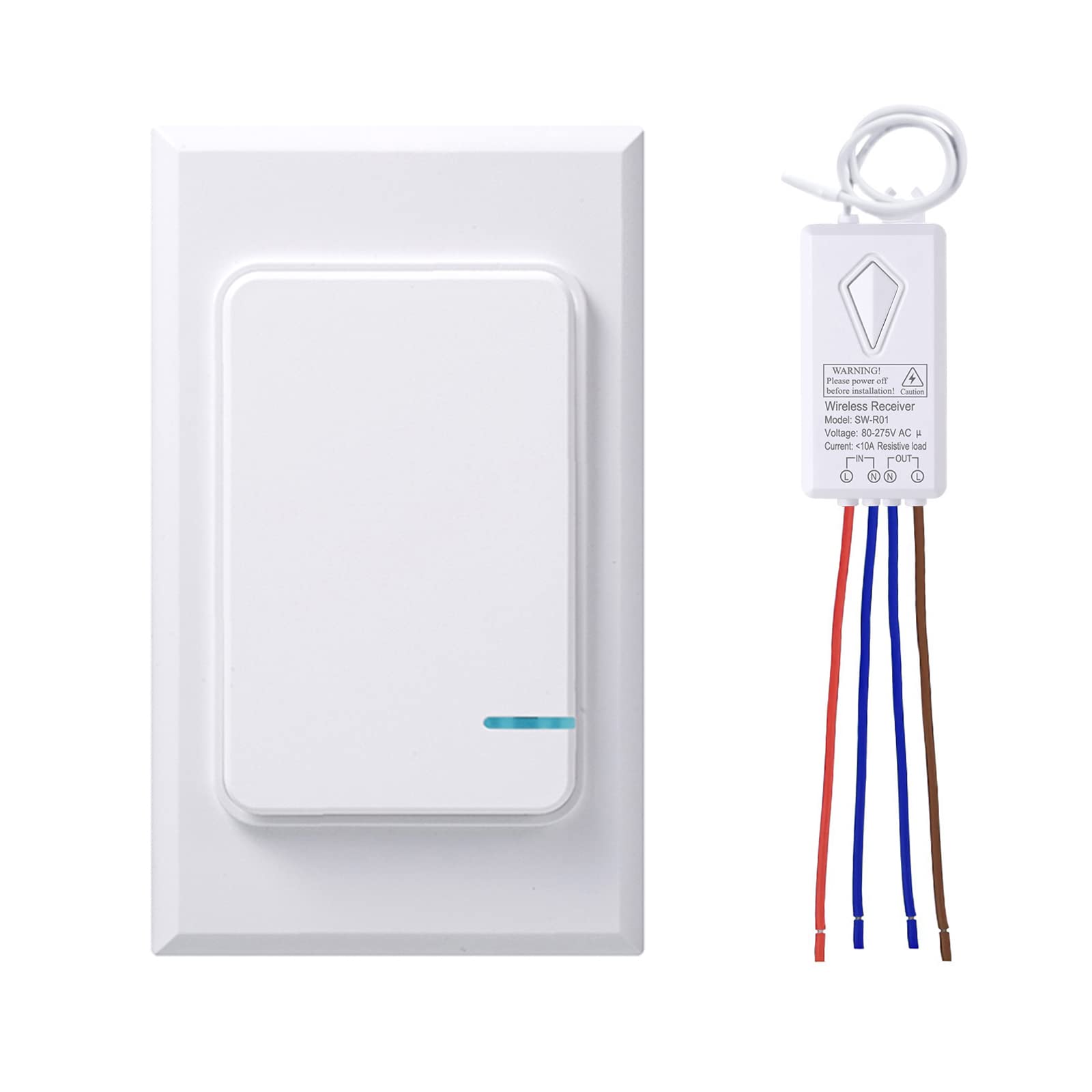
The Thinkbee Wireless Light Switch and Receiver Kit offers a hassle-free lighting solution with no wiring or WiFi needed. With an impressive range of 328ft indoors and 1969ft outdoors, this waterproof system is perfect for various settings, from homes to offices. It supports multiple control panels and comes with a 5-year warranty, ensuring reliability and longevity.
M**D
Crusty, but good enough to buy more
The main switching element is a 12A 125VAC/10A 250VAC/10A 30VDC rated relay. Only the Hot (L) wire is interrupted. The Neutral wire stays permanently connected to the load and receiver. The low voltage receiver logic also stays permanently connected to the Hot AC mains regardless of if the load is on, off or not connected.Power to the radio receiver is delivered via a 400V non polarized, red epoxy dipped film capacitor (probably Mylar type) acting as a ractive impedance in series with a zener diode. No fusing, grounding or current limiting circuity other than this capacitor can be identified. In other words, if the capacitor ever fails in a resistive manner, this device could theoretically burn your house down. Fortunately, being 400V rated and likely a decent quality film capacitor, a 120V AC mains transient would have to be very severe (ex: direct lighting strike to the power grid outside your house) to probabilistically let the smoke out in this manner. Film capacitors are normally "self healing" and will safely fail open circuit due to manufacturing defects or minor abuse (that doesn't instantaneously melt everything inside such that a resistive short can form).Just to be on the safe side, I put a 0.5 A inline fuse on the Neutral input line of the receiver (preferably 100mA fuse instead, but I only had down to 500mA fuses on hand), and connected the Natural line of the AC mains directly to the output load unfused. Note that in this configuration, the Neutral output wire on the receiver is left unconnected/unused. For added protection, I also put a 5A inline fuse on the Hot input line to protect the relay and PCB traces if the output load develops a fault.Due to the very small size of the receiver, the Hot and Neutral inputs in the receiver have a very tiny (1mm) air gap to guard against an internal short. However, they did mill slots in the PCB, so this air gap is a true air gap and unlikely to short due to condensation or microscopic conductive metal or salt dust ingress. The wires were soldered to the PCB with sufficient care such that no stray copper strands were flapping in the breeze and able to bridge the air gap. All thru hole components also had their leads trimmed after soldering, so nothing could accidentally bend and short to something else.Quiescent power draw appears to be about 29.7mA in the load-off state @ 120V, 60Hz, but somewhere between 0.01 to 0.04 power factor, so I estimate this wastes only about 225mW or ~2 kWh yearly. In the load-on state, the current dropped to 27.3mA, but the power factor increased to around 0.13, so perhaps 425mW or ~3.7 kWh yearly.Both the receiver switch and transmitter paddle buttons are rather difficult to open up as zero screws are used and everything is secured with plastic snap together hooks. The transmitters also have a second internal plastic cover that makes it difficult to replace the CR2032 batteries without damaging the plaatic unless you know where the hooks are and which direction to bend them. The top cover has two hooks at the bottom (near the LED) which hook inwards, so using a small flat screwdriver in the rear slots, pry outwards - that is, push the top handle of the screwdriver inwards towards the far end of the plastic enclosure. The other two hooks are actually rounded balls used as hinge pivots so don't need prying with a screw driver and just pop off with force. The secondary cover hooks become visible at this point and need similar prying from the back with a screwdriver.Note: if ever a transmitter, key fob or other coin cell operated, momentary actuation device seems dead after sitting around for a year or more unused, push the button repeatedly and/or hold it down for a minute or two. Lithium primary/non-rechargable cells develop extremely high internal resistance when unused for long periods and short circuiting or otherwise trying to drain them for 10-30 seconds or so brings their internal resistance back down several orders of magnitude to normal/functioning levels. Only cells that die during regular loading are actually depleted of energy and need replacing.The product description claims FCC certification. This is bogus since radio transmitters require an FCC product ID printed on them to track defective devices generating harmful RF emissions back to the manufacture and no such ID stickers or numbers are printed on these transmitters. This is quite insignificant, however, since these transmitters are momentary use and extremely limited in how much noise they could ever generate by virtue of having a tiny CR2032 power source.Overall, I award 5 stars, installed my purchase in my bedroom and plan to buy another receiver and transmitter set for use in another room because despite the things I dislike and worry about this product, the price point is way better than a true high quality/reputably branded/UL listed/FCC certified product, and simple inline fusing aleviates my safety concerns. I also like the very low quiescent power consumption - WiFi switches need 5x or more continuous power.
T**S
Works well.
Works great. Nice to have the ability to switch the light on/off without going to the wall.
C**K
Works exactly as advertised
This is a great, easy way to add or relocate an existing switch. The range is excellent: my transmitter (the switch) is about 60' from the receiver (the part that wired into the junction box) in a covered outdoor location and response to the switch is 100% and instantaneous.I opened the transmitter up to note the battery type before installation. It is a CR 2032 "watch style" battery (included). I was impressed by the layer of silicone waterproofing inside the transmitter, a testament to their claim of water resistance. However, do note that replacing the battery requires opening the transmitter with a small screwdriver while trying not to break tiny and seemingly delicate tabs that hold the case closed. The transmitter is designed to stick on a wall with double faced tape and to replace the battery would require removing the transmitter from the wall and replacing with new double faced tape. Hopefully the battery will last for months so this won't become a frequent annoyance. It is a shame they didn't design this unit to fit a standard junction box with a Decora-style electrical trim plate; that would make for an easy and ideal installation with what is called an "old work" electrical junction box; such an installation would require a hole in the wall, but it would require no wiring inside the wall and would end up looking exactly the same as any other wall switch.The instructions are actually not as bad as some reviewers have stated, but what is confusing is the fact that they have used their own color coding for the wires. Red in their case is line (hot, which is black in US standards), Brown is load (again this would be black in the US), and the unit has a confusing two blue wires that represent neutral (white in the US). In the US we would customarily see only one neutral wire coming out of the device as neutral is normally not switch but instead passed through in the junction box, bypassing the switch entirely. This begs the question: does one need to separate a neutral in and neutral out for this switch, or can both neutrals simply be connected to the neutral bus in the junction box? I tested simply connecting both neutrals to the neutral bus, as is standard in the US, and the unit worked fine so the neutral is not for some reason switched inside the receiver, they are simply two leads connected to the same common neutral. I hope this info makes installation clearer for those who understand what I am talking about.Finally, I never tried using the supplied wire connectors; they appear inferior as many other reviewers have noted and likely not up to code as well. I used traditional wire nuts, worth a couple cents extra for peace of mind.Aside from instructions that are only fairly good, and confusing wiring protocol, and aside from a form factor that almost matches other switches but simply doesn't, this is a great product that works well and appears to have very good weather proofing. I cannot speak to durability over time as I have just installed mine today, but as of this moment I am thrilled with the ease of use, the price, the quality and of course the convenience it adds for my purpose.
M**N
Very good product
I have installed several of these in both single and three-way light switches. This was to correct a very inconvenient switch layout in a new house. So far, they have performed perfectly and I have yet to change out a battery on the transmitter. You will need to have a neutral at the switch location, also to convert a three way, you will need to convert it to a normal single switch configuration (i. e., trace out the hot leg and the wire to the light and put the relay in this location). Other than that, the installation is very straightforward. It is a far better solution than pulling new wires to create a three way in a new location, since one relay can have up to eight switches (according to the manufacturer). I wouldn’t recommend it for any application except lighting as I don’t know what is the quality of the relay, nor how many switchings it will do in normal life expectancy. The blue LED indicates that the transmitter switch is functioning, which is convenient
H**6
Works as described
Worked as described.It loses a star with the short wires that come with the wiring harness - makes it difficult to tie into the romex in the ceiling box..especially when the wire is a thin gauge already.
ترست بايلوت
منذ يومين
منذ شهرين