We remain fully operational. Our teams are working around the clock to ensure your deliveries continue safely.

قم بتنزيل التطبيق


معلومات عنا
حقوق الطبع والنشر © 2024 Desertcart Holdings Limited
قم بتنزيل التطبيق
Buy anything from 5,000+ international stores. One checkout price. No surprise fees. Join 2M+ shoppers on Desertcart.
Desertcart purchases this item on your behalf and handles shipping, customs, and support to Israel.
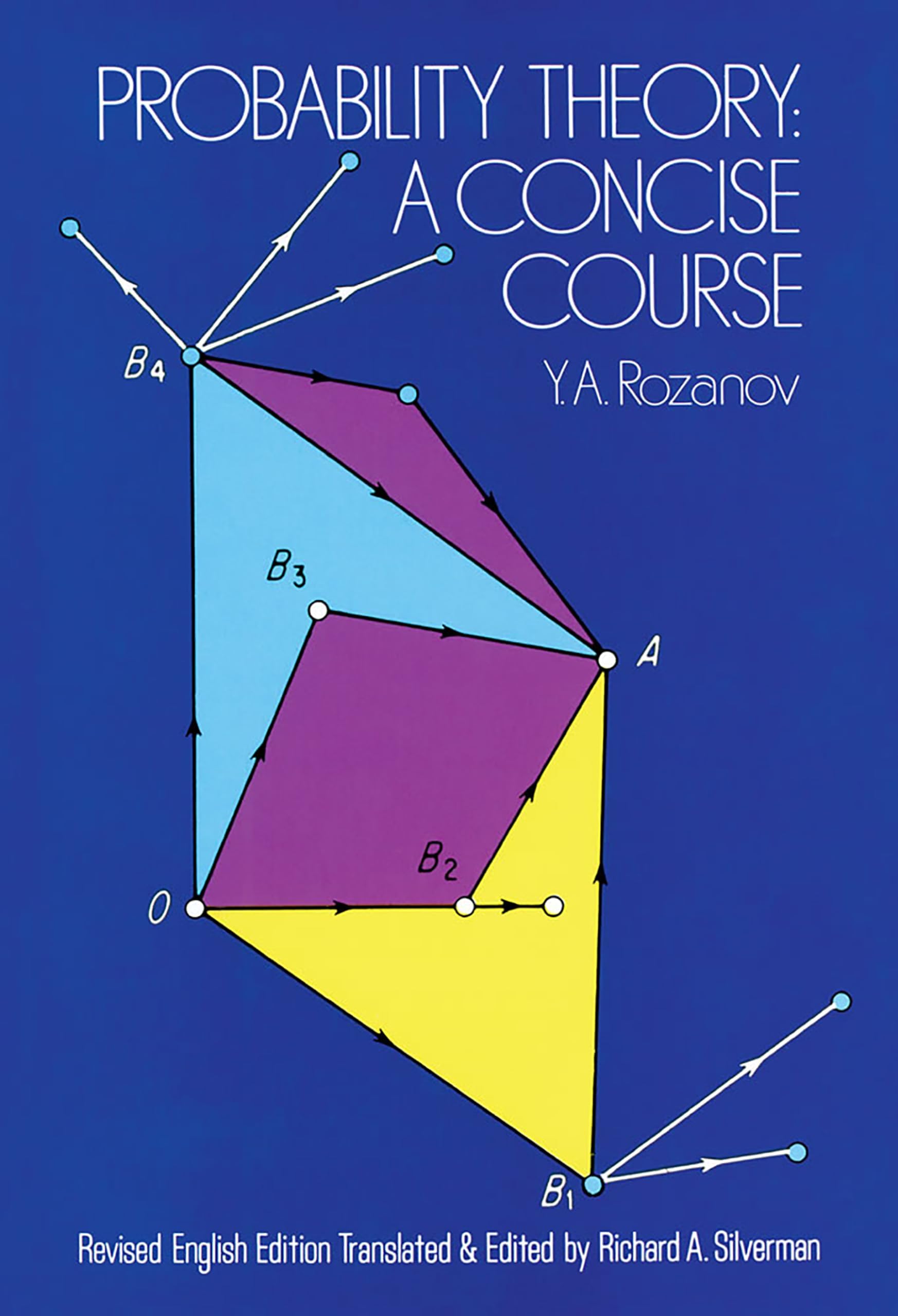
Buy Dover Probability Theory: A Concise Course by Rozanov, Y. A. online on desertcart.ae at best prices. ✓ Fast and free shipping ✓ free returns ✓ cash on delivery available on eligible purchase. Review: This is a very handy book on probability theory. All the commonly used concepts and formulae are summarized in a very compact way. Review: "Concise" is indeed the operative word here. This book is probably not suitable as a first text on the subject, but makes an excellent review or quick reference for the topics it covers. Essentially, this text is geared toward taking someone who has - in principle - no knowledge of probability and introducing them specifically to Markov processes. There is very little attention paid to conditional probabilities, and Bayes' rule is never even mentioned. Also, this book requires no measure theory. Chapter 1 covers basic concepts: probability as relative frequency, sampling with and without replacement, binomial and multinomial coefficients. Chapter 2 is titled "Combination of Events". It introduces the idea of the sample space, and focuses on how probability interacts with set theoretic operations such as intersection and union. It ends with a proof of the First Borel-Cantelli Lemma. The third chapter introduces independence and ends with a proof of the Second Borel-Cantelli Lemma. The Borel-Cantelli Lemmas are somewhat technical results that are needed to the get the theory of Markov processes off the ground, so it's pretty clear where this book is headed early on. The proofs of both of the lemmas are very tidy. Chapter 4 is devoted to random variables. Here we find the definitions of expectation, variance, and the correlation coefficient along with Chebyshev's Inequality. Chapter 5 covers the Bernoulli distribution, the Poisson distribution, and the Normal distribution. We are also treated to the De Moivre-Laplace theorem as a stepping stone toward the Central Limit Theorem. Chapter 6 is titled "Some Limit Theorems". We are immediately provided with the proof and then statement - in that order - of the Weak Law of Large Numbers. We are then provided merely with the statement of the Strong Law of Large Numbers. This chapter then introduces Generating Functions which are used quite heavily in the remainder of the work. This chapter also introduces Characteristic Functions, which don't get much attention and concludes with the Central Limit Theorem. Chapter 7 introduces Markov Chains while chapter 8 covers Continuous Markov Processes and naturally covers the Chapman-Kolmogorov equations. Here simply called the Kolmogorov equations for the fairly obvious reason that the author is Russian. The book ends with four short appendices which introduce the reader in turn to the following topics: Information Theory, Game Theory, Branching Processes, and Optimal Control. I thought these were wonderful although obviously none of them covers very much ground. This book is actually quite delightful especially for someone who already has some background in basic probability. It does provide and good and very quick introduction to Markov processes, but it's scope of coverage of any topic is necessarily quite limited.
| Best Sellers Rank | #145,770 in Books ( See Top 100 in Books ) #355 in Applied Mathematics |
| Customer reviews | 4.6 4.6 out of 5 stars (213) |
| Dimensions | 14.38 x 0.84 x 20.78 cm |
| Edition | New edition |
| ISBN-10 | 0486635449 |
| ISBN-13 | 978-0486635446 |
| Item weight | 294 g |
| Language | English |
| Print length | 160 pages |
| Publication date | 1 June 1977 |
| Publisher | Dover Publications |
S**3
This is a very handy book on probability theory. All the commonly used concepts and formulae are summarized in a very compact way.
J**D
"Concise" is indeed the operative word here. This book is probably not suitable as a first text on the subject, but makes an excellent review or quick reference for the topics it covers. Essentially, this text is geared toward taking someone who has - in principle - no knowledge of probability and introducing them specifically to Markov processes. There is very little attention paid to conditional probabilities, and Bayes' rule is never even mentioned. Also, this book requires no measure theory. Chapter 1 covers basic concepts: probability as relative frequency, sampling with and without replacement, binomial and multinomial coefficients. Chapter 2 is titled "Combination of Events". It introduces the idea of the sample space, and focuses on how probability interacts with set theoretic operations such as intersection and union. It ends with a proof of the First Borel-Cantelli Lemma. The third chapter introduces independence and ends with a proof of the Second Borel-Cantelli Lemma. The Borel-Cantelli Lemmas are somewhat technical results that are needed to the get the theory of Markov processes off the ground, so it's pretty clear where this book is headed early on. The proofs of both of the lemmas are very tidy. Chapter 4 is devoted to random variables. Here we find the definitions of expectation, variance, and the correlation coefficient along with Chebyshev's Inequality. Chapter 5 covers the Bernoulli distribution, the Poisson distribution, and the Normal distribution. We are also treated to the De Moivre-Laplace theorem as a stepping stone toward the Central Limit Theorem. Chapter 6 is titled "Some Limit Theorems". We are immediately provided with the proof and then statement - in that order - of the Weak Law of Large Numbers. We are then provided merely with the statement of the Strong Law of Large Numbers. This chapter then introduces Generating Functions which are used quite heavily in the remainder of the work. This chapter also introduces Characteristic Functions, which don't get much attention and concludes with the Central Limit Theorem. Chapter 7 introduces Markov Chains while chapter 8 covers Continuous Markov Processes and naturally covers the Chapman-Kolmogorov equations. Here simply called the Kolmogorov equations for the fairly obvious reason that the author is Russian. The book ends with four short appendices which introduce the reader in turn to the following topics: Information Theory, Game Theory, Branching Processes, and Optimal Control. I thought these were wonderful although obviously none of them covers very much ground. This book is actually quite delightful especially for someone who already has some background in basic probability. It does provide and good and very quick introduction to Markov processes, but it's scope of coverage of any topic is necessarily quite limited.
A**O
Me gustó este libro, llegó bien.
O**I
I really like pretty much all Dover's serie on Mathematics and this is one of the best books in the collection. It is concise and it might require a knowledge of basic Mathematics but it covers really important topics such as random variables, limit theorems and MCMC with enough details. The book is a revised translation of Y,A Rozanov's original book. I deeply suggest to anyone who want a good introduction on the topic of modern probability theory.
S**Y
Covers a lot, from basics to advanced topics. I mainly grabbed it for Markov chains, and optimal control (at appendix) which is laid out nicely
ترست بايلوت
منذ 3 أسابيع
منذ شهر