We remain fully operational. Our teams are working around the clock to ensure your deliveries continue safely.

قم بتنزيل التطبيق


معلومات عنا
حقوق الطبع والنشر © 2024 Desertcart Holdings Limited
قم بتنزيل التطبيق

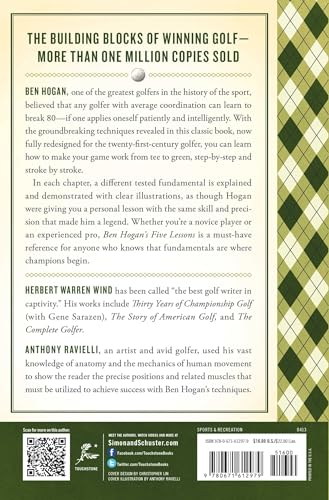


🏌️♂️ Elevate your game with the ultimate golf bible!
Ben Hogan's Five Lessons: The Modern Fundamentals of Golf is a definitive guide authored by one of golf’s greatest players. First published in 1957, this book distills Hogan’s swing secrets into five essential lessons, enhanced by original illustrations and complemented by exclusive interviews and articles. A #1 bestseller in golf books with over 14,000 glowing reviews, it remains the go-to resource for both beginners and seasoned players aiming to refine their game.
| ASIN | 0671612972 |
| Best Sellers Rank | #11,101 in Books ( See Top 100 in Books ) #1 in Golf (Books) #1 in Sports Encyclopedias #3 in Sports Reference (Books) |
| Customer Reviews | 4.8 4.8 out of 5 stars (14,813) |
| Dimensions | 5.25 x 0.5 x 8 inches |
| Edition | Reprint |
| ISBN-10 | 9780671612979 |
| ISBN-13 | 978-0671612979 |
| Item Weight | 3.21 ounces |
| Language | English |
| Print length | 128 pages |
| Publication date | September 20, 1985 |
| Publisher | Touchstone |
E**T
This should be the first book on your golf shelf.
I’m brand new to playing golf, and was unsure where to start learning. I’m a self teacher, so my search always starts with a book. Did I just ver find one?! This is THE tome of golf wisdom. Ben Hogan is renowned as one of the greatest golfers of all time, and when he originally wrote these 5 essays in 1957, he turned the world into potential golfers. This book won’t teach you everything about golf, but everything about playing golf starts with the lessons contained. From the forward by fellow legend Lee Trevino, to the original artwork detailing each point, and the second half of the book with articles and interviews detailing Ben’s life and legacy, this is the first book every new golfer should read. I’m 1/4 through, and I’ve already found a few flaws in what I would have been practicing. While I’m sure it can’t replace lessons with a real teacher, if you’re like me and can easily apply what you read, this book will get your game off the ground.
C**S
Excellent golf fundamentals
I cannot figure out why I never had this book decades ago. It's an easy read giving Hogan's methods for the swing. I recommend it to all golfers. The back section of the book is a set of articles and interviews of Ben Hogan over the decades. Those are informative. Sometimes these old books (1957 for this) are hard to find, so glad this is in print now. Don't think a book written in 1957 is irrelevant. Wrong! It certainly is.
D**T
The suggestions are legit, even in 2025.
I’m a relatively new golfer, but my husband is a fantastic golfer who has played his entire life. I decided to read this book after hearing it referenced on several golf podcasts referring to former pros who learned to play the game by adopting the advice of this book. It has stood the test of time! My husband was skeptical, especially since chapter one suggested he move from his interlocking grip to an overlap grip. He tried it and couldn’t believe the results in how he hit the ball. We are still working our way through it because you don’t want to move to fast when changing everything, we work one chapter at a time and give it time to feel natural before moving to the next! Would definitely recommend this to any golfer. If nothing else it’s interesting as he explains the why behind the movements.
N**M
Great golf lessons by the Hawk
This book is all any starting novice golfer will need for proper instructions on full swing. For short game, I will recommend Getting Up And Down by Tom Watson. I found numerous videos for tips in Youtube largely useless or misleading especially for the novice. To learn powerful and repeatable full swing, this book is best because it explains all the steps from the grip to downswing as one coherent system that is what Mr. Hogan refers to as chain actions. Having said that, this book elicits some questions, as well. For example, though Mr. Hogan devoted Chapter 2 to stance and posture, unexplicably he does not talk about how to address the ball in detail. In two other equally great books, Getting Up And Down by Tom Watson and Golf My Way by Jack Nicklaus, the authors emphasize address should reflect so called hitting geometry in which the hands are ahead of the ball location. The reader of this book can only guess what Mr. Hogan's thought might be on proper address from one of the illustrations in the book, where remarkably to me at least, the club is held almost perfectlly vertical (pg. 24)! I can confirm the same vertical address in numerous videos of him. Another example is the position of the grip at the top of backswing that he aptly refers to as the crossroad. He emphasizes in this book the left arm and grip should stay in the backswing plane which is a plane extending through the shoulders and the ball at address. This is a point I found very useful and follow. However, it is widely known that, as a player, his grip at the crossroad was far below this plane (shown in iconic Aug. 8, 1955 Life Magazine cover) and, as a matter of fact, one of the flattest of all PGA pros according to Jack Nicklaus. I wonder therefore whether his emphasis on supination (counter-clockwise rotation of the hands/wrists in the hitting area) is a way to compensate for his low top position. The starting golfers however should not mind this discrepancy. Instead they should focus on his teaching in the book to stay on the backswing plane and that will work nicely. All in all, I have no doubt this is the first book any starting golfers should read and refer to whenever questions arise as they practice full swing. They will benefit immeasurably.i P.S. Since I wrote my review two years ago, I have gained an additional insight on supination. I was baffled by the fact that some golfers did not underscore its impotance as much as Hogan did in this book and this is why. His grip, the famous Hogan grip, is essentially a fade grip and without conscious turn and control of his left hand, the face of the club will open at impact. If it is done properly however it will become a power source as the speed of the club head will increase by this turning. When it is combined with the right hand release, the result? Long and deadly straight ball to the target with slight fade at the end (Hogan's power fade) even for amateur golfers.
K**様
50年前以上に父親が海外転勤時に買ったこの本がもうボロボロになってしまって補充の為に買いました。昔も今も共通のする部分があるのがすごいですね。ゴルフがうまくなりたい人だけではなく、歴史書としても一度読んでみても面白いかと思います。和訳も出てます。おすすめです!
A**R
So interesting. Back to basics
T**S
Ben Hogan’s Five Lessons is an absolute must-read for any golfer serious about improving their game. Hogan breaks down the fundamentals of the golf swing in a way that is timeless, practical, and easy to understand. The illustrations are simple yet powerful, making it clear how to apply his teachings directly to your own swing. What’s remarkable is how far ahead of his time Hogan was—his insights remain just as valuable today as when he first shared them. Whether you’re a beginner or a seasoned player, this book provides lessons that can truly elevate your golf game.
H**L
This guy was a legend for a reason .For Amateurs it’s a great help book . It’s a must for learning a good golf .
S**I
Inutile girarci intorno. Chiunque ami questo sport e lo pratichi regolarmente, leggendo questo piccolo libro non potrà non trovarsi a provare quanto Ben Hogan, a ormai quasi un secolo di distanza, ha così efficacemente descritto. Il grip, che è la croce e delizia di ogni dilettante, spiegato in maniera chiara, così come la postura e lo stance. Nel mio caso, lavorare sul grip e modificarlo seguendo le istruzioni ha significato un incremento della distanza dei ferri assolutamente notevole. Chi ama questo sport, non può non leggerlo. Anche solo per apprezzare lo sforzo di studio fatto da quest'uomo così tanti decenni fa.
ترست بايلوت
منذ شهرين
منذ شهرين