
Buy anything from 5,000+ international stores. One checkout price. No surprise fees. Join 2M+ shoppers on Desertcart.
Desertcart purchases this item on your behalf and handles shipping, customs, and support to Israel.
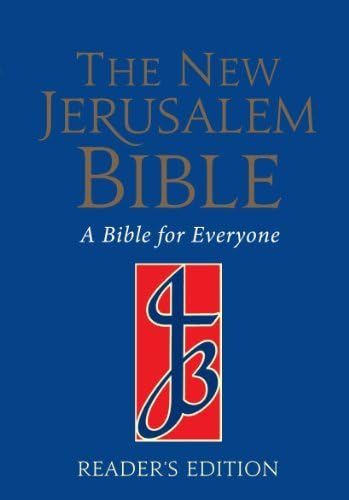
Contains the complete text of the ancient canon of scripture, along with up-to-date and extensive introductions and notes. Eight pages of color maps and indexes, including biblical themes, personal names, and major footnotes. Review: A surprising translation with a excellent features - The New Jerusalem Bible is a bold translation, and it's best read in the hardcover edition. While everyone expects something different out of a Bible, the combination of translation and features have made this one my favorite. The Translation This translation does not stand in the Tyndale tradition and lacks the familiar English Biblish. The editor opines that literary fidelity has been everywhere preferred to literary quality, but the translation is by no means wooden. It reads smoothly, and in some cases sacrifices familiar phrasing for correct interpretation: John 3:16 For this is how God loved the world: he gave his only Son, so that everyone who believes in him may not perish but may have eternal life. The most useful aspect of the translation is the treatment of God's names in the Old Testament. I know of no other modern translation that maintains the distinction of God's OT names so assiduously. El and Elohim are (depending on context) rendered God, god, or gods. El Elyon is rendered God Most High. Yahweh and El Shaddai are transliterated. Readers acquainted with the documentary hypothesis, or bronze age religion as it was practiced, will appreciate this distinction. Two examples: Exodus 6:2-3 God spoke to Moses and said to him, 'I am Yahweh. To Abraham, Isaac and Jacob I appeared as El Shaddai, but I did not make my name Yahweh known to them.' Deuteronomy 32:8-9 When the Most High gave the nations each their heritage, when he partitioned out the human race, he assigned the boundaries of nations according to the number of the children of God, but Yahweh's portion was his people, Jacob was to be the measure of his inheritance. (Following the Septuagint.) The textual basis of the Old Testament is the Masoretic Text, but as you can see from the Deuteronomy excerpt, the translators availed themselves of other sources which they felt represented a more ancient tradition, or solved problems with the Hebrew text. Editorial emendations have also been made. The deuterocanon (presented in the Roman Catholic order) and New Testament are taken from modern critical texts, with reference to other versions. Footnotes identify anything in the text taken from the versions or created by editorial emendation. Longer questionable passages, such as the ending of Mark and the pericope of the adulteress, are kept in the text, but footnotes discuss the problems with these sections. Shorter spurious passages, like the Johannine comma, are removed to the footnotes. The Features The text is presented in a single-column, paragraphed format. Poetry is formatted as such. Major divisions within books are given numbered headings (Roman numerals, naturally), and subsections or pericopes have bold headings. Chapter numbers are large and bold in the text, while verse numbers are to be found in the inner margin. If two or more verses begin on the same line, a dot or bullet point is used to separate them. While this is a rather unusual layout, it is very easy to find things in this Bible, by chapter and verse or subject. It combines the best aspects of the traditional chapter and verse bible with the best aspect of the numberless “reader's Bibles” that have recently been (re-)introduced. All footnotes are found at the bottom of the right-hand page. Footnotes comprise mainly translation information, textual variants, and historical notes. These notes usually take a historical-critical approach, and do not assume we possess a completely inerrant text. Doctrinal notes are rare, but there are some. A notable example can be found in Luke 22:32k, which reads in part, “This saying gives Peter a function in directing faith with regard to the other apostles. His primacy within the apostolic college is affirmed more clearly than in Mt 16:17-19, where he could simply be the spokesman and representative of the Twelve.” The text, of course, says nothing of the sort. It only says Peter will “strengthen” his brothers. There are various other features along the margin of the page. At the top of the left-hand page, a page number, the name of the book, and the chapter and verse of the first verse on the page. The top of the right-hand page has the same information, but the chapter and verse are those of the last one on the page. The outer margin has references to parallels, quotations, and allusions. (Quotations in the text are helpfully italicized.) While all this could make the page seem very busy, it is very easy to ignore the marginalia and concentrate on the text due to the single-column format described earlier. Several groupings of books, and several individual books, have introductions of at least several pages each. Like the notes, these are full of historical information. There are fairly detailed discussions of the documentary hypothesis and the synoptic problem, the authenticity and dating of the epistles, etc. The introductions are fairly meaty, as these things go. They compare favorably to other study Bibles. There is also some interesting back matter in this volume. The chronological table presents two or three chronologies in parallel, displaying various events from Biblical and secular history. It runs for about 20 pages. There is a family tree of the Hasmonean and Herodian dynasties. There is a page devoted to the calendar, and two pages devoted to measures and money. There are indexes to footnote subjects, to persons, and to the maps—of which there are seven, in full (if tastefully muted) color, one spread over two pages. The Physical Construction Removing the somewhat ostentatious dust cover, one is presented with a slightly-less ostentatious blue hardcover, with a big gold foil JB on the front and more restrained markings on the spine. The paper is thin and there is bleed-through. Text lines are not matched with those on the opposite side of the page. The maps are on thick, glossy paper. It lays flat for reading. Review: God's Name and other translation bias - Review of "The New Jerusalem Bible" This review is from the 1999 printing by Doubleday. It has the Imprimatur of John Crowley and Nihil obstat of Anton Cowan marking this translation safe for a Catholic reader. It includes the Apocrypha, just a few footnotes, and two maps of Palestine. There is a short forward explaining the history and features of this Bible edition. As with the Jerusalem Bible throughout the Hebrew Scriptures (Old Testament) the New Jerusalem Bible uses God's Name Yahweh to translate the Tetragrammaton (YHWH). As far as the Christian Greek Scriptures (New Testament) the only reference to God's Name Jehovah is at Revelation 19:1, 3, 4, and 6 where "Alleluia" is used which means "Praise Jah". When is comes to some particular trinitarian bias in Bible translation the following verses are translated as: John 1:1 - Here it is translated "the Word was God." of note though is the footnote it talks about "the Word or Wisdom of God is present with God..." but not is God. John 8:28, 58 - At verse 58 the editors do what many translations do and leave out the implied pronoun and fail to translate the Greek idiom past and future tense. It is translated as "before Abraham ever was, I am." Now to verse 28 the actual translation is normal except that it capitalizes the word "he" so that it reads "then you will know that I am He." and the footnotes reads that here Jesus appropriates the divine name revealed to Moses in Exodus 3:14. This is odd for the fact that the whole discussion with the Jews in this chapter centers on Jesus being the Messiah not Jesus being God. Even in verse 58 the Jews are questioning whether he has seen Abraham and as The Living Bible brings out correctly he was in existence before Abraham, not that he is God. Philippians 2:6 - Here the main concern is the use of the word `grasped' in English this word can mean either to grasp at something that you don't have or to hold on to something you already have whereas the Greek word harpagmos translated here as grasped means to steal, seize, rob to take something that does not belong to you, there is no ambiguity in its meaning. So in this verse Jesus wasn't trying to hold on to equality with God, something he never claims to have but showing his complete obedience to God even as far as death, and that his followers should have a like "mind" as verse 5 brings out. For a frank discussion of the Greek please see Jason D. BeDuhn's book "Truth in Translation" as far as Bible translations there are examples in each of these cases that translates these verses correctly. As a side point at Exodus 3:14 the New Jerusalem Bible translates the Hebrew "Eh-yeh Asher Eh-yeh" not from Hebrew meaning "I will be what I will be" or "I will be whatsoever I please" but from the Greek Septuagint (LXX) in Greek "egoeimi ho on" meaning when translated "I am the being" or "I am the one that exists". In this edition there is no way to know if the translators are using the Hebrew text or the LXX for the translation of the Hebrew portion of the Bible. Also the footnote to this verse makes a rather odd and confusing statement saying "God either refuses to give a name or reveal he is the key to existence." God does give his name Jehovah (Yahweh) almost 7000 times in the Hebrew Scriptures alone more then any other name or title in the Bible as well as the fact Abraham uses and knows God's name hundreds of years before Moses ever came along. The New Jerusalem Bible does a nice job translating the Greek proskuneo which means to do obeisance in this translation they use homage or fell down before instead of worship as some other translations incorrectly do. The verses as are follows: Matthew 2:2, 8, 11; 14:33; 18:26; 28:9, 17; Mark 15:19; Revelation 3:9. Another word that is sometimes translated as if on a whim of the translator is the Hebrew and Greek word for soul, ne'phesh or psy-khe' respectively. Unfortunately this is exactly what the New Jerusalem Bible does, a sampling of verses that use ne'phesh in the Hebrew Scriptures has the following: creature; being; someone dies; person; soul; those, life, one (pronoun not number); creatures; corpse. The Christian Greek Scriptures fare much better as using mostly soul except for a few places in my sampling, in Revelation it uses "cling to life (soul)" and "living creature (soul)". One thing of interest is that at 1 Corinthians 15:45 it has a footnote showing Paul's quotation of Genesis 2:7 pointing out that Adam became a "living soul" but if you refer back to Genesis 2:7 is says Adam became a living being. The translators of this Bible are inconsistent when it comes to the use of the word soul. The scriptures that were sampled are: Ge 1:20; 2:7; Le 19:28; De 10:22; Ps 19:7; Eze 13:19; 18:4 (soul is used for times in the original Hebrew in this verse); 47:9; Haggai 2:13; Matt 10:28; Acts 27:37; 1 Cor 15:45; James 5:20; 1 Pe 3:20; 2 Pe 2:14; Re 12:11; 16:3. A word that is sometimes rendered into English in different ways is the Hebrew word `sheol' this can be confusing to the reader but in the New Jerusalem Bible out of a sample of verses it used "Sheol" everywhere except at Jonah 2:2 translating "belly of the fish" replacing `sheol' with `fish'. Sheol is used sixty-six times in the Hebrew Scriptures. In the Septuagint (LXX) the Jewish translators used the Greek `hades' in place of the Hebrew `sheol' as the equivalent term. In the New Jerusalem Bible the ten occurrences of `hades' are translated hell twice, underworld once, and the remaining seven times as hades. The word Gehenna which means the valley of Hinnom in Greek is sometimes also translated misleadingly. In this case that is so, in ten places it is translated hell, once as hell fire, and once as hell of fire. Not only does this confuse this word with hades which they translate hell in two places but it obscures the meaning of the word, Mark 9:48 has the only indication of it's meaning the footnote for this verse reads "The word for hell is `Gehenna', the rubbish-dump of Jerusalem, with its perpetual fires." Besides being confusing using `hell' draws to mind this idea of God torturing, burning people, some sort of everlasting punishment rather than the simple scriptural truth that some will be destroyed completely as if by fire with no chance for any future life prospects or resurrection. Over all the inclusion of God's Name Yahweh throughout this translation marks it as a very good version of the Bible and a worthy reference, the places where is deviates some from the original Hebrew or Greek can easily be seen by comparison to other Bible translation and reference works.
| Best Sellers Rank | #5,417,646 in Books ( See Top 100 in Books ) |
| Customer Reviews | 4.6 4.6 out of 5 stars (1,041) |
| Dimensions | 5.67 x 1.77 x 7.99 inches |
| ISBN-10 | 0232519307 |
| ISBN-13 | 978-0232519303 |
| Item Weight | 2 pounds |
| Language | English |
| Print length | 1472 pages |
| Publication date | January 1, 1990 |
| Publisher | Darton Longman and Todd |
K**R
A surprising translation with a excellent features
The New Jerusalem Bible is a bold translation, and it's best read in the hardcover edition. While everyone expects something different out of a Bible, the combination of translation and features have made this one my favorite. The Translation This translation does not stand in the Tyndale tradition and lacks the familiar English Biblish. The editor opines that literary fidelity has been everywhere preferred to literary quality, but the translation is by no means wooden. It reads smoothly, and in some cases sacrifices familiar phrasing for correct interpretation: John 3:16 For this is how God loved the world: he gave his only Son, so that everyone who believes in him may not perish but may have eternal life. The most useful aspect of the translation is the treatment of God's names in the Old Testament. I know of no other modern translation that maintains the distinction of God's OT names so assiduously. El and Elohim are (depending on context) rendered God, god, or gods. El Elyon is rendered God Most High. Yahweh and El Shaddai are transliterated. Readers acquainted with the documentary hypothesis, or bronze age religion as it was practiced, will appreciate this distinction. Two examples: Exodus 6:2-3 God spoke to Moses and said to him, 'I am Yahweh. To Abraham, Isaac and Jacob I appeared as El Shaddai, but I did not make my name Yahweh known to them.' Deuteronomy 32:8-9 When the Most High gave the nations each their heritage, when he partitioned out the human race, he assigned the boundaries of nations according to the number of the children of God, but Yahweh's portion was his people, Jacob was to be the measure of his inheritance. (Following the Septuagint.) The textual basis of the Old Testament is the Masoretic Text, but as you can see from the Deuteronomy excerpt, the translators availed themselves of other sources which they felt represented a more ancient tradition, or solved problems with the Hebrew text. Editorial emendations have also been made. The deuterocanon (presented in the Roman Catholic order) and New Testament are taken from modern critical texts, with reference to other versions. Footnotes identify anything in the text taken from the versions or created by editorial emendation. Longer questionable passages, such as the ending of Mark and the pericope of the adulteress, are kept in the text, but footnotes discuss the problems with these sections. Shorter spurious passages, like the Johannine comma, are removed to the footnotes. The Features The text is presented in a single-column, paragraphed format. Poetry is formatted as such. Major divisions within books are given numbered headings (Roman numerals, naturally), and subsections or pericopes have bold headings. Chapter numbers are large and bold in the text, while verse numbers are to be found in the inner margin. If two or more verses begin on the same line, a dot or bullet point is used to separate them. While this is a rather unusual layout, it is very easy to find things in this Bible, by chapter and verse or subject. It combines the best aspects of the traditional chapter and verse bible with the best aspect of the numberless “reader's Bibles” that have recently been (re-)introduced. All footnotes are found at the bottom of the right-hand page. Footnotes comprise mainly translation information, textual variants, and historical notes. These notes usually take a historical-critical approach, and do not assume we possess a completely inerrant text. Doctrinal notes are rare, but there are some. A notable example can be found in Luke 22:32k, which reads in part, “This saying gives Peter a function in directing faith with regard to the other apostles. His primacy within the apostolic college is affirmed more clearly than in Mt 16:17-19, where he could simply be the spokesman and representative of the Twelve.” The text, of course, says nothing of the sort. It only says Peter will “strengthen” his brothers. There are various other features along the margin of the page. At the top of the left-hand page, a page number, the name of the book, and the chapter and verse of the first verse on the page. The top of the right-hand page has the same information, but the chapter and verse are those of the last one on the page. The outer margin has references to parallels, quotations, and allusions. (Quotations in the text are helpfully italicized.) While all this could make the page seem very busy, it is very easy to ignore the marginalia and concentrate on the text due to the single-column format described earlier. Several groupings of books, and several individual books, have introductions of at least several pages each. Like the notes, these are full of historical information. There are fairly detailed discussions of the documentary hypothesis and the synoptic problem, the authenticity and dating of the epistles, etc. The introductions are fairly meaty, as these things go. They compare favorably to other study Bibles. There is also some interesting back matter in this volume. The chronological table presents two or three chronologies in parallel, displaying various events from Biblical and secular history. It runs for about 20 pages. There is a family tree of the Hasmonean and Herodian dynasties. There is a page devoted to the calendar, and two pages devoted to measures and money. There are indexes to footnote subjects, to persons, and to the maps—of which there are seven, in full (if tastefully muted) color, one spread over two pages. The Physical Construction Removing the somewhat ostentatious dust cover, one is presented with a slightly-less ostentatious blue hardcover, with a big gold foil JB on the front and more restrained markings on the spine. The paper is thin and there is bleed-through. Text lines are not matched with those on the opposite side of the page. The maps are on thick, glossy paper. It lays flat for reading.
A**Z
God's Name and other translation bias
Review of "The New Jerusalem Bible" This review is from the 1999 printing by Doubleday. It has the Imprimatur of John Crowley and Nihil obstat of Anton Cowan marking this translation safe for a Catholic reader. It includes the Apocrypha, just a few footnotes, and two maps of Palestine. There is a short forward explaining the history and features of this Bible edition. As with the Jerusalem Bible throughout the Hebrew Scriptures (Old Testament) the New Jerusalem Bible uses God's Name Yahweh to translate the Tetragrammaton (YHWH). As far as the Christian Greek Scriptures (New Testament) the only reference to God's Name Jehovah is at Revelation 19:1, 3, 4, and 6 where "Alleluia" is used which means "Praise Jah". When is comes to some particular trinitarian bias in Bible translation the following verses are translated as: John 1:1 - Here it is translated "the Word was God." of note though is the footnote it talks about "the Word or Wisdom of God is present with God..." but not is God. John 8:28, 58 - At verse 58 the editors do what many translations do and leave out the implied pronoun and fail to translate the Greek idiom past and future tense. It is translated as "before Abraham ever was, I am." Now to verse 28 the actual translation is normal except that it capitalizes the word "he" so that it reads "then you will know that I am He." and the footnotes reads that here Jesus appropriates the divine name revealed to Moses in Exodus 3:14. This is odd for the fact that the whole discussion with the Jews in this chapter centers on Jesus being the Messiah not Jesus being God. Even in verse 58 the Jews are questioning whether he has seen Abraham and as The Living Bible brings out correctly he was in existence before Abraham, not that he is God. Philippians 2:6 - Here the main concern is the use of the word `grasped' in English this word can mean either to grasp at something that you don't have or to hold on to something you already have whereas the Greek word harpagmos translated here as grasped means to steal, seize, rob to take something that does not belong to you, there is no ambiguity in its meaning. So in this verse Jesus wasn't trying to hold on to equality with God, something he never claims to have but showing his complete obedience to God even as far as death, and that his followers should have a like "mind" as verse 5 brings out. For a frank discussion of the Greek please see Jason D. BeDuhn's book "Truth in Translation" as far as Bible translations there are examples in each of these cases that translates these verses correctly. As a side point at Exodus 3:14 the New Jerusalem Bible translates the Hebrew "Eh-yeh Asher Eh-yeh" not from Hebrew meaning "I will be what I will be" or "I will be whatsoever I please" but from the Greek Septuagint (LXX) in Greek "egoeimi ho on" meaning when translated "I am the being" or "I am the one that exists". In this edition there is no way to know if the translators are using the Hebrew text or the LXX for the translation of the Hebrew portion of the Bible. Also the footnote to this verse makes a rather odd and confusing statement saying "God either refuses to give a name or reveal he is the key to existence." God does give his name Jehovah (Yahweh) almost 7000 times in the Hebrew Scriptures alone more then any other name or title in the Bible as well as the fact Abraham uses and knows God's name hundreds of years before Moses ever came along. The New Jerusalem Bible does a nice job translating the Greek proskuneo which means to do obeisance in this translation they use homage or fell down before instead of worship as some other translations incorrectly do. The verses as are follows: Matthew 2:2, 8, 11; 14:33; 18:26; 28:9, 17; Mark 15:19; Revelation 3:9. Another word that is sometimes translated as if on a whim of the translator is the Hebrew and Greek word for soul, ne'phesh or psy-khe' respectively. Unfortunately this is exactly what the New Jerusalem Bible does, a sampling of verses that use ne'phesh in the Hebrew Scriptures has the following: creature; being; someone dies; person; soul; those, life, one (pronoun not number); creatures; corpse. The Christian Greek Scriptures fare much better as using mostly soul except for a few places in my sampling, in Revelation it uses "cling to life (soul)" and "living creature (soul)". One thing of interest is that at 1 Corinthians 15:45 it has a footnote showing Paul's quotation of Genesis 2:7 pointing out that Adam became a "living soul" but if you refer back to Genesis 2:7 is says Adam became a living being. The translators of this Bible are inconsistent when it comes to the use of the word soul. The scriptures that were sampled are: Ge 1:20; 2:7; Le 19:28; De 10:22; Ps 19:7; Eze 13:19; 18:4 (soul is used for times in the original Hebrew in this verse); 47:9; Haggai 2:13; Matt 10:28; Acts 27:37; 1 Cor 15:45; James 5:20; 1 Pe 3:20; 2 Pe 2:14; Re 12:11; 16:3. A word that is sometimes rendered into English in different ways is the Hebrew word `sheol' this can be confusing to the reader but in the New Jerusalem Bible out of a sample of verses it used "Sheol" everywhere except at Jonah 2:2 translating "belly of the fish" replacing `sheol' with `fish'. Sheol is used sixty-six times in the Hebrew Scriptures. In the Septuagint (LXX) the Jewish translators used the Greek `hades' in place of the Hebrew `sheol' as the equivalent term. In the New Jerusalem Bible the ten occurrences of `hades' are translated hell twice, underworld once, and the remaining seven times as hades. The word Gehenna which means the valley of Hinnom in Greek is sometimes also translated misleadingly. In this case that is so, in ten places it is translated hell, once as hell fire, and once as hell of fire. Not only does this confuse this word with hades which they translate hell in two places but it obscures the meaning of the word, Mark 9:48 has the only indication of it's meaning the footnote for this verse reads "The word for hell is `Gehenna', the rubbish-dump of Jerusalem, with its perpetual fires." Besides being confusing using `hell' draws to mind this idea of God torturing, burning people, some sort of everlasting punishment rather than the simple scriptural truth that some will be destroyed completely as if by fire with no chance for any future life prospects or resurrection. Over all the inclusion of God's Name Yahweh throughout this translation marks it as a very good version of the Bible and a worthy reference, the places where is deviates some from the original Hebrew or Greek can easily be seen by comparison to other Bible translation and reference works.
B**H
The Best Expository Study Bible on the Market
Henry Wansbrough and the translators and editors of this New Jerusalem Bible (NJB) have done a great job of opening up the Bible to the modern reader; just as the translators of the King James Version and the vernacular Douay-Rheims did a great job of popularizing the Bible in their day. The type setting is beautiful and easy to read, there are wonderful introductions to each of the books and a huge gamut of explanatory historical, cultural and textual footnotes, and seven beautiful color maps at the back. The Old Testament books, including all the deuterocanonical books, are in the order: Pentateuch, Historical Books, Wisdom Books and Prophets, common to most modern ecumenical Bibles; and the translations are based mainly on the Massoretic, Septuagint and Syriac versions. The language is a very beautifully poetic translation in modern English, but certain original Hebraic words have been retained, as explained in the text; notably "Yahweh" for the sacred Tetragrammaton; this is better than "the Lord" in that it signifies a proper name rather than a common noun, but obscures the fact that "yahweh" is actually a Hebraic verb functioning as a noun: do, act, become or happen. This is symptomatic of certain idiosyncrasies in translation that may puzzle the reader accustomed to other standard translations (and here I am using the RSV - second Catholic edition as a comparison). Thus, in Exodus 3:14, "I AM WHO I AM", becomes "I am he who is"; in 1 Kings 19:12, "(the Lord is) a still small voice", becomes "(Yahweh is) a light murmuring sound"; and in Isaiah 7:14, "a virgin shall conceive and bear a son", becomes "the young woman is with child and will give birth to a son"; remember all the furore the original RSV caused when it changed "virgin" to "young woman"? Aside from the above minor quibbles, this is the greatest of the modern translations since the RSV; the judicious balance between formal and functional equivalence makes it very easy and a pleasure to read, and it also has a wonderful set of footnotes, introductions to all the books and appendices that alone would make it worth the money. The NJB stimulates interest in, opens up and explains the Bible in an enlightening and engaging manner, so that anyone can get to know and understand the living Word of God in the comfort of their own home. We should be thankful to the dedicated team of researchers under Henry Wansbrough that we have such a wonderful resource at our service.
C**E
A Surprising Endorsement!
First, let me give a warning regarding these reviews. For some inexplicable reason, Amazon has lumped the reviews of ALL the editions of this translation together. That means that each reader must take care to make sure that he is reading a review of the edition that he is actually considering. I bought this version primarily out of curiosity. I had once had a copy of the original Jerusalem Bible and had heard that this revision was a great improvement. Used copies are cheap, so I got it. The NJB is a Catholic translation. In fact, it is the most popular version among English-speaking Catholics outside the United States (US Catholics prefer the New American Bible). That connection can be seen in the inclusion of the Apocrypha. The way it is published can be confusing to those of us unaccustomed to versions with the Catholic canon: the apocryphal books are dispersed according to their order in the Septuagint, not in a separate section, so the Old Testament can be confusing to those used to the Hebrew book order. The translation philosophy seems to be comparable to the NIV, i.e., dynamic equivalence. There is some adjustment for inclusive language; but such references as "brothers" are left intact, so these changes are very inobtrusive. The things I don't like are pretty limited. I don't like having the Apocrypha, though I understood ahead of time that they were included. The printface is small, which, in the double-column format, makes for a crowded page. In addition to being visually difficult, there is definitely no space for writing comments. There are no concordance or study aids, except for section headings. There are also few references; those it has are primarily linking New Testament quotes to their Old Testament sources, but not always even for that. What I do like is the use of Yahweh to translate the tetragrammaton. I have never been comfortable with the Jewish fastidiousness with the name of God. This same commitment was found in the original Jerusalem Bible. However, it apparently has not carried over to the new revision, which is not available in print, yet. The only other version that is comparable, to my knowledge, is the 1901 American Standard Version Bible , which uses "Jehovah." I also commend the translators for another editorial choice: in the Pauline epistles, they translate "episkopos," not as "bishop," which would actually be a transliteration, but as "presiding elder." That translation is more accurate, but runs counter to papal claims. This translation is surprisingly readable. Unlike some other Catholic translations, it avoids obscure latinate terms. I found it to be far superior to the original Jerusalem Bible. However, I suspect that all of its editions will soon go out of print, as soon as the new revision, which is already available online, starts coming off the printing presses.
G**N
Another excellent study Bible - presenting the Catholic viewpoint
I am very dissapointed with Amazon for not providing any description for this study Bible (only editorial reviews). This happens to be the most popular Catholic Bible version worldwide. While the New American Bible version is the most popular Catholic Bible in the US, the New Jerusalem Bible is the preferred translation with the worldwide Catholic (no redundancy here) following (used during liturgy and personal study) and also popular with the Anglican and Orthodox Christians. This New version is translated directly from the original Hebrew, Aramaic, and Greek texts with the scholarship skill reflecting the research, study, and translation of its 1966 published predecesor - the Jerusalem Bible. The Old Testament has introduction notes to its four main sections: The Pentateuch (the first 5 books; Mosaic texts), The Historical Books, The Wisdom Books, and The Prophets. The New Testament has introduction nots to the Synoptic Gospels (St. Matthew, Mark and Luke), Gospel and Letter of John, Acts of the Apostles, The Letters of Paul (pastoral epistles/letters), The Letters to All Christians (catholic/universal epistles/letters). The Supplemental notes include a Chronologic Table, charts and calendars, an Alphabetical table of the Major Footnotes, an Index of Persons (a great feature), and some great Color Maps. With the claim that J.R.R. Tolkien was one of the original translators and that this edition targets "the Christian and non-Christian, believer and skeptic audiences, and anyone who wishes to own a Bible independent of sectarian and confessional considerations" it would seem to be the ideal Bible to own. A note on this marketing strategy is that this version includes the Apocrypha (Old Testament Deutero-canonical books), and explanatory footnotes which are non-polemical but from a Catholic/Anglican theological perspective. What I like most about this Bible is is literary quality. Verses flow easily without numbering interruptions and the text really reads like the original recipients (e.g. the churches in Asia Minor) would have read it ... as a letter. The textual presentation is truly literary, such that poetical, liturgical, and prayers that Paul writes in his letters are formated uniquely and separately. The same is the case with the Psalms and Gospels. The verse numbers are listed to the right of the text, and verse separation is denoted by a dot (it was only in the 13th century when the original texts were numbered and divided into verses and subtitles added for ease of reference). As an evangelical Protestant, I am using this guide as a more comprehensive view of textual and historical hermeneutics, and a more reader-friendly textual literary format. THANK YOU for your VOTES (up or down)!
K**R
Good quality.
Good quality print. More books included than other bible versions.
A**I
A Winner
The New Jerusalem Bible I've just received the New Jerusalem Bible. The notes are outstanding. The print is relatively small, but OK. But I have to use a magnifying glass to read the small text notations, "a," "b," "c," etc. The introductory articles are outstanding, too. I've checked it against my NIV and the JB Jerusalem Bible-Jr (Bible Jb) . They form together my gold standard: Galatians 3, 16: (1) "Now the promises were addressed to Abraham "and to his descendants"--notice, in passing, that scripture does not use a plural word as if there were several descendants, it uses the singular: to his posterity, which is Christ." JB (2) "Now the promises were addressed to Abraham "and to his progeny." The words were not "and to his progenies" in the plural, but in the singular "and to his progeny," which means Christ." NJB (3) "The promises were spoken to Abraham and to his seed. The Scripture does not say `and to his seeds,` meaning many people, but `and to his your seed,' meaning one person, who is Christ." NIV The terms descendant/descendants along with "posterity," progeny/progenies, and seed/seeds all present problems. (1) JB has "descendants" as being singular in contrast to "descendants" in the plural. "Descendant" is the common contrasting singular form and should have been used to avoid ambiguity. The Greek lists contrasting forms, "spermati," singular, and "spermasin," plural (see [a link to an online interlinear translation of the Bible, which was removed; evidently outside links are not OK] ). In addition the JB uses the word "posterity" as if it were singular, pointing a single individual far removed from Abraham in time: it is only singular in form; it refers to all in his line. (2) The NJB uses a mass noun in a singular sense, resulting in ambiguity: for "progeny" means all the progeny. To construe it as singular means to confer on it a special, unfamiliar sense. (3) NIV's seed/seeds is used in a non-literal, figurative sense, taking the source, Abraham (as seed), for the result, Christ. Further, "Progeny" is a count noun, pointing to an entire descent from a source, rather than to a remote individual in the line. The 20-volume Oxford English Dictionary lists "Offspring, progeny" as rare, except in biblical phraseology. So as it is, the NIV takes the prize--but using terminology meaningful only to someone already grounded in the Biblical usage. If the JB had translated "spermati" in the singular, "descendant," it would have provided a sound translation for the general reader. The mass-noun/count-noun distinction is not rigidly followed, though one could expect it to be in a Bible. In future I'll use the New Jerusalem Bible and the NIV as my gold standards. I haven't tagged my NIV because I'm not sure it is the latest. 12/23/10 I have since run onto problems with some notes commenting on the text. For example, the NJB note on the song of Simeon, Lk 2, 29-32, reads: "Unlike [the] `Magnificat' and `Benedictus' this canticle seems to have been written by Luke himself, using especially texts from Isaiah. . . ." The note on the "Magnificat," Lk 1, 46-55, is largely to the same effect. Here the commentator does not say flatly that it is the work of Luke himself, but that "Lk must have found this canticle in the circles of the `Poor,' where it was perhaps attributed to the Daughter of Zion. He found it suitable to bring it into the prose narrative and put on the lips of Mary." The commentator's use the word "`Poor`" without further explanation seems pejorative, i.e., as if to say "the poor and ignorant." The note on the "Benedictus," Lk 1, 68-79: "Like the `Magnificat' this canticle is a poem which Lk has drawn from elsewhere to put on Zechariah's lips, adding vv. 76-77 to adapt it to the context. . . ." ["All those who heard it treasured it in their hearts. . . ."] These are offensive in tone. The comments not do justice to what Luke says at the start: Lk 1, 2-4: an account drawn up "as these were handed down to us by those who from the outset were eyewitnesses and ministers of the word[.] I in my turn, after carefully going over the whole story from the beginning, have decided to write an ordered account for you . . . ." When Luke says, for example, "treasured up in their hearts," this includes various memories by Mary and others. Textual criticism asks questions of a text, e.g., How do you come to know Mary's thinking?--Because she talked about it, reminisced about it with others: it was of increasing interest to them. These were religious people in touch with religious life: Elizabeth and Zechariah, and the bystanders at the critical times. They treasured it up in their hearts: their lives were coming to be defined by these "wonders." It should come as no surprise that their thinking tended to be expressed in terms of appropriate, familiar texts. Luke drew on the record of these memories as he wrote. Today I'd give 3 stars to the New Jerusalem Study Bible, and only as a second Bible.
M**W
Great notes, great translation, great study Bible
Let's face it, there are two reasons to buy a Jerusalem Bible, the notes chief among them, and the New Jerusalem Bible has the best out there. The other reason, of course, is the accessibility of the text, and again, the NJB is unrivaled on this count, as well. Unlike other modern translations that bend over backwards to achieve "inclusiveness" in the English, the NJB makes very few concessions on this front, again, one of its strengths. It wants to say in clear English what the original texts wanted to convey and succeeds admirably, unlike other versions like the NRSV that is on a mission from God to be an "inclusive language" translation, often taking liberties with the original language. Besides, I never liked the Oxford Annotated editions of the RSV because the notes were too often contrived. Example: Gn 3:14-15, the note reads "The curse contains an old explanation of why the serpent crawls rather than walks and why men are instinctively hostile to it." WHAT?! This is filler masquerading as information. Besides, what value does it offer the reader? None. Compare this with the NJB notes on the same passage: "The punishment is appropriate to the specific functions of each: the woman suffers as mother and wife, the man as bread-winner. The text does not imply that, without sin, woman would have given birth painlessly or that man would not have had to work with sweat on his brow, any more than that before sin, snakes had feet, v. 14. Sin upsets the order willed by God: woman, instead of being man's associate and equal 2:18-24, becomes his seductress, while he for his part reduces her to the role of child bearer; man, instead of being God's gardener in Eden, has to struggle against a new hostile environment. But the greatest punishment is the loss of intimacy with God;v. 23. These penalties are hereditary. The doctrine of hereditary guilt is not clearly stated until Paul draws his comparison between the solidarity of all in the Saviour Christ and the solidarity of all in sinful Adam, Rm. 5." Which is more helpful? I think it's obvious. Buy it for the notes, buy it for the translation, and know that you have the finest study Bible out there.
M**E
Bible reader
I think it's a very correct product if you wish to have this - excellent - text alone, without any critical apparatus. I have it on my bed table.
D**E
Beautiful small and light bible
I am a middle aged Catholic who has never had a bible in her house. I decided it was about time so researched profusely until I came up with this as the best bible for me. It's not too big or heavy so I can keep it on my desk in my office and refer to it as often as I want. My plan is to put it by my bedside and read it every night and the size and weight of this bible would definitely make that possible.
P**S
Buena adquisición
The new Jerusalem bible. Cumple las expectativas de un libro que siempre hay que tener. Además de tener buen precio
P**M
読み易い!!
定評のある聖書ですが、今まで読み慣れていた聖書との差についてどの位あるのか気になっておりました。 部分的に読んだ程度ですが非常に読み易く、分かり易い英文と思います。 前の訳との差について分からないところがありますがへブル語、ギリシャ語の専門家が祈りと共に訳されたのですから素直に受け止めようと思います。
S**R
A must for any Bible enthusiast.
I read the Bible a lot, which I suppose in this day and age is considered... err... somewhat eccentric, shall we say? My usual book of choice is either the New King James or the latest version of the New World Translation. The former is lovely to read but when compared to a decent interlinear, not particularly accurate; the latter, although very accurate, is not the easiest to read. The Jerusalem Bible was recommended to me by a friend but since that is a weighty tome and rather an unwieldy book to snuggle up with at bed-time, I plumped for this one - it was a great price too! The New Jerusalem Bible is now my favourite version of them all (and I've read quite a few of them) being a very good balance between the "free" and the "literal" translation methods. It retains the poetic beauty of the old King James but in modern, easy to understand language that has a very moving turn of phrase. It very properly translates the Tetragrammaton (Hebrew YHWH or JHWH) too; it uses the "Yahweh" form (which is my personal preference) rather than the more commonly used "Jehovah" as God's name. Unlike the New World Translation, however, it only does so in the Hebrew (Old Testament) books. Where there is a quote from the OT in the New Testament (or Christian Greek Scriptures) the New Jerusalem uses italics with a reference to where the quote can be found. The NWT also gives a reference but keeps God's name in the NT text. It also (questionably) adds it in places where there isn't a direct quote but the translators felt it was appropriate to put it in. Which is better is down to your own personal preference but either is a welcome change from the increasingly popular trend of only using the capitalised "LORD" to replace His name the 6000 or so times the Tetragrammaton appears in the original texts. Even the old King James retained it in the "Jehovah" form a handful of times. But I digress, suffice it to say, the New Jerusalem Bible: Readers Edition is, in my humble opinion, simply the best; it's also a handy, normal book-size for ease of use. My one single complaint, however, is the quality of the cover. It is far to thin and easy to damage. I've taken the precaution of wrapping mine in thick paper just the way we were told to do with our school books way back when. Still, at this price, that really is just nit-picking!
Trustpilot
3 weeks ago
1 month ago