We remain fully operational. Our teams are working around the clock to ensure your deliveries continue safely.

قم بتنزيل التطبيق


معلومات عنا
حقوق الطبع والنشر © 2024 Desertcart Holdings Limited
قم بتنزيل التطبيق
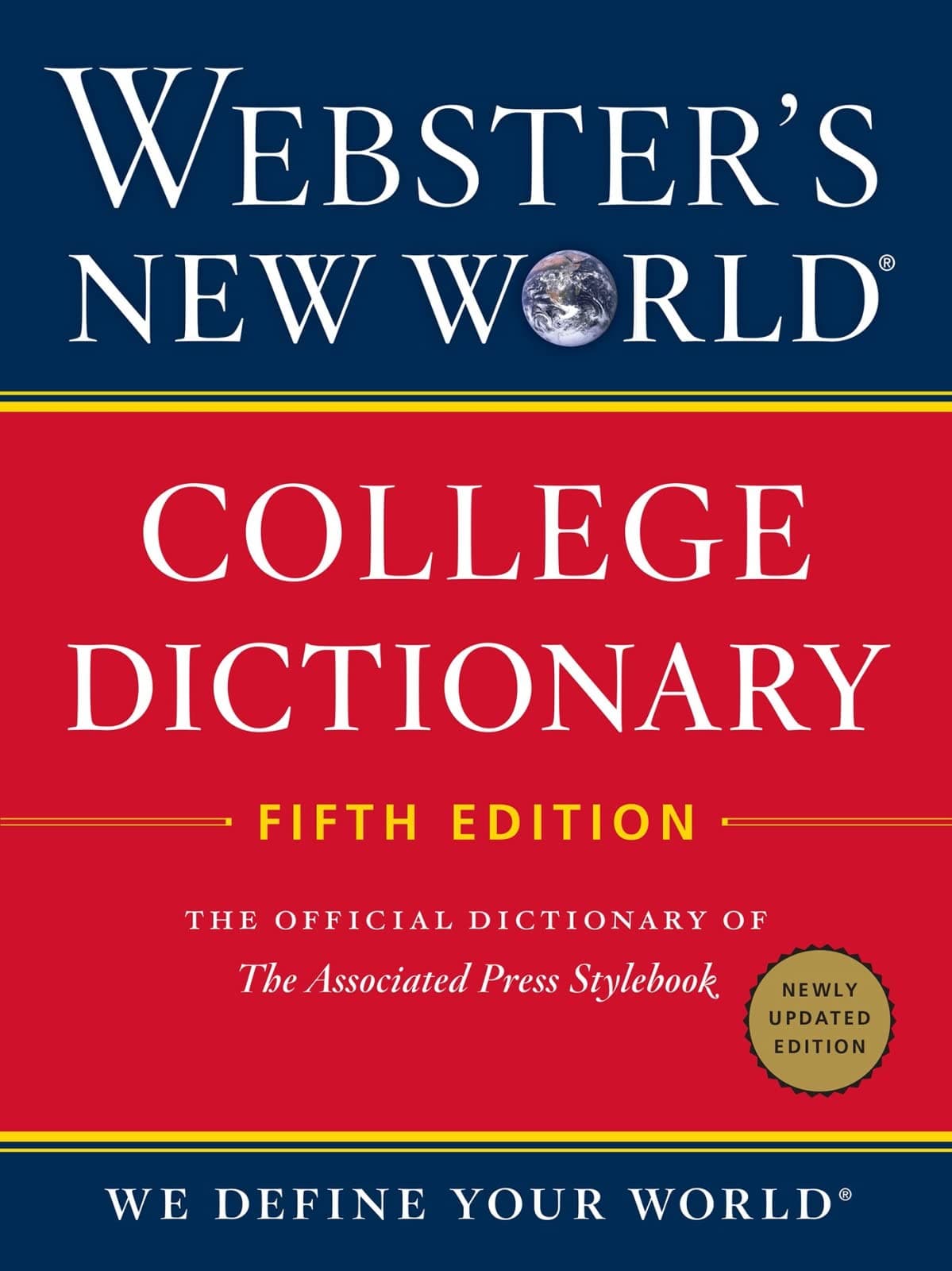
desertcart.com: Webster's New World College Dictionary, Fifth Edition: 9780358126614: Editors of Webster's New World Coll: Books Review: The 5th Edition of This Great Dictionary Takes Its Honourable Place among Earlier Ones of Webster's New World College Dictionary - I long have used the Webster's New World Dictionary of American English, the most recommendable and comprehensive of its variants being any designated for "college" (in U.S.A. lingo including "university") use. Having just received the new Fifth Edition ("new" in this year of 2014) causes me to ponder the unbroken excellence of every edition of this great American dictionary. The edition which most people usually think of as the first one of this dictionary was the only English dictionary which students at the college where I did my freshman and sophomore years of study, in the mid-1960s, were permitted to cite as their lexical authority (the then recently debased "Collegiate" dictionary from Merriam-Webster, having been prime among the dictionaries that students were forbidden to use in writing their papers and assignments). By the time of its Fifth Edition, the Webster's New World Dictionary has become so compendious, so hefty, that it now barely fits the format of a single volume dictionary. The Fourth Edition already had been "groaning at the seams". To accommodate what appears surely to be a larger base of vocabulary of terms, abbreviations, names, etc. (the totals of which the dictionary's introductory features themselves do not quantify explicitly, unless something has eluded my glance), the Fifth Edition (comparing it here only to the Fourth Edition), even though it has decreased slightly in pagination, has cut out some extraneous (albeit useful) features from the "Reference Supplement", and has decreased slightly (but noticeably) the print size in the main bulk of the work. To limit the comparison to the main paging sequence between the two most recent editions, one goes from the Fourth's 1716 p. to the Fifth's total of 1703 p. The "Reference Supplement" at the end of the Fifth Edition has dropped some features which orient specifically to the United States and which were found in the Fourth Edition's more numerous sub-sections therein (e.g., among such omissions are the texts of national U.S. documents; tables of population and of some other data about American, Canadian, and Mexican cities; as well as some other matter); what remains has more universal application and is less susceptible to fall out-of-date too quickly. Most readers, of course, now have access to the multitude of data of nearly all sorts on the World Wide Web and elsewhere on the Internet, and, if they do not have such cyber-access to the information in this dictionary's "Reference Supplement", they can find information of the kind readily and more appropriately in printed almanacs, in other books of "vade mecum" nature, in gazetteers or atlases, and in single-volume and larger multi-volume cyclopaedic generalist reference works. At least a few such handy works, anyhow, most households really should have within easy reach. If, to continue to augment the inclusion of new words in the dictionary and yet to remain reasonably within the confines of a single volume work, the editors of Webster's New World College Dictionary, in eventual subsequent editions, were to drop entries for most of the names (of persons, places, and the like), in order to opt for still larger inclusion of vocabulary, that would be a wise choice, even if it would be rather counter to what coverage in collegiate dictionaries has tended to be over the years. For now, name entries still appear in the Fifth Edition, so be not alarmed, those who like to have them! There had been forerunners of the supremely fine Webster's New World Dictionary under the same title, published decades before the 1950s, under the imprint of World Publishers, but those earlier ones did not so deserve to be considered the first edition (which seems to have gone through printings from 1953 to 1968 or so, of which the one that I first obtained was the 1964 printing), the famed Second Edition, completely revised, appearing in 1970. I have acquired and used every edition of this dictionary, right up to and including the Fourth and now the Fifth Editions. There had been, years ago, before any of the College Editions were shortly to begin to appear, a more complete, two-volume "Webster's New World Dictionary of the American Language", published in 1951, but I never have encountered any later multiple-volume edition of the work. I have retained each much-loved, well-used College Edition, keeping them in various rooms of my house, along with some other favoured dictionaries, for ready resort near desks, tables, or armchairs where I most often read or write. An interesting feature, by the way, of the Second College Edition, at least of the sturdy "Special School Printing" of it which I own, is a flexi-disc (33.3 r.p.m., 7 in.) included with it that bears the title upon it, "New World Phonoguide: an Audio Supplement to the Pronunciation Guide and Phonetic Symbols" which could be of considerable help to users for whom English is a second (third, etc.) language. I have not seen this helpful disc in other editions of this dictionary as I own copies of them. As for the fourth college edition, one or some printing(s) of it come(s) with an accompanying CD-ROM. Each edition of the Webster's New World Dictionary has improved on the one that preceded it and one can make a good case especially for any of the Third to Fifth Editions as the one preferred for reasons of content or of sheer attractive format, ease, and presentation (the Third Edition being particularly fine in those regards, remaining quite a viable option to choice over the somewhat more austerely cramped pages of the Fifth Edition). Alas, for some dictionaries, decline, rather than consistently genuine improvement, can set in with their later editions. That is so very notably in the case of those benighted "Collegiate" dictionaries from Merriam-Webster, which fell from grace when they began to be based on the excessively permissive Webster's THIRD New International Dictionary (the unabridged dictionary from Merriam-Webster, which had displaced the rock-solid and far more trustworthy Webster's New Twentieth Century Dictionary of the English Language, Unabridged SECOND Edition), Earlier and better Merriam-Webster's "Collegiate" dictionary editions formerly and more happily had been based, to such good effect, on the Unabridged Second Edition, which had guaranteed a solid foundation. Similar decay also has beset numerous other dictionaries which have not undergone wise or sufficient revision, leading to the lessening of quality or of reliability as later editions appear, when compared to former ones. The most admirable (of many good) qualities of the Webster's New World Dictionary is the sane approach to matters of word usage; while this dictionary is "prescriptive" in indicating what pronunciations and definitions are normative, it does give alternate ones that are common but less "proper", so far as American usage is concerned. It includes an healthy amount of words of informal English and slang; unlike the too prim-and-proper Funk and Wagnall dictionaries or the American Heritage Dictionary, both quite fine but rather too staid, the Webster's New World Dictionary does not exclude such words and locutions of less-then-high-pedigree from the lexicon, but, rather, admits them while it very helpfully indicates their level of English usage admissibility or unacceptability for inclusion in formal writing or speaking. Each subsequent edition of the Webster's New World Dictionary, too, has undergone a thorough updating to add new words, technical or otherwise, to the vocabulary of the language. A single, general-purpose college or desk-reference dictionary, even so admirably aimed at sophisticated adult level as the Webster's New World College Dictionary is, will not suffice to fulfil all requirements. For one thing, a truly unabridged dictionary, usually multi-volume, is good to have around for exceptional needs; I have several such dictionaries, of which, among them, I particularly commend "The Random House Dictionary of the English Language, Unabridged", Second Edition, in one humongous and heavily oversized volume (of xlii, 2478, 32 p.). Also, of dictionaries of solid but modestly single-volume scope, one or a few dictionaries which correspond(s) to Commonwealth usage is (or are) important for non-American readers to possess and to use. Being here in Canada, I tend most to rely upon British dictionaries for spelling (especially Cassell's, Chamber's, and Harrap's fine recent editions of their respective dictionaries) and on specifically Canadian dictionaries (most notably the impeccable Gage dictionaries) for pronunciation or for peculiarly Canadian use and origin, but for definitions, I always have preferred the best American dictionaries, especially the various editions of Webster's New World Dictionary. The desertcart buyer cannot go wrong in purchasing any variant of the Webster's New World Dictionary. If he cannot afford or find the latest edition, any of the previous "college" editions is quite suitable and reliable for everyday use. Go for it! Review: Uses Tinier Fonts But Remains An Excellent Dictionary - This dictionary isn't available anywhere else that's convenient to me except on desertcart. I was glad to order it as I've always had a fondness for Webster's New World Dictionaries. They still manufacture it in the U.S and price was attractive as well. They did away with photos and some supplementary materials. They used smaller fonts (no issue with me as I use reading glasses) and simpler paper. But it remained true to its tradition of uncramped, easy to understand defining style without being simplistic. Up-to-date as of 2020, this new version is more compact and neater to look at. It's perfect for my need for an alternate dictionary with clear, up-to-date, reliable definitions. Quick and easy to use, it's right beside me when I'm reading and taking notes.
| Best Sellers Rank | #811,425 in Books ( See Top 100 in Books ) #96 in Thesauruses (Books) #330 in Catalogs & Directories (Books) #532 in Dictionaries (Books) |
| Customer Reviews | 4.6 4.6 out of 5 stars (909) |
| Dimensions | 7 x 2.42 x 9.25 inches |
| Edition | 5th |
| ISBN-10 | 0358126614 |
| ISBN-13 | 978-0358126614 |
| Item Weight | 14.7 ounces |
| Language | English |
| Print length | 1728 pages |
| Publication date | June 2, 2020 |
| Publisher | Collins Reference |
G**R
The 5th Edition of This Great Dictionary Takes Its Honourable Place among Earlier Ones of Webster's New World College Dictionary
I long have used the Webster's New World Dictionary of American English, the most recommendable and comprehensive of its variants being any designated for "college" (in U.S.A. lingo including "university") use. Having just received the new Fifth Edition ("new" in this year of 2014) causes me to ponder the unbroken excellence of every edition of this great American dictionary. The edition which most people usually think of as the first one of this dictionary was the only English dictionary which students at the college where I did my freshman and sophomore years of study, in the mid-1960s, were permitted to cite as their lexical authority (the then recently debased "Collegiate" dictionary from Merriam-Webster, having been prime among the dictionaries that students were forbidden to use in writing their papers and assignments). By the time of its Fifth Edition, the Webster's New World Dictionary has become so compendious, so hefty, that it now barely fits the format of a single volume dictionary. The Fourth Edition already had been "groaning at the seams". To accommodate what appears surely to be a larger base of vocabulary of terms, abbreviations, names, etc. (the totals of which the dictionary's introductory features themselves do not quantify explicitly, unless something has eluded my glance), the Fifth Edition (comparing it here only to the Fourth Edition), even though it has decreased slightly in pagination, has cut out some extraneous (albeit useful) features from the "Reference Supplement", and has decreased slightly (but noticeably) the print size in the main bulk of the work. To limit the comparison to the main paging sequence between the two most recent editions, one goes from the Fourth's 1716 p. to the Fifth's total of 1703 p. The "Reference Supplement" at the end of the Fifth Edition has dropped some features which orient specifically to the United States and which were found in the Fourth Edition's more numerous sub-sections therein (e.g., among such omissions are the texts of national U.S. documents; tables of population and of some other data about American, Canadian, and Mexican cities; as well as some other matter); what remains has more universal application and is less susceptible to fall out-of-date too quickly. Most readers, of course, now have access to the multitude of data of nearly all sorts on the World Wide Web and elsewhere on the Internet, and, if they do not have such cyber-access to the information in this dictionary's "Reference Supplement", they can find information of the kind readily and more appropriately in printed almanacs, in other books of "vade mecum" nature, in gazetteers or atlases, and in single-volume and larger multi-volume cyclopaedic generalist reference works. At least a few such handy works, anyhow, most households really should have within easy reach. If, to continue to augment the inclusion of new words in the dictionary and yet to remain reasonably within the confines of a single volume work, the editors of Webster's New World College Dictionary, in eventual subsequent editions, were to drop entries for most of the names (of persons, places, and the like), in order to opt for still larger inclusion of vocabulary, that would be a wise choice, even if it would be rather counter to what coverage in collegiate dictionaries has tended to be over the years. For now, name entries still appear in the Fifth Edition, so be not alarmed, those who like to have them! There had been forerunners of the supremely fine Webster's New World Dictionary under the same title, published decades before the 1950s, under the imprint of World Publishers, but those earlier ones did not so deserve to be considered the first edition (which seems to have gone through printings from 1953 to 1968 or so, of which the one that I first obtained was the 1964 printing), the famed Second Edition, completely revised, appearing in 1970. I have acquired and used every edition of this dictionary, right up to and including the Fourth and now the Fifth Editions. There had been, years ago, before any of the College Editions were shortly to begin to appear, a more complete, two-volume "Webster's New World Dictionary of the American Language", published in 1951, but I never have encountered any later multiple-volume edition of the work. I have retained each much-loved, well-used College Edition, keeping them in various rooms of my house, along with some other favoured dictionaries, for ready resort near desks, tables, or armchairs where I most often read or write. An interesting feature, by the way, of the Second College Edition, at least of the sturdy "Special School Printing" of it which I own, is a flexi-disc (33.3 r.p.m., 7 in.) included with it that bears the title upon it, "New World Phonoguide: an Audio Supplement to the Pronunciation Guide and Phonetic Symbols" which could be of considerable help to users for whom English is a second (third, etc.) language. I have not seen this helpful disc in other editions of this dictionary as I own copies of them. As for the fourth college edition, one or some printing(s) of it come(s) with an accompanying CD-ROM. Each edition of the Webster's New World Dictionary has improved on the one that preceded it and one can make a good case especially for any of the Third to Fifth Editions as the one preferred for reasons of content or of sheer attractive format, ease, and presentation (the Third Edition being particularly fine in those regards, remaining quite a viable option to choice over the somewhat more austerely cramped pages of the Fifth Edition). Alas, for some dictionaries, decline, rather than consistently genuine improvement, can set in with their later editions. That is so very notably in the case of those benighted "Collegiate" dictionaries from Merriam-Webster, which fell from grace when they began to be based on the excessively permissive Webster's THIRD New International Dictionary (the unabridged dictionary from Merriam-Webster, which had displaced the rock-solid and far more trustworthy Webster's New Twentieth Century Dictionary of the English Language, Unabridged SECOND Edition), Earlier and better Merriam-Webster's "Collegiate" dictionary editions formerly and more happily had been based, to such good effect, on the Unabridged Second Edition, which had guaranteed a solid foundation. Similar decay also has beset numerous other dictionaries which have not undergone wise or sufficient revision, leading to the lessening of quality or of reliability as later editions appear, when compared to former ones. The most admirable (of many good) qualities of the Webster's New World Dictionary is the sane approach to matters of word usage; while this dictionary is "prescriptive" in indicating what pronunciations and definitions are normative, it does give alternate ones that are common but less "proper", so far as American usage is concerned. It includes an healthy amount of words of informal English and slang; unlike the too prim-and-proper Funk and Wagnall dictionaries or the American Heritage Dictionary, both quite fine but rather too staid, the Webster's New World Dictionary does not exclude such words and locutions of less-then-high-pedigree from the lexicon, but, rather, admits them while it very helpfully indicates their level of English usage admissibility or unacceptability for inclusion in formal writing or speaking. Each subsequent edition of the Webster's New World Dictionary, too, has undergone a thorough updating to add new words, technical or otherwise, to the vocabulary of the language. A single, general-purpose college or desk-reference dictionary, even so admirably aimed at sophisticated adult level as the Webster's New World College Dictionary is, will not suffice to fulfil all requirements. For one thing, a truly unabridged dictionary, usually multi-volume, is good to have around for exceptional needs; I have several such dictionaries, of which, among them, I particularly commend "The Random House Dictionary of the English Language, Unabridged", Second Edition, in one humongous and heavily oversized volume (of xlii, 2478, 32 p.). Also, of dictionaries of solid but modestly single-volume scope, one or a few dictionaries which correspond(s) to Commonwealth usage is (or are) important for non-American readers to possess and to use. Being here in Canada, I tend most to rely upon British dictionaries for spelling (especially Cassell's, Chamber's, and Harrap's fine recent editions of their respective dictionaries) and on specifically Canadian dictionaries (most notably the impeccable Gage dictionaries) for pronunciation or for peculiarly Canadian use and origin, but for definitions, I always have preferred the best American dictionaries, especially the various editions of Webster's New World Dictionary. The Amazon buyer cannot go wrong in purchasing any variant of the Webster's New World Dictionary. If he cannot afford or find the latest edition, any of the previous "college" editions is quite suitable and reliable for everyday use. Go for it!
H**6
Uses Tinier Fonts But Remains An Excellent Dictionary
This dictionary isn't available anywhere else that's convenient to me except on amazon. I was glad to order it as I've always had a fondness for Webster's New World Dictionaries. They still manufacture it in the U.S and price was attractive as well. They did away with photos and some supplementary materials. They used smaller fonts (no issue with me as I use reading glasses) and simpler paper. But it remained true to its tradition of uncramped, easy to understand defining style without being simplistic. Up-to-date as of 2020, this new version is more compact and neater to look at. It's perfect for my need for an alternate dictionary with clear, up-to-date, reliable definitions. Quick and easy to use, it's right beside me when I'm reading and taking notes.
M**E
Solid, Reliable Desk Dictionary
I picked up Webster's New World College Dictionary, Fifth Edition to have a real reference book on my desk instead of relying only on online lookups, and it has been very useful. The entries are clear and easy to read, with straightforward definitions that usually get right to the point. I like that it includes modern usage and newer terms along with the more traditional vocabulary, so it feels up to date without losing the depth you expect in a full sized dictionary. The layout is clean, with bold headwords and helpful pronunciation guides and usage notes where it matters. It is easy to flip through and find related words or check spelling when I am writing. The book itself feels well made, with good quality paper and binding that holds up to regular use. If you want a solid, comprehensive dictionary for home, school, or office that you can actually keep within arm’s reach, this edition is a very dependable choice.
G**R
Still an excellent dictionary, and not just for journalists
Webster's New World College Dictionary is an excellent source, and a must-have for journalists, as it is the Associated Press Stylebook's primary backup reference (although AP-style spellings often deviate from the dictionary's). I understand the chagrin in other reviews about some source material that's now missing, but in these days of the omnipresent Internet, I just don't think it's that important to have the Bill of Rights in a dictionary. The slightly smaller text also isn't a major concern. More than the book itself, I use the CD-ROM, and have since the Fourth Edition. The software for the computer version of the Fifth Edition has been overhauled, and while the default text size is small and has to be kicked up every time you use the program, the software and interface seem a bit better and with fewer glitches. One major welcome change is the addition of illustrations to the definitions. Alas, while the Fourth Edition's CD-ROM included a thesaurus that you could use at the same time when looking up a word, the new version does not; it's the dictionary only. This is a major disappointment and why the dictionary gets only four stars instead of five.
J**G
Print is still relevant
I am thankful this edition exists. I don't know about other people but I have noticed it is virtually impossible to buy a dictionary nowadays from your local Wal-Mart or Target. When I went to both of these stores I was literally told that no one uses print dictionaries anymore, they just Google definitions. I am so thankful that this dictionary exists because I am an avid reader and occasionally I write, so this dictionary not only helps me with definitions but also how to correctly spell various words. This dictionary is also awesome because it has a wide array of words not always found in dictionaries that I have come across. Impressed and well pleased.
A**E
A must have.
P**U
Love my book but i do find the print very very small.I should have ordered large print. Thank yoy.
海**山
最近の、アメリカ系の、中型辞典は、文章語の定義が、サッパリ、載らなくなった。 だが、当Webster's New World College Dictionary は、違う。文章語が、キチンと載っているのです。ですから、英文学が、読める辞書として、貴重な存在です。 例えば、aditional の項目には、added; more; extra と、記載が、有る。先ず、この定義が、載っていない中型辞典が、多い。 even の項目には、calm; tranquil; serene; placid と言う、記述が、有る。American Heritage Dictionary(5th Ed.)には、かろうじて、placid; calm と記載が有るが、additional は、added と、捉えるしかない。 この様に、英文学の文章語が、読める、辞書としては、アメリカ系の、中型辞典としては、唯一であり、もし、英文学を、志している方ならば、アメリカ系の、中型辞典としては、まず、この辞書から、購入すべきだ、と、思う。 元々は、$25.95の価格の辞書ですが、American Heritage Dictionary の、半値で、買える。だが、内容は、決して、半分では、無い。 こと、英文学を、読む場合、American Heritage Dictionary よりも、詳細な、記述があるので、便利で助かる。 無論、「アメリカ文学が、読めれば、それで良い」方や、アメリカの新聞や、雑誌「TIME」等を、見る方にも、向いています。 なお、この辞書は、1970年代には、Webster's New World Dictionary の、書名で、出版されていた、中型辞典であり、今現在、同書名(Webster’s New World Dictionary)と言うと、当Webster's New World College Dictionary の、簡約本の、ペーパーバックのコンパクトな辞書の事、です。もし、興味の有る方は、そちらも、ご笑覧下さい。 とりあえず、アメリカ系の、中型辞典としては、当Webster's New World College Dictionary が、「ファースト・チョイス」ですネ。
A**S
Best dictionary, better than Collins.
C**W
It was good and delivered rapidly
ترست بايلوت
منذ أسبوعين
منذ شهرين