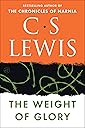

The Weight of Glory [Lewis, C. S.] on desertcart.com. *FREE* shipping on qualifying offers. The Weight of Glory Review: Words of Wisdom - Acclaimed author of the children's Chronicles of Narnia series, novelist, poet, literary critic, influential Christian apologist and theologian C. S. Lewis delivers another insightful and captivating piece of literature in this collection of sermons and essays under the title "The Weight of Glory." I found the introduction of the book by Walter Hooper to be very enlightening and interesting. It offered me a small glimpse into the personality and practices of C. S. Lewis himself. It brought the incredible C. S. Lewis down to the human level, to my level, and helped me understand him and why he wrote. Lewis delivered these speeches and sermons during World War II, in hopes of bringing insight to select difficult issues of Christian apologetics. The topics of these addresses include, forgiveness, education, friendship, belonging, and living in light of the reality of eternity. In a time of great doubt, Lewis offers honest advice and guidance, using methodical reasoning and wisdom to build up believers in faith, hope, and love. He is able to make clear what is often lofty and confusing, and to express with clarity its relevance and practical importance. As sermons, these texts are addressed directly to the audience, which I appreciated a lot. The principle characters are the audience members themselves, mostly on an individual level as Lewis takes them on a journey to examine their innermost thoughts and soul, but also on a larger scale as a society and humanity as a whole. The main goal of these sermons/writings is to make the reader question their beliefs and actions, which works a lot better with this way of communication. He does not attempt in these sermons to convince us that Christianity is true; he takes it as a given and uses it as the basis for his arguments. Mostly, he digs deeper into why the belief is worth it. His main focus is to get us to turn our gaze from the temporal and earthly to the eternal, comparing our current life and circumstances to something higher and holy. C. S. Lewis does a masterful job with his argument in each essay. He addresses the objections people could raise. He understands the emotional impact on people and battles that they were going through. I appreciated how he started off most essays by defining his terms carefully. He is using logic to appeal to the audience and this is very effective as it considers all options. He systematically takes apart opposing options one by one, to be left with his own position as the best option. The title essay is remarkably memorable, and is clearly the product of extended thought and reflection, contributing greatly to its excellence. "The Weight of Glory" is an address on the nature of glory, beginning by reminding the reader that they are too often distracted by simple distractions of life and fail to see that something greater remains just beyond our view. To desire something greater, to desire glory, is not a sin. Lewis says that only by the work of Christ, the believer is made an object of glory and is accepted by God. The end result is that "the door on which we have been knocking all our lives will open at last". Lewis concludes with emphasizing the value we are to place on each other. He says, "It is a serious thing to live in a society of possible gods and goddesses, to remember that the dullest most uninteresting person you can talk to may one day be a creature which, if you saw it now, you would be strongly tempted to worship, or else a horror and corruption such as you now meet, if at all, only in a nightmare. All day long we are, in some degree, helping each other to one or the other of these destinations." We truly have never met a mortal person. We all shall live forever. This should have an impact on how we think about all people. Another sermon is on the relationship between Christian Theology and poetry. Lewis surprisingly denies that Christianity resembles poetry, as ultimately the narrative of Christianity is something more real and historical. In this piece, Lewis' language and his argument are pure poetry; I thought it was persuasive and very well written. The sixth sermon is titled "The Inner Ring." Lewis describes here the cliquish nature of human relationships. The rings of acceptance and exclusion are a natural part of life but are dangerous. Lewis wants the reader to consider carefully the desire to belong, because he believes "unless you take measures to prevent it, this desire is going to be one of the chief motives of your life." Some of the other essays are quite complex, and readers could easily get lost in the metaphysical arguments in "Transposition," but for the most part each piece is, if not straightforward, presented in a most logical and down-to-earth way. While this book is not quite a full cohesive text, it is a collection of bite-sized pieces of wisdom on issues that are too easily overlooked, making it the perfect book to read bit by bit with time in between to reflect on the wisdom Lewis has packed into the pages. Review: Critical Analysis Book Review - The Weight of Glory by C.S. Lewis C.S. Lewis writes with a very intriguing and interesting style, especially in one of his great books titled The Weight of Glory. He is a very logical writer that is able to tie in emotions to keep the reader engaged and be able to relate to the topics. The book is organized in different sections with different topics. The title of this work refers to the connection to Christianity in all of his topics. C.S. Lewis is a strong Christian that directs his writing at other Christians and non-Christians; he makes the reader think about how he/she can change for the better for whatever topic is being discussed. The arguments in this piece are set up from a logical standpoint therefore, the reader will find a lot of strong warrants for each claim that Lewis states. The topics that Lewis will be discussed from Lewis’s piece include: “On Forgiveness,” “Learning in War Time,” “The Inner Ring,” and “Membership.” The overall background of the writings includes resolving common issues in the context of Christianity. The first topic that Lewis discusses is forgiveness. An example of how he relates the topic of forgiveness to Christianity is how many Christians will ask God to excuse them instead of confessing their full sin and truly believe in God’s forgiveness. Lewis (2001) makes this claim and then backs it up with evidence immediately by writing, “If you had a perfect excuse, you would not need forgiveness; if the whole of your action needs forgiveness, then there was no excuse for it” (p. 179). This is very logical support from Lewis and it is shown by his “if, then” statements. Another topic that Lewis brings up is titled, “Learning in War Time.” This reading describes the everyday war that Christians endure. It really struck me when Lewis said he believes that all humans are called to be righteous in the duties we participate in within this war. He then continues from a logical standpoint by saying that every duty is a religious duty, thus it is absolute that it’s our obligation perform every duty in the name of God. This statement caught my attention because it teaches me that I can do every duty I am called to do in my life to the glory of God. The way that Lewis warrants this statement comes from a very emotional standpoint, which gives the reader a strong example to test their morality in a certain situation. Lewis (2001) attacks the reader’s emotions when he writes, “Thus we may have a duty to rescue a drowning man and, perhaps, if we live on a dangerous coast, to learn lifesaving so as to be ready for any drowning man when he turns up” (p.53). Not only was I able to relate to this example, but it definitely tested my morality. Before Lewis even said in the next sentence, “It may be our duty to lose our own lives in saving him,” I already thought to myself that I would be willing to die for another person through my own moral/emotional mindset. As mentioned, I was also to be able to relate to the situation. For example, I have taken a few CPR and childhood safety classes because my mom runs a daycare; therefore, I always have to be ready to act if any of the children ever had any health implications. “The Inner Ring” dilemma is another topic that Lewis presents. Logic is, once again, used by Lewis in the strongest way in explaining this concept and relating it to Christianity. The inner ring represents an individual always wanting to be involved in something for the lone reason of just wanting to be “in.” Unless we can find virtue, happiness, loyalty, and kindness in the things we’re involved in, we will always feel excluded and we will always be looking for more. This is exactly what Lewis explains before he boldly states his two reasons behind this dilemma. The first reason he stated was that passion for the ring is the most skillful thing in causing a good man to do bad things. In his second reason, he said that until one conquers the fear of being an outsider, an outsider that individual will remain. He even makes a clear comparison to the reader for better understanding, which is something Lewis is very effective at. He is the type of author that can make the topic easily relate to the reader, which helps with better understanding for the reader. The last topic that Lewis discusses is the issue on “Membership.” This is another case of Lewis showing his strength in logic by making a statement and then supporting it with two bold reasons. There were two reasons behind why he stated for religion to be solitude is dangerous. He then proceeded with his logical reasoning by quoting the modern world, “You may be religious when you are alone, and I will see to it that you are never alone” (p.160). Of course, he explains in detail what this means by saying it is basically banishing all of Christianity to believe in this statement. Supporting the claim with a second warrant, he says, “There is the danger that real Christians who know that Christianity is not a solitary affair may react against that error by simply transporting into our spiritual life that same collectivism which has already conquered our secular life” (p.160). When Lewis clearly states a few reasons a claim is true, it shows how sharp his logical reasoning is. As mentioned before, the book appealed to me in an extremely logical way. Lewis also incorporates an emotional effect on the reader in a few different topic areas. The writing was very easy for me to understand and relate to, which makes the reading much more intriguing. Even though I am the type of audience that Lewis is mainly targeting (Christians), I do believe that non-Christians would also be blown away by Lewis’s powerful writing style. The book, The Weight of Glory, showed the importance of recognizing certain topics/issues present in our world today and being able to relate them to Christianity to understand how we can make a difference for the better in the glory of God. Citations Lewis, C.S. The Weight of Glory. (1963). New York. (2001) Print.


| Best Sellers Rank | #6,907 in Books ( See Top 100 in Books ) #1 in Christian Sermons (Books) #36 in Christian Apologetics (Books) #54 in Inspirational Spirituality (Books) |
| Customer Reviews | 4.8 out of 5 stars 2,257 Reviews |
B**H
Words of Wisdom
Acclaimed author of the children's Chronicles of Narnia series, novelist, poet, literary critic, influential Christian apologist and theologian C. S. Lewis delivers another insightful and captivating piece of literature in this collection of sermons and essays under the title "The Weight of Glory." I found the introduction of the book by Walter Hooper to be very enlightening and interesting. It offered me a small glimpse into the personality and practices of C. S. Lewis himself. It brought the incredible C. S. Lewis down to the human level, to my level, and helped me understand him and why he wrote. Lewis delivered these speeches and sermons during World War II, in hopes of bringing insight to select difficult issues of Christian apologetics. The topics of these addresses include, forgiveness, education, friendship, belonging, and living in light of the reality of eternity. In a time of great doubt, Lewis offers honest advice and guidance, using methodical reasoning and wisdom to build up believers in faith, hope, and love. He is able to make clear what is often lofty and confusing, and to express with clarity its relevance and practical importance. As sermons, these texts are addressed directly to the audience, which I appreciated a lot. The principle characters are the audience members themselves, mostly on an individual level as Lewis takes them on a journey to examine their innermost thoughts and soul, but also on a larger scale as a society and humanity as a whole. The main goal of these sermons/writings is to make the reader question their beliefs and actions, which works a lot better with this way of communication. He does not attempt in these sermons to convince us that Christianity is true; he takes it as a given and uses it as the basis for his arguments. Mostly, he digs deeper into why the belief is worth it. His main focus is to get us to turn our gaze from the temporal and earthly to the eternal, comparing our current life and circumstances to something higher and holy. C. S. Lewis does a masterful job with his argument in each essay. He addresses the objections people could raise. He understands the emotional impact on people and battles that they were going through. I appreciated how he started off most essays by defining his terms carefully. He is using logic to appeal to the audience and this is very effective as it considers all options. He systematically takes apart opposing options one by one, to be left with his own position as the best option. The title essay is remarkably memorable, and is clearly the product of extended thought and reflection, contributing greatly to its excellence. "The Weight of Glory" is an address on the nature of glory, beginning by reminding the reader that they are too often distracted by simple distractions of life and fail to see that something greater remains just beyond our view. To desire something greater, to desire glory, is not a sin. Lewis says that only by the work of Christ, the believer is made an object of glory and is accepted by God. The end result is that "the door on which we have been knocking all our lives will open at last". Lewis concludes with emphasizing the value we are to place on each other. He says, "It is a serious thing to live in a society of possible gods and goddesses, to remember that the dullest most uninteresting person you can talk to may one day be a creature which, if you saw it now, you would be strongly tempted to worship, or else a horror and corruption such as you now meet, if at all, only in a nightmare. All day long we are, in some degree, helping each other to one or the other of these destinations." We truly have never met a mortal person. We all shall live forever. This should have an impact on how we think about all people. Another sermon is on the relationship between Christian Theology and poetry. Lewis surprisingly denies that Christianity resembles poetry, as ultimately the narrative of Christianity is something more real and historical. In this piece, Lewis' language and his argument are pure poetry; I thought it was persuasive and very well written. The sixth sermon is titled "The Inner Ring." Lewis describes here the cliquish nature of human relationships. The rings of acceptance and exclusion are a natural part of life but are dangerous. Lewis wants the reader to consider carefully the desire to belong, because he believes "unless you take measures to prevent it, this desire is going to be one of the chief motives of your life." Some of the other essays are quite complex, and readers could easily get lost in the metaphysical arguments in "Transposition," but for the most part each piece is, if not straightforward, presented in a most logical and down-to-earth way. While this book is not quite a full cohesive text, it is a collection of bite-sized pieces of wisdom on issues that are too easily overlooked, making it the perfect book to read bit by bit with time in between to reflect on the wisdom Lewis has packed into the pages.
A**R
Critical Analysis Book Review
The Weight of Glory by C.S. Lewis C.S. Lewis writes with a very intriguing and interesting style, especially in one of his great books titled The Weight of Glory. He is a very logical writer that is able to tie in emotions to keep the reader engaged and be able to relate to the topics. The book is organized in different sections with different topics. The title of this work refers to the connection to Christianity in all of his topics. C.S. Lewis is a strong Christian that directs his writing at other Christians and non-Christians; he makes the reader think about how he/she can change for the better for whatever topic is being discussed. The arguments in this piece are set up from a logical standpoint therefore, the reader will find a lot of strong warrants for each claim that Lewis states. The topics that Lewis will be discussed from Lewis’s piece include: “On Forgiveness,” “Learning in War Time,” “The Inner Ring,” and “Membership.” The overall background of the writings includes resolving common issues in the context of Christianity. The first topic that Lewis discusses is forgiveness. An example of how he relates the topic of forgiveness to Christianity is how many Christians will ask God to excuse them instead of confessing their full sin and truly believe in God’s forgiveness. Lewis (2001) makes this claim and then backs it up with evidence immediately by writing, “If you had a perfect excuse, you would not need forgiveness; if the whole of your action needs forgiveness, then there was no excuse for it” (p. 179). This is very logical support from Lewis and it is shown by his “if, then” statements. Another topic that Lewis brings up is titled, “Learning in War Time.” This reading describes the everyday war that Christians endure. It really struck me when Lewis said he believes that all humans are called to be righteous in the duties we participate in within this war. He then continues from a logical standpoint by saying that every duty is a religious duty, thus it is absolute that it’s our obligation perform every duty in the name of God. This statement caught my attention because it teaches me that I can do every duty I am called to do in my life to the glory of God. The way that Lewis warrants this statement comes from a very emotional standpoint, which gives the reader a strong example to test their morality in a certain situation. Lewis (2001) attacks the reader’s emotions when he writes, “Thus we may have a duty to rescue a drowning man and, perhaps, if we live on a dangerous coast, to learn lifesaving so as to be ready for any drowning man when he turns up” (p.53). Not only was I able to relate to this example, but it definitely tested my morality. Before Lewis even said in the next sentence, “It may be our duty to lose our own lives in saving him,” I already thought to myself that I would be willing to die for another person through my own moral/emotional mindset. As mentioned, I was also to be able to relate to the situation. For example, I have taken a few CPR and childhood safety classes because my mom runs a daycare; therefore, I always have to be ready to act if any of the children ever had any health implications. “The Inner Ring” dilemma is another topic that Lewis presents. Logic is, once again, used by Lewis in the strongest way in explaining this concept and relating it to Christianity. The inner ring represents an individual always wanting to be involved in something for the lone reason of just wanting to be “in.” Unless we can find virtue, happiness, loyalty, and kindness in the things we’re involved in, we will always feel excluded and we will always be looking for more. This is exactly what Lewis explains before he boldly states his two reasons behind this dilemma. The first reason he stated was that passion for the ring is the most skillful thing in causing a good man to do bad things. In his second reason, he said that until one conquers the fear of being an outsider, an outsider that individual will remain. He even makes a clear comparison to the reader for better understanding, which is something Lewis is very effective at. He is the type of author that can make the topic easily relate to the reader, which helps with better understanding for the reader. The last topic that Lewis discusses is the issue on “Membership.” This is another case of Lewis showing his strength in logic by making a statement and then supporting it with two bold reasons. There were two reasons behind why he stated for religion to be solitude is dangerous. He then proceeded with his logical reasoning by quoting the modern world, “You may be religious when you are alone, and I will see to it that you are never alone” (p.160). Of course, he explains in detail what this means by saying it is basically banishing all of Christianity to believe in this statement. Supporting the claim with a second warrant, he says, “There is the danger that real Christians who know that Christianity is not a solitary affair may react against that error by simply transporting into our spiritual life that same collectivism which has already conquered our secular life” (p.160). When Lewis clearly states a few reasons a claim is true, it shows how sharp his logical reasoning is. As mentioned before, the book appealed to me in an extremely logical way. Lewis also incorporates an emotional effect on the reader in a few different topic areas. The writing was very easy for me to understand and relate to, which makes the reading much more intriguing. Even though I am the type of audience that Lewis is mainly targeting (Christians), I do believe that non-Christians would also be blown away by Lewis’s powerful writing style. The book, The Weight of Glory, showed the importance of recognizing certain topics/issues present in our world today and being able to relate them to Christianity to understand how we can make a difference for the better in the glory of God. Citations Lewis, C.S. The Weight of Glory. (1963). New York. (2001) Print.
@**N
More and Better Than Expected!
The C. S. Lewis book titled “The Weight of Glory” is actually a collection of essays or lectures made by Lewis. The title of the book comes from the first of these lectures and is also the most quoted of them. Since this book is a compilation, I provide below a brief overview of each essay below. The Weight of Glory 6/8/1941 – In this address, Lewis first talks about the longings we each have: the deep longing for something which no experience on earth satisfies though we have faint glimpses of, like a memory of something long ago. It’s the desire that beauty stirs within us, the longing to be fully immersed and joined into the beauty. It’s what others have described as the God shaped void within us. Lewis argues that this longing proves that there must be a world where this longing can be fulfilled and that we are made for that world. Lewis takes some time to discuss the idea of rewards received for work. First, there are rewards which are not directly connected to the work, such as being paid to clean for example. Then there are rewards which are clearly organically tied to the effort to obtain them, such as a good marriage is the reward for loving one’s spouse. Lewis points out that while the former can be accused of only doing the work for the reward, this makes no sense to say in the latter case. Lewis also notes that some rewards, while organically tied to the effort taken to obtain them, aren’t recognized as desirable until one has obtained them or is at least closer to that goal. Lewis uses the example that one wouldn’t know they enjoy Greek poetry until after they had gone through the work of learning Greek. Lewis believes that heaven is like this. I think he conceived of everything in heaven as being of a higher order than things of this world. Thus he talks about how we improperly long for worldly things, which are really a false substitute for the heavenly things we ought to long for. Lewis spends most of the remainder of the lecture talking about glory. He thinks that while seeking fame on earth may be conceited, desiring to please God is not. This is the first sense of glory. The second is in how we will “shine” as God’s masterpieces. Lewis considers this idea that God can take delight in us to be something so amazing that we can barely believe it—the “weight or burden of glory”. Finally, Lewis discusses how we ought to keep other’s glory in mind when considering those around us and how this ought to keep us humble. Learning in War-Time 10/22/1939 – Lewis addresses how study can seem to be a trivial pursuit during war time. His argument is primarily that we must engage in normal human activity whatever the circumstances are. And there is always some crisis or matter which may seem more important. For example, the matter of heaven and hell is always present and more significant than war. Study is a necessary undertaking to which some have been called and which they should work at despite distraction, frustration and fear. Why I’m not a Pacifist 1940 – Lewis first lays a foundation from which he will build the rest of his arguments. The foundation consists of Lewis’ view of the conscious as having two parts: a drive to do what is right and beliefs about what right and wrong are. Lewis next explains his concept of reason by which he will address the latter portion of the conscious. A reasonable argument, says Lewis, consists of facts, “intuition”, and a series of linked, logical propositions. What Lewis means by intuition is that which can’t be argued but with which virtually everyone agrees, such as love is good and hate is bad. (Lewis believes that people “must be trained in obedience to the moral intuitions…”, an idea he also addresses in The Abolition of Man.) Authority is also an important consideration in deciding a matter, both because we don’t have time to examine every belief and because our beliefs are liable to be corrupted. After all this groundwork, Lewis finally begins making his case. First, he considers the fact of whether or not all wars do more harm than good, concluding that “history is full of useful wars as well as of useless wars.” He next examines whether the intuition of love as better than hate (or helping as better than harming) leads to pacifism or not. First, he recognizes that we are incapable of helping everyone so that to help one means not helping another. He then states that if two parties are in conflict, for an observing party to do nothing would violate the intuition. (He assumes that action would come in the form of physical intervention and violence.) From here says, “The question is whether war is the greatest evil in the world…”. This shows that he thinks of pacifism as the view that war should never be engaged in. And the only reason he could see to take this position would be if it could be argued that war is always worse than the alternative. After this, he argues that pacifism is impractical, because pacifists will be overcome by those who are not. Turning next to authority, Lewis argues that human authority, both specific (England at that time) and general (“righteous war” praised throughout history) support war. Examining at last divine authority, Lewis argues that current Christian authority and Christian history both support violence. The only verse which Lewis apparently can think of which might support pacifism is Matthew 5:39, “Do not resist an evil person”. Lewis believes Jesus here is addressing personal revenge and considers Paul and Peter’s talk about government using the sword as support for Christians using the sword. Lastly Lewis considers his bias and argues that since it would be more convenient to be a pacifist, it is more likely for one to be biased towards it. In other words, not finding a logical reason to be pacifist nor authoritative support, Lewis concludes that people must be pacifist because it is easier and more convenient for them to do so.1 Transposition 5/28/1944 – Essentially, as I understand it, Lewis is addressing the argument that since alleged supernatural works of the Holy Spirit manifest as naturally explainable phenomenon, isn’t it more reasonable to believe all such instances are simply natural, not supernatural? Lewis’ argument is that the “higher” spiritual must be transposed into the “lower” natural world and must therefore use otherwise natural means to do so. He uses the metaphor of how we attempt to represent three-dimensional reality in two-dimensional drawings. Is Theology Poetry? 11/6/1944 – Lewis addresses the question of if our beliefs about God (and even in the existence of God) are merely fanciful and quaint ideas we hold sentimentally but without any true reality behind them. The Inner Ring 12/14/1944 – Lewis speaks about the desire to be “in” and accepted along with the fear of being left out and rejected. He warns against the danger of doing wrong in order to fit in as well as the fleeting nature of the sense of being “in”. Membership 2/10/1945 – Lewis refutes the idea of Christianity as a private, individual, personal matter alone. He takes some time to differentiate between groups whose members are different but complementary (metaphor of church as a body) and mere collections of like people or things. Lewis also touches on hierarchy and authority. Overall, Lewis basically argues against isolated individualism on one hand and homogeneous collectivism on the other. On Forgiveness 8/28/1947 – Lewis talks about God’s forgiveness of our sins. He explores the difference between excusing (I understand, no big deal, etc.) and true forgiveness as well as how this relates to forgiving others. A Slip of the Tongue 1/29/1956 – Lewis warns against the temptation to “play” at Christianity which comes from the desire to hold onto the things of the world. Refusing to let go of these things causes one to not get too spiritual to the point which would require real change in their life.
C**R
Exceeded my lofty expectations...
I've read and deeply appreciated many of the classic works of C.S. Lewis and have heard glowing reports of "The Weight of Glory" for many years, but my first journey through this eclectic collection of sermons and talks exceeded even my lofty expectations. To be sure, this is not a cohesive work. The assembled talks, delivered over the course of nearly 20 years in settings from churches to various societies, cover a range of unrelated topics (heaven, pacifism, the value of higher education, the nature of theology, forgiveness, insecurity). There is no narrative thread from one to the other. And my experience was that some of the talks were decidedly more engaging and accessible than others. "Transposition" was rather abstract and cumbersome to me. "Why I Am Not a Pacifist" was clearly the weakest link for me, with a handful of disappointingly shallow or incomplete arguments (though it did include an insightful challenge to my pacifist inclinations towards the end). That uneven and disjointed nature of the book is its primary limitation. But several of the talks were simply fabulous, in all of the ways that Lewis engages with the listener/reader when he's at his best. "The Weight of the Glory," the portion of the book sufficiently notable to warrant becoming the namesake of the entire collection, is an enduring and highly quotable contribution, though it wasn't actually my favorite. I basically underlined the entirety of "On Forgiveness," a straightforward but brilliant summary of this fundamental Christian virtue. But "The Inner Ring," the least explicitly theological and Christian talk in the collection, was an utterly profound analysis of the insecurities that I navigate daily. Lewis was able to articulate unconscious ruminations that consistently motivate my thoughts and actions but which I've never before had words to describe. And that essay similarly resonated with others in our book club, so my appreciation for it cannot simply be ascribed to idiosyncrasies that only Lewis and I share. While "Mere Christianity" and "The Screwtape Letters" remain my most treasured works of Lewis, "The Weight of Glory" has immediately climbed into the next tier of favorites, the sort of genuine classic that I expect to rediscover periodically for a fresh burst of insight and clarity that Lewis so profoundly and uniquely offers me. And while it's not a cohesive unit, it's episodic composition will allow me to access the talks that inspire me and avoid the ones that do not. I am delighted to have finally discovered what all the fuss was about, look forward to reengaging with "The Weight of Glory" in the future, and happily recommend it to anyone interested in being challenged and inspired as only Lewis can.
T**E
C S Lewis
It’s a little wordy, but it’s pretty good. He makes some good points. However, since he was a university professor, he mentions some authors, books and eras I wasn’t familiar with until I looked them up. I suppose that’s how you learn.
W**6
Provocative collection of sermons and essays
This is a very fine set of sermons, short articles, and addresses by Lewis, each of them taking up a different and interesting topic but also somehow relating to its fellows. As much as I enjoy longer sustained pieces by Lewis, these little kernels of thought, so concise and self-sufficient, are especially pleasurable to read. Indeed, I found them a little addictive, which is no doubt why I read the book so quickly. "The Weight of Glory" is C. S. Lewis considering heaven again, something he does very well (as in The Problem of Pain), here trying to make sense of the promises of the "glory" beyond earthly life. In some ways, a complementary piece with "Transposition." "Learning in War-Time" and "Why I Am Not a Pacifist" were both delivered in the context of World War Two. Of the two I like the first best, which features Lewis arguments to students at Oxford why the crisis of war does not make their academic studies less important. A great celebration of learning and liberal arts, passions of Lewis which readers of his Christian works might be apt to overlook. The second piece is as it sounds, a defense of fighting for one's country from a Christian perspective. Less convincing, still stirring stuff. "Transposition" is one of my faves in the book. Why do "religious" experiences yield themselves to other, simpler explanations so easily--why may not mystical experiences simply be erotic love mischanneled, and so forth? Lewis postulates the theory that we "transpose" higher emotional experiences into our only available means of expressing them, so that the same physiological signs are called upon to represent a wide range of experiences, including religious ones. This is an elegant, analogy-rich explanation of the sort that will keep the mind buzzing for days. "Is Theology Poetry?" is another great essay, both clever and amusing. To the idea that Christian theology might "merely" be poetic feeling, aesthetic pleasure, Lewis cleverly notes that if it is, it is very poor poetry--not half so aesthetically pleasing as Norse myth, for instance. My favorite part of this essay is Lewis's parodic presentation of the Big Bang theory as a romantic story, demonstrating that the presentation of any theory of origins can be manipulated and diminished in dignity. After the heady stuff of the beginning essays, "The Inner Ring" is surprisingly modest in scope. The ring of the title is the coveted, half-imaginary circle of confidence within any social group--the top group, the exclusive club, the most influential clique. Lewis here counsels a group of graduates not to spend their lives hankering after membership in these rings, pointing out the rewards of tending to one's affairs and passions to the best of one's ability. A satisfying and encouraging address. "Membership" is another relatively simple idea that Lewis follows to very interesting places. He points out the typical secular understanding of "member," denoting a more or less uniform member of a set, and contrasts this idea with the Christian understanding of the "members" of the Body of Christ. Within Christianity, he is arguing, members are meant to differ, to have different traits and "functions," like the organs of a body. Elegant. The last and shortest pieces in the set, "On Forgiveness" and "A Slip of the Tongue," were the least interesting for me, though certainly worth reading and reviewing. "Forgiveness" makes a distinction between what we ask from God and what we seem to expect (not to be forgiven but "excused"). "A Slip of the Tongue" shows how a misquotation in prayer leads Lewis to consider how believers reserve temporal, secular pleasures and comforts to themselves while ostensibly requesting/desiring eternal gifts. A good critique of complacency and "practical" Christianity. Overall a very fine collection, and probably a great place to begin sampling Lewis's writings for Christians.
P**N
Classic Lewis
The book opens with a neat little introduction by Walter Hooper which reminds the reader of the intense personality of "Jack." A window into the humor of one of the greatest Christian minds of the last century does the reader much good in empathizing with the writer. This factor is all-important because most readers are not comfortable with the level of detail to which Lewis will go to make his points. In the mind of this reviewer, many millennials will miss much from this great writer for this reason. The first address, "The Weight of Glory" is an address on the nature of glory. Lewis begins the address by reminding the reader that they are too often distracted by simple distractions of life and fail to see that something greater remains just out of view. As he makes this argument, Lewis utters his classic statement, that "it would seem that Our Lord finds our desires not too strong, but too weak. We are half-hearted creatures, fooling about with drink and sex and ambition when infinite joy is offered us, like an ignorant child who wants to go on making mud pies in a slum because he cannot imagine what is meant by the offer of a holiday at the sea. We are far too easily pleased" (26). Point made. Lewis moves on now to the substance of his argument (35). What is the meaning of glory? Lewis answers in one sense that glory is the answer to depth of the human desire for acceptance and admiration. In the Gospel, "only...by the work of Christ" (38), the believer is made an object of glory and is accepted by God. The end result is that "the door on which we have been knocking all our lives will open at last" (41). But Lewis doesn't end here, but now turns to another aspect of the concept (42). Glory is the transformation of mortality into immortality, the elevation of the creature to its creative glory. In this context Lewis closes with another of his oft quoted statements. "It is a serious thing to live in a society of possible gods and goddesses, to remember that the dullest most uninteresting person you can talk to may one day be a creature which, if you saw it now, you would be strongly tempted to worship, or else a horror and corruption such as you now meet, if at all, only in a nightmare. All day long we are, in some degree, helping each other to one or the other of these destinations. It is in light of these overwhelming possibilities, it is with the awe and circumspection proper to them, that we should conduct all our dealings with one another, all friendships, all loves, all play, all politics. There are no ordinary people. You have never talked to a mere mortal. Nations, cultures, arts, civilisations [sic] - these are mortal, and their life is to ours as the life of a gnat. But it is immortals whom we joke with, work with, marry, snub, and exploit..." (45-46). The second address speaks to an issue that one would think inapplicable to the modern world, but much here should resonate with the modern reader. Lewis here addresses a group of young men pursuing a university education while bombs fell on the streets. No one knew if their work of education would be an exercise in futility. For a group of listeners who saw their time as an abnormality, Lewis reminded them that "life has never been normal" (49) and encouraged them not to allow the concerns of war dissuade them from the task at hand. He reminded them to take their task as a religious duty for "every duty is a religious duty, and our obligation to perform every duty is therefore absolute" (53). But before glorifying scholarship, Lewis strikes at the knees of the young listeners. The ordinary duty of a believer may also be quite, daresay, ordinary. With a great reminder of the perspective of heaven, Lewis states that "all of our natural activities will be accepted, if they are offered to God, even the humblest, and all of them, even the noblest, will be sinful if they are not" (54). He goes on again to strike at the heart of intellectualism. "I reject at once the idea which lingers in the mind of some modern people that cultural activities are in their own right spiritual and meritorious--as though scholars and poets were intrinsically more pleasing to God than scavengers and [shoe shiners]....The work of Beethoven and the work of a [cleaning maid] become spiritual on precisely the same condition, that of being offered to God" (55). Stopping short of wholly discouraging education, Lewis then reminds the listeners of some "enemies" of the scholar. First, Lewis notes that excitement can draw the scholar off to pursue what seems more romantic, but ends up only distracting from a noble cause. "If we let ourselves, we shall always be waiting for some distraction or other to end before we can really get down to our work" (60). Next, is the challenge of frustration. By becoming unduly focused on the future, scholars may be enticed to demur from the call to education. In return, Lewis calls his hearers to leave the future to God as that is where it has always been. Lastly, Lewis warns the band of students to shake off fear as they pursue education. War is just a reminder of death, whose victims cannot be increased or decreased. To allow it to control us is wrong, but rather one should allow war to bring to remembrance the reality of death. The third treatise entitled "Why I am not a Pacifist" was delivered to the Oxford Pacifist Society. Lewis begins by laying out a substantial number of logical arguments against pacifism. He begins by making an astute observation. The human conscience accepts ideas of right and wrong often without logical explanation. There should be a logical interaction between morality and reason, but unfortunately many simply make decisions with their consciences and come to opposing positions. These positions allow for no debate or reasoning. So, from the outset, Lewis admits a degree of futility in his speech. But he begins by cutting down the generalization that war always does more harm than good. Quite apropos for the modern age, Lewis agrees that "it is...true that wars never do half the good which the leaders of the belligerents say they are going to do" (73), but still holds that wars serve a certain utility. He then moves to the argument from self-defense and the defense of the weak (76). Next, he reminds his listeners that the supposition that death and pain are the worst evils may, in fact, be wrong and suggests another possibility or two (77). Ultimately, Lewis argues that if Pacifism succeeds, it will itself be annihilated, because where it wins, the state will be overcome and a totalitarian regime will not tolerate the weakness of the theory. In classic form, Lewis concludes that "Pacifism of this kind is taking the straight road to a world in which there will be no Pacifists" (78). Turning now from the authority of logic, Lewis reminds the listeners of their human authorities. The weight of the state authority should weigh on the Pacifist to reconsider (80-82). Lastly, Lewis draws upon the weight of Divine authority. Under this head, the subject takes a different turn. Lewis portrays the contrasting points within Scripture and church history where different perspectives are given on the matter. He carefully weighs the evidence and concludes that Christianity does not mandate Pacifism (82-88). In the end, Lewis admits a degree of uncertainty, but ends up finding the Pacifist position "very doubtful" (90). Fourth comes Lewis' heady idea of "Transposition." This reviewer is not going to attempt a thoroughgoing explanation of the concept because the metaphysical argument is still gelling and the reader would likely do better wading in the waters of the argument on their own. The only thought that seems fair to suppose is that Lewis is hinting at something of a fourth dimension beyond sensory perception, but which breaks into the physical universe in spasms of miracles and Divine intervention. This dimension is superior to the physical universe in a similar way that three dimensions are superior to a two-dimensional painting. In one of the soaring heights of the address Lewis picturesquely begins by quoting the Apostle John ""We know not what we shall be"; but we may be sure we shall be more, not less, than we were on earth. Our natural experiences (sensory, emotional, imaginative) are only like the drawing, like penciled lines on flat paper. If they vanish in the risen life, they will vanish only as pencil lines vanish from the real landscape, not as a candle flame that is put out, but as a candle flame which becomes invisible because someone has pulled up the blind, thrown open the shutters, and let in the blaze of the risen sun" (111). The fifth article is Lewis' speech on the relationship between Christian Theology and poetry. In a beautiful turn, Lewis denies that Christianity bears a great resemblance to poetry. Yes, there is a sense in which Christianity, in the heart of the believer, becomes a kind of poetry (122), but ultimately the epic of Christianity is something more real and historical (128-129). Christianity is not like poetry (which is fact turned into myth), but Christianity is something greater, something like "myth become fact" (129). To this end Lewis postulates in regard to "the humiliation of myth into fact, God into Man; what is everywhere and always, imageless and ineffable, only to be glimpsed in dream and symbol and the acted poetry of ritual becomes a small, solid--no bigger than a man who can lie asleep in a rowing boat on the Lake of Galilee"(130). So if Christianity is something more like fact, then what can be said for the prevailing theories of the day? Lewis retorts that the theory of naturalistic evolution is more poetry in Christianity. In an epic that simply must be read, Lewis tells the nihilistic epic of evolutionary atheism (123-125). Ultimately, Lewis points out that the atheists have rejected special creation a priori. Their presuppositions do not allow for a Creator, so to allow for such a consideration makes no sense; however, Lewis looks on their naturalistic explanation for the metaphysical realm (cf. 139-14) as "immensely unplausible" (137). Against this backdrop, Lewis argues that after abandoning naturalism he was led inevitably to idealism, which led him to Theism, which led him to Christ. "And when you examined [the claims of Christ] it appeared that you could adopt no middle position. Either He was a lunatic, or God. And He was no lunatic" (138). In conclusion, Lewis summarizes naturalism as poetry and Christianity as myth made fact and soars to his own heights of epic poetry in his final statement. "I believe in Christianity as I believe that the Sun has risen, not only because I see it, but because by it I see everything else" (140). The sixth address is entitled "The Inner Ring." Here Lewis describes the cliquish nature of human relationships. The rings of acceptance are a natural part of life (148), but "dangerous" (149). Articulately, the reader will see how exclusion and inclusion in the rings of culture drive all sorts of ill behaviors and motivations. Lewis brings this issue to the forefront because he believed that "unless you take measures to prevent it, this desire is going to be one of the chief motives of your life" (152). The end of the rings is twofold. The primary danger is that a passion for achieving the innermost circle makes "a man who is not yet a very bad man do very bad things" (154). The secondary danger is something of a spiral into nihilism. "As long as you are governed by that desire you will never get what you want. You are trying to peel an onion; if you succeed there will be nothing left. Until you conquer the fear of being an outsider, an outsider you will remain" (154). Seventh is a fascinating essay on the utter difference between the community of the Body of Christ and the popular expressions of individualism, on the one hand, and collectivism, on the other. Christianity is not a "solitary affair" (160), but neither is it the rush and bustle of our modern society. "We live, in fact, in a world starved for solitude, silence, and privacy, and therefore starved for meditation and true friendship" (160). Another aspect of how the church stands out against the ideas of the day is brought to the surface. In culture, diversity is often sought at the expense of unity or unity at the expense of diversity. In the Body, both unity and diversity are elevated. One body, unified by Christ, has many parts (166-167). This otherworldly love and community only can come from one source, for "if there is equality, it is in His love, not in us" (170). All of humanity is able to draw ultimate significance and value from Christ (174-174) and thereby to find something that is beyond what culture can offer, namely "natural self" or "collective mass," but instead "a new creature" (176). The eighth essay was quite challenging. Here Lewis strikes a nerve when he speaks of the Lord's explanation that one will not be forgiven except that he forgive others. This sobering thought is expounded in about seven little powerful pages. The writer postulates that humans often approach God not seeking forgiveness, but in offering excuses. In turn, when it comes to human forgiveness there are certainly similarities, but also significant differences. "In our own case we accept excuses too easily; in other people's we do not accept them easily enough. As regards my own sins it is a safe bet (though not a certainty) that the excuses are really not so good as I think; as regards other men's [sins] it is a safe bet (though not a certainty) that the excuses are better than I think" (182). In conclusion, Lewis reminds the reader of the Dominical instruction that "to be a Christian means to forgive the inexcusable, because God has forgiven the inexcusable in you" (182). Finally comes Lewis' discourse on "A Slip of the Tongue." It is here that the reviewer must again admit his inability to follow the argument of Lewis. As best understood, it seems to be a series of thoughts regarding a failure to look to the eternal. The temporal distractions of life take their toll in drawing one's affections from the eternal. In a stroke of genius, Lewis quotes Thomas More before climbing to another literary peak. ""If you have not chosen the Kingdom of God, it will make in the end no difference what you have chosen instead." Those are hard words to take. Will it really make no difference whether it was women or patriotism, cocaine or art, whisky or a seat in the Cabinet, money or science? Well, surely no difference that matters. We shall have missed the end for which we were formed and rejected the only thing that satisfies. Does it matter to a man dying in a desert by which choice of route he missed the only well?" (191) In these nine selections, the reader will find a wealth of information on a variety of topics. The level of understanding for the modern reader will range from simple to highly complex. The mental gymnastics are half the fun of a volume such as this and well worth the cost. So grab some Starbucks, kick back, and enjoy!
K**Y
Loved it!
Book Review: The Weight of Glory Katelyn Larson P.O. 1495 July 2, 2017 Bethel University Author Note Book Review: The Weight of Glory This paper was prepared for GES110 College Writing, Section 1, taught by Professor Yost. Book Review: The Weight of Glory Author C.S. Lewis published The Weight of Glory, in 1949. It is one of many books that Lewis has written including well known titles such as The Chronicles of Narnia and The Screwtape Letters. Lewis is known for writing with an underlying Christian theme and moral, through persuasive and descriptive writing. This is no different from what has previously written. The Weight of Glory was published first as a sermon, the title was the name of the sermon. That being said the title is fitting for the rest of the book as it is a collection of sermons. The point of each written sermon is to cover common struggles of Christians from a different, more raw perspective. The sermons include: The Weight of Glory, Learning in War-Time, Why I’m Not a Pacifist, Transposition, Is Theology Poetry, The Inner Ring, Membership, On Forgiveness, and Slip of the Tongue. All sermons are neatly displayed in the table of contents. The prologue and preface adequately addressed and prepared the book, it was useful and a good edition to the book. As far as initial impressions of the book, the impression was good. The cover was an accurate and good representation of the book. The hand drawing was intriguing and fitting for the cover. It was eye catching but not overpowering and would be something that would easily be picked up at a bookstore. Something to be noted that added to the interest of the book was the way the pages were cut. It isn’t often when uneven page cuts add to a book, but it was an interesting and good addition to the book. Something to appreciate about Lewis’s writing is is consistency in style. When reading the book through, sermon after sermon, it is consistent. He always uses the same kind of language and style, his position doesn’t change either. Another important part of this is that he consistently remains relatable, partly why his books are so popular. He uses raw relatability and truth to speak about many subjects that others won’t. Part of doing this is using arguments, in which he backs up with fact. This relates to his main idea of the book: topics that aren’t covered, but are essential for Christians. While there isn’t an overarching theme of the book, each sermon was a spotlight of its own. Each is important to highlight in a different way because of its different take on different things. This made the book incredibly interesting and insightful to read. Overall, I highly recommend the book. If not for the Christian principles, read it for the swift and raw writing of Lewis. There is definitely something to be learned from his writing, religious or not. It leaves you asking questions in an intriguing way and on new and fresh topics. It is a must read.
ترست بايلوت
منذ شهر
منذ شهر