We remain fully operational. Our teams are working around the clock to ensure your deliveries continue safely.

قم بتنزيل التطبيق


معلومات عنا
حقوق الطبع والنشر © 2024 Desertcart Holdings Limited
قم بتنزيل التطبيق

Buy anything from 5,000+ international stores. One checkout price. No surprise fees. Join 2M+ shoppers on Desertcart.
Desertcart purchases this item on your behalf and handles shipping, customs, and support to Israel.
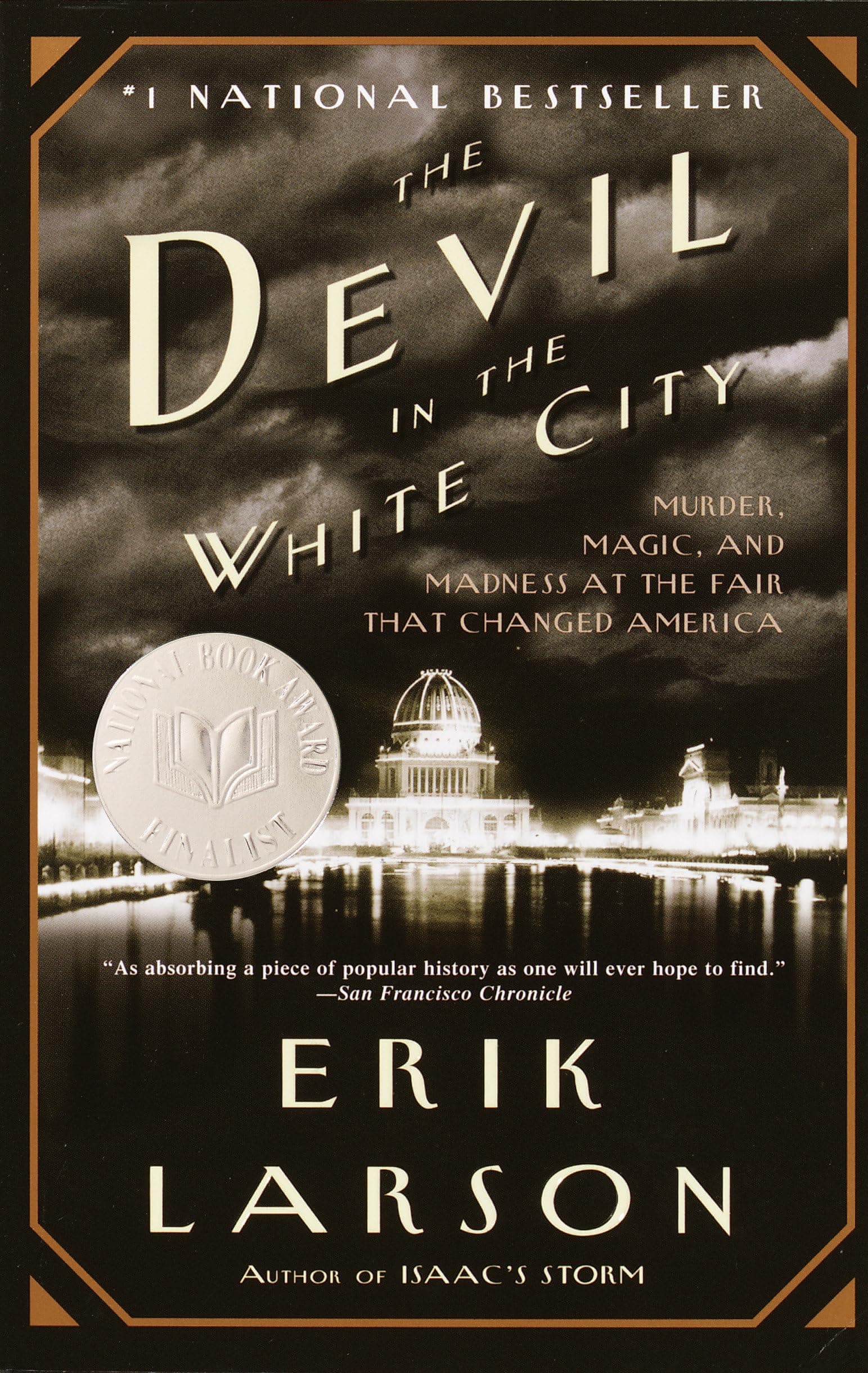
The Devil in the White City: Murder, Magic, and Madness at the Fair That Changed America [Erik Larson] on desertcart.com. *FREE* shipping on qualifying offers. The Devil in the White City: Murder, Magic, and Madness at the Fair That Changed America Review: A Beautifully Constructed Patchwork - If you read "Isaac's Storm," you have some idea of Mr. Larson's writing ability. Still, that book did not prepare me for this experience. With "The Devil In The White City" the author has moved the bar up a notch. He has several major themes and a few minor ones and he succeeds in meshing everything together seamlessly. First, we have the story of the Chicago World's Fair of 1893. Mr. Larson gives us the background, explaining the competition between various American cities that lobbied Congress for the right to hold the fair. New York, Chicago, Washington D.C. and St. Louis all wanted the fair. (The pressure was on to outdo the Paris Exposition Universelle of 1889.) The "upper-crust" of Chicago was especially anxious to prove to New York City that Chicago was much more than a place where animals were slaughtered and butchered. They wanted to demonstrate that Chicago had "class" and culture. Once Chicago won the competition to hold the fair, the race was on to design something spectacular and to get it built by the deadline that had been set. Mr. Larson introduces us to Daniel Burnham, the fair's director of works, and brings us into the offices of Burnham and the other architects and details the difficulties involved in getting such a diverse group of people, some with very large egos, to cooperate with one another. The author provides crisp character studies of Burnham, his partner John Root, Louis Sullivan and other famous architects, as well as Frederick Law Olmsted, who was eventually convinced to come on-board, despite being around 70 years old, to do the landscape architecture. Mr. Larson explains the physical details of putting the fair together and the bureaucratic jungle that Burnham had to hack his way through in order to accomplish his goal. The author tells us about some of the products that were introduced or popularized at the fair, such as Juicy Fruit gum, Cracker Jack, Aunt Jemima's pancake mix and Shredded Wheat ("shredded doormat, some called it). One of the many things Burnham had to worry about was to come up with something to "out-Eiffel, Eiffel" as Gustave Eiffel's tower had amazed the world when it was "unveiled" in Paris in 1889. Mr. Larson has a lot of fun with some of the crackpot ideas that were suggested to Burnham....one of which was to build a complex set of towers-within-towers, which could be telescoped to expand and contract at will. The inventor suggested putting a restaurant at the top but, Mr. Larson writes, "... possibly a bordello would have been more apt." As you can see, the story of the fair could easily have been a subject for an entire book, but Mr. Larson chose to also tell the story of Henry Holmes, the charming serial killer who operated just outside the confines of the fair. Details of his background are provided, and we are brought deep into his hellish world and are shown how he enchanted, killed and disposed of his victims...who were usually young women, but also included small children. Holmes had big, blue eyes and when talking to women he would always maintain eye contact and appear to be fascinated by what they were telling him. He would establish intimacy by touching them on the arm. But he also had a personality that could win over men, as well as women. He was cultured and soft-spoken and never lost his temper, even when under extreme pressure. He was a gifted liar. In addition to his "skills" as a killer, he was able to buy things without paying for them....managing to put creditors off for months and years because they not only believed his lies, but also just couldn't help liking him. Again, Mr. Larson manages to flesh out this portion of the book by bringing some of Holmes's victims to life for us...they are more than just caricatures. The author did a lot of legwork and dug deeply into the primary sources. Extracts from numerous personal letters are provided and people who were later interviewed by newspaper reporters and detectives are quoted. This brings such an intensity to the book that we are happy to have the story of the fair in counterpoint. We are allowed to "come up for air" in alternating chapters. Too much of Holmes at one time would be too much to handle. Finally, if you read "Isaac's Storm" you know that Mr. Larson has a true storyteller's gift. His prose is richly descriptive. One of my favorite sections in the book is where Mr. Larson writes about a meeting of architects in an office building known as the Rookery: "As the light began to fade, the architects lit the library's gas jets, which hissed like mildly perturbed cats. From the street below, the top floor of the Rookery seemed aflame with the shifting light of the jets and the fire in the great hearth." I love the imagery, and the use of the word "mildly" is a great touch. With "The Devil In The White City" you get two great tales, written with beautiful attention to physical detail and with the subtle and nuanced psychological portraits usually found in really fine fiction. Review: the author examines the single event that acted as the crucible for revealing both the best and worst that these men could conju - “I was born with the devil in me. I could not help the fact that I was a murderer, no more than the poet can help the inspiration to sing” –H.H. Holmes “Make no little plans; they have no magic to stir men’s blood” –Daniel Burnham Erik Larson opens his book with these two quotes that function as a preview—and microcosm—to the essence of the two minds at the heart of his Devil in the White City. More than that, both men operated within the same city that spurred their minds to blossom in all their respective depravity and grandeur: Chicago. And more specifically, the author examines the single event that acted as the crucible for revealing both the best and worst that these men could conjure—that event being The Chicago World’s Fair of 1893—an event that would serve as a symbol to the spectrum of the human spirit in all its glory and monstrosity upon the advent of the twentieth century. Chicago of 1893 was a burgeoning American city determined to demonstrate itself against its metropolitan rivals to the East. And with the national decision to commemorate Columbus’ 400th anniversary—coupled by the renowned debut of Eiffel’s Tower at the recent Paris Exposition of 1889—America needed to utilize the upcoming Chicago World’s Fair as a monument and announcement to American’s unparalleled capacity for achievement and innovation. Leading this endeavor would be Daniel Burnham—the architect responsible for overseeing its exhibits, maintaining production, and selecting the fellow men responsible for elevating the Fair into a phenomenon surpassing all expectations. After the death of Burnham’s professional partner, celebrated architect John Root, almost the entire burden of the assignment fell upon his shoulders. a task with the potential to cripple most men faced with the challenge, but one in which Burnham would work tirelessly to succeed—despite certain failures and shortcomings often out of his control—to exemplify the power of a determined mind coupled with an unceasing work ethic. These obstacles of Burnham’s contention would often arrive in the form of inclement weather, bureaucratic battles, and internal squabbles with fellow department heads. Nonetheless, despite numerous delays and last-minute fixes, the Fair was a triumphant success. One that would leave behind such marvels as The Ferris Wheel, Tesla’s alternating electrical current, gum, shredded wheat, spray painting, the device that creates plates for printing Braille…the list goes on ad nauseam. But besides these tangible heirlooms still affecting present American society, the ambition and awe of by the Fair itself would prove to be perhaps its most profound legacy. As one example, Larson relays an anecdote concerning one of the countless construction workers hired to help the Fair reach its nearly impossible deadline. This construction worker being an otherwise anonymous employee by the name of Elias Disney, who would recount stories of the overwhelming awe instilled by the spectacle of The White City upon the attendees to his young son Walt, which, Larson implies, would later be imitated in his designs of Disneyland. Interspersed between these anecdotes of American achievement at its zenith, Larson weaves a parallel narrative focused upon the exploits of H.H. Holmes—America’s first true serial killer. Operating his nearby World’s Fair Hotel—which would later be infamously remembered as The Murder Castle—Holmes would seize upon the opportunity afforded by the Fair in the most monstrous manner imaginable: as a vehicle for his plans of murder and theft to be unleashed. In stark juxtaposition to Burnham’s continued efforts to utilize his resources for the benefit of society, Holmes embodied the nightmare version of the American self-made man. Calculated, cold, and patient, Holmes worked with methodical ingenuity in his construction of the Murder Castle: a three-story hotel assembled from Holmes’ designs that would provide the perfect tenement to his abominable ambitions. From assigning certain workers to only certain sections (limiting their knowledge to corroborate with one another), to his ability to charm creditors for money that would never be repaid, to his own manufactured public image of a well-to-do businessman that would attract his varied women of interest, Holmes exploited every conceivable aspect of the trusting American public in order to appease the commanding vices surging within him. These vices would be numerous and varied. From insurance fraud, to theft, to murder, to kidnapping, Holmes existed as a personification of evil. At every turn—with Burnham working relentlessly mere miles away to produce a vision of America that would change and inspire the world—Holmes indulged in every act of depravity that he could conceive. As though possessed (a claim that Holmes would literally attest to after his arrest), H.H. truly lived up to his opening quote of being incapable of quelling his deviant impulses. Whether it was his numerous wives—all naïve women who sought out Chicago in hope of a new life within the burgeoning metropolis—or random hotel guests, or eventually the children of his accomplice…Holmes exhibited no mercy in satisfying the limitless depths of his immorality. And, as Larson reminds the reader in the introduction, the book is not a work of fiction. Nonetheless, the author weaves this sprawling narrative with compelling and compulsive chapters—each one short and episodic so that the reader falls under the trance of believing that the work could be a fictional, historical thriller. More importantly and impressively, these chapters are written with such specificity and atmosphere as to completely transport the reader into the setting. Larson favors stark, smooth prose that paints a vivid picture of the subject and allows the reader to experience the range of emotions occurring within this revolutionary event: from the majesty of the Court of Honor to Annie Williams’ utter panic after Holmes locks her within a vault, turns on the valve for poisonous gas to be released, and listens to her final screams before death just outside the door. The last third of the novel—with the Fair inexorably approaching its bleak end and the determined detective named Frank Geyer on Holmes’ elusive trail—Larson escalates the suspense to especially memorable and powerful effect. After Holmes’ many, many creditors finally coalesced to take him down, H.H. escaped from Chicago. However, the hotelier did not flee alone; instead, he absconded with three children belonging to his former assistant: the drunken henchman Benjamin Pitezel. As Geyer tracks Holmes across the northern states, locates him in Toronto, and discovers the gruesome remains of the children murdered and mutilated by Holmes, the storytelling morphs into a riveting chase across America and Canada to finally deliver retribution upon the killer. Geyer’s descent into the cellar of the climactic Toronto home reads with as much suffocating suspense and dread as any horror novel, and the brutal aftermath—wherein the mother must identify her horribly mutilated child at the coroner’s office—delivers the unbearable emotions of devastation experienced by the victim that are often glossed over by similar works in the genre. By the finale, wherein Larson interweaves the rapid destruction of the Fair following the assassination of Chicago’s mayor with Holmes’ arrest and execution, the author provides perspective on how the immense scope of these events affected the American public. Burnham with the World’s Fair—a prodigious monument to the power of accomplishment in American creativity, innovation, and inspiration; then with Holmes and the Murder Castle—a material edifice containing the darkest conceptions of a man’s mind and a literal house of horrors that contributed nothing but carnage and chaos. In this striking juxtaposition, Larson underscores how these two men—existing under the same time, place, and tested by the same opportunity—opted to forge the material legacy of their lives. And in demonstrating these expanded boundaries of American accomplishment and depravity upon the advent of the twentieth century, Larson impresses a larger understanding of the scope of human nature; and more importantly, the significance of how each man chooses to actualize his own nature, despite his limited time, and how profoundly the consequences of these actions continue to echo beyond the ephemeral present. [...]


| Best Sellers Rank | #2,083 in Books ( See Top 100 in Books ) #2 in Serial Killers True Accounts #4 in Murder & Mayhem True Accounts #8 in U.S. State & Local History |
| Customer Reviews | 4.3 4.3 out of 5 stars (30,700) |
| Dimensions | 5.12 x 0.95 x 7.95 inches |
| ISBN-10 | 0375725601 |
| ISBN-13 | 978-0375725609 |
| Item Weight | 1 pounds |
| Language | English |
| Print length | 447 pages |
| Publication date | February 10, 2004 |
| Publisher | Vintage |
B**T
A Beautifully Constructed Patchwork
If you read "Isaac's Storm," you have some idea of Mr. Larson's writing ability. Still, that book did not prepare me for this experience. With "The Devil In The White City" the author has moved the bar up a notch. He has several major themes and a few minor ones and he succeeds in meshing everything together seamlessly. First, we have the story of the Chicago World's Fair of 1893. Mr. Larson gives us the background, explaining the competition between various American cities that lobbied Congress for the right to hold the fair. New York, Chicago, Washington D.C. and St. Louis all wanted the fair. (The pressure was on to outdo the Paris Exposition Universelle of 1889.) The "upper-crust" of Chicago was especially anxious to prove to New York City that Chicago was much more than a place where animals were slaughtered and butchered. They wanted to demonstrate that Chicago had "class" and culture. Once Chicago won the competition to hold the fair, the race was on to design something spectacular and to get it built by the deadline that had been set. Mr. Larson introduces us to Daniel Burnham, the fair's director of works, and brings us into the offices of Burnham and the other architects and details the difficulties involved in getting such a diverse group of people, some with very large egos, to cooperate with one another. The author provides crisp character studies of Burnham, his partner John Root, Louis Sullivan and other famous architects, as well as Frederick Law Olmsted, who was eventually convinced to come on-board, despite being around 70 years old, to do the landscape architecture. Mr. Larson explains the physical details of putting the fair together and the bureaucratic jungle that Burnham had to hack his way through in order to accomplish his goal. The author tells us about some of the products that were introduced or popularized at the fair, such as Juicy Fruit gum, Cracker Jack, Aunt Jemima's pancake mix and Shredded Wheat ("shredded doormat, some called it). One of the many things Burnham had to worry about was to come up with something to "out-Eiffel, Eiffel" as Gustave Eiffel's tower had amazed the world when it was "unveiled" in Paris in 1889. Mr. Larson has a lot of fun with some of the crackpot ideas that were suggested to Burnham....one of which was to build a complex set of towers-within-towers, which could be telescoped to expand and contract at will. The inventor suggested putting a restaurant at the top but, Mr. Larson writes, "... possibly a bordello would have been more apt." As you can see, the story of the fair could easily have been a subject for an entire book, but Mr. Larson chose to also tell the story of Henry Holmes, the charming serial killer who operated just outside the confines of the fair. Details of his background are provided, and we are brought deep into his hellish world and are shown how he enchanted, killed and disposed of his victims...who were usually young women, but also included small children. Holmes had big, blue eyes and when talking to women he would always maintain eye contact and appear to be fascinated by what they were telling him. He would establish intimacy by touching them on the arm. But he also had a personality that could win over men, as well as women. He was cultured and soft-spoken and never lost his temper, even when under extreme pressure. He was a gifted liar. In addition to his "skills" as a killer, he was able to buy things without paying for them....managing to put creditors off for months and years because they not only believed his lies, but also just couldn't help liking him. Again, Mr. Larson manages to flesh out this portion of the book by bringing some of Holmes's victims to life for us...they are more than just caricatures. The author did a lot of legwork and dug deeply into the primary sources. Extracts from numerous personal letters are provided and people who were later interviewed by newspaper reporters and detectives are quoted. This brings such an intensity to the book that we are happy to have the story of the fair in counterpoint. We are allowed to "come up for air" in alternating chapters. Too much of Holmes at one time would be too much to handle. Finally, if you read "Isaac's Storm" you know that Mr. Larson has a true storyteller's gift. His prose is richly descriptive. One of my favorite sections in the book is where Mr. Larson writes about a meeting of architects in an office building known as the Rookery: "As the light began to fade, the architects lit the library's gas jets, which hissed like mildly perturbed cats. From the street below, the top floor of the Rookery seemed aflame with the shifting light of the jets and the fire in the great hearth." I love the imagery, and the use of the word "mildly" is a great touch. With "The Devil In The White City" you get two great tales, written with beautiful attention to physical detail and with the subtle and nuanced psychological portraits usually found in really fine fiction.
N**H
the author examines the single event that acted as the crucible for revealing both the best and worst that these men could conju
“I was born with the devil in me. I could not help the fact that I was a murderer, no more than the poet can help the inspiration to sing” –H.H. Holmes “Make no little plans; they have no magic to stir men’s blood” –Daniel Burnham Erik Larson opens his book with these two quotes that function as a preview—and microcosm—to the essence of the two minds at the heart of his Devil in the White City. More than that, both men operated within the same city that spurred their minds to blossom in all their respective depravity and grandeur: Chicago. And more specifically, the author examines the single event that acted as the crucible for revealing both the best and worst that these men could conjure—that event being The Chicago World’s Fair of 1893—an event that would serve as a symbol to the spectrum of the human spirit in all its glory and monstrosity upon the advent of the twentieth century. Chicago of 1893 was a burgeoning American city determined to demonstrate itself against its metropolitan rivals to the East. And with the national decision to commemorate Columbus’ 400th anniversary—coupled by the renowned debut of Eiffel’s Tower at the recent Paris Exposition of 1889—America needed to utilize the upcoming Chicago World’s Fair as a monument and announcement to American’s unparalleled capacity for achievement and innovation. Leading this endeavor would be Daniel Burnham—the architect responsible for overseeing its exhibits, maintaining production, and selecting the fellow men responsible for elevating the Fair into a phenomenon surpassing all expectations. After the death of Burnham’s professional partner, celebrated architect John Root, almost the entire burden of the assignment fell upon his shoulders. a task with the potential to cripple most men faced with the challenge, but one in which Burnham would work tirelessly to succeed—despite certain failures and shortcomings often out of his control—to exemplify the power of a determined mind coupled with an unceasing work ethic. These obstacles of Burnham’s contention would often arrive in the form of inclement weather, bureaucratic battles, and internal squabbles with fellow department heads. Nonetheless, despite numerous delays and last-minute fixes, the Fair was a triumphant success. One that would leave behind such marvels as The Ferris Wheel, Tesla’s alternating electrical current, gum, shredded wheat, spray painting, the device that creates plates for printing Braille…the list goes on ad nauseam. But besides these tangible heirlooms still affecting present American society, the ambition and awe of by the Fair itself would prove to be perhaps its most profound legacy. As one example, Larson relays an anecdote concerning one of the countless construction workers hired to help the Fair reach its nearly impossible deadline. This construction worker being an otherwise anonymous employee by the name of Elias Disney, who would recount stories of the overwhelming awe instilled by the spectacle of The White City upon the attendees to his young son Walt, which, Larson implies, would later be imitated in his designs of Disneyland. Interspersed between these anecdotes of American achievement at its zenith, Larson weaves a parallel narrative focused upon the exploits of H.H. Holmes—America’s first true serial killer. Operating his nearby World’s Fair Hotel—which would later be infamously remembered as The Murder Castle—Holmes would seize upon the opportunity afforded by the Fair in the most monstrous manner imaginable: as a vehicle for his plans of murder and theft to be unleashed. In stark juxtaposition to Burnham’s continued efforts to utilize his resources for the benefit of society, Holmes embodied the nightmare version of the American self-made man. Calculated, cold, and patient, Holmes worked with methodical ingenuity in his construction of the Murder Castle: a three-story hotel assembled from Holmes’ designs that would provide the perfect tenement to his abominable ambitions. From assigning certain workers to only certain sections (limiting their knowledge to corroborate with one another), to his ability to charm creditors for money that would never be repaid, to his own manufactured public image of a well-to-do businessman that would attract his varied women of interest, Holmes exploited every conceivable aspect of the trusting American public in order to appease the commanding vices surging within him. These vices would be numerous and varied. From insurance fraud, to theft, to murder, to kidnapping, Holmes existed as a personification of evil. At every turn—with Burnham working relentlessly mere miles away to produce a vision of America that would change and inspire the world—Holmes indulged in every act of depravity that he could conceive. As though possessed (a claim that Holmes would literally attest to after his arrest), H.H. truly lived up to his opening quote of being incapable of quelling his deviant impulses. Whether it was his numerous wives—all naïve women who sought out Chicago in hope of a new life within the burgeoning metropolis—or random hotel guests, or eventually the children of his accomplice…Holmes exhibited no mercy in satisfying the limitless depths of his immorality. And, as Larson reminds the reader in the introduction, the book is not a work of fiction. Nonetheless, the author weaves this sprawling narrative with compelling and compulsive chapters—each one short and episodic so that the reader falls under the trance of believing that the work could be a fictional, historical thriller. More importantly and impressively, these chapters are written with such specificity and atmosphere as to completely transport the reader into the setting. Larson favors stark, smooth prose that paints a vivid picture of the subject and allows the reader to experience the range of emotions occurring within this revolutionary event: from the majesty of the Court of Honor to Annie Williams’ utter panic after Holmes locks her within a vault, turns on the valve for poisonous gas to be released, and listens to her final screams before death just outside the door. The last third of the novel—with the Fair inexorably approaching its bleak end and the determined detective named Frank Geyer on Holmes’ elusive trail—Larson escalates the suspense to especially memorable and powerful effect. After Holmes’ many, many creditors finally coalesced to take him down, H.H. escaped from Chicago. However, the hotelier did not flee alone; instead, he absconded with three children belonging to his former assistant: the drunken henchman Benjamin Pitezel. As Geyer tracks Holmes across the northern states, locates him in Toronto, and discovers the gruesome remains of the children murdered and mutilated by Holmes, the storytelling morphs into a riveting chase across America and Canada to finally deliver retribution upon the killer. Geyer’s descent into the cellar of the climactic Toronto home reads with as much suffocating suspense and dread as any horror novel, and the brutal aftermath—wherein the mother must identify her horribly mutilated child at the coroner’s office—delivers the unbearable emotions of devastation experienced by the victim that are often glossed over by similar works in the genre. By the finale, wherein Larson interweaves the rapid destruction of the Fair following the assassination of Chicago’s mayor with Holmes’ arrest and execution, the author provides perspective on how the immense scope of these events affected the American public. Burnham with the World’s Fair—a prodigious monument to the power of accomplishment in American creativity, innovation, and inspiration; then with Holmes and the Murder Castle—a material edifice containing the darkest conceptions of a man’s mind and a literal house of horrors that contributed nothing but carnage and chaos. In this striking juxtaposition, Larson underscores how these two men—existing under the same time, place, and tested by the same opportunity—opted to forge the material legacy of their lives. And in demonstrating these expanded boundaries of American accomplishment and depravity upon the advent of the twentieth century, Larson impresses a larger understanding of the scope of human nature; and more importantly, the significance of how each man chooses to actualize his own nature, despite his limited time, and how profoundly the consequences of these actions continue to echo beyond the ephemeral present. [...]
P**W
A really well written and engaging book on Daniel Burnham (creator of Chicagos White City) and the notorious serial killer H H Holmes.
C**R
I found this book so stressful with the two story lines - the building of the 1893 World's Trade Fair in Chicago and the serial killer on the loose. They had 2 years to design and build the site including the buildings and the site. As the Landscape Architect could not do his work until the buildings were erected and finished due to the railway tracks coming into the site to deliver the goods and he had to finish his work after whereas when he designed Central Park in NYC it was a 25 year project. With all the contractors and the short time frame - I was stressed wondering how they were going to get it done. The story line of the serial killer - every time he met with someone or took a girl on a date - would this be the time he got rid of them. I must say I certainly got my $s worth in reading this book. It was the July selection for our Book Club - great choice. A great read and enjoyable. Great discussions after.
M**S
Muy buen libro
C**N
C'est la 3ème fois que j'achète ce livre. Les deux premières fois c'était sous forme papier. Je l'ai prêté par deux fois (j'en parlais avec tant d'enthousiasme que cela faisait envie !) à des gens qui ne me l'ont pas rendu.Cette fois-ci sous forme électronique je suis sure de le garder. On apprend beaucoup de choses sur l'Amérique de la fin du 19ème (j'étudie cela à l'université et cela fait prendre vie au cours théorique). De plus il y a du suspens avec le côté thriller ce qui ne gâte rien. Pour mon 4ème voyage à Chicago, je verrai un autre aspect de la ville, surtout en imagination, car beaucoup de choses ont disparu car les bâtiments de l'exposition universelle ont brûlé.
S**M
ترست بايلوت
منذ شهرين
منذ أسبوعين