We remain fully operational. Our teams are working around the clock to ensure your deliveries continue safely.

قم بتنزيل التطبيق


معلومات عنا
حقوق الطبع والنشر © 2024 Desertcart Holdings Limited
قم بتنزيل التطبيق
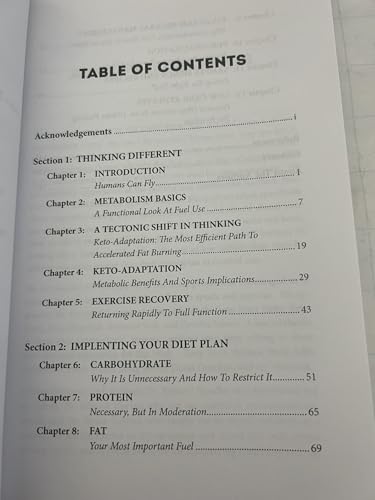

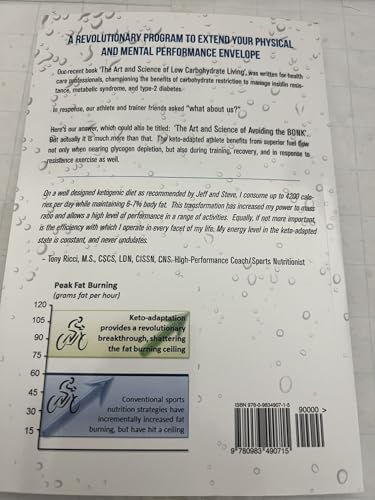


The Art and Science of Low Carbohydrate Performance [Jeff S. Volek, Stephen D. Phinney] on desertcart.com. *FREE* shipping on qualifying offers. The Art and Science of Low Carbohydrate Performance Review: Best book in the health/exercise category for 2012 - This is the first and possibly still only book that talks in depth about why a very low carb ketogenic diet may not just be useful for weight loss, insulin-resistance, metabolic syndrome, heart disease, epilepsy and autoimmune diseases but also to significantly improve athletic performance. The authors have many years of research experience in the field of low carb nutrition and had published another outstanding book, "The Art and Science of Low Carbohydrate Living" last year which focused on the details of doing low carb eating the right way by avoiding the many possible pitfalls. This new book is written for athletes who want to improve their performance, but also for people who want to be athletes and never could be because their body would not cooperate on a higher carb diet. The authors explain in detail how on a higher carb diet the body is dependent on glucose for most of its functions including muscle functions and brain function. Glucose can only be stored in our body in a fairly limited amount, somewhere around 2000 calories. When this supply is close to being exhausted we need to refuel with carbohydrates to keep functioning or we will "hit the wall" as endurance athletes call it, meaning our brain and muscles are running out of fuel. When eating a high carbohydrate diet our body can not quickly switch from fueling with carbohydrate to fueling with fat, even though even a slim person has 40,000 calories of energy on their body at all times from fat. This fat can only be accessed to fuel the muscles and the brain for most of their energy needs if the body is used to using it. Fat is converted to ketones which can fuel the muscles and the brain for most of their energy needs in a keto-adapted person. For keto-adaptation to happen carbohydrate intake has to be drastically reduced, usually at least down to 50 grams/day, in many people to under 20 grams/day at least initially. The reason is that higher carb levels than this will lead to more insulin production and insulin inhibits release and use of fat from our fat storage cells. The graphics in the book show that with even moderate carbohydrate intake (of any form) there is too much insulin for the body to be able to access any significant amount of fat as fuel. Once carb levels are lowered enough the body will start producing ketones from fat and from that point on it takes a few weeks for our body to make all the necessary changes to become fully keto-adapted. The whole process typically takes about 6 weeks, which is why many benefits of a low carbohydrate diet are only optimized after this period. Some improvements, like a lack of hunger and a reduction in body fat, can be seen much earlier, often after just a few days. Once the body is fully keto-adapted something amazing happens: Fat use during exercise increases tremendously with moderate exercise for both endurance exercise and resistance training. In a study of high-level cyclists who had been keto-adpated for 4 weeks the average fat oxidation per hour at about 65% VO2max was about 90 grams/hour. So far I have just summarized the first three chapters. The rest of the book talks about implementing the diet, macronutrient levels, faster recovery rates on ketogenic diets and fluid and mineral management. Just to make sure nobody who buys this book is going to be disappointed: The diet itself is not very different from what you can find in the original Atkins diet: low carb and high fat although there is some additional info here as well. The main benefit I get from this book is to understand how to optimize a low-carb diet to get far superior results from the time I spend exercising. I am planning to measure this by recording my body weight, body fat percentage vs. lean muscle mass and by recording improvements in my running and resistance training over the next 3 months. This book gives enough detail to helpful for serious athletes but is written in a way that anyone who wants to live a healthy lifestyle can understand it. Review: I am a convert to this regimen - Extremely informative and eye opening. It makes sense rather than the dogma of whole grains and overconsumption of grains. In 2 weeks my body adapted to relying on fat for fuel rather than carbohydrate. The first 2 weeks were rough but when my body "switched over" I had nothing but energy for my workouts. To those who say they have tried it and couldn't survive their workouts due to low energy don't quit. It's an enzymatic process that the body needs to change. It takes 2-4 weeks for the body to "change." Then stand by for the energy surge. Remember for those who are critical of this nutritional method it takes time. Your body WILL adapt. Your body has the same biochem process as the inuit, eskimo, africans, native americans (who went where the buffalo rome) and aborigines who thrived on high fat and very little vegitation." What many of the high carbers fail to realize is that if they were in a situation where they had no choice but to survive mainly on animal products that they would actually thrive. Grains are not what they used to be and the overabuse to our pancreas causing it "shoot out" more insulin than it was meant to has caused so many health problems in this country. Other exceptional books that support scientifically a controlled carbohydrate consumption are "The Zone," "The art and science of low carbohydrate living," "Protein power" and "Wheat belly" diet (an exceptional eye opener on wheat and the negatives that are associated with it). Anyway, this book gets deep into the biochem aspect of this type of eating. These other books do as well. Bear in mind these books are not for the laymen. I have a medical background so it was a good read. Try this book as well as the author's first book "The art and science of low carbohydrate living." The first few weeks on this nutritional regimen I lost over 25 lbs and my strength (powerlifting) has increased dramatically with very few carbohydrate in my diet and I'm talkin' less than 30 grams daily. Workout recovery was cut in half. I'm 42 and my recocery seems to have improved as if I were ten years younger. Blood pressure is now back in check. Cholesterol dropped from 270 to 200 in 6 weeks as well as triglycerides (that were 3 times the normal) now in the normal range. HDL increased and LDL dropped. The use of coconut oil, butter, eating the skin with chicken and not worrying about the fat on beef and pork has literally changed my life. I'm currently being very militant in body fat reduction while powerlifting right now but when I attain my bodyfat level goal, I will then gradually add carbohydrate until I find my carbohydrate equilibrium where I'm neither gaining or losing. Along with the fatty meats I consume a ton of green veggies and the only white thing I eat is cauliflower and small amounts of onions. Fish oils added too this regimen takes it to a different level. I felt as though I was on caffeine without the jitters. Took from 4 -6 grams daily of ultra filtered and processed fish oil that passes european standards for fish oil purity. High does of the DHA (helps neurologial system) along with the lo carb regimen has increased cognitive ability, the need for less sleep, decreased incidence of heart beat irregularities. (I have an abnormal sinus rhythm,EPA addresses vascular, cardio and musculoskeletal systems etc). I can't recommend this more due to the positive effects I've experienced in my body. For those who don't suffer the ills of high consumption of carbs (genetics) this book is not really needed. But if you want an edge in performance and an almost unlimited energy supply without the hassle of continous replenishment of glucose that is required due to the severely low capacity of the body to store glucose then try it out.
| Best Sellers Rank | #193,331 in Books ( See Top 100 in Books ) #306 in Low Carbohydrate Diets #320 in Sports Training (Books) #19,580 in Health, Fitness & Dieting (Books) |
| Customer Reviews | 4.6 4.6 out of 5 stars (2,115) |
| Dimensions | 6 x 0.39 x 9 inches |
| Edition | 39798th |
| ISBN-10 | 0983490716 |
| ISBN-13 | 978-0983490715 |
| Item Weight | 14.2 ounces |
| Language | English |
| Print length | 172 pages |
| Publication date | April 1, 2012 |
| Publisher | Beyond Obesity LLC |
B**E
Best book in the health/exercise category for 2012
This is the first and possibly still only book that talks in depth about why a very low carb ketogenic diet may not just be useful for weight loss, insulin-resistance, metabolic syndrome, heart disease, epilepsy and autoimmune diseases but also to significantly improve athletic performance. The authors have many years of research experience in the field of low carb nutrition and had published another outstanding book, "The Art and Science of Low Carbohydrate Living" last year which focused on the details of doing low carb eating the right way by avoiding the many possible pitfalls. This new book is written for athletes who want to improve their performance, but also for people who want to be athletes and never could be because their body would not cooperate on a higher carb diet. The authors explain in detail how on a higher carb diet the body is dependent on glucose for most of its functions including muscle functions and brain function. Glucose can only be stored in our body in a fairly limited amount, somewhere around 2000 calories. When this supply is close to being exhausted we need to refuel with carbohydrates to keep functioning or we will "hit the wall" as endurance athletes call it, meaning our brain and muscles are running out of fuel. When eating a high carbohydrate diet our body can not quickly switch from fueling with carbohydrate to fueling with fat, even though even a slim person has 40,000 calories of energy on their body at all times from fat. This fat can only be accessed to fuel the muscles and the brain for most of their energy needs if the body is used to using it. Fat is converted to ketones which can fuel the muscles and the brain for most of their energy needs in a keto-adapted person. For keto-adaptation to happen carbohydrate intake has to be drastically reduced, usually at least down to 50 grams/day, in many people to under 20 grams/day at least initially. The reason is that higher carb levels than this will lead to more insulin production and insulin inhibits release and use of fat from our fat storage cells. The graphics in the book show that with even moderate carbohydrate intake (of any form) there is too much insulin for the body to be able to access any significant amount of fat as fuel. Once carb levels are lowered enough the body will start producing ketones from fat and from that point on it takes a few weeks for our body to make all the necessary changes to become fully keto-adapted. The whole process typically takes about 6 weeks, which is why many benefits of a low carbohydrate diet are only optimized after this period. Some improvements, like a lack of hunger and a reduction in body fat, can be seen much earlier, often after just a few days. Once the body is fully keto-adapted something amazing happens: Fat use during exercise increases tremendously with moderate exercise for both endurance exercise and resistance training. In a study of high-level cyclists who had been keto-adpated for 4 weeks the average fat oxidation per hour at about 65% VO2max was about 90 grams/hour. So far I have just summarized the first three chapters. The rest of the book talks about implementing the diet, macronutrient levels, faster recovery rates on ketogenic diets and fluid and mineral management. Just to make sure nobody who buys this book is going to be disappointed: The diet itself is not very different from what you can find in the original Atkins diet: low carb and high fat although there is some additional info here as well. The main benefit I get from this book is to understand how to optimize a low-carb diet to get far superior results from the time I spend exercising. I am planning to measure this by recording my body weight, body fat percentage vs. lean muscle mass and by recording improvements in my running and resistance training over the next 3 months. This book gives enough detail to helpful for serious athletes but is written in a way that anyone who wants to live a healthy lifestyle can understand it.
T**R
I am a convert to this regimen
Extremely informative and eye opening. It makes sense rather than the dogma of whole grains and overconsumption of grains. In 2 weeks my body adapted to relying on fat for fuel rather than carbohydrate. The first 2 weeks were rough but when my body "switched over" I had nothing but energy for my workouts. To those who say they have tried it and couldn't survive their workouts due to low energy don't quit. It's an enzymatic process that the body needs to change. It takes 2-4 weeks for the body to "change." Then stand by for the energy surge. Remember for those who are critical of this nutritional method it takes time. Your body WILL adapt. Your body has the same biochem process as the inuit, eskimo, africans, native americans (who went where the buffalo rome) and aborigines who thrived on high fat and very little vegitation." What many of the high carbers fail to realize is that if they were in a situation where they had no choice but to survive mainly on animal products that they would actually thrive. Grains are not what they used to be and the overabuse to our pancreas causing it "shoot out" more insulin than it was meant to has caused so many health problems in this country. Other exceptional books that support scientifically a controlled carbohydrate consumption are "The Zone," "The art and science of low carbohydrate living," "Protein power" and "Wheat belly" diet (an exceptional eye opener on wheat and the negatives that are associated with it). Anyway, this book gets deep into the biochem aspect of this type of eating. These other books do as well. Bear in mind these books are not for the laymen. I have a medical background so it was a good read. Try this book as well as the author's first book "The art and science of low carbohydrate living." The first few weeks on this nutritional regimen I lost over 25 lbs and my strength (powerlifting) has increased dramatically with very few carbohydrate in my diet and I'm talkin' less than 30 grams daily. Workout recovery was cut in half. I'm 42 and my recocery seems to have improved as if I were ten years younger. Blood pressure is now back in check. Cholesterol dropped from 270 to 200 in 6 weeks as well as triglycerides (that were 3 times the normal) now in the normal range. HDL increased and LDL dropped. The use of coconut oil, butter, eating the skin with chicken and not worrying about the fat on beef and pork has literally changed my life. I'm currently being very militant in body fat reduction while powerlifting right now but when I attain my bodyfat level goal, I will then gradually add carbohydrate until I find my carbohydrate equilibrium where I'm neither gaining or losing. Along with the fatty meats I consume a ton of green veggies and the only white thing I eat is cauliflower and small amounts of onions. Fish oils added too this regimen takes it to a different level. I felt as though I was on caffeine without the jitters. Took from 4 -6 grams daily of ultra filtered and processed fish oil that passes european standards for fish oil purity. High does of the DHA (helps neurologial system) along with the lo carb regimen has increased cognitive ability, the need for less sleep, decreased incidence of heart beat irregularities. (I have an abnormal sinus rhythm,EPA addresses vascular, cardio and musculoskeletal systems etc). I can't recommend this more due to the positive effects I've experienced in my body. For those who don't suffer the ills of high consumption of carbs (genetics) this book is not really needed. But if you want an edge in performance and an almost unlimited energy supply without the hassle of continous replenishment of glucose that is required due to the severely low capacity of the body to store glucose then try it out.
A**L
Compelling but technically challenging read.
A very convincing but technically challenging read. I bought into it and now I am on the keto diet t largely as a result of reading this book. I had to read it several times as it is unlike a novel or a biography and includes lots of technical terms and fine points that are hard to digest for the non-medical professional. It has lots of research behind it. The authors are research proffs in universities and not book retailers etc.There are no grandiose claims but strong, science-based arguments to look at this model of eating, exercising and losing weight. My own interest is in increasing energy and improving recovery from workouts etc. so it really fit my interests. The weight loss and control is a free bonus of the high fat, low carb, low protein diet.
F**E
porém um pouco complicado para quem não é da área da saúde, pois é bastante técnico claro que este tipo de livro é tão essencial quanto para os leigos como eu excelente para nutricionistas, educadores físicos e médicos lerem
L**U
Excellent book on LCHF. I bought both this and their other book "The Art and Science of Low Carb". This book is shorter, covers everything and has what you need to get started. I also really liked how it addressed physical activity and athletic training whilst on LCHF. I would also recommend their other book although it can be pretty heavy on the science at times. I am a few weeks into LCHF so yes a while to go but already I feel really good. The best part has been that I am no longer a slave to hunger and sugar/carb cravings. Do you know how great it is to NOT have invasive food thoughts all the time. So liberating. This book has given me freedom and I look forward to how it goes over the next few weeks/months/years.
A**W
Stephen Phinney und Jeff Volek, als international renommierte und engagierte Vorkämpfer und Experten auf diesem Gebiet, geben hier - als Erweiterung ihres Grundlagenleitfadens - einen wunderbaren Leitfaden für Sportler an die Hand, um mit Low-Carb-Ernährung gesund, leistungsfähig und verständlich zu leben. Alle (potentiellen) Fragen von Hobby-Sportlern wie auch Profi-Athleten werden beantwortet, die Kapitel sind kurz und klar gehalten, immer mit einer sehr hilfreichen Zusammenfassung. Definitiv eine wärmstens zu empfehlende Pflichlektüre für alle Sportler und Low-Carb-Interessierten, Anfänger wie Fortgeschrittene.
M**O
Super recomendado, llego muy bien
M**E
This book is more Art then Science. The perfect compliment to the first book! All the "How to" info you need. My favorite part is that after the very technical explanations they summed it up with "simply put". Just what I needed. Loved it and will re read several times just to get the info straight and to be better able to explain it in conversations.
ترست بايلوت
منذ شهر
منذ أسبوع