🔧 Elevate Your Measurements with Style!
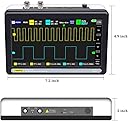
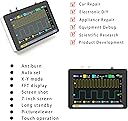
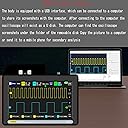
The Tablet Oscilloscope is a cutting-edge digital storage oscilloscope featuring a 7-inch touchscreen, 100Mhz bandwidth, and a powerful 6000mAh battery. Designed for professionals, it offers advanced measurement capabilities, extensive storage options, and user-friendly navigation, making it an essential tool for engineers and technicians.


M**G
Very capable scope for the price!
I wanted a small, portable, battery-operated oscilloscope having reasonable performance at a reasonable price. This oscilloscope is much more than merely satisfactory! I could have bought more performance for less money with one of the units that uses a laptop PC as its host, display and power source, but I find that a very cumbersome arrangement for portable use. And most of the outboard units that use a PC do not protect the PC from over-voltage spikes and ground faults, from my viewpoint a crippling (and potentially expensive) deficiency.I read comments that indicated that packaging had been a problem for some buyers, so I made a point of buying my scope from Anmascop-US, a storefront in the US for the Chinese manufacturer that stocks items in the US. My unit arrived within a week, well packed and in perfect condition.This unit is sold under several different brand names, but the model number appears to always be ADS1013D-II. There are two versions available: the older ADS1013D has the probe connections projecting from the top edge of the case, while the ADS1013D-II has the probe connections inset into a well in the top edge of the case. The ADS1013D-II also has a shiny "picture frame" around the display screen. Price is about the same for the two versions, but it appears that the -II version that I bought has some updates.Like many offshore designs, the user manual requires some interpretation because the writer was clearly not a native speaker of English. However if you know how a conventional oscilloscope works, you can make sense of it after several readings and some experimentation. Also, you have to remember that a small device like this one has no space for knobs; all settings are made via the touch screen (which has VERY fast response) and thus you have to get used to operating it via that interface. A few settings are "hidden", in that there was no obvious way for the manufacturer to incorporate them. For example it took me awhile to understand that the time-base setting is adjusted up and down by tapping on the right and left sides of the screen.I was astonished to find that the two input channels use 12-bit converters; I had expected to find 8-bit resolution which would have been good enough for my needs. However testing against an adjustable DC supply, monitored by a 3 1/2 digit DVM, made it clear that the display is indeed 4000 counts from bottom to top and the trace on the screen does not reveal the 100 steps per division that careful testing indicates. The specifications are unclear about this, but the unit automatically handles + and - inputs with a seamless crossover as you would expect. The on-screen digital voltage readings indicated very good linearity and accuracy. And the display is very sharp and clear.Are there weak spots or missing features? Of course, what would you expect for $150? But for me they are not a problem. The biggest weakness is in triggering, and use of a common timebase. There is no external triggering input, and the two channels are driven from the same trigger; you select which channel, voltage level and direction. And for long timebase settings, the triggering is one-shot, not recurring. Since the two channels use the same timebase you can't trigger from one channel and then display the result on the other channel using a faster timebase setting. The approach for saving the waveform works OK but it wasn't clear from the instructions that tapping the saved image would add the annotation overlay that isn't shown on the thumbnails. The file saved to the PC is in a format that I haven't been able to open, but as long as a high-resolution screenshot "photo" is OK for your needs, no problem. The battery takes a long time to charge, and I suspect a higher-current adapter would be OK; 4 hours use time is great but 6 hours to charge isn't. The inset BNC connectors for the probes provide a sleek appearance but getting the probe connector for Channel 1 attached requires small fingers. And I would be astonished if the scope has anywhere near the 1GS/sec sampling performance listed in the specs. Each input appears to have a dual A/D converter and perhaps the timebases are "verniered" so that on a sampling basis you have 1GS/sec sampling. I'm not likely to ever need even as much as a 20MHz real-time capture, so don't anticipate a problem. And like any semiconductor A/D converter, be careful about input voltage. You're not applying the input to the grid of a tube that can handle over-voltage, as in my younger days with Tektronix scopes.I am glad I bought this scope!Martt
H**R
Husband Loves This
My husband is an engineer and loves this. The portability is great for around the house jobs. The touch screen is handy, and, according to him, the reasons are very accurate.
B**H
Pretty Much DOA
This device definitely had potential. I was able to give it a short test run before it up and died on me. There are a lot of features, and a working model would definitely be very useful.I'm not able to say how accurate it is. I expect it's reasonable. It seems that modern test equipment tends to be accurate.The were several features I liked. It has an FFT capability, meaning you can get an idea of the harmonics present in your wave. This can be useful; it might alert you to distortion in a sine wave, for example.I liked how it was possible to quickly and easily adjust how many cycles appeared in the display. Displaying many cycles helped ensure the FFT display was more accurate. But you could easily expand the waveform to show only one, or even just a part of one. You can do this simply by tapping on the screen, either to the left or the right of center. One way displays more waves; the other way fewer. I don't recall which was which, and can no longer check.The display was colorful, which made it easy to distinguish between, for example, channel 1 and channel 2. You can select or deselect several measurements such as Vpp, Vrms, frequency, cycle (period), and so on, depending on what your needs are.I liked that this 2-channel oscilloscope came with two probes. It just made it simper to get started quickly.Sadly, the scope stopped working. It just shut down unexpectedly, without any warning. I let it sit for a while and was able to restart it, but then it shut down again. This time, there was no further response.I am going to have to return it. I considered just getting a replacement, but I am now a little worried about whether this device will last. I decided to get a refund.I will say that if this device were functional, it would be an excellent, useful tool for working with electronics.
A**O
Excellent Value, Intuitive and Portable
I would say a very good basic 2-channel oscilloscope made by Fei Ni Rui Si Technology, in PRC - China. Simple and intuitive touchscreen layout that responds and works well. Several YouTube videos confirm the Bandwidth is around 27-30 MHz as opposed to the claimed 100 MHz and the sampling rate around 200 Ms/s as opposed to the claimed 1 Gs/s, but I knew this going in and for the price you simply cannot ask for more. I intend to use mostly for automotive where unnecessarily high bandwidth is undesirable anyway because it introduces more noise. I understand the bandwidth requirement for automotive is at least 5 MHz to 20 MHz and Sampling Rate cannot be lower than 10 MS/s or it won't be fast enough for certain scenarios such as CAN (more is better), so this product seems to fit the bill. In terms of portability and integration to me this layout beats the virtual scopes that require you to drag a laptop (added risk). It seems to me the best and most practical scope solutions for automotive are exactly tablet touchscreen standalone solutions, where if Android-based is better and if designed for automotive even better. This scope comes with basic probes not suitable for automotive. I will end up spending three times as much on leads, adapters and accessories since a good current clamp meter is a must. The AESWave U-scope was also on my list but it is just 1-channel and you need at least two channels (CAN Bus testing). On my list are also the Micsig STO1104E (Android-based), Micsig ATO1104 Automotive Tablet (impressive) and of course the Virtual Scope Pico 4425A and the 2405A. Micsig is also PRC-Chinese and Pico Technologies is out of UK. Of all, Pico offers the most impressive array of support, plus their software is also quite good. I wish Pico would come out with Android-based solutions and touchscreen tablets. I am a DIYer and not a professional mechanic so my situation and needs are different.
ترست بايلوت
منذ أسبوع
منذ أسبوع