
قم بتنزيل التطبيق


معلومات عنا
حقوق الطبع والنشر © 2024 Desertcart Holdings Limited
قم بتنزيل التطبيق




♟️ Unlock Grandmaster-Level Endgame Secrets – Don’t Get Left Behind!
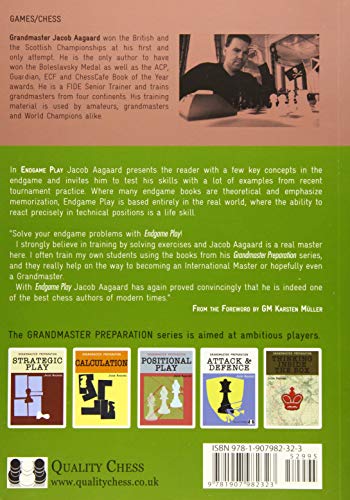
Endgame Play (Grandmaster Preparation) by Jacob Aagaard is a cutting-edge chess endgame manual featuring 442 positions across 12 chapters. Designed for serious players aiming to elevate their endgame skills, it combines modern grandmaster theory with practical examples from 2006-2013. The book’s clear diagrams, detailed analysis, and durable format make it an essential resource for deep, self-paced study and long-term improvement.
| ASIN | 1907982329 |
| Best Sellers Rank | 953,603 in Books ( See Top 100 in Books ) 1,200 in Chess (Books) 1,927 in Indoor Games |
| Customer reviews | 4.7 4.7 out of 5 stars (53) |
| Dimensions | 17.07 x 2.03 x 23.98 cm |
| Edition | Illustrated |
| ISBN-10 | 9781907982323 |
| ISBN-13 | 978-1907982323 |
| Item weight | 706 g |
| Language | English |
| Print length | 376 pages |
| Publication date | 30 April 2014 |
| Publisher | Quality Chess UK LLP |
M**0
Long ago when I was a junior, Fine's Basic Chess Endings was about all that was available on the endings. BCE is a generally difficult book to read & out of date. Later I acquired Keres' Practical Chess Endings, readable, and usable, but I didn't develop much endgame skill until years later. In 1999, when I became determined to address my losing record to my club rival. A 2100 Serbian player who would only play 5-minute chess. His strategy was: always play the same opening, swap down to the endgame, play every move within a few seconds and score a win either in the endgame or on the clock. To counter this, I picked up Chernev's book of Capablanca's Endings. Read it from cover to cover (incidentally how many of us have actually read through an entire chess book). I raised my ability and we became pretty much equal in results. Of course modern GM & IM chess no longer has adjournments, so they too have had to improve their endings. The result has been real growth of endgame understanding and a recent flood of excellent endgame books. If you have any manual by Mueller, Dvoretsky, Nunn's series or de la Villas you are covered for basic endings (though I find these texts are tough slog to read, but great for reference). However, to play well in the endgame takes something more. Chernev's book is still a good choice for 1500-1900s to develop their skills for practical play (in spite of it's being dated with a few errors of no great significance). Since 2001, the entrance of the PC revolution has impacted the study of practical endgame play. Databases, quick-sorting of like-positions, and the quality of publishing layouts with big, clear diagrams has allowed a major improvement in this area of chess publishing. Two great examples are Muellers incredible book on pawn ending and Flears gigantic study of double piece endings. Nowadays all GMs are being tested to prove their endgame competence. With Carlsen setingt a high standard for calculation, speed of play and has infused fresh imaginative ideas into practical play. Aagaards starting premise with this book is "endgames will at some point become entirely concrete, just as middlegames usually do... they oscillate between manoeuering and tactical confrontation". In twelve chapters, he presents 442 positions to study, solve, and understand. Each chapter starts with theoretical details (some intros are extensive and others are fairly short.). Study positions mostly come from play between 2006 to 2013, with a few earlier examples. The solutions present the moves, with detailed analysis and well-worded explanations of what Aagaard believes we should learn from that particular diagram. Brilliant stuff! Tons and tons of information. The chapters cover pawn endings, opposite B's, Rook endings, fortresses, complex endings. Production quality is superb, with six diagrams to a page followed overleaf by solutions and learning. Unlike Mueller who is very terse and almost humorless, or Dvoretsky who drifts a bit and often struggles with focus and Chernev who is sychophantic about Capa; I find Aagaard is exactly on point. His breezey prose style treats the reader as an equal while conveying large chunks of understanding and constantly testing us to open our chess-minds. The book opens out flat on my table; the binding seems likely to handle a long life of many readings; and can also be studied in a chair or in bed. Diagrams are easy on the eye. Notes are well-laid out. The double column layout means there is a huge amount of material. Aagaard reports Mueller has actually twice checked the book for errors. I believe the $20ish price, is a good value for a few hundred hours of study from this book (making it a good return). Aagaard reccomends using this as a self-study workbook where you follow a self-drilling approach. The reader is intended to go back again and again to expand/review knowledge and practice analytic ability.
C**N
Com a experiência que eu adquiri ao longo da minha carreira como professor e instrutor de xadrez e amante em livros, este aborda finais práticas, diretamente retiradas de partidas reais, o autor não explica conceitos básicos mas as partidas são de fácil compreensão quanto às ideias detalhadas. Em suma, o autor explica muito bem. Livro recomendado para jogadores que já conhecem os conceitos fundamentais de finais. Recomendo.
J**A
A good book to sharpen your endgame practical play with some concepts here and there in the usual Aaggaard's high quality standard.
C**D
Le gain d'une partie d'échecs n'est possible que si l'on a acquis de bonnes bases dans le secteur de jeu que sont les finales. A mon sens, cette partie du jeu, bien qu'assez complexe, est la plus passionnante car elle peut déboucher sur des retournements de situations extraordinaires. Dans son ouvrage, le Grand Maître aux "4 a" : Jacob Aagaard, aborde tous les types de finales que nous devons maîtriser. Les éditions Quality Chess et la préface de Karsten Muller confèrent à ce livre un sérieux supplémentaire. A se procurer.
F**O
Besty
ترست بايلوت
منذ شهر
منذ يومين