Some deliveries may take a little longer than usual due to regional shipping conditions.

قم بتنزيل التطبيق


معلومات عنا
حقوق الطبع والنشر © 2024 Desertcart Holdings Limited
قم بتنزيل التطبيق

Everyday Calculus: Discovering the Hidden Math All Around Us
D**N
Great book for math enthusiasts
This book is not meant to be used as a single source for learning calculus or for calculus classes, however it is a beautiful book for math enthusiasts to take it along on vacations. It beautifully explains the math and calculus all around us. This book is not for everyone, don’t buy it if you do not love mathematics.
U**R
Sneaky Intro to Differential Equations
The systems, events and measurements highlighted in this fine little book are the "everyday" part-- the calculus is not! In order to model the types of everyday experiences the author describes in fine fashion, simply taking the first or second derivative to find slope or acceleration doesn't do much. The truth is that he's subtly talking about dynamical systems-- differential EQUATIONS, not just calc as we'd see it as an isolated technique.The real physics, engineering, biology, etc. that these equations model require matrix vectors and really advanced concepts and techniques, many of them not even able to be generalized beyond that model or problem. In fact, of the four methods used in dynamical systems (analytic, qualitative, numeric and the newest family member stochastic/statistical), most are incapable of modeling anything but the simplest versions of the underlying "reality." We can't, for example, specify the design of an airplane wing analytically, so we use qualitative (graphs, for example) and numeric ("guesses" with computer algorithms), which as we engineers would say, gets us "close enough."I just didn't want you misled into thinking that the calculus itself was everyday or simple. The author does a wonderful job of hand holding us through the foundations. There is a lot of value in this in: 1. Getting us "ready" for advanced applications 2. Giving us a fun glimpse at why calc is so important 3. Giving us an intuitive feel for why we model in the more advanced form. Every High School student interested in math should read this, even though the true topics are advanced undergrad and grad level! The author actually makes this possible, which is a rare feat. If you're an AP math student, you'll get this easily, and the appendix will transition you to undergrad. The sneaky part is that the solutions to the calculus described here are quantities, whereas the real-life modeling dynamical systems equations have functions as solutions. This is normally not taught in High School, at least in the US (I teach bright HS kids math online).If you're an autodidact or math enthusiast, you'll enjoy this regardless of your level, as there is a very broad collection of applications, and the author explains them in enough detail to whet your appetite for more. Highly recommended for the right reader. I also had no problem with the formulas (they aren't that detailed, and have no nasty page breaks) on my Kindle. If I were home schooling, I'd definitely get this as a "motivator" to teach why math is so important to "real" life. Realistically, it is the brain that uses these equations to cross a street, not necessarily our everyday mind! You won't be doing calculations after reading this (except unconsciously) to decide where to sit in a movie. Honestly, most "users" of these techniques are engineers and physicists, but even an 11 year old child is doing advanced calc when s/he rides a bike!!! Pretty astonishing.
L**J
gravity, raindrops and the age of the universe.
Raindrops.After a interesting discussion with the author I like to comment on the subject of raindrops. I presume equation(13) is the equation for the terminal velocity of the raindrop. A sort of umbrella manufacturer estimate. What confuses me is the wording. Using drag I would consider form drag and/or viscous drag. The differential equation in the Appendix 3 is about the change of momentum. I presume again this equation to be correct. It describes the influence of the change in momentum and gravity on the raindrop, no form or viscous drag. No problem the book is about calculus and not about physics. By the way viscous drag for low Reynolds numbers works in the same way as the change of momentum.(When dm/dt is positive!) However, it is not an alternative description! For completeness the viscous drag should have been involved in the differential equation. Again, the book is about calculus and not about physics.I do appreciate the calculus of the book. The book concludes with a nice example of present day physics: the age of the universe. The author descibes the formal steps for obtaining equation (93). However, I can imagine that for a layperson learning quite a few things about calculus with help of this book these steps are not of a great help to find (93). Some wording that a detailed description of the integration and taking the limit is beyond the scope of "Ëveryday Calculus" would have been of some help. A layperson will not read the [email protected]
I**C
This is a fun book if you ever wondered what calculus is good ...
This is a fun book if you ever wondered what calculus is good for. His presentation is so clever that, as he says, you can skip the equations and appendices and still see how calculus is all around us. I enjoyed it thoroughly.However, his uncritical enthusiasm for Einstein has led him astray:On p. 111, he says, ". . . Albert Einstein managed not only to prove Newton wrong, but also to replace his theory of gravity with a much more correct one."He should have a conversation with the guys at NASA and ESA: "Today the world's space agencies, such as NASA and ESA, still use Newton's laws of motion and gravitation to work out the most effective trajectories for spacecraft," (p. 55, IN PURSUIT OF THE UNKNOWN, Ian Stewart, Basic Books, 2012).Fernandez should have stayed with math and avoided Einsteinian physics.
D**O
Certain aspects of calculus that relate to everyday phenomena are ...
Certain aspects of calculus that relate to everyday phenomena are missing. Have you ever thought about infinite series and convergence while doing laundry by hand? slow convergence for drip removal of soapy or chemical containing water, faster for hand wringing, even faster for machine wringing or centrifuge extraction, vacuum extraction as the ultimate? Repeated soaking and dilutions apply as well. Fractional crystallization of freezer ice left in a long time, other processes, natural an man-made.... I have not finished reading, but this aspect of analysis (series) is neglected.
B**I
Another beautiful Calculus book; W. Sawyer and Kline Morris also have super nice Calculus and Math books for non mathematicians.
Unique in that the book runs like a story and makes us see Calculus in every aspect of our daily life. Style is relaxed and easy.In Calculus books, a problem is posed and Calculus is used to solve it. But in this book, you are amazed to bump into Calculus at every turn in life. You understand and fall in love with Calculus in a totally new fashion. The complex formulae are in the appendicesin order to avoid stumbling blocks that would detract from the train of thought.I loved the author's dedication of his book to his mother, wife, and daughter, in Spanish.Pierre Ghassibi, MD
M**L
It is just a view.
I personally did not like the format of this book.
F**N
Fantastico
Libro molto bello che illustra con chiarezza concetti matematici e fisici legati al mondo reale e a fenomeni quotidiani. Si apprezza soprattutto se si ha già una conoscenza intermedia/avanzata della matematica e in particolare calcolo infinitesimale, equazioni differenziali, trigonometria ecc. oltre che se si è spinti da un forte interesse per argomenti scientifici, in assenza di questi requisiti potrebbe non essere il libro idoneo. Assolutamente da leggere
S**�
Best book for understanding Calculus
Oh. Best book for understanding Calculus. Pupil from sixth sad, onwards can start "just reading" this book for sub-conscious foundations.
A**N
Dull, superficial, and confused
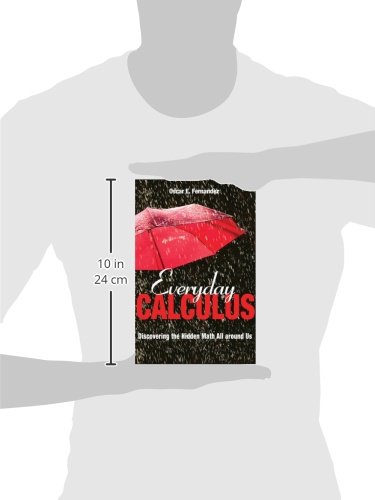
I'm not impressed. The book is neither interesting nor rigorous, and I think any book on math must be one, preferably both.Fernandez applies calculus to everyday things, but along the way he imports all sorts of assumptions and physics without much explanation or defence. His examples, too, are banal, which makes the book feel rushed into print.Take, for example, the discussion of rain, illustrated on the cover. Why do raindrops not grow to a huge size before they hit the ground, he asks. Interesting question and he promises insight through math. It turns out there is none here. Anyone could tell you that air resistance and gravity balance each other out. And that, unfortunately, is what Fernandez tells us too, with no additional insight from math but much intellectual handwaving. Variables and constants seem to appear and disappear without justification, presumably to make the equations easier to read. This makes the logic impossible to follow.In the raindrop example, Fernandez makes confusing simplifications to the equations he needs. Where does the seconds-squared go in the law of gravity? I don't know, but it disappears from his logic as he works through the equation. Where does the natural constant e come from? Again, no idea. I'd love to know about e--surely a fascinating part of the "math all around us". No luck. It comes in when Fernandez wants it then disappears. If I didn't know a little bit about math, I'd have no idea whatsoever what e was or did; he never explains it.Many textbooks have left me confused but with an appreciation for the math and rigour I can't understand. This book left me confused and unimpressed.Fernandez clearly needs to do more careful audience analysis. If your audience wants rigour, give them rigour. If they want interesting examples and superficial insight, go with those--but leave out the equations and discussion of your morning coffee, which only confuse and bore.Unfortunately, this book disappoints.
M**H
Five Stars
excellent
ترست بايلوت
منذ أسبوع
منذ شهر