Some deliveries may take a little longer than usual due to regional shipping conditions.

قم بتنزيل التطبيق


معلومات عنا
حقوق الطبع والنشر © 2024 Desertcart Holdings Limited
قم بتنزيل التطبيق
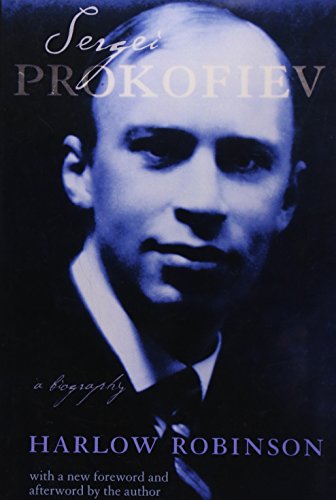
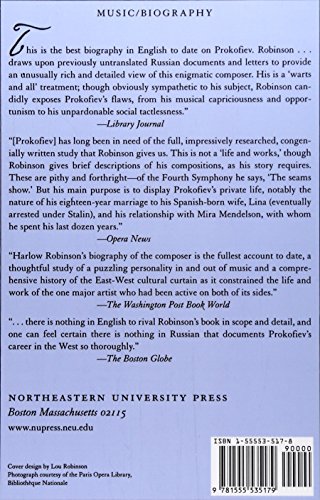
Sergei Prokofiev: A Biography
D**N
Enjoyable biography of a musical innovator
This is one of the most engaging and informative biographies I have read. Other reviewers have pointed out that the book is dated. It was first published in 1987, right before the fall of the Soviet Union, and before further information on Prokofiev became available. Since Prokofiev spent the last seventeen years of his life solely in Stalin’s Russia, those might be highly relevant issues. Nevertheless, in terms of research, writing skill, and the ability to bring to life one of the 20th century’s greatest composers, Robinson’s biography is superb.Prokofiev’s musical personality was difficult to fathom. With one foot in the classical past and one in the 20th century’s reaction against the past, Prokofiev’s music is unique. He loved to be independent in his compositions yet his absolute love for his homeland and the resultant artistic purges led to some works that his earlier self would have found repulsive. He loved children deeply and enjoyed writing for them (my grandson loves Peter and the Wolf) but he was a distant father to his own two sons. He and his first wife traveled the globe together with Prokofiev’s innovative music but his leaving her in the Soviet Union may have created an opening for paranoid Soviet bureaucrats to arrest her. He could write powerful piano concertos treating the piano, as Robinson notes, like a percussion instrument, yet compose some of the most lyrical music in the last 100 years. Robinson details all this in a way that completely involves the reader. Robinson gives synopses of all Prokofiev’s major works but also gives the reader real insight into the composer’s personality and character.Prokofiev’s life was a journey through different types of music and different cultural and political systems. Prokofiev cared little if at all about politics; his life was his art. It can be tough to write a coherent and highly readable account of an artist so single-minded but whose personal life was so varied. But Robinson succeeds in beautifully summoning Prokofiev the person for the reader. With 493 pages of text it was a book that I had to return to many times. In every case I looked forward to continuing the story. For a biography of a 20th century composer this book has my highest recommendation.
N**O
Just what I wanted to know
I enjoyed this biography very much. It was a thorough survey of Prokofiev's life with a good insight to his life after he had returned to the Soviet Union from Paris. The book had a nice array of photographs, the author avoided lengthy discussions of his music and there were no examples from his sheet music.
T**N
The Mind and Music of Prokofiev
Harlow Robinson spent years in Soviet Russia researching Prokofiev during the height of the Cold War. His research does not just include manuscripts and letters but also involves many personal conversations with those who knew Prokofiev and even with those who persecuted Prokofiev. As a result he navigates his way through Prokofiev's life with that added dimension of relating personally to those events. Robinson's writing is interesting and warm without being too academic or dry. This book seems to be intended for any real fan of Prokofiev. Lastly, this book really strives to explain some of the perplexities of Prokofiev's decisions. In particular, Robinson strives to explain why Prokofiev needed to return to Russia after his extended residence in Paris. This book is well worth the time to read.
G**.
Great Prokofiev Bio
A exceptionally well written bio by an author who really knows his Russian music (and who also sings it with the Yale Russian Chorus!)
R**N
Riveting, and thorough
Thoroughly researched, well written, concise and to the point, full of facinating details -- this is a masterly biography of Prokofiev. I was riveted to this book from the first page to the last.
A**C
Five Stars
wonderful biography
J**S
The foremost biography of a paradoxical composer who may still suffer from reputation lag vs. the facts of his popularity
His reputation and fame not buoyed with a particular "school" or "style" of music, by which he could be easily "placed" in 20th music history, Prokofiev occupies a rather unique position. His music is much played and recorded, but his standing still seems to lag those who carry the mantle of "style," e.g., Stravinsky (primitivism), Schoenberg (12-tone), or Bartok (ethnic).The composer himself said he had no particular "style:" "Curious about Prokofiev's evolution as a composer, Gliere asked him which theory he believed in. "None at all," Prokofiev replied without hesitation." p. 122.Despite this "handicap," Prokofiev has been more recorded than those whose reputation appears to exceed that of his own, being right behind Rachmaninoff, and ahead of Shostakovich, Stravinsky, and Bartók! Who knew! According to our research:Most Recorded Composers RecordingsRUSSIANS PLUS1 Bach, J.S. 74472 Mozart, Wolfgang A. 74443 Beethoven, Ludwig van 59754 Brahms, Johannes 42685 Schubert, Franz 41316 Tchaikovsky, Peter 357719 Rachmaninov, Sergei 207524 Prokofiev, Sergei 167226 Shostakovich, Dmitri 158032 Stravinsky, Igor 125939 Bartók, Béla 97141 Mussorgsky, Modest 95842 Rimsky-Korsakov, N. 94968 Scriabin, Alexander 53373 Borodin, Alexander 49577 Schoenberg, Arnold 51683 Khachaturian, Aram 39184 Glazunov, Alexander 382Despite manifesting brilliant creations without an obvious "handle," it is clear that Prokofiev is a composer whose works are standing the test of time, and, in fact, growing in stature. I am thinking particularly of the VC No. 2, an endlessly creative and highly accessible concerto that one never tires of.If one would be forced to select a pigeon-hole to slot Prokofiev, it might well be that of "neoclassicist," or "robust neoclassicist" (our term). Consider his take on Stravinsky, who had his own neoclassic tour of duty: "As was usually the case with Stravinsky's music, it both fascinated and repelled him. "There's a lot that is interesting in it," Prokofiev wrote to Miaskovsky, who shred Prokofiev's love-hate relationship with Stravinsky, "but at the same time the absence of material, or its lack of definition, left feelings of emptiness and disappointment in one's soul." p. 261.Perhaps a fair assertion that Prokofiev had "more to say" than the more arid, "music for music's sake" neoclassical Stravinsky. Yet who is more "famous?" A strange injustice, it would seem.Prokofiev the neoclassicist composer manifested those same values as a person: sturdy, highly energetic, satiric even sharp-tongued, hard-working (he was a touring virtuoso as well as composer), and more oriented to humor than pathos, even in dire circumstances: "The return trip to Petrograd was long and uncomfortable. The boat was crowded with many other Russians and Poles making the roundabout overland passage through Salonika and Bucharest (to get away from WWI), but Prokofiev joked bout the hardships in a letter to Diaghilev. Meanwhile, the Russian army was rapidly running out of arms and ammunition, and commanders sent soldiers to the front unarmed, telling them to scavenge among the dead for weapons." p. 111Prokofiev was also brilliant, and facile, neoclassic traits, and as at home on the tennis court, across a chess board, or even writing sonnets, as he was in his day job, music: "For amusement, Prokofiev and Bashkirov were engaged in a sonnet-writing competition. They each composed sonnets on three themes, and then sent them for numerical evaluation (on a scale of one to four) to Balmont and to another Russian emigre poet, Igor Severyanin. Prokofiev wons easily, even though Bashkirov was the one who called himself a poet." p. 175This book is a terrific insight into the life story of one of the lesser-known, not fully celebrated, and highly complex giants of 20th century music. Prokofiev straddled many things and remains hard-to-categorize: forward-looking Europe vs. his native backward-looking Russia (he returned to the latter which tended to dampen his stature in the West), styles of writing, and was at all times, his own man. Very worthwhile reading, too, for the discussion of some of his lesser-known works, e.g., the bassoon quartet, and lesser-known operas, ballets, etc.Few know there was a lyrical, and quietist Prokofiev, too, it turns out, vis-à-vis his more famous and often-played "big" works, e.g., Romeo and Juliet, and the most popular symphonies, concertos, and piano sonatas.There is still much Prokofiev to discover. Prokofiev himself never understood why his Sinfonietta was so rarely performed, whereas the "Classical" Symphony was played constantly.Highly recommended, this volume is regarded as the gold standard of Prokofiev biography.
フ**ラ
劇的な生涯を描ききった超一流の伝記
ロシア革命を嫌って横浜経由でアメリカへ亡命したプロコフィエフは、何故再び故国に戻り骨を埋めたのか。モダニズムの申し子としてパリでもてはやされたプロコフィエフは、社会主義の故国でどういう気持ちで数々のわかりやすい「名曲」を作曲していったのか。こういった疑問に極めて納得性のある答えを与えてくれるのがこの伝記です。ロシア革命と、そして何よりも独裁者スターリンに翻弄され、奇しくもスターリンと同じ日に死んだプロコフィエフの劇的な生涯を、著者は自ら集めた膨大な資料をもとに、客観的かつ克明に追ってゆきます。発言の出所まで細かく記した良心的な姿勢と、過度に技術的な作曲・作品論に踏み込まない記述が、この本を資料としても読み物としても、刺激あふれる超一流の「伝記」としています。最大級の賛辞を惜しみません。おすすめ!
ترست بايلوت
منذ أسبوعين
منذ شهرين