We remain fully operational. Our teams are working around the clock to ensure your deliveries continue safely.

قم بتنزيل التطبيق


معلومات عنا
حقوق الطبع والنشر © 2024 Desertcart Holdings Limited
قم بتنزيل التطبيق
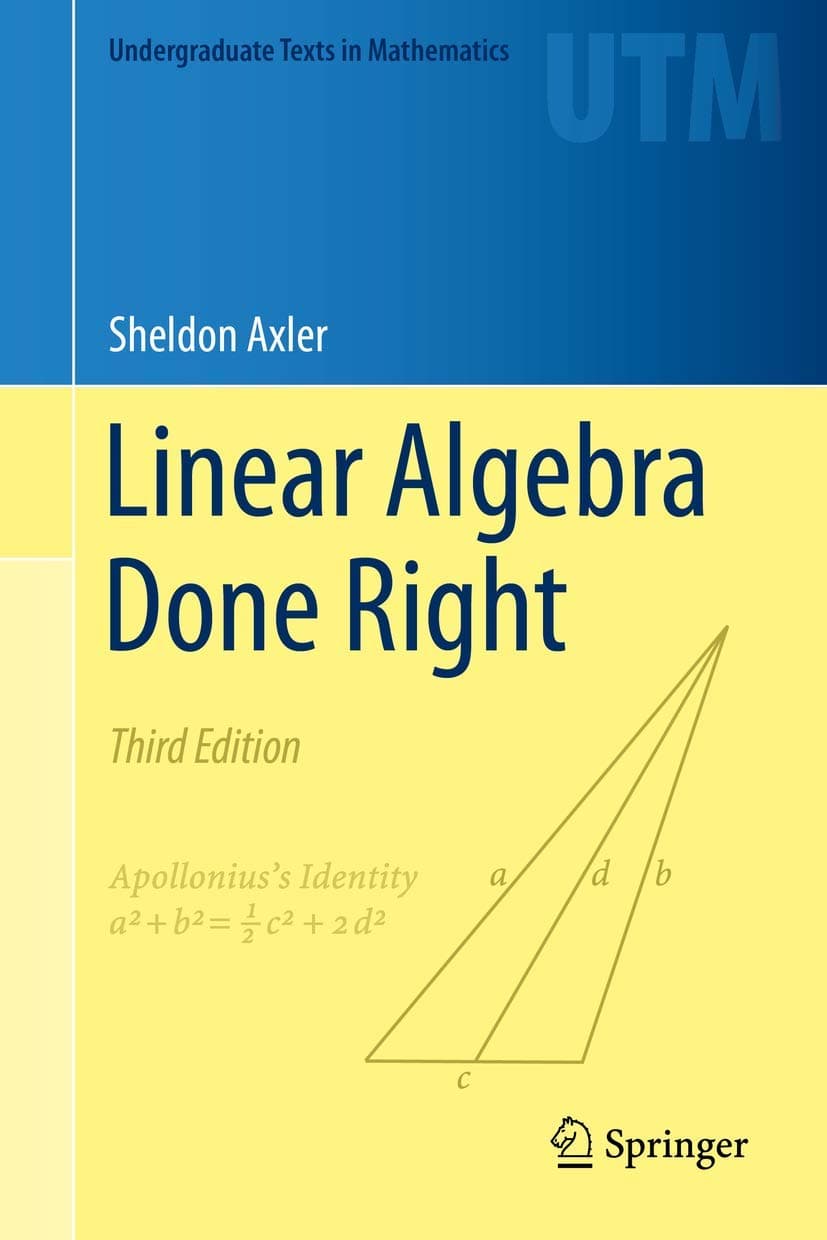
📚 Unlock the Power of Linear Algebra!
Linear Algebra Done Right is a meticulously crafted textbook designed for undergraduate students, offering a clear and rigorous approach to the subject. It emphasizes understanding over rote memorization, making it an essential resource for anyone looking to master linear algebra.
| Best Sellers Rank | #551,200 in Books ( See Top 100 in Books ) #19 in Linear Algebra (Books) #209 in Algebra & Trigonometry |
| Customer Reviews | 4.7 4.7 out of 5 stars (732) |
| Dimensions | 6.25 x 0.75 x 9.25 inches |
| Edition | 3rd ed. 2015 |
| ISBN-10 | 3319110799 |
| ISBN-13 | 978-3319110790 |
| Item Weight | 7.4 ounces |
| Language | English |
| Print length | 357 pages |
| Publication date | December 18, 2014 |
| Publisher | Springer |
M**T
A Fantastic Second Pass at Linear Algebra
I used this book in my second course in linear algebra, and I absolutely loved it. One of my biggest points of irritation in my first course in linear algebra was the fact that we first defined determinant as some unintuitive, computational nonsense and then defined eigenvalues from there. Judging off of the foreword, Axler essentially wrote this book so that students like myself could gain some peace of mind. The material is developed wonderfully, in my opinion -- it was much more intuitive than my first pass at linear algebra, and the problems within the book (at least those that my professor assigned) were commonly quite good. On top of that, it was one of the first math textbooks I've owned that I could legitimately sit down and read rather than, say, fall asleep or come away more confused than when I first started reading. The proofs are *mostly* quite readable, and Axler definitely has an enjoyable writing style. Whether it's the little surprises like getting to page 22 and seeing it labeled "~7pi" (there are other easter eggs of that variety, by the way) or writing an anecdote from the supreme court where one of the justices is caught up on the word "orthogonal" inside the chapter on inner products and norms (p. 174), he certainly does his best to make reading the book enjoyable. Apart from the material itself, though, as others have mentioned, the book is also just plain looks nice. I purchased a hardcover edition (which I believe may be the only style printed for the 3rd edition), and whether it's the outer cover or the typeset they use inside, everything just has a nice, colorful pop to it. Coming in at ~330 pages and ~6.5W x 9.5H x 0.8D inches, the book is also compact, an aspect that made carrying it to and from campus each day a trivial task. As a whole, I have essentially nothing but praise for this text. Some may have wanted a linear algebra text that's more computationally intensive, but I'd rather gain the conceptual understanding that Axler has to offer than manually row reduce or invert some arbitrary matrix any day. I absolutely don't want to sell my copy -- this text is one that I'm going to be happy to leave on my bookshelf and use as a reference whenever I find myself needing to freshen up on my linear algebra later in life.
E**L
Best at what it does (that I’ve seen)
Teaches Linear Algebra as an Algebra. It’s flavor is very Abstract Algebra light (and working oen will carry over to the other). It is not, by itself, always excellent at creating intuition. Doing the exercises is part of that. Geometrically... well, you’ll probably get plenty of that over the course of ... just existing in any semi-technical realm. Compared to, say, Strang’s excellent online intro course (not a fan of his book, but the lectures are great; opposite of axler) Strang os great at getting hands dirty with simple systems and developing strong, key intuitions. Axler takes those simple comprehensions and intuitions and elevates them to something more sublime and, potentially, much more powerful. Despite his harping about finite dimensional vector spaces early on, a large part of the material discusses Infinite dimensional vector spaces amd here is where LA really helps bring new intuitions. If you took Strang’s course you learn to approximate data using projections. If you read the correspondong section of Axler you come away having learned to approximate arbitrary functions in the infinite space of functions with some subset of your choosing. The inner product, abstractly defined, allows for almost arcanely powerful tasks. But, again, it’s an algebraist’s take on LA. That’s not for everyone.
W**.
Let their education begin!
Excellent textbook for a second look at linear algebra from a strictly theoretical standpoint. It size is small enough so that one may comfortably carry it around and promptly, effortlessly smack around fools that utter: "linear algebra! that's just y =mx + b!!! LOLZ". Their education is the responsibility of us all, and how often we forget the old ways... The proofs are clear but do require the reader to fill in some gaps. This is intended. Open to any page and witness the clarity that so often escape the best efforts of a certain class of instructor; Axler will not suffer any unmotivated concepts. Everything builds from previous definitions until there's just enough structure to flesh out the chapter objectives, thus there's little fat to distract the reader. Moreover, Axler is so badass that he does away with determinants until the last chapter of the book, he's so pimp he just didn't need any stinking determinants in his proofs. That's right, the last chapter introduces trace and determinants and proceeds to bring everything together into a magnificent mic drop. I now finally understand why determinants are inextricably tied to notions of volume, and why we must multiply by the Jacobian when performing change of variables in multi-variable integrals, and so on. A newcomer to linear algebra will get very little of use here, save for the clearest definitions I've ever seen regarding the structure of vector spaces, subspaces and linear operators. For a more applied/introductory approach to linear algebra, one can do much worse than Strang. I now feel much more comfortable moving onto a graduate-level Linear algebra course after visiting Axler's book, as such, it will be an invaluable reference moving forward.
A**I
O livro é muito interessante, uma vez que trata de uma abordagem pouco usual do aprendizado de Álgebra Linear. Eu o utilizo em minhas atividades de pesquisa.
R**K
Good book
T**S
Perfect condition
M**N
This is a very clear and engaging book on linear algebra. The eigenvectors and eigenvalues are taught before the matrices. I really appreciate the book, and the problems helps a lot for the understanding.
A**X
Ho acquistato l'edizione hardcover (foto): edizione ben curata e con pochi refusi; la rilegatura è ottima e duratura (non si sciupa progressivamente durante la lettura) e le pagine sono di buona qualità; il formato del libro è molto maneggevole. Dal punto di vista dei contenuti, si è rivelato un'ottima introduzione all'algebra lineare (spazi vettoriali, mappe lineari, autovettori, autovalori e autospazi e matrici) astratta e rigorosa ma anche molto concreta: ogni argomento è corredato da utili ed illuminanti esempi e/o esercizi svolti e molti teoremi sono preceduti da un breve preambolo che ne introduce il senso e il contenuto ad un livello discorsivo ed informale, agevolando la comprensione degli aspetti più astratti. Talvolta le dimostrazioni sono lasciate al lettore ma si tratta sempre di casi in cui, se si è seguito il libro, tale dimostrazione è alla portata del lettore, essendo spesso analoga a quella di altri teoremi dimostrati nelle pagine precedenti. Inoltre ogni sezione è corredata da numerosi utili esercizi (non svolti!). Unico veniale difetto è che talvolta (ancorché molto raramente), dimostrazioni proposte in tali esercizi sono considerate poi propedeutiche a teoremi presentati in sezioni successive e questo, in qualche modo, obbliga a ritornare indietro a rivedere l'esercizio e, qualora non sia già stato fatto, a risolverlo. Decisamente brillante ed originale la trattazione della teoria degli autovalori, sviluppata senza far uso del concetto di determinante, che viene poi definito e spiegato solo nelle ultime pagine anche se la trattazione delle matrici viene comunque svolta in maniera progressiva mano a mano che i concetti astratti diventano in qualche modo applicabili. Sheldon Axler è un mito per rigore e chiarezza: oltre a questo ottimo testo di Algebra Lineare, consiglio il testo "Measure, Integration & Real Analysis" disponibile in formato digitale gratuito anche in formato Kindle su Amazon nella collana Open Access della Springer.
ترست بايلوت
منذ شهرين
منذ 3 أسابيع