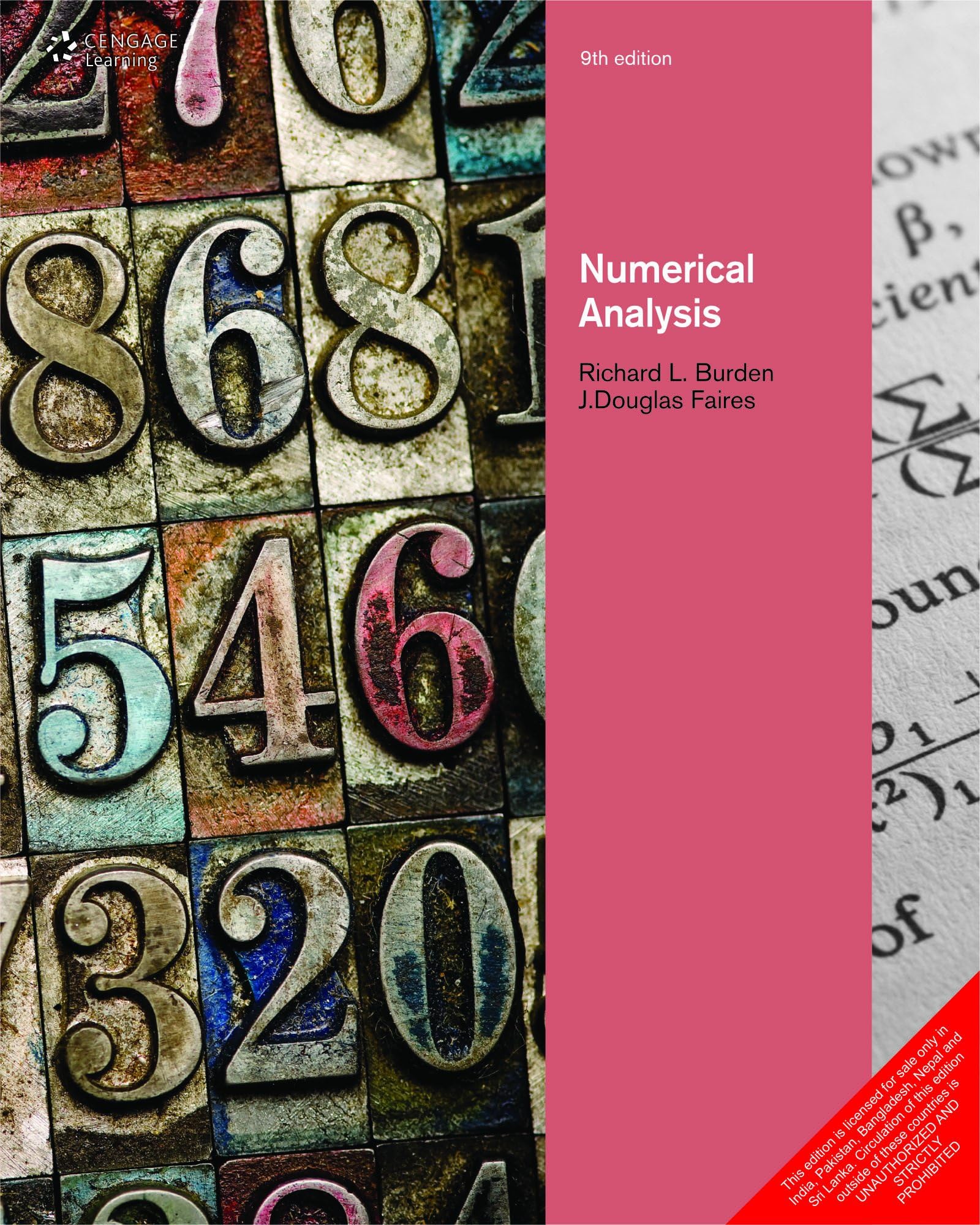
Numerical Analysis, 9th Edition
Product ID: 132934101
Buy anything from 5,000+ international stores. One checkout price. No surprise fees. Join 2M+ shoppers on Desertcart.
Desertcart purchases this item on your behalf and handles shipping, customs, and support to Israel.
This well-respected text gives an introduction to the modern approximation techniques and explains how, why and when the techniques can be expected to work. The authors focus on building students' intuition to help them understand why the techniques presented work in general and why, in some situations, they fail. With a wealth of examples and exercises, the text demonstrates the relevance of numerical analysis to a variety of disciplines and provides ample practice for students. The applications chosen demonstrate concisely how numerical methods can be and often must be, applied in real-life situations. In this edition, the presentation has been fine-tuned to make the book even more useful to the instructor and more interesting to the reader. Overall, students gain a theoretical understanding of and a firm basis for future study of, numerical analysis and scientific computing. A more applied text with a different menu of topics is the authors' highly regarded NUMERICAL METHODS, Third Edition. Review: A good introduction to numerical analysis - I really found this book to be approachable for a student who is rather okay at Mathematics. The book explains the concepts and the theory behind numerical methods very well and is easily understood with some work. I would really recommend readers to buy this book if they intend to start on numerical analysis thanks to its approachability. Review: Good - Excellent
| Best Sellers Rank | #148,142 in Books ( See Top 100 in Books ) #297 in Electrical & Electronic Engineering |
| Customer Reviews | 4.4 out of 5 stars 104 Reviews |
G**N
A good introduction to numerical analysis
I really found this book to be approachable for a student who is rather okay at Mathematics. The book explains the concepts and the theory behind numerical methods very well and is easily understood with some work. I would really recommend readers to buy this book if they intend to start on numerical analysis thanks to its approachability.
R**H
Good
Excellent
S**M
Five Stars
Very good book
S**L
Five Stars
Excellent book
A**R
Five Stars
very good
G**A
what a crap!!!
whats this book is all about? Not for competitive exams after all!!! go for Iyenger book its best
M**X
Solido aiuto nell'avvicinarsi all'analisi numerica
Questo volume contiene alcuni dei principali metodi per risolvere i problemi più comuni dell'analisi numerica, ad esempio (ma non solo) la ricerca di soluzioni di equazioni in una variabile e di sistemi di equazioni (lineari e non), problemi di approssimazione e di interpolazione e problemi di integrazione. Gli argomenti sono esposti in maniera piuttosto chiara, con esempi ed esercizi. Viene data molta importanza anche all'errore che i metodi descritti comportano nell'approssimare una soluzione. Spesso sono anche suggeriti metodi per minimizzare tale errore. Nel libro sono presenti anche algoritmi che possono essere implementati nei principali software di calcolo (Maple, Matlab e simili) ed alcuni esempi di applicazioni (principalmente usando Maple). Un'aspetto che differenzia questo libro da altri simili è il fatto che i singoli capitoli non siano collegati tra loro, rendendo quindi il lettore libero di affrontare gli argomenti in base alle proprie necessità. Laddove dei prerequisiti sono richiesti vengono forniti dagli autori gli opportuni riferimenti (sia interni al volume stesso che ad altri volumi
J**I
Five Stars
Definitely the best book in numerical analysis. but it does not worth it to buy a completely new book.
L**E
Good Refernce book
I'm a grad student and I recently had to learn how to numerically solve PDE's. I'm rather new to computer programming and numerical analysis in general. I've really only been in my field for about 1 year now. I picked up this book and went straight to Chapter 12. It explained everything quite concisely and had very clear descriptions and diagrams. Armed with pen and paper, I learned how to numerically solve these PDE's quite quickly. It was honestly a fun experience. Whenever there were tools that I was missing, the authors would reference the section and chapter where you could find the necessary tools. I believe this book was written as a reference, as well as, textbook. A problem that many textbooks suffer from, is that the material is written in sequential order, with newer material depending heavily on the previous chapters. These types of books are not adept to being just picked up and read, to gather the relevant information. They require you to pretty much read all the preceding text to understand it, and who has time for that? This book is NOT like that. You can just pick it up and easily learn from it. Unlike Numerical Recipes, this provides the method with a very clear explanation and justification for the algorithms. Numerical Recipes is good, but its purpose is not to provide detailed explanations of why and how the algorithms work. To be able to use this text, I would suggest having taken Calc 1,2 & 3, differential equations, linear algebra class, and be comfortable with programming. I suspect that the folks complaining heavily about this text, are not very comfortable with with Calculus, linear algebra, and/or programming. If you are an undergrad and have not taken those classes or are not comfortable with the material, I can see you struggling. If you are a grad student in Math or Physics, this text will be rather refreshingly easy to read. It will help fill in the necessary gaps in your knowledge of computational work, if you have any like I did. Enjoy!
F**R
Me ha salvado el curso
Buenísimo, me ha salvado el curso
2**S
Five Stars
Great textbook.
Trustpilot
1 month ago
3 days ago