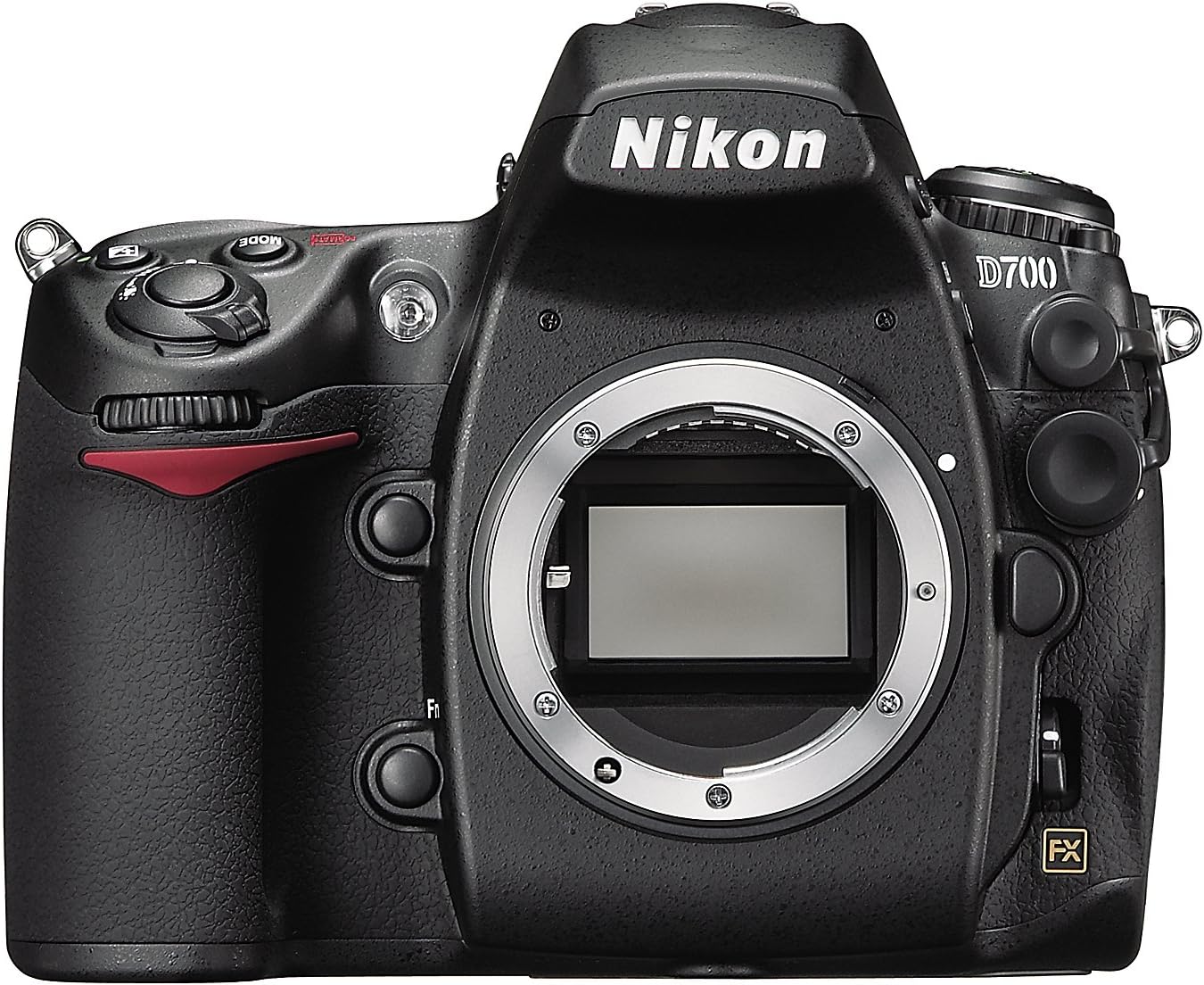
📷 Own the moment with Nikon D700 — where pro power meets timeless precision.
The Nikon D700 is a professional-grade digital SLR featuring a 12.1MP full-frame FX-format CMOS sensor, renowned for its exceptional image quality and low-light performance. Equipped with a sophisticated 51-point autofocus system with 3D tracking, it delivers fast and accurate focus for dynamic shooting. The camera supports continuous shooting at 5 FPS (expandable to 8 FPS with an optional battery grip) and includes advanced features like Nikon’s Scene Recognition System and Active D-Lighting for superior exposure control. Its rugged magnesium alloy body is weather-sealed for durability, making it a trusted tool for serious photographers seeking high performance in a nimble platform.
| ASIN | B001BTCSI6 |
| Aperture modes | F2.8-F16 |
| Are Batteries Included | Yes |
| Aspect Ratio | 3:2 |
| Auto Focus Technology | Phase Detection |
| Autofocus | Yes |
| Autofocus Points | 51 |
| Best Sellers Rank | #207,433 in Electronics ( See Top 100 in Electronics ) #290 in DSLR Cameras |
| Bit Depth | 42 Bit |
| Brand | Nikon |
| Built-In Media | カメラボディのみ |
| Camera Flash | Built-In |
| Camera Lens | Lens not included; Nikon F-mount accommodates a wide range of AF lenses |
| Color | Black |
| Compatible Devices | Nikon F lens mount devices |
| Compatible Flash Memory Type | CF Type I |
| Compatible Mountings | Nikon F |
| Connectivity Technology | HDMI, USB |
| Continuous Shooting | 5 FPS |
| Crop Mode | 3:2 |
| Customer Reviews | 4.4 out of 5 stars 339 Reviews |
| Digital-Still | Yes |
| Display Fixture Type | Fixed |
| Display Maximum Resolution | 922,000 pixels |
| Display Resolution Maximum | 922,000 |
| Display Type | LCD |
| Dots Per Screen | 921000 |
| Effective Still Resolution | 12.87 MP |
| Expanded ISO Minimum | 100 |
| Exposure Control | Manual |
| File Format | JPEG; DCF 2.0, DPOF and Exif 2.21 compliant |
| Flash Memory Bus Interface Type | Parallel |
| Flash Memory Speed Class | [HIGH] |
| Flash Memory Supported Size Maximum | 32 GB |
| Flash Memory Type | Compact Flash (Type I) |
| Flash Memory Video Speed Class | U3 |
| Flash Modes | Automatic |
| Flash Sync Speed | 1/250_sec |
| Focus Features | Multi-CAM3500 FX Phase detection |
| Focus Mode | Continuous-Servo AF (AF-C) |
| Focus Type | Auto Focus |
| Form Factor | Mid-size SLR |
| Generation | 1 |
| Global Trade Identification Number | 00018208254446 |
| HDMI Type | Type C Mini HDMI |
| Hardware Interface | AV Port |
| Has Color Screen | Yes |
| Image Capture Type | Stills & Video |
| Image Stabilization | None |
| Image stabilization | None |
| Item Weight | 2.4 Pounds |
| JPEG Quality Level | Basic, Fine, Normal |
| Lens Type | interchangeable |
| Manufacturer | Nikon |
| Manufacturer Part Number | 25444 |
| Maximum Aperture | 2.8 f |
| Maximum Focal Length | 1.5 Millimeters |
| Maximum Image Size | 4256 Pixels |
| Maximum Shutter Speed | 1/8000 Seconds |
| Memory Slots Available | 1 CompactFlash© (CF) card |
| Memory Storage Capacity | 32 GB |
| Metering Methods | Multi, Center-weighted, Average, Spot |
| Minimum Shutter Speed | 30 seconds |
| Model Name | Nikon D700 12.1MP FX-Format CMOS Digital SLR Camera with 3.0-Inch LCD |
| Model Number | 25444 |
| Model Series | D |
| Movie Mode | Yes |
| Night vision | No |
| Number of Diaphragm Blades | 8 |
| Optical Zoom | 5 x |
| Photo Sensor Resolution | 12.1 MP |
| Photo Sensor Size | Full Frame (35mm) |
| Photo Sensor Technology | CMOS |
| Real Angle Of View | 170 Degrees |
| Remote Included | No |
| Screen Size | 3 Inches |
| Sensor Type | CMOS |
| Series Number | 700 |
| Shooting Modes | LiveView shooting: Handheld mode, Tripod mode |
| Skill Level | Professional |
| Special Feature | 920,000-dot VGA color LCD with 170° wide-angle viewing |
| Supported File Format | JPEG; DCF 2.0, DPOF and Exif 2.21 compliant |
| Supported Image Format | JPEG; DCF 2.0, DPOF and Exif 2.21 compliant |
| Total Still Resolution | 12.1 MP |
| Total USB 2.0 Ports | 1 |
| Total USB 3.0 Ports | 2 |
| Total USB Ports | 1 |
| Total Video Out Ports | 1 |
| UPC | 018208254446 001820825446 |
| Video Capture Format | MP4 |
| Video Output | VGA |
| Video Resolution | FHD 1080p |
| Viewfinder | Optical |
| Viewfinder Magnification | 0.72x |
| White Balance Settings | Auto |
| Wireless Technology | None |
| Write Speed | UDMA class up to UDMA7 (167 MB/s) |
| Zoom | Optical Zoom, Digital Zoom |
D**Y
Wonderful, but a few observations
I agree with everyone else here that the Nikon D700 is the state of the art in digital cameras. So just some picky observations based on a few weeks use: 1. I compared photos from the D700 at ISO 1600 with the same shot from my DX D60 (jpegs only) - and looking at fine detail, the image is much smoother and the noise much less, just as one would hope. Compared to high-end pocket cameras with the same pixel count, much superior contrast and dynamic range. 2. Nice understandable manual, which is not always true with Japanese cameras. 3. I experimented with using a DX lens, specifically my Nikon 10-24mm zoom, even though theoretically this should vignette badly on this FX camera. To my delight, it does work, not over the whole zoom range, but reasonably well from about 18-24 mm. This means I do not have to go out and buy an expensive FX wide angle zoom if I only use it occasionally. I also tried to see if these results could be improved by using a new tool in the D700 called Vignette Control which compensates for lenses (typically wide angle lenses at full aperture) whose brightness falls off in the corners. Although the D700 manual says Vignette Control is not effective with DX lenses, this seems to mean when DX lenses are used in the default DX Crop mode, which uses only the central portion. If DX Crop is turned off so the DX lens is used over the full FX field, Vignette Control does indeed improve the results in some cases. It's subtle and inconsistent and dependent on the other settings, in particular Active D-Lighting, so be sure to try it first. But the bottom line is that you may already have your 20mm lens from your DX collection, a big cost saving. 4. A minor complaint. The only remote wireless shutter release which works with this camera is an expensive radio setup which plugs into the electrical connector and then has a transmitter and receiver, way too complicated and overkill for occasional use. I wish they had enabled the D700 to support the $15 ML-L3 infrared remote which is used in their consumer DSLR's such as D60. A cheap and handy way to set off the shutter remotely is important for nature photo, portraits, even self-portaits. 5. The multi-selector control on the back is annoyingly vague and does not give a sufficiently positive switching action. I often have to press twice. This is not just my individual sample - they are all like that. Nikon, please, a better quality switch! 6. Finally, in spite of the 51-point exposure control sensor, I have had trouble capturing proper exposures in high contrast situations such as a flower backlit by bright sunlight against a dark background. The highlights tend to get blown out. Many pocket cameras such as Canons let you watch the LCD and adjust the exposure compensation in real time until it looks right. Although the D700 has a Live View mode where you can pop the mirror up and watch the image on the LCD, it does NOT show the compensation in real time. The compensation is only applied at the time of capture. Disappointing. Maybe they will fix this in a later firmware upgrade? Summary: Love this camera. But of course nothing is perfect!
R**D
Instant Classic
4/1/13 Update: It's been nearly a year and this camera has still met all my expectations. I've shot a variety of subjects from sports to studio to street and it's not let me down. Recently, I've done a car shoot and some night street photography during SXSW here in Austin with some amazing results. With the money I've saved (vs. getting a D800), I've been able to add other photography gear like a studio strobe, lighting modifiers, and the AWESOME Nikon 85mm f/1.8 AFS. I'd eventually like to add a D3S or D800E as a primary (and keep the D700 for a backup camera) in 8-12 months. For those considering the D600 and D700: if you're a hobbyist, the D600 will probably meet 99% of your needs. It's got a great 24MP sensor, improved high ISO capability, smaller body, dual card slots, movie mode, etc. Basically a mid-range DSLR camera with all the features one would expect in 2012/2013. I can't speak to the quality issues regarding oil spots on the sensor, but on paper, the D600 is a great full frame camera for the money. Pro's may consider one as a backup body. Where the D700 trumps it is in ergonomics, weather sealing, and autofocus. If any of those matter, then the D700 is still a very strong contender. Original review: I won't get into the specs, but give my take on how this camera holds up being a generation older than the current competition. At current used prices it matches up very closely to the new Nikon full frame kid on the block-- D600, although the ergonomics and features of the D700 are closer to the the D800. The D700's lineage is from the mighty D3 so you're getting essentially the same camera in a smaller body. Slap on the optional hand grip and you can fire away at 8 FPS. The sensor and processor don't quite match up today's semipro DSLRs, but it is still VERY GOOD. Unless you're always shooting in the dark with no flash, images are clean up to ISO 3200 and still usable at ISO 6400 with the proper exposure and post processing. I rarely go up to 3200, so that was no big deal to me. The only major omission is the lack of a movie mode, though that really wasn't a deal breaker for me. Other features you may miss: No custom modes on the mode dial, single card slot (unlockable), and live view isn't that useful. It's hard not to get caught up with GAS (Gear Acquisition Syndrome), but you really have to consider that last gen cameras are still capable of producing the same high quality images as any new camera today. Besides, the money saved could be best used for lenses, lighting, and photography lessons.
W**M
Fantastic camera! No need for the D800
I am a pro portrait photographer and after much angst purchased this camera over the D800. While the D800 has tweaks and more resolution over the D700, I did not feel like investing in a more powerful computer to handle humongous files nor felt such resolution was necessary unless I was going to print something 5 stories hgh or was too lazy to take two steps forward closer to my subject! Great decision. While my current D90 and D7000 are great cameras and have more than paid for themselves, there is something remarkable about full frame. My 24-70 and 70-200 vrII have come alive. Video. .....why would any photographer use a limited use video on a DSLR and not a dedicated video camera? I am so happy this camera has no awkward video like the d90 and d7000 with crappy focus and horrible lack of stabilization for hand held. No....VR is not video stabilization and to have good focus you have to leave VR on and camera on full time focus....and that means your videos are visibly breathing. No thanks! New semi and pro video cam models easily give digital 12 mp photos straight from the video and the image stabilization blows away VR. Also sound quality is easily superior and conveniently monitored on a dedicated video cam, without the need for some camera frame and a zillion attachments! No separate sound recordings to blend with video. Time IS money! No one will ever sell me on the convenience of inferior video from a DSLR. When shooting a wedding and the dancing starts I take off my two camera harness and pick up my 24 mp camcorder and am liberated to shoot the flower toss at 64fps, the first dance at 24fps, recorded in 5.1 surround and know I will have an awesome still for my clients. The D700 means no crowded sensor, no subtle noise issues, just awesome, mind blowing colorful, sharp and creamy background photographs. Glad I waited to buy 'last years' Rolls Royce' and skip on the new model and pocket the price difference. Nikon is coming out with a new range of lower priced full sensor bodies. I could not see myself spending three grand on the newest toy when cheaper and better performing full sensor bodies are on the horizon. I do not track through the Everglades so I do not need to use my camera bodies to drive nails into trees in the rain! By no means am I saying don't buy the d800. If you have the cash of course buy it. Rich hobbyists are gobbling them up. Bravo! What I am saying, is if you take pictures for a living, then the D700 is more than enough to impress your clients with mind blowing photographs. FYI-I will now be retiring my D7000 as i find it's image/ noise quality inferior to the D90 and will get another d700. I just don't buy into the Rockwell school of more pixels is everything! More pixels on same old sensor means more noise. Cannot argue physics.
P**L
5-9-12 New D700 arrived
The D700 came today, maybe the last NEW USA body from Amazon? Exif read 1 shot for the one I took to check. Some folks were reporting high shutter counts on NEW cameras from Amazon. Luckily I'm good to go. I'll add more later as I shoot more with this. I have a D90, D700, D2x and a D3 and now the D700 to add. I'll keep everyone posted. UPDATE: Ok, now after using the D700 for a month I am well-pleased. I have now purchased a grip and a RRS L bracket. I do a lot of macro work, and the camera has been wonderful, shots are clean and well lit with natural light. I also have the Nikon Macro flash setup R1C1 with an 3rd SB 200 wireless flash unit. This and my D3 doing macro shots make me feel that I can almost do no wrong. My preferred macro lens is the 105mm f2.8 VR micro, this is also well suited for portrait use if you walk the lens a bit. As a walk around camera, with the grip it is actually larger than the D3. I'm a big guy and use the BlackRapid RS DR-1 double strap. This can be used as a single strap as well. With 2 bodies I can have my 70-200 2.8 VR mounted on one and the 105 2.8 or 85mm 1.4D on another body, and just reach for what will work best. The D700 is a real close second to the D3, pics once setup are quite similar, it works well in low-light, and also I am happy to just take a walk with it in auto mode, burst 3 shots with a third step of exposure up or down, or just single shot it and then make corrections in Lightroom 4.1 or Nikon's own Capture NX2. I feel that capture NX2 handles Nikon's .nef files best, which makes a lot of sense as both camera and software come from the same folks. Do I regret not waiting for the D800? Not a bit. Seems to me from reading at a popular photo forum that lots of folks are having a left side focus issue.... ad in my thinking, pixels don't make the picture. I've shot some great stuff with 4 MP point and shoots. How BIG do your shots need to be, not to mention the overhead of extremely large MP shots with the computer, as well as file sizes. Well, that's about it, I'm not the world's best writer, I hope you all can get something from my words.....
J**O
The Nikon D700 is Amazing (and Updated)
UPDATED: 6/20/2012: WOW. WOW. WOW. Yes, I repeat myself. I just love this camera so much. Images are clean at ISO 1600, and very usable at ISO 3200. I'm now over 90,000 clicks and couldn't be happier. I do have on order the new D800, but may cancel that if the new D600 is released before I receive the D800. This camera (D700) is revolutionary IMHO. It just works. It feels good with the larger lenses and my Zuiko battery grip. The images are amazing. I've printed 30 x 20" wedding and landscape images that will blow your mind. Super reliable. Never a glitch, or a hiccup at any events I have shot. You can't go wrong with this beast. UPDATED: 3/10/2010: WOW. WOW. WOW. Those three words really say it all. I can't believe how nice this camera has worked. I love it. I thought my D300 was great in low light. Nothing compares to this camera. I just returned from a trip up north to photograph the Canadian-American Dog Sled Racing Championships and the camera functioned flawlessly in the cold and snow. I shot over 1900 frames between the dog sled racing teams, and some landscapes. All I can say is that I'm blown away by the quality. I have been shooting with the Nikon D300 since 2008 and it was stolen in January 2010. I then ordered two D300s' which I returned and then purchased the D700. WOW. I am so happy I did that. The camera is amazing. Nice weight, and heft. Even after i took my Zeikos (also purchased here) battery grip from the d300 and attached it to the 700. Sharpness wise, the D300 and D700 are on par. However, I have shot many events at high ISO upto 1600 with my D300. I wish I had had the D700. The images with the D700 are absolutely amazing whether at lower ISO's or higher. Here is one of my test images shot at ISO 3200: [...] Also on this blog are "philadelphia Flower Show" pictures that I shot at ISO's up to 3200. Check them out and you'll see none of the reviewers here are exaggerating when we say it's truly amazng. The downside is I can no longer use my go-to lens the Nikon 18-200VR but I found in one of my boxes of "old"gear a Nikon 28-200AF-D lens that works beautifully, and a 50mm F1.8 For now, these two will do the job for me.
T**Y
Sigh of Relief
As a longtime F100 and D100 user, I've been holding my breath, on the edge of buying a new DSLR for years. I was so used to shooting with my F100 film camera and collection of Nikon lenses that I was somewhat disappointed when I first bought the D100: Performance, speed and of course the loss of lens range. However, I was pretty pleased with the image quality under most conditions. The full frame pro models were a bit too much of an investment for me then. I got a chance to use both the D200 and D300 and although quite impressed, I still held off buying either even after the price drops for 2 main reasons: Still wasn't full frame and not made in Japan. Yes, I'm one of those who have a thing about stuff made in Japan and for good reason: Far less issues, if any, with equipment manufactured in Japan than elsewhere. Like all my Nikon equipment, film and digital, still going strong with the exception of my 18-200DX lens which I had to exchange due to AF issues (and made in Thailand, I might add.) Don't get me wrong, I think Nikon holds the highest of standards regardless of where their factory is located, but the "longevity / reliability" factor increases at their factory in Japan for some reason. (This comes from years of personal experience) I got to the point I was ready to buy a used D2xs. Anyway, when I first got to test drive a D700 a huge sigh of relief came out! FINALLY, a new Nikon that met my needs and wants for under 3 grand. Almost everything about it was perfect for me: Full frame, made in Japan, performance, speed, size, lightweight yet beefy construction. I was ready to buy but due to personal circumstances I had to hold off. Boy was I lucky. The price dropped more than 600 bucks by the end of the year! Thanks Santa! I've had it a couple of weeks now and am very impressed with its performance. I'm most happy about the fact that I can fully use all my D type lenses and the camera's buffer keeps up with my trigger finger. I am also very impressed with the quality at high ISO settings. I have been given a huge amount of freedom not having to always rely on a flash in low light or long zoom ranges without always having to worry about the "noise". Just a few of minor gripes, which led me to give it 4 out of 5 stars: The color and contrast quality seems a bit "soft" compared to identical shots taken with my D100 using same lens and settings. (I prefer the "richer" contrast) I suspect this has to do with the fact that the D100 (and D200) used a CCD sensor chip and all other current cameras use a CMOS chip. Still, the image quality is fantastic and nothing that can't be tweaked in camera preferences or post processing. Another gripe is that my current flash (SB-80DX) won't work in DTTL mode with the D700. Although it works ok in regular Auto mode, the exposures are a touch off when shooting portraits compared to identical shots paired with the D100 and I have to make flash exposure compensations for perfect skin tones. I know my flash is a couple of generations behind, but I figured Nikon would make it recognize the flash and give the option to be compatible to the limit of that flash's generation. Oh well, gotta move forward. Bottom line is, I have to invest in another 3-400 bucks for an equivalent paired flash. Only other small gripe is the rubber flap for the connections is not tight and comes off too easily. The pull lip is along the back edge of the camera and catches on my hand easily. (I put a piece of black gaffers tape over it.) Though the rest of the camera is designed and built tight and solid. All in all, I am extremely happy with the D700! It is so worth the price. (I paid a little over 2 grand as of 12/08)
B**O
Caveat Emptor
OK, Amazon asked me (by email) to review this camera so I'm going to bite. First of all, I must say that I am a long-time Nikon user. I currently own two film bodies(N90S and F100) and one DSLR (D200). I've used primarily the D200 for the past 3 years. Before that, I collected a lot of "film" Nikkors as well as my film bodies, so that was one reason I wanted to go FX. So I'm not a troll or have any axe to grind with Nikon. Generally their products have performed very well for me and when (rarely) I have needed their customer service, it has been good. I love the F100 and if I had time, I think I would still shoot film with it. But this review is about the D700 and unfortunately, the D700 is on its way back to Amazon for a refund. There was a really bad spot on the sensor (many pixels were affected) that was visible on any image shot at ISO 400 or above. This "red spot" was even visible on jpegs on the normal size that opened with NX2 - no magnification. The main reason I am writing this review is to let prospective buyers know you should thoroughly check out your new camera ASAP after receiving it. Thanks Amazon for you great return policy! This was a BIG investment for me. I have seen images from the D700 and they are really gorgeous but now I wonder how good Nikon's QA/QC is. I'm undecided if I'm going to try another sample as this has created work and anxiety that I don't need. I may stick with my D200 for awhile, as it still works great an produces nice images. I have no idea what the probability of getting a defective Nikon may be, but I sure would like to know the odds. I'm pretty sure that if I would not have been able to return the camera that Nikon would have made some sort of fix under warranty, but that would have been even more hassle and anxiety. Hence the title of this review. Good luck and I hope you get a good sample. I'm sure this would have been five stars if I had gotten a D700 with a good sensor.
E**N
Versatile full frame DSLR camera for any light condition
Nikon D700 is the first and the only (up to now) compact full frame (FX) camera Nikon has to offers. It inherits many great features from Nikon pro-DSLR camera Nikon D3 and add some other useful features such as dust reduction and wireless flash commander. What is special about Nikon D700? Like its big brother Nikon D3, D700 has incredible clean image at high ISO setting, 51 AF points with several tracking modes include 3D tracking. It shoots 5 fps but can be boost to 8 fps with battery grip attached. Unlike D3, it has compact size but it is not light. It is 995 g. Body and Handling Nikon D700's body is similar to Nikon D300 (a crop sensor DSLR camera or DX) in many ways. But of course it has a little bit different here and there. For example. D700 is taller and wider to accommodate larger viewfinder. D700 body feels very solid and made by magnesium alloy body. It has textured rubber in the grip area. As discussed above, the camera is quite heavy, but it helps to balance the camera especially if you mount it with heavy pro grade lenses. Although regarded as pro camera, D700 body is not as tough and reliable as top of the line pro camera and some advanced crop sensor camera. There are some irritations for example the rubber side door open up occasionally and the built-in flash also opens up because the flash button is quite sensitive to touch. Nevertheless, the control and handling are great, just like Nikon D300. Nikon has different philosophy than other cameras such as Canon. Instead pressing button, dial and pressing button again, Nikon requires you to press and hold the button and then dial. It is so to avoid accidental change of setting. There is no more mode dial, but there are so many dedicated buttons for all important camera settings such as ISO, WB, Mode, Metering, Auto focus mode, and many more. D700 also has top LCD screen like some advanced Nikon cameras (D90, D300), but it is a bit smaller to make room for the viewfinder and flash. So there is no AF points position in the top LCD. But most of the crucial information are there. The other great thing about the camera is you can program function button and depth of field preview button to other function that you like, it could be activating live view, or set the focus point to center, etc. There wide customization available to suit your shooting style and preferences. Although this camera has only 95% viewfinder coverage (Both D3 and D300 has 100% coverage), the size of the viewfinder are very big and it will amazed most of people that use crop sensor camera without fail. Image Quality and Auto ISO Image quality in high ISO is the best in the world (along with Nikon D3). Images are very clean up to ISO 4000. Image at ISO 6400 is very usable and great in print up to 8' X 11'. The great image quality in high ISO is due to Nikon full frame sensor which has only 12 megapixel and software that control the chroma/color noise out of the image. The noise in Nikon looks more natural compared to camera of other brand. For pixel peepers (people who likes to zoom in 100% in digital images), you will be very satisfied. D700 is very sharp (depends on the lens too) up to pixel level. One of my favorite feature of D700 and also Nikon D90 is the Auto ISO limiter. You can effectively limit the ISO and minimum shutter speed. The Auto ISO works very well and accurate most of the time. My favorite way to use this is to set the camera to Auto ISO, and then use Aperture mode and let the camera adjust the rest for me. LCD Screen It is 3' LCD Screen with 920k res which is standard for mid range camera in the late 2008 and 2009 camera. It is very detailed and relatively good in bright light condition. Menu Like other Nikon cameras, I feel Nikon menu is pretty confusing because they throw all over items regardless if the item is popular item or not. Therefore, it might take you some time to find some of your favorite menu items. To be fair, Nikon has my menu tab, where you can choose and put the menu item in this tab. Overall, I feel menu could be improved. Canon cameras menu for example, is easier, more logical and simple to navigate. Auto Focus system & Continuous shooting speed Nikon D700 has 51 AF points. It is the same as Nikon D3 or D300. It has several dynamic tracking modes include 3D tracking which is very fast and accurate. The AF speed varies depend on what kind of Nikon lens you use. Old Nikon lenses usually slower in AF, same as customer grade AF-S lens like 35mm AF-S f/1.8G lens. D700 has continuous shooting speed are good (5 fps), but when you attached the battery grip, it becomes 8 fps, which is great for sports or wildlife. It cost several hundred more for the grip, but it worth it, because not only you get more frames per second, but it is easier to shoot in portrait mode. The drawback is the entire package becomes bulky and heavy. Lens compatibility Investing in FX / full frame Nikon cameras means that you are ready to spend money, not only for the camera, but you need to spare some money to get the lenses as well. As a FX camera, D700 does not compatible with many consumer grade lenses which has "DX" letters attached in the lens name. You can still use DX lenses, but your image will be cropped and you will get only 5 megapixel image. Nikon has several primes that work very well with D700 such as Nikon 50mm f/1.4G, Nikon 35mm f/2D and Nikon 85mm f/1.4D. For zoom lenses, there are Nikon 14-24mm f/2.8, Nikon 24-70mm f/2.8 and Nikon 70-200mm f/2.8 VR. Most of the lenses above are expensive, but there are some affordable solutions (third party lenses) that cost a lot less, but they are really good for Nikon D700. Creative Lighting System Unlike D3 which has no built-in flash, D700 has built in flash. It is due for a reason, to fit in wireless commander features or also called Creative Lighting System (CLS). This system is not perfect because it won't work in certain position and situation, for example in bright daylight, in a great distance, or if the line of sight to the flashes are blocked. However CLS is fun to use and save you money. Nikon D90 also has built-in AF motor so it is compatible with older Nikon AF-D lenses which we often found in fixed focal length lenses / primes. Competitors Nikon D700 has three major competitors in compact full frame DSLR class and some competition from crop sensor DSLR class. In the full frame category, Nikon D700 competes with Canon 5D mark II and Sony A900. 5D mark II has video mode, and 21 MP, but the image is not as clean as D700 in low light, Also, 5D mark II has old auto focus system which is slower and it also have slower 3.9 fps continuous shooting. Sony A900 has double the resolution of D700, 100% coverage viewfinder and 5 fps continuous shooting. A900 does not have sophisticated AF system and live view. Photographers that consider to get D700 should also consider Nikon D300/D300s and Canon EOS 7D. They are not only cheaper but have most of the features D700 has. The other benefit of crops sensor camera is the crop factor of 1.5 (Nikon cameras) / 1.6 (Canon cameras) so you get more reach for sports or wildlife. The drawback of crop sensor camera is it won't be have great image quality in high ISO. Conclusion Nikon D700 is an very versatile camera for any kind of assignments. It is great for portrait, wedding, sports, photo journalistic assignments. It is great in bright or extremely low light. I will say it is all-around camera. The image quality is fantastic. However, I will not recommend it for travel because it is an heavy camera, and I don't recommend it to use in extreme environment condition because the built quality and seal is not as good as Nikon D3 or Canon 1D series. For outdoor field sports such as football or soccer, you might miss crop sensor DSLR camera because it has extra reach. Overall this is great camera, with a great price of this class. Subjective Rating - Relative to competitors * Image Quality: 5/5 * Features: 4/5 * Performance: 5/5 * Body and Handling: 4/5 * Value for money: 4/5 Check out my website for sample images and more reviews
ترست بايلوت
منذ أسبوع
منذ 5 أيام