
قم بتنزيل التطبيق


دعم العملاء

Desert Online General Trading LLC
Warehouse # 7, 4th Street, Umm Ramool, Dubai, 30183, Dubai
قم بتنزيل التطبيق
دعم العملاء
Desert Online General Trading LLC
Warehouse # 7, 4th Street, Umm Ramool, Dubai, 30183, Dubai


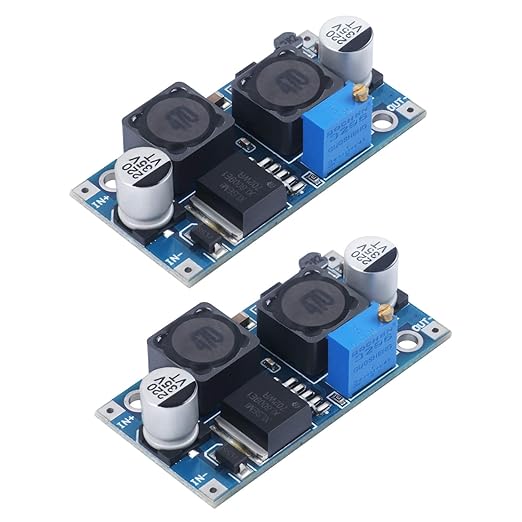
⚡ Elevate your power game—regulate like a pro, anywhere, anytime!
The XL6009 2-Pack DC-DC Buck Boost Converter is a versatile voltage regulator module capable of automatically stepping voltage up or down within a wide input range of 5V to 32V, delivering a stable output from 1.25V to 35V. Featuring high-efficiency 4A MOSFET switches with up to 94% efficiency and a rapid 400KHz switching frequency, it ensures minimal ripple and precise voltage regulation. Ideal for automotive, solar, and wind power applications, this compact module offers reliable performance in fluctuating voltage environments.
Z**L
Allows me to run a DC charger at a non-standard voltage
I have an old Extech Multiscope multimeter that doubles as a (very bad) oscilloscope. I keep it around mostly because it fits in a tool bag and is useful for looking at voltage/current waveforms at mains voltages (120+ volts). It gets dragged out when I fire up a generator to check voltage and frequency, for example. Yeah, there's better tools for this but it cost me almost nothing, so... One thing it does really well is kill batteries. Extech knew this and placed a 9V power jack on the side of the beast so you can power it from a wall plug. If you use rechargeable batteries in it, you can also charge them without removing them from the meter. Except... it doesn't work. A 9V charger is barely enough to get the LCD to display a reading, and it sure won't charge batteries. I used a variable power supply to determine that it needs around 10.5V to actually work (at least mine does). The cheapest way to make that happen was to cut the cord on a generic 9V wall charger, wire this buck/boost converter in series, and shrink-wrap the whole mess back up. This took less than 15 minutes to do. I set the output voltage for 10.5V and plugged it in. The meter works perfectly on this. The charge cord now has a big lump in the middle of it where the boost converter is wired. I have to be careful not to throw the charger around too much or get it snagged on something for fear of ripping the wires loose. Since I only use the charger when the meter is on the bench, this is no big deal. The converter worked out of the box and I have a second one just waiting for another project.
S**8
Consistent power
I am going to be using these to power an Arduino and automotive sensors. I set one to 8.25 volts to power the Arduino using my bench power supply. I can power it on and off and my Fluke MM always reports the set voltage. The second one I'm using to power automotive sensors. I set that one to 4.9998 volts using my Keysight bench MM and every time I turn the power off and on, it reports the same output voltage. Got to love 4 digit stable voltages.
K**N
Handy and compact. Watch power dissipation.
Handy little regulator. As other posters noted, if you draw too much current without heatsinking it properly you'll regret it. Note the limiting factor isn't the switcher IC, it's the diode next to the output filter. It only has 3A absolute max rating. And is that a series ceramic cap? If you run it near its max I'd put a big heatsink on the back as well as on the switcher IC, that should help the diode do what it can. Also pay very close attention to your input voltage, as another commenter noted if it drops under spec the converter can suddenly shut down causing the boost inductor to spike. The zener he suggested sounds like a good idea though I would use a higher value for more margin. A nice plus on this module is mounting holes. Many competing modules don't have any. Overall it's a good module for the price but pay attention to its specs.
R**N
Happy
Great item. Worked well.
C**L
Works Great
Works great, did plug one into a power supply backward and it exploded and no longer works but that is to be expected. Mine came with heat sinks to attack to it but no adhesive to attach it with, but I don't think it ever got hot enough to need the heat sync.
A**O
Nothing but problems with both (2) of them!
I tried these on multiple applications even on a breadboard. The voltage kept changing, then it wouldn't change at all no matter how long I turned the potentiometer or which way, then it suddenly started working then the audio started sounding terrible and the voltage once again would not go up or down. I can't get either of the2 I purchased to run stable if I can even get them to work at all with the small variety of amps I have (1 watt and under). Batteries? no problem. But these things? Days and days and I finally threw in the towel and just sticking with straight batteries from now on or try a different type of device if I ever recuperate and cool down from this week straight of pulling my !@#$%! hair out!
M**R
Perfect solution for low wattage, higher voltage devices
I've got a camper with a 12V system and been trying to figure out the best way to run my 24V devices. I was trying to find some 12v DC input power supplies when I came across this. Since my 24v devices don't have high amperage requirements, this seemed like a perfect solution! It's easy enough to change the voltage, just need a tiny flathead and a multimeter. This will definitely be easier if you have a friend to hold the multimeter probes to the output side of this board as it can be a bit tricky to try and adjust the voltage while holding the probes to the board. Alternately if you have a cooler multimeter kit, just use the gator clamps that came with it. Either way, once you get it to your desired voltage just solder up some wires of appropriate thickness, put this in some kind of small project box (3D printer opportunity here) then move on with life. This was definitely a great investment for the price over some of the other adapters I've seen, required minimal work and was a fun little project. Oh and don't forget to double check power requirements for the device you want to power and also fuse things because safety and stuff.
D**.
Terrible. Only one of the 3 i purchased actually worked. 2 won't output the correct voltage once set. Set it to 3.7v and it still outputs the same as the supply voltage.
R**E
I've had this module connected to my 12V bench supply for a few hours now and can only adjust the output from 12V to over 30V, but not down to 9V where I need it. Not sure what I'm doing wrong, but it seems to be a boost module, not a buck!
ترست بايلوت
منذ 5 أيام
منذ 3 أسابيع