

Desert Online General Trading LLC
Warehouse # 7, 4th Street, Umm Ramool, Dubai, 30183, Dubai
Desert Online General Trading LLC
Warehouse # 7, 4th Street, Umm Ramool, Dubai, 30183, Dubai
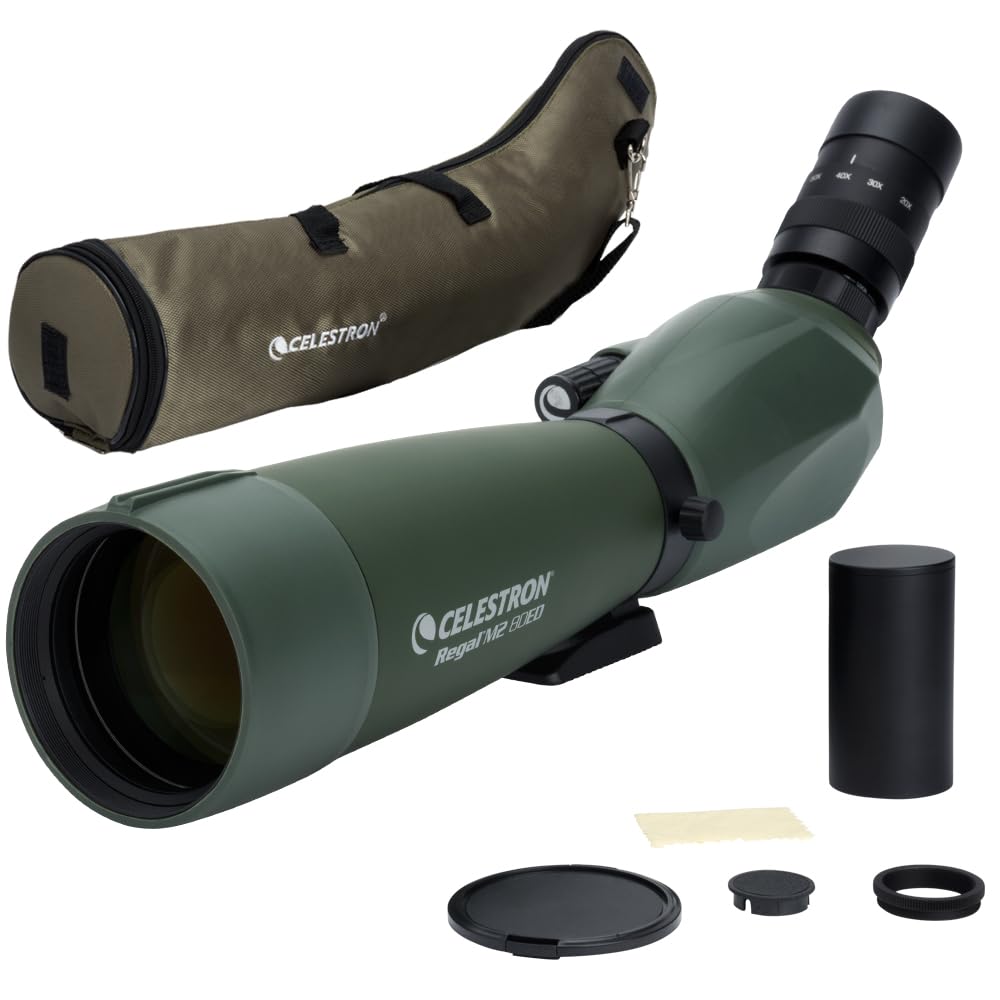
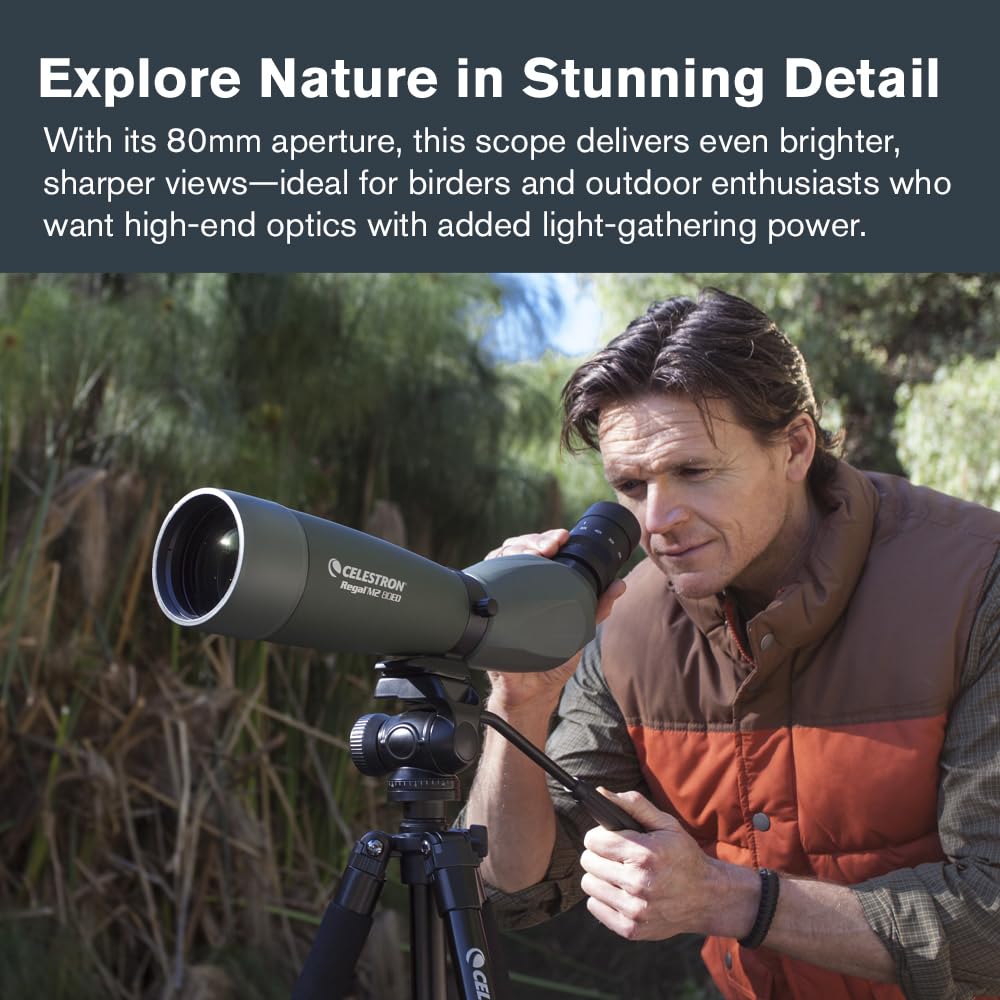



🔭 Elevate your outdoor vision — don’t just watch, experience every detail!
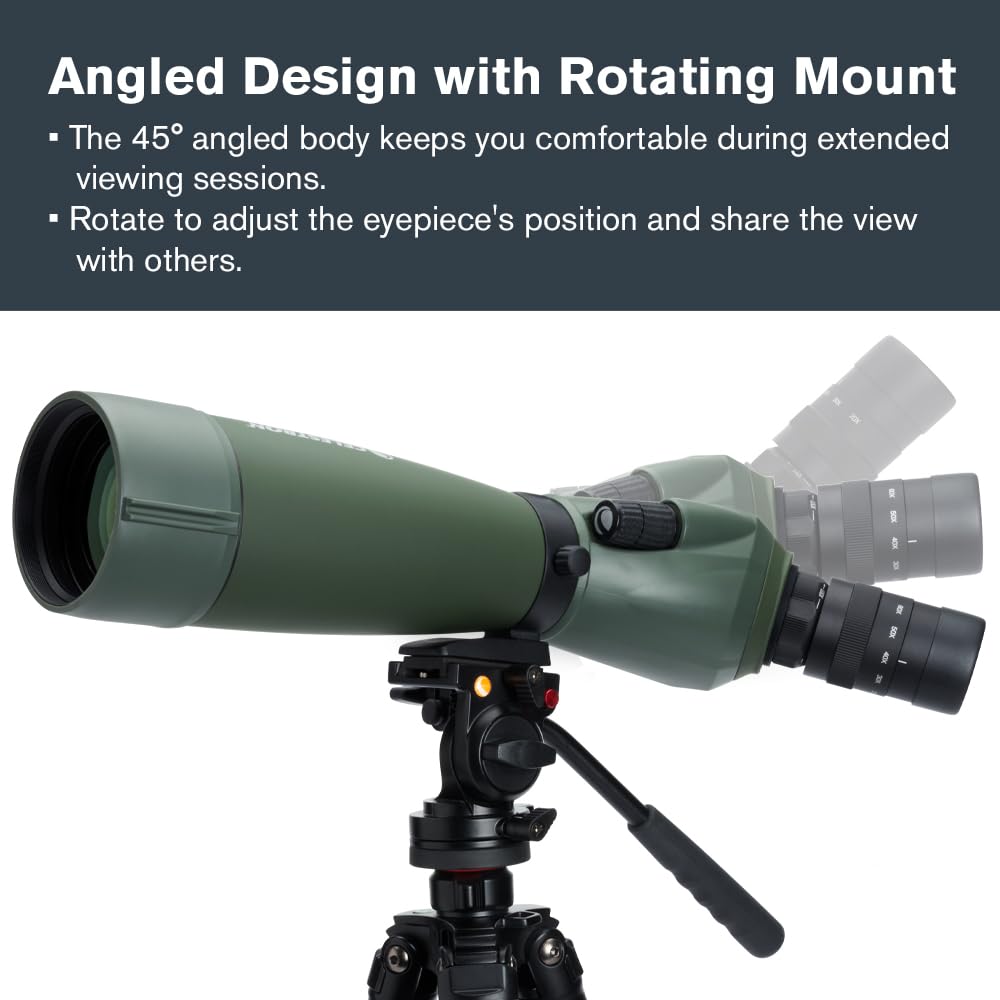
The Celestron Regal M2 80ED Spotting Scope combines an 80mm extra-low dispersion objective lens with fully multi-coated XLT optics and a versatile 20-60x zoom eyepiece. Designed for birding, nature observation, and casual astronomy, it features a rotating tripod mount for ergonomic viewing and includes essential accessories like a padded case and T-mount adapter for digiscoping. Built with a durable magnesium alloy body and backed by a Limited Lifetime Warranty, this scope delivers professional-grade clarity and reliability for outdoor enthusiasts.


| Brand | Celestron |
| Color | Green |
| Style | Regal M2 80ED |
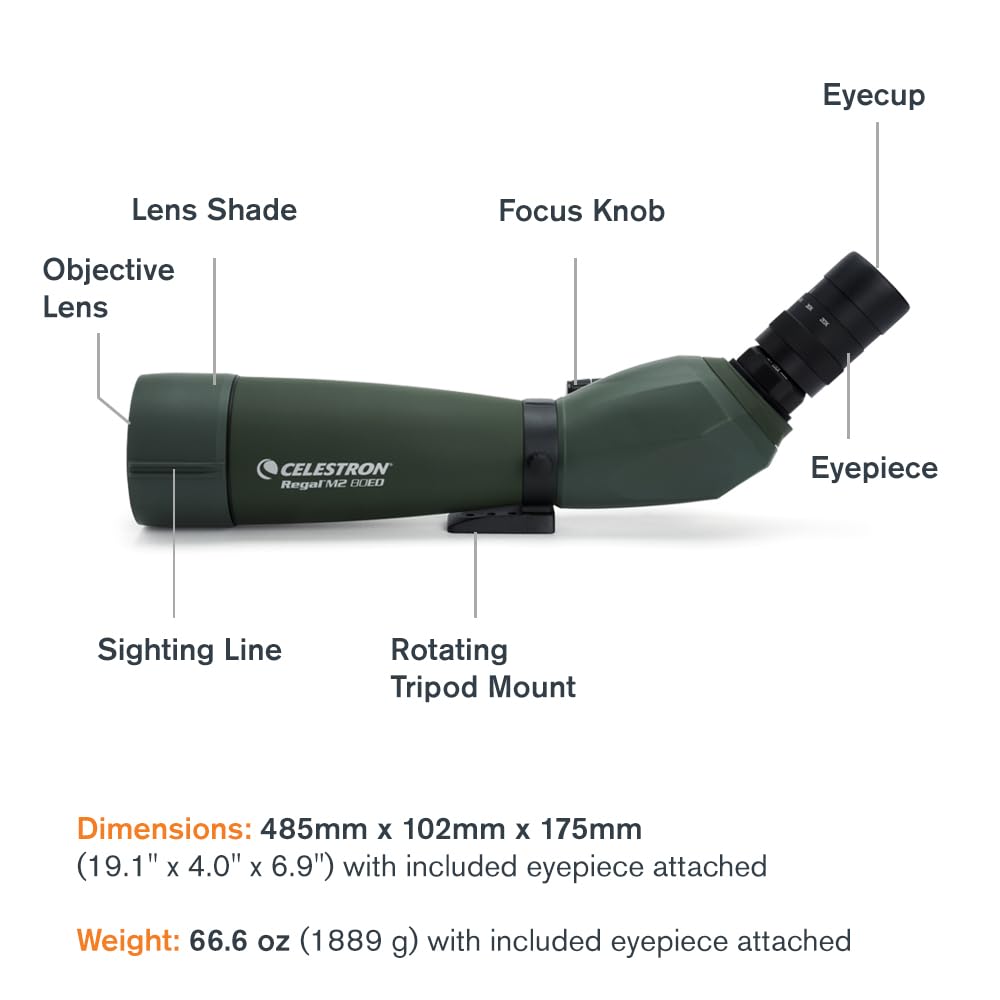
| Product Dimensions | 16.7"L x 4"W x 4.9"H |
| Sport | Bird watching, nature observing, long distance viewing and casual astronomical observing. |
| Item Weight | 4.5 Pounds |
| Material | Magnesium Alloy Body |
| Magnification Maximum | 60 x |
| Objective Lens Diameter | 80 Millimeters |
| Magnification Minimum | 20 x |
| Compatible Devices | Handgun |
| Mounting Type | Tripod |
| Night vision | No |
| Model Name | Regal M2 20-60x80mm ED Angled Zoom Spotting Scope |
| Manufacturer | Celestron |
| UPC | 050234523059 |
| Global Trade Identification Number | 00050234523059 |
| Item Package Dimensions L x W x H | 23.7 x 8.5 x 5.75 inches |
| Package Weight | 3.02 Kilograms |
| Item Dimensions LxWxH | 16.6 x 4.6 x 3.9 inches |
| Brand Name | Celestron |
| Warranty Description | Celestron Limited Lifetime Warranty |
| Suggested Users | unisex-adult |
| Number of Items | 1 |
| Part Number | 52305 |
| Model Year | 2018 |
| Included Components | Soft Carrying case, Eyepiece cover, Lens cloth I, Objective lens cap, Eyepiece mount cap, Instruction manual, Zoom eyepiece, T-adapter ring |
| Size | Regal M2 80ED |
J**F
Beautiful Scope for a great price!
I am an avid birder and have been looking for a scope for a few years now. I finally decided to look through some scopes and do my due diligence on finding a great scope at a great price. This was not an easy task. Fortunately for me I live close to Cape May point where many birders come from all over the world. This enabled me to talk to many people about their scopes and actually look through many of them, which if you have been looking for a scope you know this is not an easy thing to do. Most stores are limited in what they sell. The hawk watch is sponsored by Swarovski so this enabled be to look through the top of the line scopes of the birding world. They were very nice, but was not willing to spend $2,500 or more on a scope. This is where I saw someone with a Celestron scope who was more than happy to let me use it for a couple of minutes. I couldn’t believe how bright and crisp the image was even a higher magnification ( even compared to the Swarovski) and when I was told what the price tag was I was sold. So I went home did more research and discovered this scope has great reviews and is priced quite nicely.Likes:Quality of the scopeThe clarity and brightnessThe weightThe PriceDislikes:The only thing I can say is the where the focus mechanism is, but after using it for a day this is a non-factor and I can focus quickly after using after one day.I would recommend this scope to anyone, no matter what they are willing to spend.If you are looking for a tripod to match check out the Magnus VT-4000.
L**Y
-Celestron Regal M2 65ED vs Vortex Viper HD 65
I had both of these spotting scopes side by side for comparison. My results are as follows.Design: I'll state the obvious first since you can see most of this from photos of the two spotting scopes. Both scopes have a kind of rubber like exterior with the Vortex being a little "tacky" feeling and the Celestron being a little smooth. Both have rotating rings and a foot for attachment to a tripod. The Celestron fit my tripod adapter, the Vortex did not. Different sizes so beware. Objective cover for the Vortex is soft rubber push on, the Celestron has a solid plastic two clip cover like on most SLR lenses. The eyepiece cover for the Vortex covers the eye cup and the Celestron covers the entire eyepiece down to the scope body and is made of metal and is screwed on to the scope body. Both have sliding sun shades. Biggest difference externally is the picatinny rail on the Vortex. Celestron does not have one. The rail is for mounting a very small "scope" for finding object quickly. Really nice idea. The "slow" and "fast" focusing is on the top right on the Celestron and directly on top on the Vortex. I liked the Vortex on top, my son liked the Celestron focus. So, each to his own. Both have rotating eye cups.Optics: Well, they were virtually tied in quality of optics as far as I can tell. Note that the Vortex costs about 150 more than the Celestron. One difference in operation of the scope was the eyecup and eye relief. When you put your eye up to the Vortex and touch the eyecup edge with your nose for example you see a darkening around the edge of the image. If you pull your eye away from the eyecup it will fill and be ok. The Celestron view is perfect the minute you put your eye to the eyepiece. I noticed I had to search around a little to find the best view with the Vortex, but the Celestron was much more forgiving of having my eye out of direct line or at the right distance. Image acquisition was much faster with the Celestron. Eye glass wearers would not have an issue with either of them. Incidentally the Celestron advertises the use of a groove in the sun shade to help find an object faster. It is totally useless in the 65 mm scope. You can't find any place to look down the groove, the body of the scope is in the way. Maybe you can in their larger objective lens scopes. Also, the Vortex zoom is 15-45 and the Celestron is 16-48. No real world practical difference.Conclusion: I ended up keeping the Celstron 65. There were things I liked about them both but what did it for me was the image acquisition speed in the Celestron and forgiveness of eye placement. Eye piece cover was also nicer, more secure on the Celestron. As I mentioned, they were pretty much identical as far as image quality. The focus and zoom operation seemed to be just a bit nicer quality on the Celestron also. I liked the picatinny rail on the Vortex. A nice design. I may try to put one on the Celestron.By the way, it would be nice if the mounting ring shoe was reversed on the Celeston scope since most of the scope weight is behind the mount. My guess is that the 80 and 100 mm scopes balance pretty well with the shoe mounted this way, but the 65 is shorter and lighter on the front end making it balance differently. It is back end heavy. I contacted Celestron a few days ago about reversing the ring and they said it was not possible.
M**A
Use for Astronomy!
First, I would like to highlight the quality of the image delivered by the ED lenses. I did an image comparison with a Celestron Skymaster 15x70 binocular and the image is much sharper and the colors are much more natural. No chromatic aberration can be perceived, and the focus is very precise. Definitely it is worth the money if you are pursuing image quality.The telescope is highly portable, fits in your backpack, and can be deployed very quickly. For astronomical use, by using separate 1.25" eyepieces the 65 ED can give you a very bright image with a 40mm eyepiece (10X, 6.8 mm exit pupil), or high power with a 4mm eyepiece (96X). 96X is the maximum usable magnification in this case. As others have said, the telescope is tail heavy, so by using astronomical eyepieces the center of gravity is somewhat restored (The included eyepiece weighs 300 g). High magnification will require a good tripod. At the lower powers the telescope can be aimed easily by using the sight rotated 90° and aiming through the side.The included eyepiece will show you the discs of the planets and the rings of Saturn. Definitely for planet detail more magnification will be needed, using additional eyepieces.The main drivers for my selection were high image quality, quick deployment and portability. I live in Bogota, Colombia where cloud cover can change very quickly, so maximizing viewing opportunities is a must!
T**O
This scope is good value for the money.
This 65mm scope is good value for the money. I got this mainly so I could have an angled scope when I take groups birding. My straight scope needs too much adjusting with a group.It has ED glass which is a good start. The zoom eye piece is good to 30-35X. I have a Pentax ED scope that does better at 45x. Since they can both use a 1.25 inch astronomy eye piece, I put a Vixen zoom on them, and the Pentax was quite similar in view at 45x to the Celestron. With the Celestron eye piece, the view was breaking up a bit at 45x.(I put the Celestron eye piece on my Pentax as well and it was good to 30x).Look for the Vixen eye piece here, it runs about 200 dollars. I bought one so I have it on both scopes now. Also, the Celestron is rear heavy, so it tips back on the tripod. With the Vixen eye piece it does less of that,
G**7
Great scope!
Excellent optics. Easy to operate! Sturdy.
ترست بايلوت
منذ يومين
منذ 5 أيام